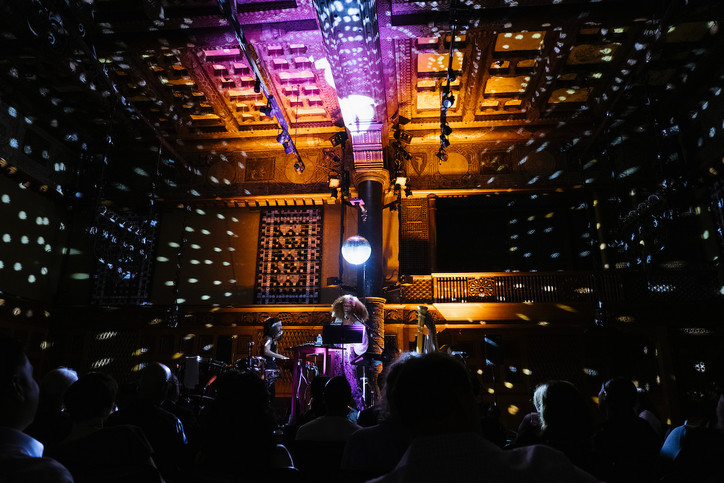
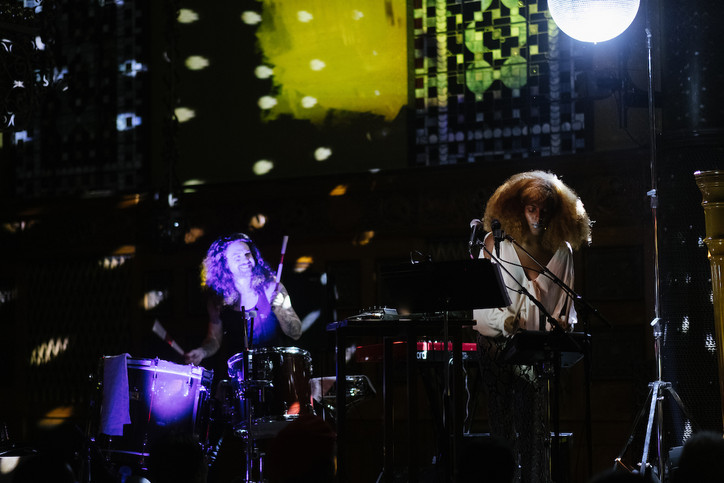
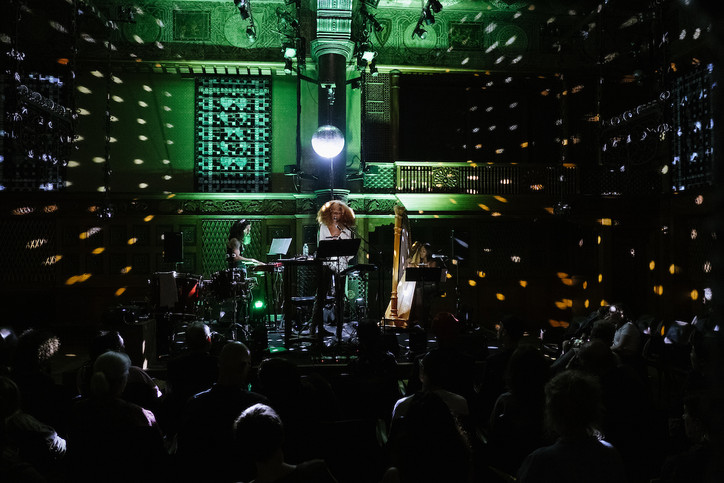
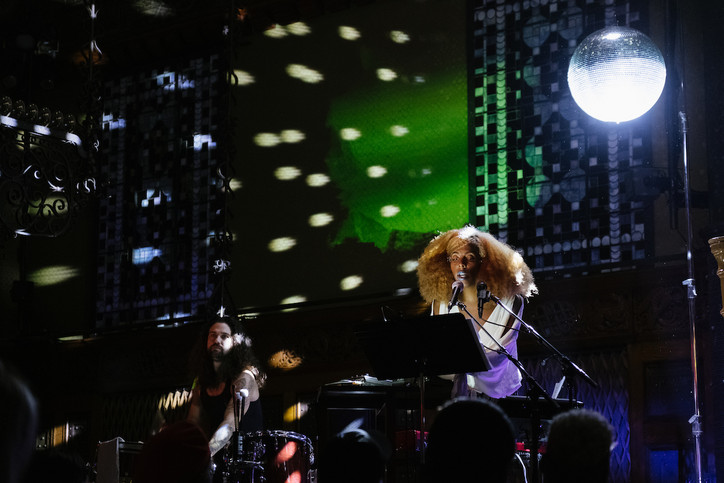
Talk to me about what was being addressed at your Armory performance.
Well, It’s basically [the result of] an evolution. So, I started this piece—well one part of it, the performance, has totally changed since its original form—but basically, I started writing and thinking because I was invited to a festival that I really love in Glasgow at the very end of 2016. I really love the people who throw the festival and they had proposed an interesting idea to me—the loose idea around the conference was how to challenge or undermine ideas of power, but thinking critically about conventional ways in which people formulate those ideas. And specifically, thinking of the idea of a body—that was one of the subtexts of the conference. Like, what does a body mean? Does a body actually exist? When we say we have a body, does that involve a distinction with the outside world? There’s mind-body division. There’s also the idea that our body represents our relation to the state, and that there are an inherent set of rights attached to a body as a static and cohesive thing. So, the counter proposal was to find other ways of thinking of a body and thinking of ways that are actually a line in which that sort of fantasy is fabricated—whether its fabricated in law or literally, the way we talk about rights.
Fred Moten is a thinker who has written at length about this. If you’re thinking about something like blackness, how do you conceive of the notion of a rights bearing subject with a rights bearing body when you clearly have a long history of entire populations of people who have had that very notion completely unmasked in the sense that people were living as chattel? Not to say that rejects some inherent humanity of people, but in terms of the law, people were totally erased and that body meant nothing. That body signified a refusal of a coherent idea of rights. So, that was the loose theoretical starting point for the performance. I wanted to think about ways that plays out.
So, you originally created this piece for the Glasgow performance?
There’s one section in that festival performance, which is the one piece of the original performance that carries through to the Armory, about the train. And it talks about being on the train and it’s this experience of—I don’t know if everyone has experienced this but I know I have—whether it's sexual harassment, a rapey vibe, a homophobic vibe, or a transphobic vibe, a racist vibe—whatever. And being on the train is the example I use because it’s so specific to the past. In my adult life, since I was 18 years old, the train has played a central part in how I relate to the world around me. There’s that feeling when you sense a imminent threat or imminent violence and you realize there is only so much your so called ‘body’ will be able to do for you. Like, the idea of a right ceases to exist at the moment you realize that you have no defense mechanism; when someone takes your life a right ceases to exist; when someone threatens you, even in your head, a right as something real ceases to exist. And in the same way, a body really ceases to exist as a limit point, too. So, I wanted to think about flesh and fleshliness as an alternative [to the term ‘body’]. That's partially taken from some of the reading I did in preparation for that conference—the idea of flesh, and wanting to escape your body, or the body as a trap, as an allusion to this statement that ultimately you're a sack of flesh, which you could think of as negative, but that was kind of the starting point. So, basically I was thinking about fleshliness.
I had done other performances that weren't really related to that but when I had the opportunity to do something new, I thought of it as an opportunity to update that. So, for this performance there was a lot of new music. New text, because the original performance was focused more on danger, or perceived violence—i was all under the pretense of things that are related to some sort of violence. So, for this performance I was thinking of other ways that fleshliness could exist. I've been in a romantic mood lately, so I was also thinking about the dissolution of a body as the limit point, as a self-contained unit, that then contains a brain. Another way of projecting that is to encounter experiences with love and identification, whether that be with friends, whether that be racial identification, whether that be the dissolution of identity into a group, whether that be taking LSD. There are a lot of ways where the idea of a body as a limit and a self-contained entity that demands things like rights or—even thinking of things medically—that you would understand what you're touching is the only way to address an ailment. So, I was thinking a lot about those things and the performance kind of expanded. Also, I’ve been making music because I’m releasing music next year. So, performances are a really nice opportunity for me to practice. I haven't performed in New York in three years—I did one show at the Rubin Museum, but aside from that I haven't performed in New York at all since my Performa piece, which is strange.
And that was 2015, right?
That was 2015. Also included in the Armory performance was a section on WorldstarHipHop. I was thinking of Worldstar and the denial and invisibility and the refusal to recognize the constant erasure of black women’s bodies. And I think—specifically when thinking about black women—the notion of flesh and opposition to a body as some sort of rights bearing cohesive thing becomes really clear. Because so many videos on WorldStar are of black women.
Right. Videos of women being harassed or disrespected.
Or getting the shit beat out of them. Like 80 guys are just basically like—some might say ‘running a train’ and some might say raping. Real mental breaks, women having real mental breaks, and a lot of the times its voluntary and I relate to that—being in that moment of desiring your own extermination in one sense, because extermination is at least a moment where you feel real. And I think part of that feeling is related, as well, because that's when you are just flesh. So, to be in a moment when you are reduced to just flesh might feel exhilarating and free in the sense that it feels like something true. You know what I mean? In the way that walking around in a body that is constantly denied of all of the privileges and entitlements that are supposed to come with the body, it might feel more real, like more truth, to videotape that experience and put it on WorldStar. And honestly, I think the culture of WorldStar is disgusting but it really makes sense. That was a primary place—a sight of encounter—where I was thinking about the difference between fleshliness and bodies, and rights and violence, and the moment where all of these things come crashing into each other. And then at the end of the last part, which is the Worldstar part, it's about the basic question of wanting to be intelligible, wanting to be rendered. The desire for other people to engage you and have the cognitive ability to see and understand and treat you as a fully present, sentient being—it doesn't need to be human specifically. So, these are the pieces of the questions that the performance dealt with—different ways of thinking and through that.
With the WorldStar section of the performance there was a line that you deliver: “It’s violence you crave from a scene struggling to escape your own snuff film.” People’s rights are ignored and their bodies prevent those rights from being extended to actually being real. So, in these moments where you’re being degraded or brutalized that's when you might feel like your most ‘real’ as a person, because its authentic.
A sense of truth.
What about the space that your work is presented in—how does that affect its impact or how it’s perceived?
Generally, I'm down to perform anywhere as long as I feel like I don't have to compromise what I’m doing. I think there are advantages and disadvantages of being in different spaces. Part of the reason why I haven't done the type of performance that I did last night, why that hasn't happened in New York, is because there aren’t really resources. Like, if I want to just do a little thing and play a backing track and have Joe drum with me, I can do that in New York, but the resources here are much more stratified in the sense that it’s either the basement at the Spectrum or the Guggenheim or Park Avenue Armory. I haven't seen a model of making it work differently here versus spaces that exist in other places. So, I find in New York specifically for performing, if I want to do something of a certain scale or a level of production, it just has to be in an institution. The same cost of renting lights in New York is like half that in other cities—like renting a disco ball and having LED. It’s so expensive.