I love that you brought up this educational aspect because that is so, so important to be that beacon in the industry. Two of the things that LOTI focuses on are this zero-waste factor and expelling a minimal carbon footprint — can you tell me a little bit more about both of those things?
Of course. I do actually want to start changing the terminology of zero-waste to minimal waste because part of being transparent is being completely honest. We started using the terminology zero-waste because aside from our primary fabrics already being scraps from production from factories, we were using our own scraps to make smaller accessories. So I wanted to showcase how special these accessories are because they're made from scraps of scraps. But ultimately, is it zero-waste? Are there still little things that get left behind even when making these accessories? Yes. And that is an honest answer. So now I would like to shift to minimal waste because that also sounds a lot more attainable. I never want to mislead anyone. Right now, you don't actually end up with zero-waste. There are still threads and little things that we haven't figured out how to use. We do save it all because I think one day I will figure it out, whether it's stuffing for a cushion or even donating it to a business that can do something with it that is maybe not necessarily fashion. It doesn't all have to stay within fashion. But one thing we will always do is figure out an item to produce to be able to use our own production scraps.
And then you mentioned carbon footprint — I have a little story for that. When I first started upcycling, I went to a Goodwill and I saw racks filled with pristinely pressed men's dress shirts that honestly looked new. That really impacted me. And at that time, I was thinking of upcycling — I was like, 'How can I do this? How do I incorporate this into a business?' So that day I bought 300 of those shirts. I think it took me almost a year to develop the aesthetic, using upcycling, that I wanted to develop for the brand. We ended up upcycling over a thousand men's dress shirts from the Goodwill outlets. But when it came time for me to take these shirts to the United States to sell, I was like, 'Wait a second. There's a disconnect here.' Yes, the intention of upcycling men's shirts is great. But I saw a red flag already — air travel has a huge carbon footprint. It was actually my dad who brought up this point, he said, 'Peru is a textile hub; I'm sure you can use someone's garbage.' So then I actually knocked on a lot of doors of factories in Peru. Most of them were not interested — but a couple of them were, one of them being the biggest vertically-integrated, 100% cotton producer in Peru. They actually have all of the sustainability certifications that I would want a factory that I'm working with to have. So that was a huge added bonus. Now we directly upcycle all of their manufacturing scraps and their damaged rolls of fabric. So our textiles are in Peru and we avoid all of that air travel, which was huge for me.
It's a learning experience and you found your way — I think that's amazing. You were also able to bring it back home by figuring out that everything you needed was right there.
Yeah, and now we have other factories that are like, 'We care and we want to be a part of this too. We know sustainability is the future. How can we partner?' So we've actually partnered with a boutique factory in Peru that makes shoes and uses leather. Their leather is ethically sourced and we've vetted that from the beginning. So now we're going to be doing some accessories in patchwork leathers from their production scraps. We're very excited about that as well.
Do you have any plans to expand into any more accessories past bags?
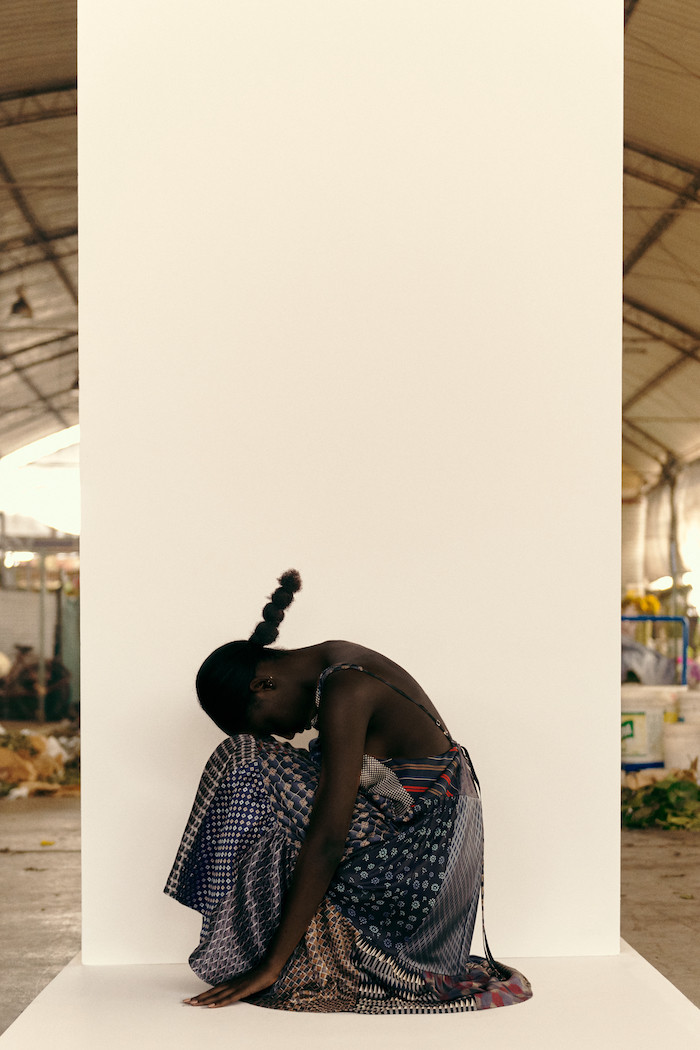
Yeah, definitely. And they are wanting to help us develop that. Again, it's a boutique factory, so it's a very small kind of family-run factory, so I feel comfortable with that. Right now, we actually don't work with any factories. I've built my team from scratch, which I'm really proud of because it's created this bond between all of us. We all want to see LOTI do well. Everyone puts so much heart and soul into everything we do and the boutique factory also operates in the same way. They toured me around a few times and I felt it in my gut that it was the right thing — I saw no red flags. I see lots of green ones actually — so much willingness to want to do better. But we actually do have more accessories that we've done ourselves. We have our silk bras, so these are made out of men's ties. We also have our silk head-pieces. And our newest development, which is not an accessory, but I'll show it to you because it has to do with the ties. We created a tie dress. She's truly a work of art. It's taken us over five months to develop her and the fit is great. We're trying to get all of our upcycled pieces to that standard, to be really competitive with non-upcycled pieces and just as beautiful and well-made.
How has Peruvian culture and influences from the city of Lima made their way into your designs? Do you take any inspiration from the colors or the sounds of the city, and how does that manifest into the product?
I think that's always an interesting question, just because generally, I think when you say, 'I'm a Latin designer,' people expect a certain aesthetic from you. But then you have designers like Jacquemus; he's French, but not all of his collections are directly inspired by France or aesthetically look French. We want there to be more space for Latin American design to be able to just design freely without the pressure of 'looking' Latin American, because, ultimately, my designs and my collection are Peruvian because I am Peruvian and the people who make them are Peruvian. But I do think it's inevitable for a place like Peru to inspire design just because it is so beautiful and rich in culture and textiles. In this case, Peru is providing me with the textiles. So that's already a huge aspect that I'm taking design-wise from there, for sure. And Peru is so diverse — for example, I grew up in Lima, so it wouldn't be authentic for me to be inspired directly by Cuzco or somewhere else. These countries are just like the United States in that every state is so, so different. But Lima is wonderful and beautiful. The people mostly inspire me and street style in Lima definitely gets my brain moving and I will snap little things here and there with my memory.