We had the pleasure to sit down with Kaito and discuss his background, his perceptions, and his future. Keep reading to find out what’s more in store for him.
Stay informed on our latest news!

How long have you been doing photography?
I’ve been doing photography for about six years.
What was the starting point of your career in photography that made you go, “Boom! This is what I want to do.”
I would say probably when my friends and I just used to meet up and walk around the city and go to New York. We would travel and really just have fun shooting and creating street photography. It was just fresh and really free to create.
Do you remember the first camera that you had?
The first camera was a T2i, I believe. A Canon T2i.
So what do you shoot on now?
I shoot on various cameras depending on the shoot. I'm not really tied to anything to shoot, but two shoots ago I used the Hasselblad, and the last shoot I used a Canon. So, it depends on what I am in the mood for.
You’ve worked with so many artists over the time such as Saweetie, you did the Vanity Fair shoot with Diddy, and more. Which artist was the first person you ever shot and who was your favorite?
The first artist that I collaborated with was Montana of 300 from Chicago. Then it was King Los. I would say that I don't really have a favorite yet.
Okay, cool. That’s understandable. Is there any artist that, like, you're looking to work with in the future? Like on the top of your head?
Probably The Weeknd.
That would be really nice.
Yeah, The Weeknd would be sick.


Your work has such nuances of classic black excellence. What is your process and intention for each shoot?
If it's like my photojournalism work, I like to tell the story of what's kind of going on and just bring bring the person and beautiful light. Whether it's added light or typically I just shoot natural light. And if it's more studio photography, I like to just sit and really think of how this subject should be portrayed and and how do I see them being portrayed for the shoot still in beautiful light. But yeah, I like to do research on the person, really do a deep dive on where the person comes from. And then I just think start thinking creatively about what I see.
Well, in this day and age, there's been like a definite emergence of photography. I think the amount of photographers that really come out and I think have just become so successful has been really nice. But are there any other photographers right now that have inspired you or anyone from the past?
Yeah, my favorite photographer is. A mix between Howard Bingham, Gordon Parks, Annie Leibovitz, I would say photographers of this modern day that inspire me are Sasha Samsonova and Micaiah Carter.
Okay. So you've captured in really different settings, I feel like it really shows throughout your work how you can keep the emotion of each shoot so profound, Since you’ve worked in concerts or you've done really personal photo shoots. So if you had to pick, especially when it comes to your photojournalism work, is there a particular setting that you feel more comfortable with or you prefer shooting with?
So actually, I just traveled to Vegas and I shot Usher's concert and it was really different for me because, you know, through Covid and through everything, you know, everything kind of scaled down a lot, even photo shoots and, you know, how many people are on set and stuff. And I'm used to just being a one man band through like these last five years. And I would say, like, I love just documenting moments, but I've grown to love studio photography or, you know, outside natural lighting and more locations so I would honestly say that. My favorite would probably be location shoots.


Yeah, I think when you talk about, I think, capturing people in their moment, that reminds me of one of the pictures you've taken of Tyler and Rocky, I think in a recording studio. But I think that one is just so nice because you can feel just what that element was and probably how fun it was to be in that place with them. So I could definitely agree with that.
So, yeah, just a touch on that, they were laughing the whole time and I selected that to put that, to share that with the world because that actually gave a real description and a real image to describe that studio session. You know, it could have been any other choice of a photo out of the hundreds that I probably took, but that one was just a perfect moment. And I'm always just aware of what's going on around me.So I'm always just ready to just document. I sit in the corner and I just observe and I look for different moments, whether they're intimate or the whole room is laughing. I'm always just trying to document what is going on. I've learned through my journey of telling stories and making sure that people in the future can really know-- if there were no words-- what images, what set of images, what four images could tell a story in.
If there was a song to describe your work or a film, what would it be?
Hmmm. That’s such a good question. I’d have to say “My Testimony” by Marvin Sapp.
What is the future for Kaito? Are you interested in doing any long-form, or campaigns?
I would say my future would be, getting more into the advertising space, working with brands and really shaping how I see their brands looking. So that's one thing I would love to keep creating in the editorial space. I love the creative elements of that. Also I would love to direct a lot of commercials. I would love to keep just exploring photojournalism and maybe traveling somewhere overseas or, you know, something like that and just telling real stories as well. So that's kind of what it is. I'm kind of just in the moment, but I would love to see myself just in those various spaces for sure.

Curated by Udo Kittelmann in cooperation with Katharina Sieverding, Watching the Sun at Midnight pays homage to Sieverding’s persistent treatment of contemporary German and global matters, one that has ensured the ongoing relevance of her work over the past 60 years. In conjunction with the exhibition in Baden-Baden, Salon Berlin presents Headlines, a thematically focused selection of large-scale photographs referring to the darkest chapter in Germany’s history, the National Socialist era, in the Former Jewish Girls’ School in Auguststrasse in Berlin.
The solo presentation will also feature new works that include Gefechtspause (“Ceasefire”), which addresses the lockdown during the COVID-19 crisis. This exhibition is the latest in a series of monographic exhibitions of photography-based positions at the Museum Frieder Burda, including Gregory Crewdson, Andreas Gursky, Rodney Graham, and JR, all of which investigated the staging opportunities and great breadth of technology as opposed to painting.
A student of German artist Joseph Beuys, Sieverding has continuously focused her artistic energy on political issues. Considered a pioneer of photography internationally, testing the boundaries of the medium’s manifold technical possibilities, she is known for her unconventional visual strategies and media-led creative practice.
From the microscopic to the macroscopic, the references in her oeuvre are complex. Her father’s clinically dissecting view sharpened her own focus and opened it to the technical opportunities presented by her chosen medium. From her origins in theater, Sieverding understood how images on a wall can define an entire room, with the same immediate and all-consuming effect of a stage backdrop or a big screen in a cinema – which in turn unlock the imagination for an introspective look at fantasy worlds. Her pictures, often in black-and-white with a bright red signal color and accompanied by striking slogans, reflect media-based and commercial manipulation strategies, questioning them at the same time: it is no coincidence that the artist has repeatedly and consciously escaped the museum setting and sought direct contact with the broader public in common urban spaces.

This is insane though, that both of these [shows] are happening right back to back. Tell me about these three pieces, how you came about showing them. Um, and I guess like what these pieces mean to you within the context of this other work?
Well I had wanted to show with Todd for a while. And it really just happened organically through mutual friends and coming here for other openings. But the three pieces are kind of, like I said before, oddballs out. They are all kind of all different from one another because the way I work starts as a list of ideas that I want to become paintings. Now, the list has become like 40 paintings long! So some of them are more cohesive than others. But I'm working towards building more cohesive ones for her solo show at Seasons LA next year. And since I had two big group shows happening this summer, I was figuring out what pieces I could give to the shows that still look okay together. You know?
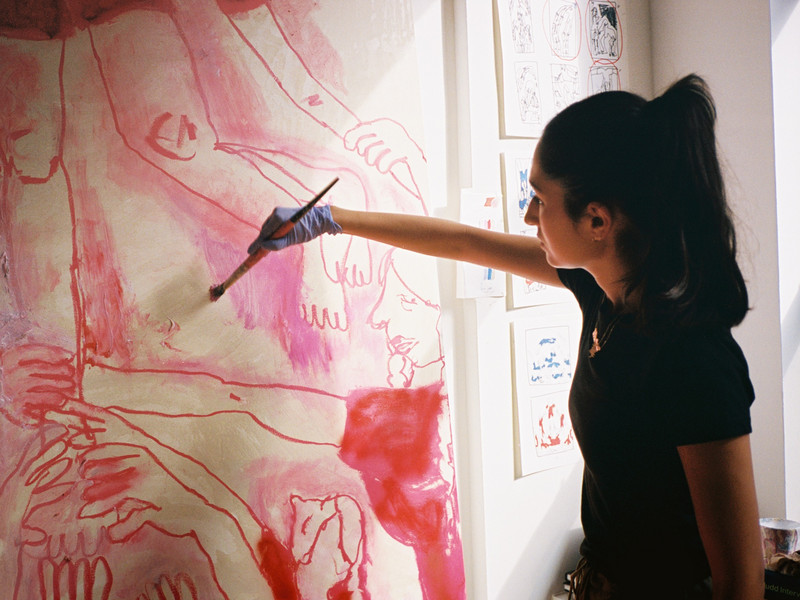
There's that and because this show is with four different artists, it was easier to show pieces that didn't necessarily look as great together for say- a solo show. I mean the first one [pointing to My Sunday Best] piece, like My Sunday Best, which is the piece in the kitchen, was my first experiment with painting myself nude. So it was definitely way different. At the same time, that piece was kind of in the line of me still putting bags over my head and I think that painting for me, was the start of taking myself seriously as an artist. I was like, “I'm going to make a big painting. I'm going to make a big figure painting. It's gonna, I'm gonna use tape all over it so it looks like it could be hung in a gallery—”I spent so long on that one — something like two months that I spent on that one whereas now I spend two weeks on a painting.
So what changed between having bags on your head to featuring your face?
For a while, I was putting the bag over my face because I was still figuring out why I was painting. My paintings have always been deeply personal, but I didn't realize it was a meditation for me to make them. I also, for a while, struggled with the idea of only making self-portraits because it made me very nervous to be like, “What are people gonna think? Are people gonna think that she's obsessed with herself or whatever?” But once I figured out why I was painting, I stopped caring about that because these paintings are way more about self-hatred than an excess of love for myself.
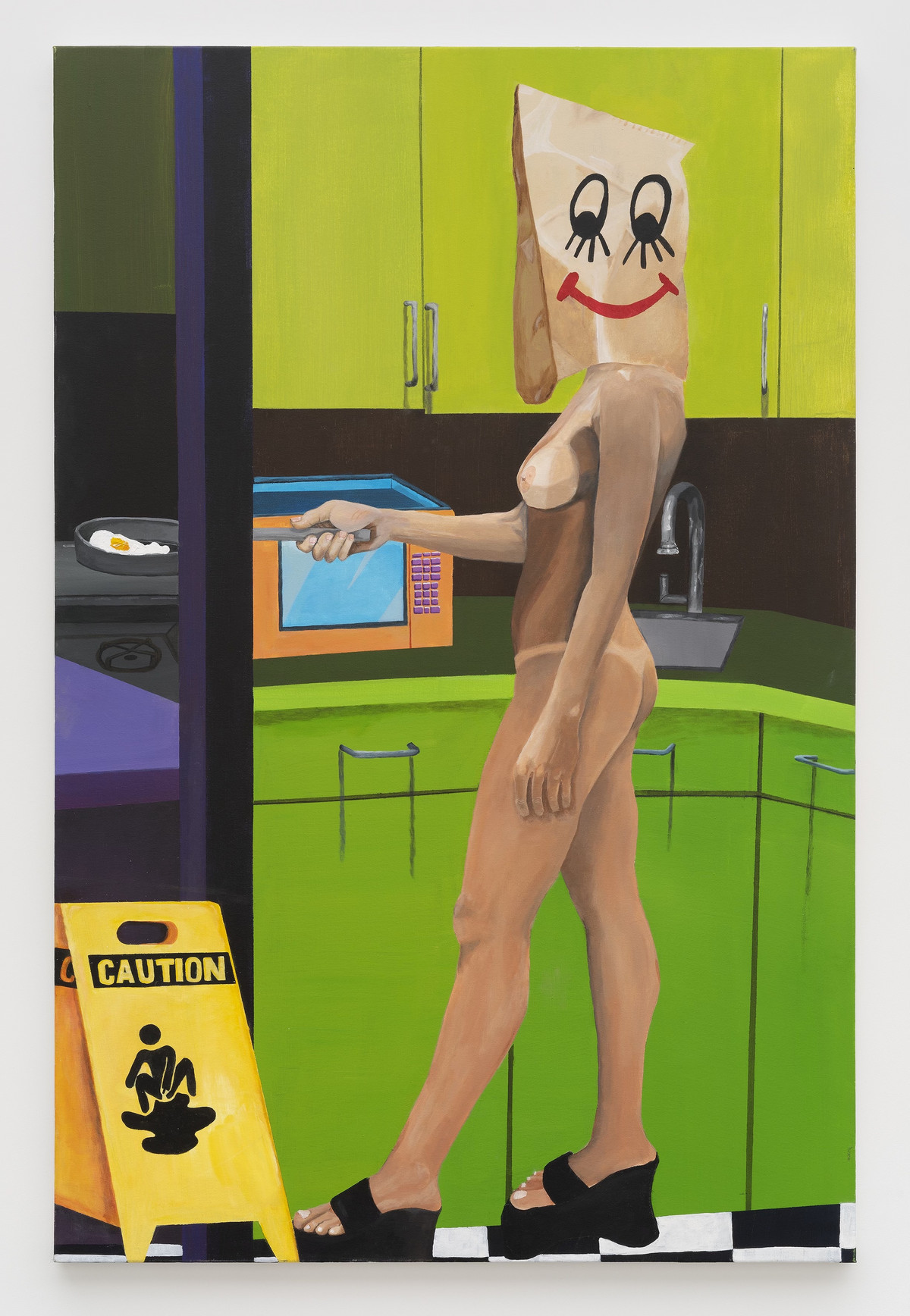
Like I was talking with someone recently and we were talking about how it's almost as if I’m hyper-sexualizing myself before you do.
Absolutely.
‘The gaze’ is kind of the starting point for these paintings really. So I had to begin with painting my face. So the first one I did was like this painting that is going to Italy at the beginning of next year. And it's, I made it during the pandemic and it had a COVID mask. So it was still masked, but it was like, I'm going to paint my eyes now and like half my face. So, and after that I was like, okay, I guess I can do my whole face. Like that turned out really, really nice. So it's just kind of like transitions and then, I don't know, I just became more comfortable with it and stopped caring about what people are gonna think that I'm painting me? But I think that's also what is fun with my work. I try to incorporate a lot of elements that are super intense and personal to me but don't necessarily come across that way. But then once you notice, even the food sometimes looks menacing, even the random objects. So I love playing around with the details in the painting.
How do you end up choosing what playful additions you add to each piece?
Honestly, every piece marks such a specific memory or point in time that I always pick something that had or has a lot of meaning at that time. Sometimes I feel, even though I am painting myself, the objects are way more personal because they're things that remind me of very specific points in my life or like feelings I've had. The hardest part is not giving things away too easily because—

You don’t want it to be too “easy.”
Yeah, exactly. Though the paintings are super personal to me, I'm fine with someone not seeing all of that right away. Like seeing a chipwhich in this, and being like ‘I know, that! I can relate to that.’ But I'm fine with them not understanding it fully right away. It's kind of a bonus sometimes. Like little secrets.
I like that: ‘little secrets’.
Yeah, I mean, I have list [of works] that is just so long now, but also it's kind of that thing of, you just have to get it out and make it into the world and have it exist. And then it's like, “okay, it's gone.” And maybe it was a bad painting, but it is somewhere else now. And it’s out of my mind, so I try not to edit myself too much on also the paintings I make. If you feel like you need to make that, then do it because now it's there. But I'll probably look back in a couple of years and be like, some of these were really stupid.
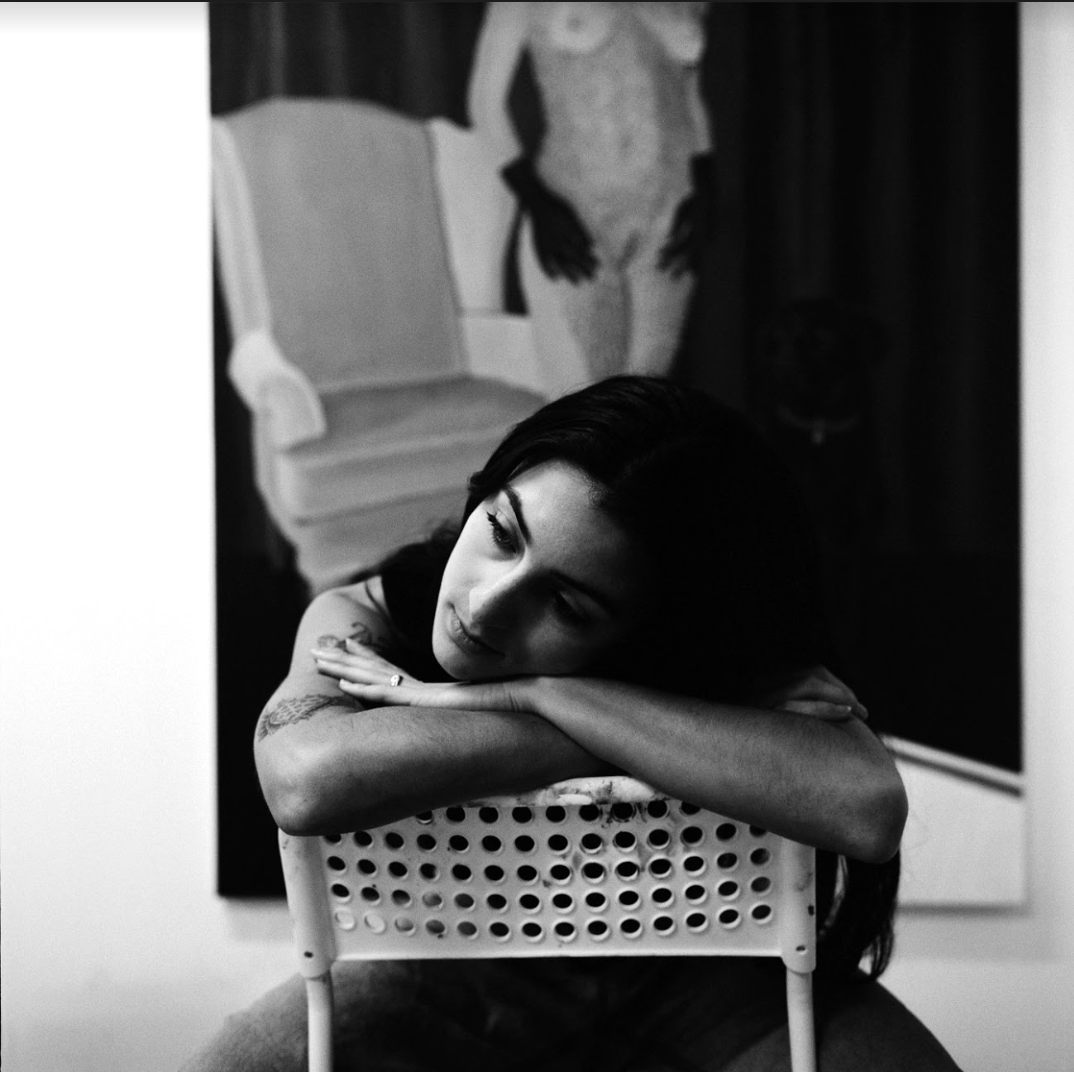
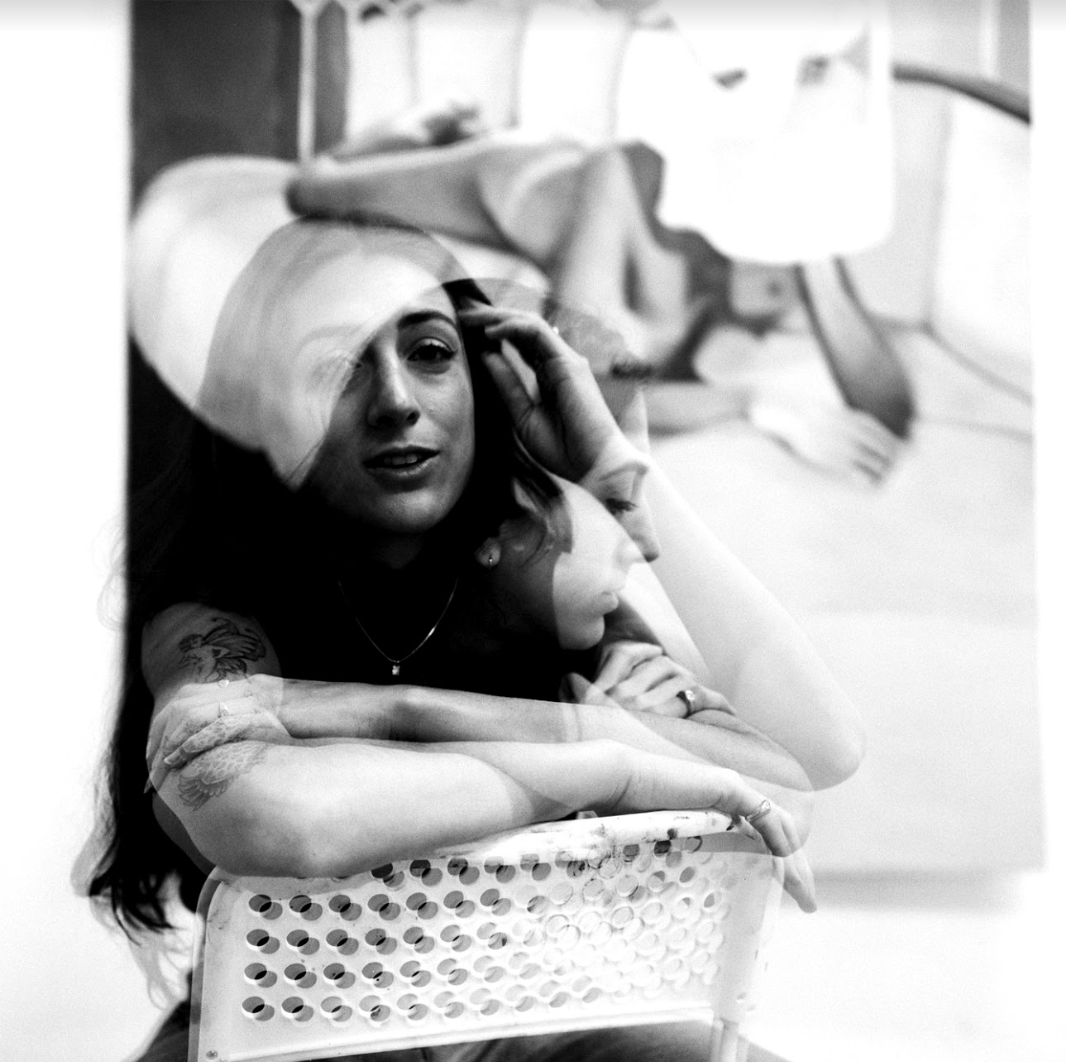
But that's good that you allow yourself the freedom to do that. Yeah. I think it can be really stifling.
I think that's also the nicest part about making self-portraits is 1) inspiration. It isn't really hard to find like I just get it from everyday life. And also, you don't have to edit that much because if some, like the biggest criterion that I have for my paintings, is that it is personal to me. If there's not a reason why I'm making something that I'm like, ‘Oh, should you make this?’ If it's just a picture of me then there's kinda no meaning behind it. But if it's personal and I can talk about it or, think about a moment in my life that this painting felt real because they're kind of like...well I call them psychological self-portraits. ‘Cause they're more about feelings or memories that may or may not have happened. But if that feels real then it was real for me at one point, then I'm like, ‘Okay, it can, it can exist as a painting.’ So yeah, the inspiration part isn't as hard. Once I started painting myself, I was stressed out a lot less, about like, ‘Oh, what am I going to make?’
And these figures? Do you draw from a mirror? From photos? Or do you have friends model certain positions postures etc.?
Well I look up stock photos at that time. I always painted from pictures cause I liked the details, but then I did my first nude photoshoot- and that happened organically more as like a... I mean, you know, this cause you know, me personally, but like struggling with body image for so long and like my experience with eating disorders that I recently realized, or like tied to like my history with like abuse. Um, it came to me that like, it came at a really weird time where that was like an expression of being comfortable enough with my body. Like this weird, like exhibitionism was kind of like, ‘Okay, I don't hate myself as much as I did before.’

Is that because it's like considered art once you put it in on canvas?
Yeah. I mean, I wouldn't, I don't think about it that way. I think about it just like the actual photoshoot was — I can be comfortable enough to show myself to someone and look at my image. And then I realized, at one point I was like, ‘Okay, I am going to be using these photos for paintings and like for nothing else,’ obviously. So nude photoshoots are still a part of my process and it's definitely transforming now because I've had some bad experiences with those ’shoots. So eventually I think I'll just shoot myself because I'm also really inspired by how Cindy Sherman works.
What’s good with that diner piece I’ve seen you wrestling with?
Yeah, for that piece that, I was thinking of a diner piece for this show in Los Angelos. Just about growing up in New Jersey. That's like what everyone thinks of? Anyway, the show is called “Breakfast in America”. That was the first thing I thought of. Rusha wanted the “first bite” at this gallery to be memorable like that...like the first eggs and bacon, he had ya know? But I had a dilemma where I didn’t think I could Photoshop together well enough. So I went to this diner with a friend just a couple blocks away to shoot. We went at like 8:00 AM and of course, but right as we walked in, there were a bunch of construction workers having like a huge breakfast. So I was like, like what are we going to do? So we just sat down and she was like, ‘Do you just want to do it [strip down to bra and undies]?’ And I was like, ‘No, I have to ask, I don't want to get thrown out of this diner.’ So we called this Greek guy over who works there and I'm like, trying to hype myself up for this wild pitch. After explaining that I needed to make a painting in a diner and that I make all nude self-portraits I just went for it and asked if I could get into my bra and underwear. And he's like, ‘I mean, I have no problem with that, but let me ask my manager.’ He comes back and says it’s fine, ‘But you may want to wait until those construction workers leave.’ I was so glad we're on the same page for that. So we just waited until they left. And there was this old couple, watching me the whole time. I definitely felt super weird, but honestly, it just makes the painting funnier than it actually happened. I know my body now enough that I think I may do that more — shoot on scene I mean— but once you kind of know the way your own body moves, it's much easier to just kind of like edit and what's the word? Not compromise. Go on the fly. What's the word though? Do you know what I'm talking about?

Yeah, improvise.
Improvise, damn! We used to be smart—but yeah, that painting came out great. I'm very excited for it.
Try to catch some of her work with Ross + Kramer’s at Summer Summer Group Show in The Hamptons next week starting August 21st-Sept 12th.