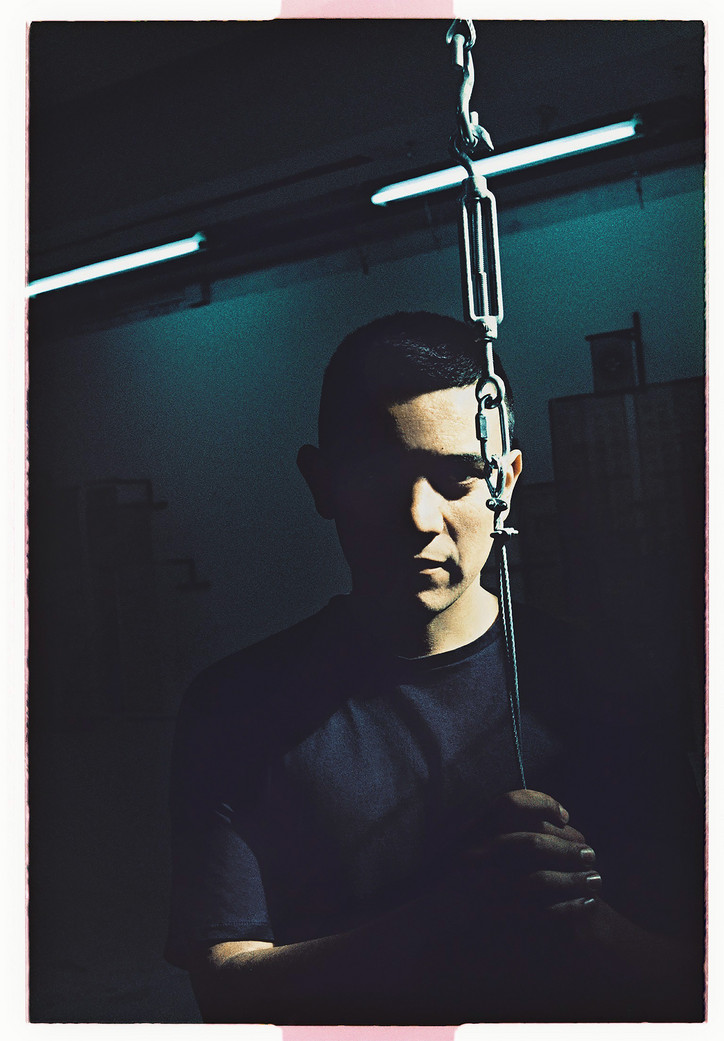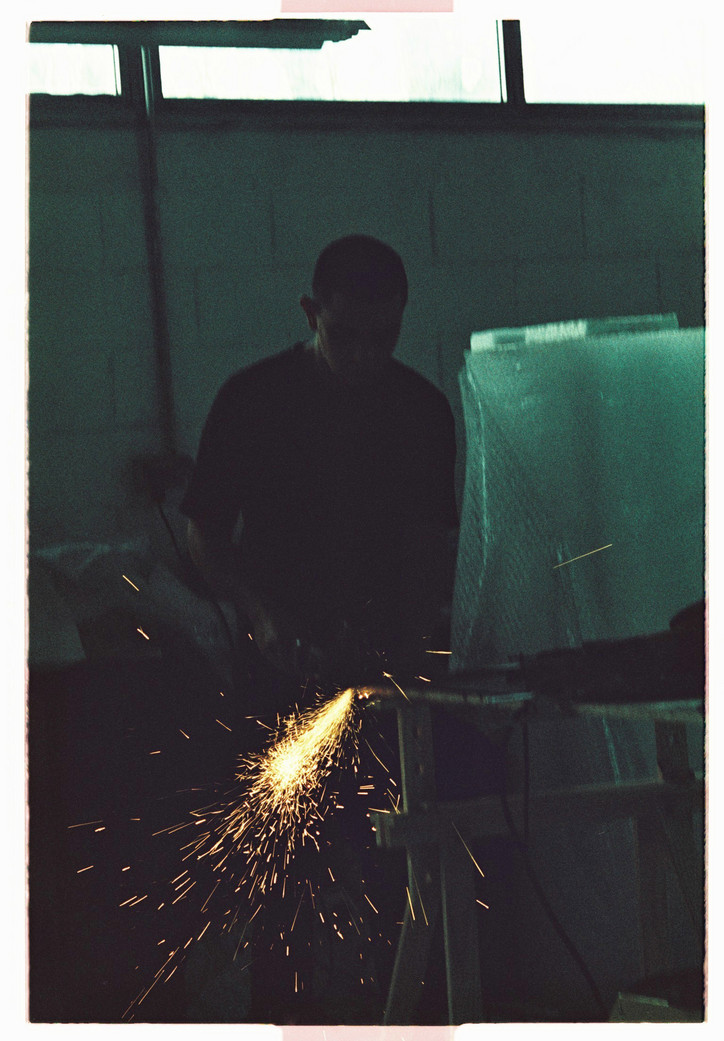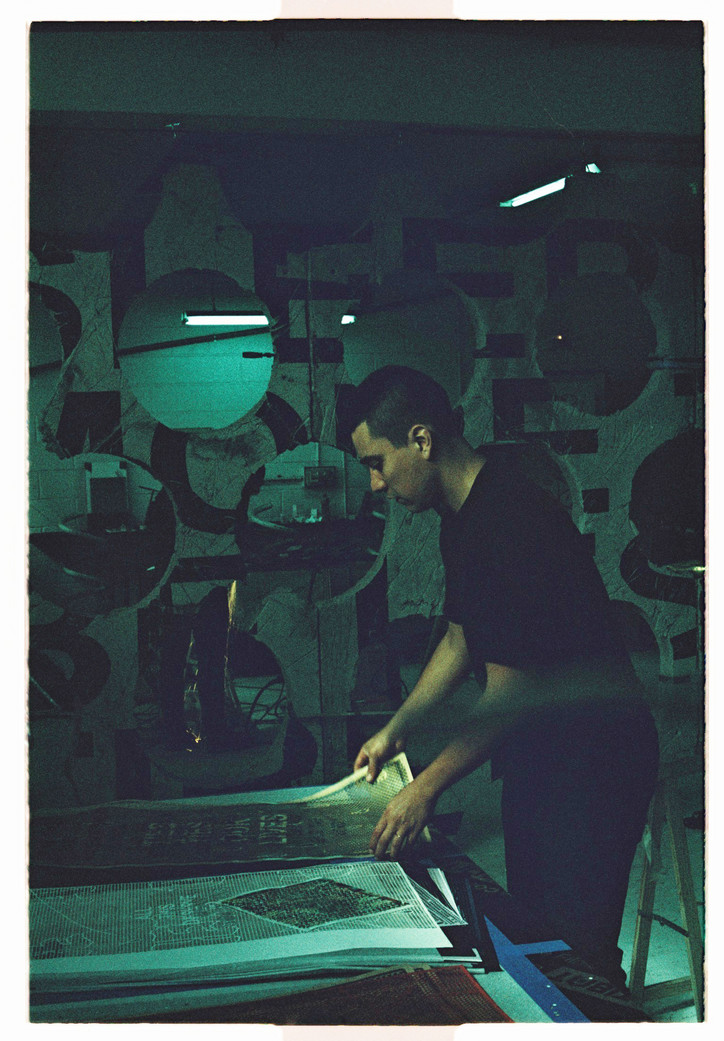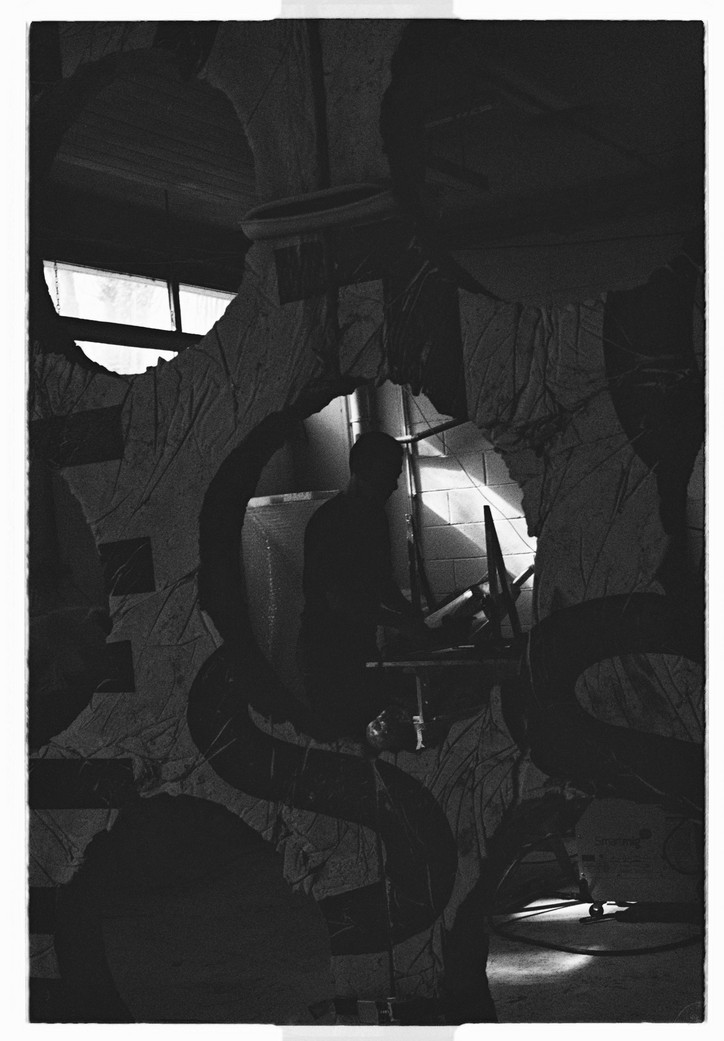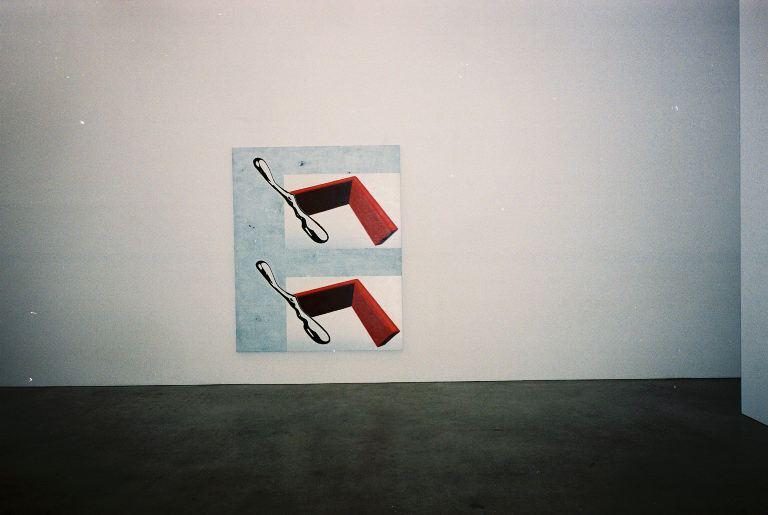



The artist walked me through his show, shedding light on the themes that pervade his work and personal history. On one wall of the gallery, a multi-part film is projected. The others are hung with sculptural media works—honeycomb-like wall fragments printed with partially legible words, draped fabric and layered panels laser-cut with phrases, figures and comic book scenes. An enormous gilded sweet potato sits quizzically in the center of the room. The work is not obvious, nor is it obscure. It challenges us to pause and question the ways in which we interact with the people and phenomena that influence us.
IA: Let’s begin with the film, I think the film is somehow the heartbeat of the show. Actually, it’s the rhythm of the show, because it goes on and off, and makes the exhibition breathe, a little bit. There are seven different sequences. This film is about these two places that are exactly at the opposite in the world. This town in Indonesia named Palembang, and this other one in Colombia named Neiva. They’re both small cities, not well known, not big economies. I wanted to go to these anitpodes to prove many things. I wanted to make this an historical parallel, and show how different these two towns are, but show mainly how close they are, despite the fact that they are exactly the farthest place they could be, one from the other. So the film talks in a way about geopolitics, and also about the idea of the other. How we construct the idea of the other as different, like our neighbor, or the people in the next country, but we’re pretty much the same. Not only in terms of sensibility, but in terms of economy, in terms of history. Like, Indonesia and Colombia, they were both colonies. One a Dutch colony, one a Spanish colony, and they have pretty much the same history, with of course several different details.
O: So why is the film split into seven parts?
It’s chapters, and so the film is 21 minutes, but I just wanted people to interact, I didn’t want to make people sit and watch for 20 minutes. I didn’t want to have the cinematic experience, but more like, somehow you’re watching this, and almost like a dream the images appear.
Do you think it’s best that people see the film in its entirety?
I think it’s OK if they get pieces, each clip has its own independence. Some are more like music clips, others are text, some are sound and images.
The viewer in a gallery or museum can ask a lot of a video piece, there’s often an attitude of, “I’ll stay here if it grabs me.”
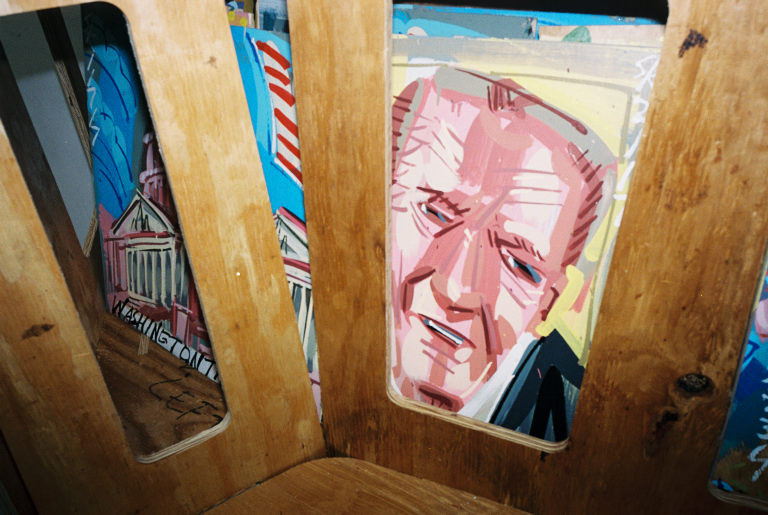
You need to be very engaging, yeah. It’s very horrible when you arrive to the exhibition and it’s the credits, it’s like “Ugh.” And they’re long. So that’s kind of the heart of the show, in a way, the pulse of the exhibition. Then there are paper works. I’m always collecting material, actually I started because I found this story about the company Kodak. Somebody who worked at Kodak told me that in the ‘40s, the company switched the developing process from Kodachrome to Ektachrome, because they realized when the pictures get old, they turn red. It was during the Red Scare time, so they said the photos cannot be red, because red is the color of Communism. Ektachrome, actually, when the images become old they become bluish. So I made this project reddish blue, and tried to find if the story is true or not. I actually never found the answer, but I found a lot of history on propaganda, or industry colluding or interacting with ideology. And then I expanded to like, history books, how history is taught in schools. For example, the images in some of the collages in the show come from this comic named Is This Tomorrow?, which is a comic made in ’46, the same time of that Kodak story, and the name is Is This Tomorrow?: America Under Communism, so it’s a fictional comic, advertised to children and teenagers to make them afraid of Communism. But it actually touches very large themes about unions, about racial stuff. It’s very hardcore. They say, for example, “Of course, Communists will try to empathize with minorities. What they’re going to do, is they’re going to start making minority conflicts. So they’ll show the ruling party saying super racist stuff, and then some insider will say ‘You see? They’re so racist here, you should join us.’” Same way with Jewish, with African American. So it’s very hardcore, it’s very twisted. And at the end of the comic the Communist party is in power, and you see the White House with a Communist flag.