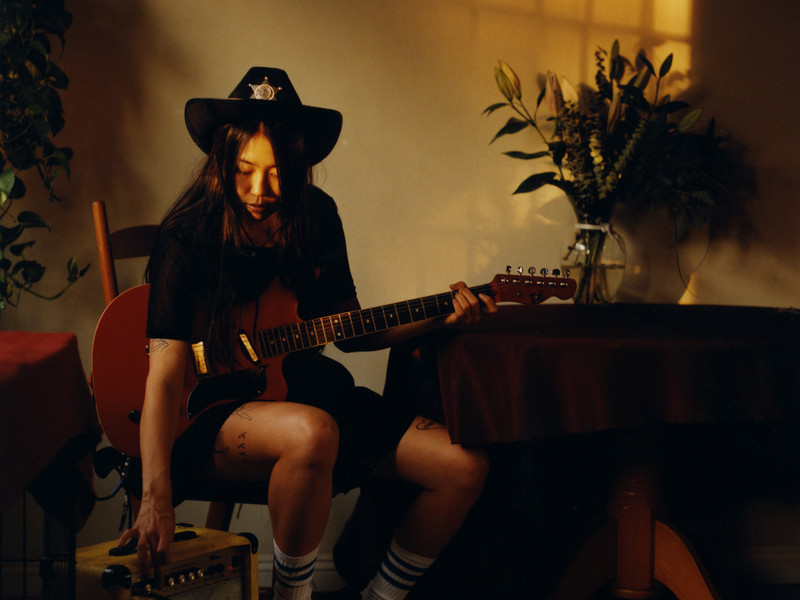
MIRRORS

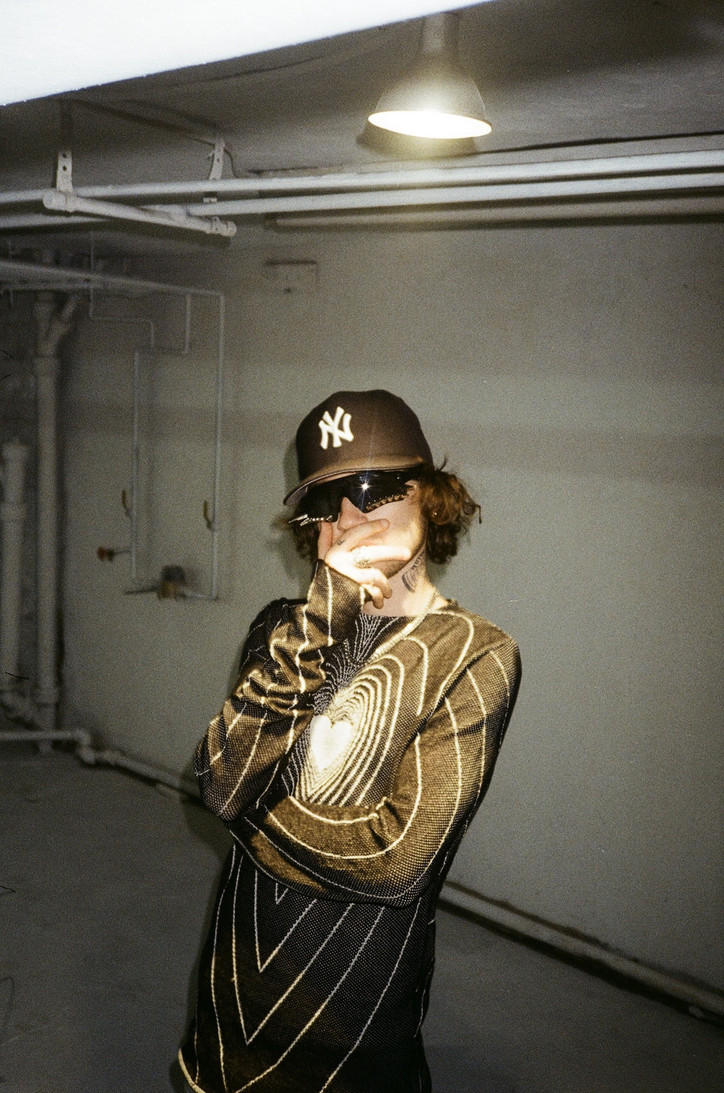
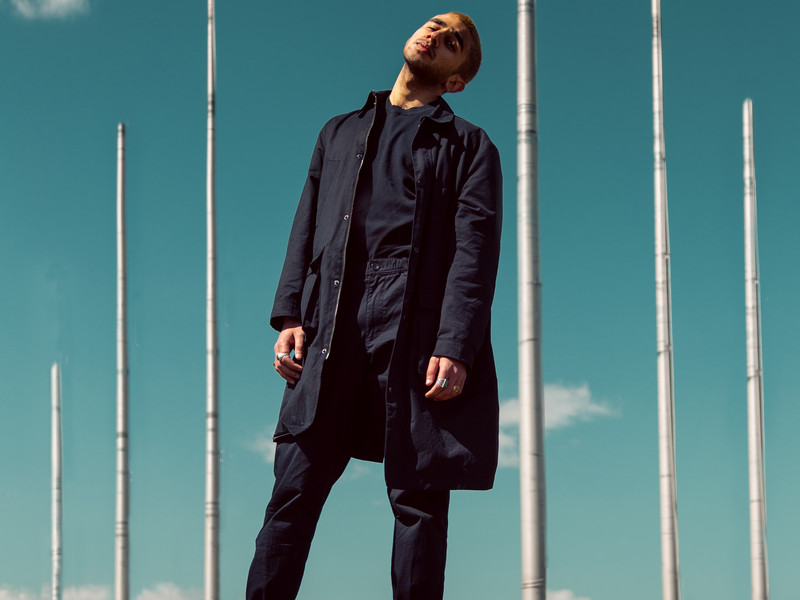
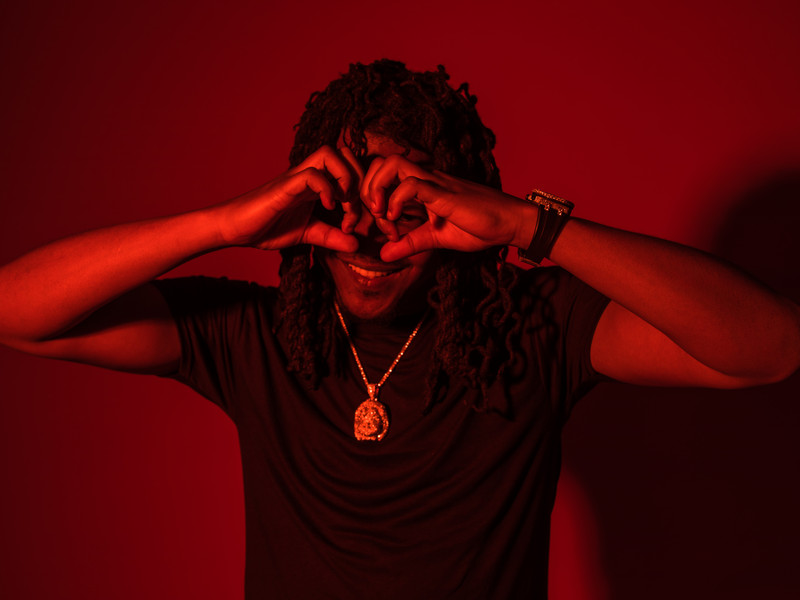
“The whole reason I started doing electronic music and house music was to try to bring a new culture and something different to house music,” Topgun says. “It’s been really cool because I brought two features to electronic music that have never been done.”
Since City of the Freaks released last month, Topgun knew there was no turning back. Many of his songs on previous projects such as Ravestar have little to no lyrics – just beats. Now that he’s collaborated with lyrical musicians, he says he wants to maintain the lyricism on his beats for future projects. Topgun gets into a different zone when creating music. He’s able to tap into his emotions and lived experiences to produce sounds you wouldn’t expect.
“I just lock in for a month or so,” he says. “I get in these zones and moods every few months and I’ll say it’s go-time. For a week straight, I’ll just work on music all day, every day and that’s how a project will come to life. I like working on music in the morning. I’ll walk, get coffee, smoke some cigs and get tweaked out. I’m a mellow person, so it gets hard to get in a mindset to make hard, dance party music.”
Although Topgun’s music dates back to 2020 on streaming services, he got his start in 2015 dropping exclusive songs in the underground SoundCloud scene. During that time, he’s done events with and collaborated with artists such as UnoTheActivist, Tyla Yaweh and CHXPO.
His grind hasn’t stopped since. Despite releasing City of the Freaks only a month ago, he’s already working on his next project – a dark techno house with elements similar to A24’s Midsommar as it’s anticipated to drop mid-summer. He says he will include more features on the album, one being Sam Austins.


But there’s more: He and his band, Alex Sucks, are releasing their debut album Situations on June 9 and headlining The Roxy on June 10. How he balances DJing and playing bass… we salute him.
“To be honest, I love it,” Topgun says. “I love going back and forth because I grew up skating and listening to punk music and shit. I can really be my true self with that. And I really turned DJ Topgun into a real character. I use it as an art form and show people my creativity.” He admits playing live bass is a lot more intimidating than DJing, but he likes to get loose no matter what and you can expect that no matter what he’s playing.
The future's looking bright for DJ Topgun. He’s remaining booked and busy in multiple cities. He plans on coming back to NYC as he loves Le Bain, a Paris Fashion Week event with Steven Victor, a mini-tour with Alex Sucks, an afterparty for Detroit’s Movement Festival and much more.
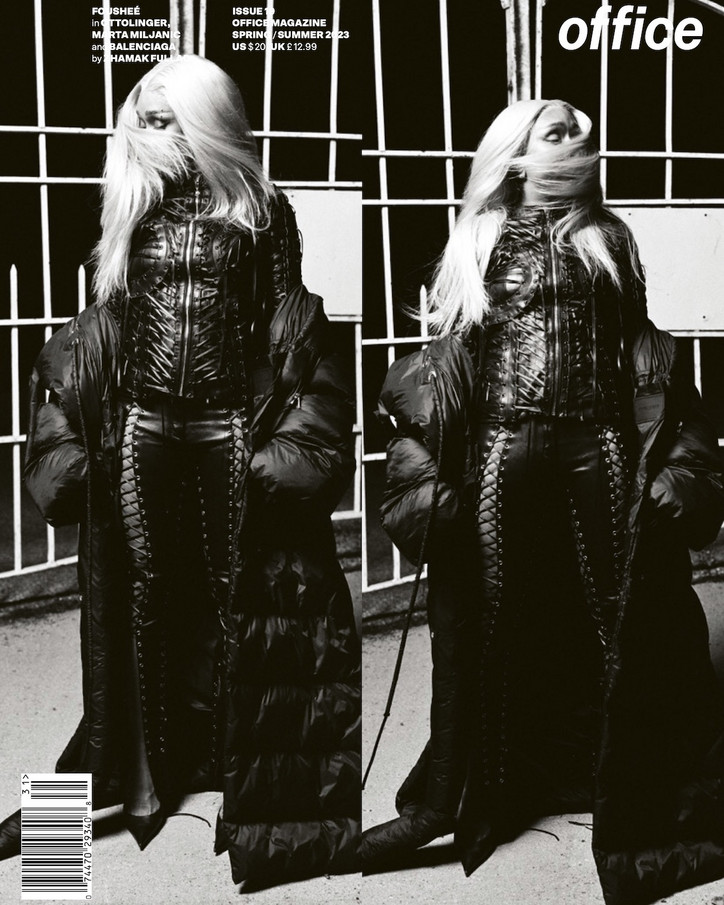
Since outgrowing my first pair of Doc Martens, I’ve had much more of a musical and cultural education, and through exposure, expanded my understanding of the subculture in both its modern and mainstream iterations. But it wasn’t until recently that I realized the final remnants of the stale punk archetypes in my mind had more renovating to do. Punk is purely about an anti-establishment attitude. It isn’t just about genre, and it isn’t about aesthetic choices or the amount of holes or ink on your skin. It’s defined by how you destroy the boxes that have been built around your craft, your culture and your rights as a human in this world. And today, though it may have been more of a gut instinct than an intentional act for singer-songwriter Fousheé, she’s solidified her place as the star of the modern punk movement.
I met the Jamaican, New Jersey-born artist on a winter afternoon at the Chateau Marmont. I’d listened to her music before, immediately familiar with the viral hit “Deep End” that had brought the young artist recognition as well as the hit “Bad Habit” by Steve Lacy, who had been an avid fan and frequent collaborator of the young singer since attending a show of hers in New York. On these tracks, her voice carries strong against softer melodies, offering emotion-fueled R&B energy, a sticky amalgamation of SZA and Etta James. But it wasn’t until I dug into her latest project, softCORE, that suddenly I sat up straight in my chair. Something was very, very different. These tracks were unlike anything I’d heard. They flowed with ease I’d have formerly thought impossible from quietly romantic, eerie ballads to literal screamo in seconds, before grinding the gears back into a folksy rhythm that felt bizarrely natural. While TikTok surely has provided its fair share of pop punk covers of Top 40 songs, and we all fell into our own phase with early aughts mashups, the transitions in Fousheé’s project from one sound to the next are something completely new. From sitting with softCORE, to meeting the soft-spoken leather-clad singer that day in Los Angeles, I can confidently report that there is no kitsch to what Fousheé is doing, no intentional “flipping the script” to generate a synthetic moment of hype. With her music, she harnesses authenticity, speaking to her own experiences with love and anger, expressing them through electrifying auditory range. She has created work which I am hesitant to even call a blend of “folk” and “metal,” though she describes it that way, as that would be giving the idea of genre too much credit at all. Without forcing it, Fousheé has created something far greater than a novel sound, she’s something new and groundbreaking, simply by following the feelings. And that, I would say, is truly anti-establishment.
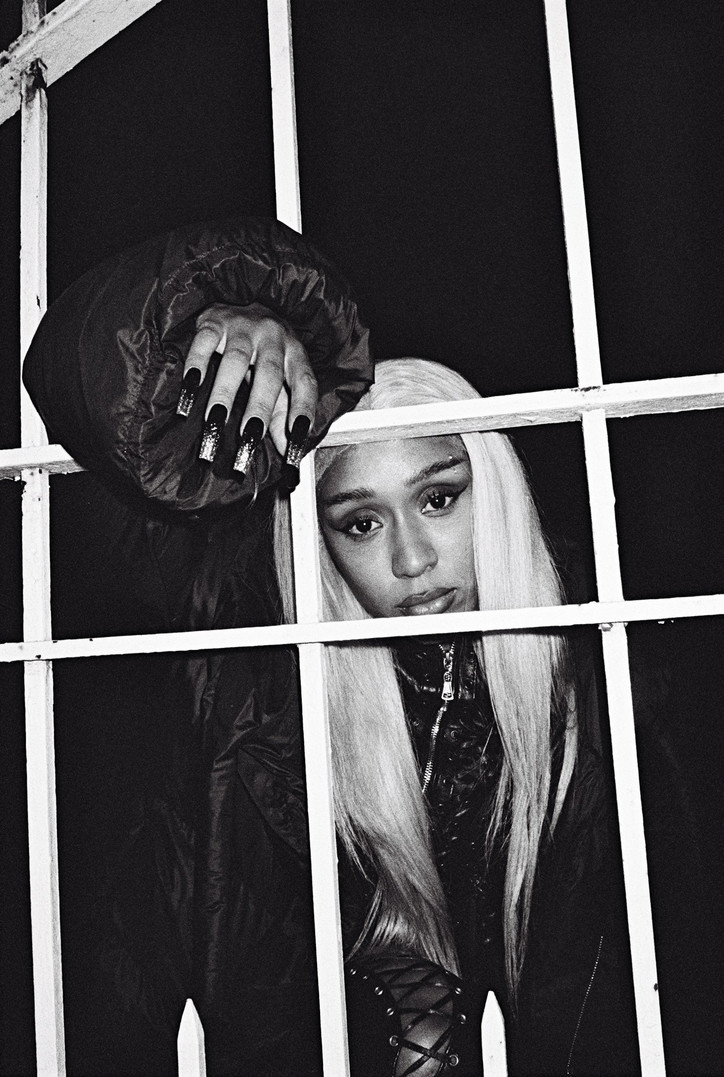
While the audience at large may have heard a lilt in the audiovisual gap between Fousheé’s first viral hit and her softCORE project, for the artist herself, the change of direction went almost unnoticed.
“It just happened so naturally,” she tells me, a honey-colored curl falling into her face, “It’s how I felt, and it reflected the music I was listening to. I didn’t notice how extreme the difference was until it was out.” And while her label had her back, believing in the song and video ideas that stood out against anything she’d done before, their support — or her audience’s — felt secondary.
“I think the need for me to express certain things holds a greater weight, personally, than anyone’s support. But I’m always like, I want that support, too. What if you take that leap and you’re completely in touch with yourself and no one likes it and no one supports your message?” But the endearingly soft-spoken Foushee before me finds her balance in a heartbeat, adding, “at the same time, I’m someone who likes harsh honesty. If it’s constructive, I can grow from it.” Suddenly I’m reminded that as shy as she may seem today, this is the same girl who put in hours perfecting her guttural, heavy metal growl.
Fousheé is full of yin and yang, even in reflecting on her East Coast roots. “I was born in Newark, and then I moved around Plainfield for a while. My mom immigrated from Jamaica, and we would try to work up to better neighborhoods. Then we ended up in Bridgewater, and we stayed there for a while. Pretty good area. That was the suburbs… I hated New Jersey growing up,” she confesses. “Now I appreciate it. I think I have a lot to owe to New Jersey for my eclectic music taste… It was a mix of the music New Jersey is known for that lent itself to my taste, but also my mom is Jamaican — so there was reggae and a lot of Celine Dion heavily playing in the house. And then I was just a black girl growing up, so I listened to hip hop and R&B. That's where I learned how to write metaphors and stuff. Battle rap. Smack music. When I would turn on the radio, it would be like ‘97. Overall, there was a whole world of different music that I was exposed to, and I don't think I would've been if it wasn’t for Jersey.”
Though there was alternative rock being played and made around her growing up, at the time it didn’t suit her. But years later, upon moving to New York, that facet of suburban subculture came back into the forefront, and sparked Fousheé’s interest. “It was in New York that I fell in love with guitar and live music.” Her mother, back in Jamaica, had been in an all girls band, and always encouraged Foushee’s musical experimentation and ventures, even from an early age. However, when I ask when she first thought of herself as a “musician” proper, Fousheé laughs and looks at the Praying bag printed with the words “give girls money” propped in her lap. “I always knew I wanted to be a recording artist, since maybe age five. But even today… I don’t know if I think of myself as a Musician.”
While I’d argue the contrary, it seems that for the burgeoning talent, admonishing the formal label for herself has been working out.
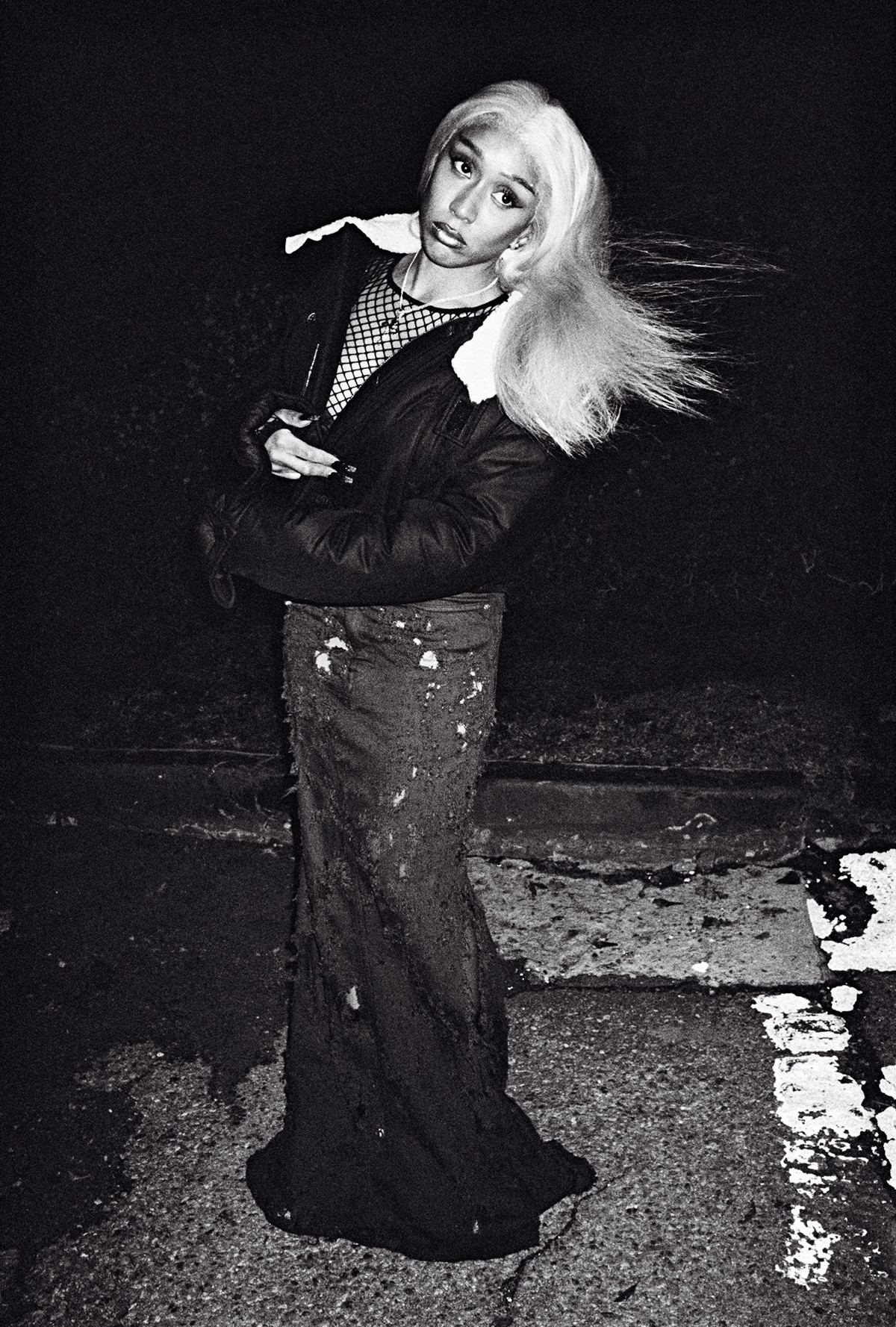
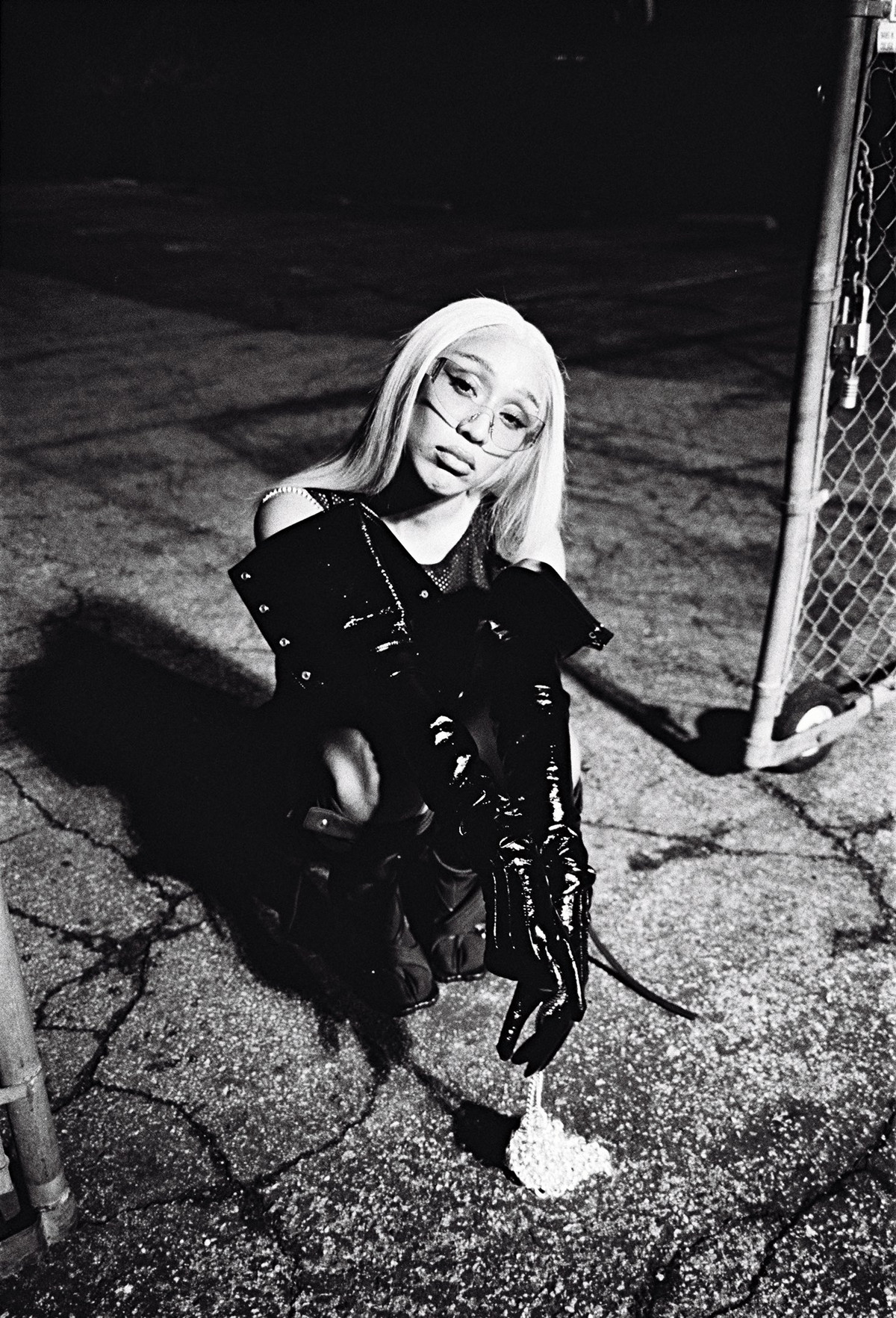
FOUSHEÉ wears JACKET by AMIRI, BRA by BURBERRY, TOP by MONZLAPUR, SKIRT by MARGIELA, BOOTS by PETER DO,
NECKLACE by MAOR
FOUSHEÉ wears JERSEY, SHORTS by 7 DAYS ACTIVE, GLOVES by ALEXANDRE AKHALKATSISHVILI, BAG by MARTINE ALI, SHOES by OTTOLINGER, GLASSES by BALENCIAGA
For the last three years, Fousheé has been finding her footing in the Los Angeles music scene. Since arriving on the West Coast, she’s found a group of fast friends who range from gothic tattoo artists, to models to other musicians — though it’s changed, like many things have for the young artist over the last few years.
“I ended up in Los Angeles because of Steve Lacy. I met Steve in New York at one of my shows — he’d come to the show to see one of the other artists, but afterwards, came back to introduce himself. Later, when he moved to LA, I decided to move with him and live in his house. It was a big house with some empty rooms. When I got here, I fell into the rap scene. Then from there, that just grew — I would be around, see Loopers, Nacel. I met different people, until I found my sound and my close-knit, tight-knit crew today.”
Out of those in the crew, she’s become especially fond of Izzy Spears, the former Anonymous Club member-turned-punk prodigy. “Every time I see him, we’re just drawn together. After we met at a party, we kept in touch, then we got really close these past few months making music together.”
The idea of Izzy and Fousheé being drawn together makes perfect sense. In a crowded room, these two would be creative magnets — each buzzing with an energy unparalleled by the average artist. That punk attitude, they have it: both in their persons and their sound. It’s clear, unapologetic and uncomfortable for them as artists as much as their audiences. Izzy’s is overt and overpowering, his lyrics brash, violent and homoerotic, while with Fousheé, it’s not always on the surface — in a track that at first feels slow, without warning her voice will make an aggressive lunge forward, screaming and fighting for air. But though the layout and the lyrics diverge, it’s clear that Spears and Foushee have found common ground alongside a group of equally gifted friends in the creative landscape they’re discovering and creating together as punks, and artists of color, in a genre that has historically lacked diversity.
Though she’s now drifted from the rap and R&B community, Lacy led her into the edgier side of the city’s creative scene she spends her time around today. She still works closely with Lacy, and considers that sound and lifestyle an important aspect of all she does. “I always feel like I'm trying to juggle both worlds, this very grungy world and then this very folksy world. I think what Steve and I make is really like folksy soul music. But I want to figure out a way to exist in both. That's why I made softCORE.”
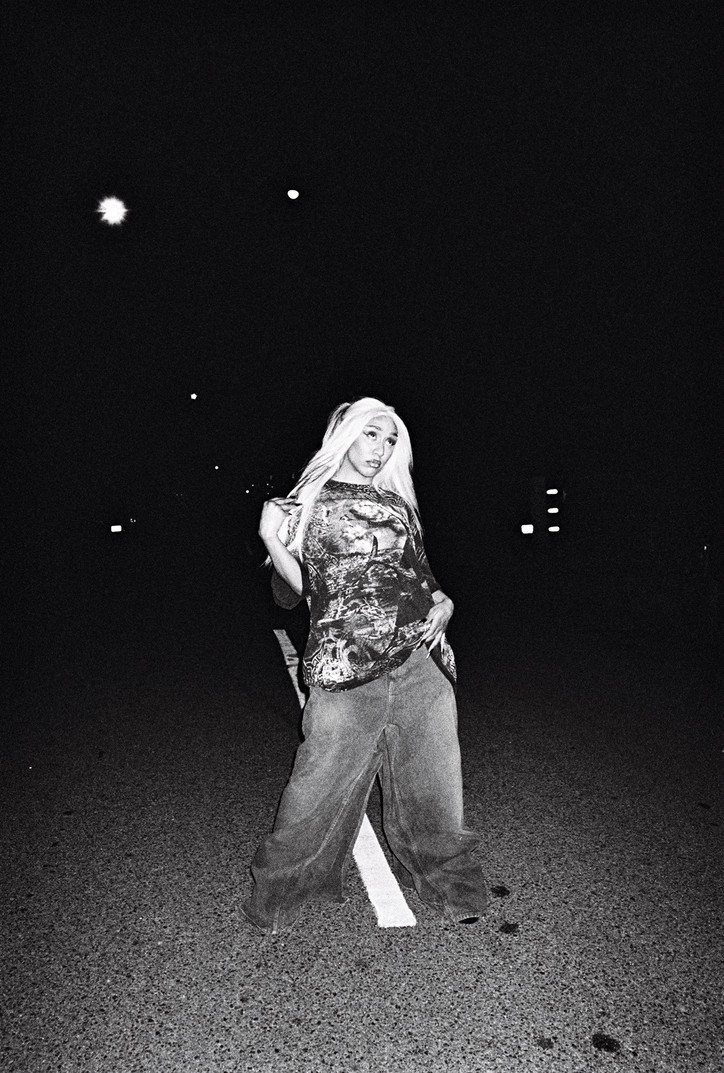
FOUSHEÉ wears JEANS by BALENCIAGA, T-SHIRT is TALENT’S OWN, SHOES by MOONBOOTS
Having had a metal track on repeat for the year prior, and drawing on punk ethos for her project, softCORE gets emotional. Where did the anger come from? “From being angry.” She tells me, point-blank and without hesitation. “I think when you feel a certain way, you're drawn to certain sounds.” But while evoking those feelings comes easily to her these days with the new tracklist, she’s still in touch with the other side of it all. “On tour, we lived on both ends of the spectrum. Listening to metal before we went on stage, opening with softCORE stuff, and then singing “Sunshine” with Steve — I would be splitting myself in two every night.”
But it seems like she’s figuring it out and finding her confidence, experiencing a catharsis of sorts through the heavy metal facets of her new sound. It’s the same rush of endorphins a therapist might have a patient explore through screaming at the top of their lungs. “I think as the tour went on, I started working on my growl. Not that I incorporate it into the show every night, but I just do it on “'i’m fine” and “in secret.” [Laughs] At first, we used to put a bunch of distortion, and then towards the end I didn’t need it. It's scary, though. I don't want to go too deep into any world.”
But which world does the Foushee just an arms length away from me belong in? “I think the person you see on stage is more of an extreme version of me. I'm pretty soft spoken. That’s “Brave Me.” I have to hype myself up every time — I used to have extreme stage fright as a kid. But now I love it… The first time I felt that stage fright disappear was at this open mic that my aunt forced me to do. I was 16. I had performed before then in school and stuff, but I think that experience really broke me, because I failed so hard. I did so badly, and the host was like, “Make some noise for her. It's not easy to get up here.” I remember those words, and thinking to myself, That means I suck. I was like, I’ve got to get better. I’ve got to nail it.”
For most, failure doesn’t eradicate fear. It can easily be a recipe for that fear to become crippling. But for Fousheé, who defies odds at every turn, it’s the embracing of fear and weaponizing of criticism that adds flavor and feeling to her craft. In fact, not only does she use the fear to her advantage, it’s inspired her to push the stage persona, aesthetic and sound behind softCORE even further. “I think people are a little scared. I had friends who thought I was in the Illuminati [after releasing the project]. But I love it. I think that was my favorite part of the tour — scaring people. My favorite part of performing is the reaction. I like to think that I bully people up there, and it gives me the sense of control that you can never, never have, because every audience is different and every day is different. When I'm like, You're all my little bitches today,that brings out a certain confidence. Especially during that song “i'm fine”. It’s like, guys, I'm just going to sing this pretty song.
“That song was actually the first time we tried that concept of merging the two sounds. It came up when I was on tour with James Blake and we were in Philly — I was so sad during that time, and singing those slow songs, I just wanted to scream. I was like, “Ooh, what if I do a song that's like half folk, half metal?” So we went into the studio, the next day and recorded the track. That was it. I immediately knew I wanted to do a whole album of that. Literally, we didn't overthink it at all. Just one of the quickest songs that I made off that project… But that’s exactly what I'm trying to change now, that process. I want to reflect on the past and think about the future more. But I'm always asking myself, How do I feel right now?
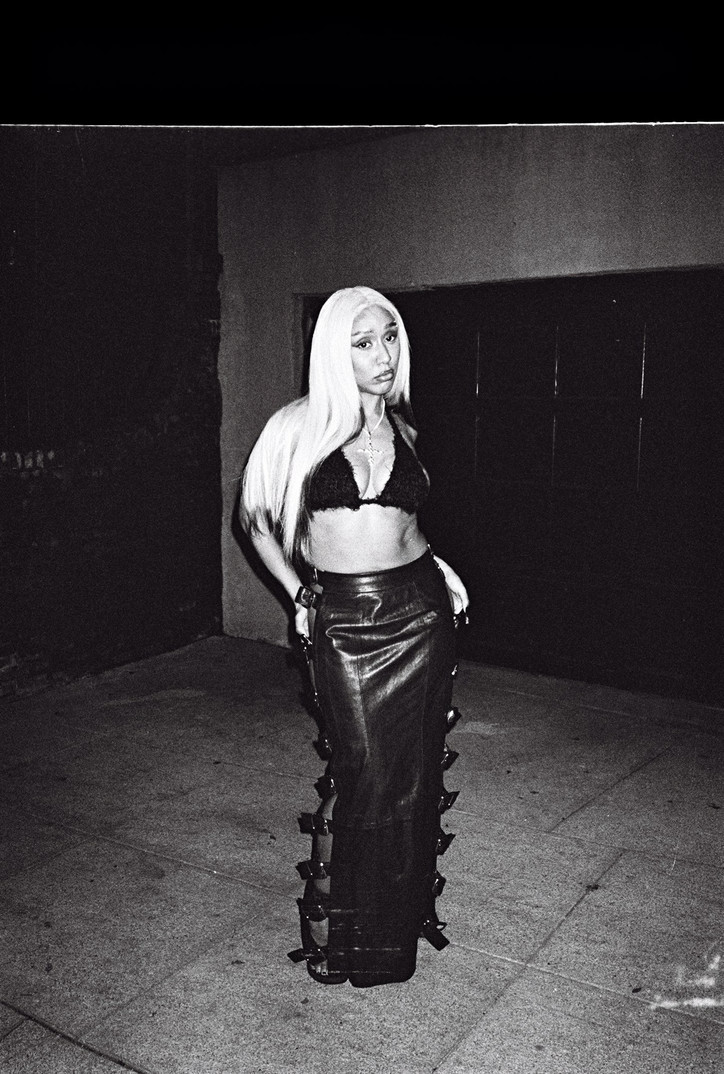
FOUSHEÉ wears BRA by SUSS, SKIRT by ALABAMA BLONDE, SHOES by BURBERRY
Fousheé’s mind and process swing from one end of a pendulum to another. But rather than coming off as erratic, it’s more like a Newton’s cradle, with a muted and mathematical rhythm to it. It’s about the center of the Venn diagram, and building an understanding of balance. “I want to make more thoughtful music. I used to be really thoughtful about every word, or at least the format of it. But I reached a point where I was like, I need to be more free flowing and stream of thought. I was doing that for a while. Now I hope to meet in the middle somewhere.”
Steve Lacy, while a part of her folksier friend group, has been a major part along every step of her journey — the sweet and the screamo. “We have similar tastes in what we like, and it's a good balance, because I think where he is more musical, I tend to think more about the words. We just do this back and forth type of thing. He's Gemini, I'm a Leo, so we just have fun in the studio. That's one of my best signs to hang out with. We just move around the studio, laughing and just picking up different instruments and ordering food. We're just talking about life. That's what it’s like.”
For the future, alongside slowing down her thoughts, Fousheé is focusing on a new project: her first full album. “I would say that was a project, softCORE, so I think I could take more time with the process and make something with a little more attention to detail musically with the next body of work. It might sit more in the middle, so maybe I won't be screaming. [Laughs] I want to let life naturally lead me to what's going to be next. Maybe it's just going to be another level of this style, and just refining the balance of it. Well, OK, maybe I will yell, but I'm just going to go into the studio and see how it goes. When I just do only one side of things or the other, I feel like something's missing. I have to take it day by day.”
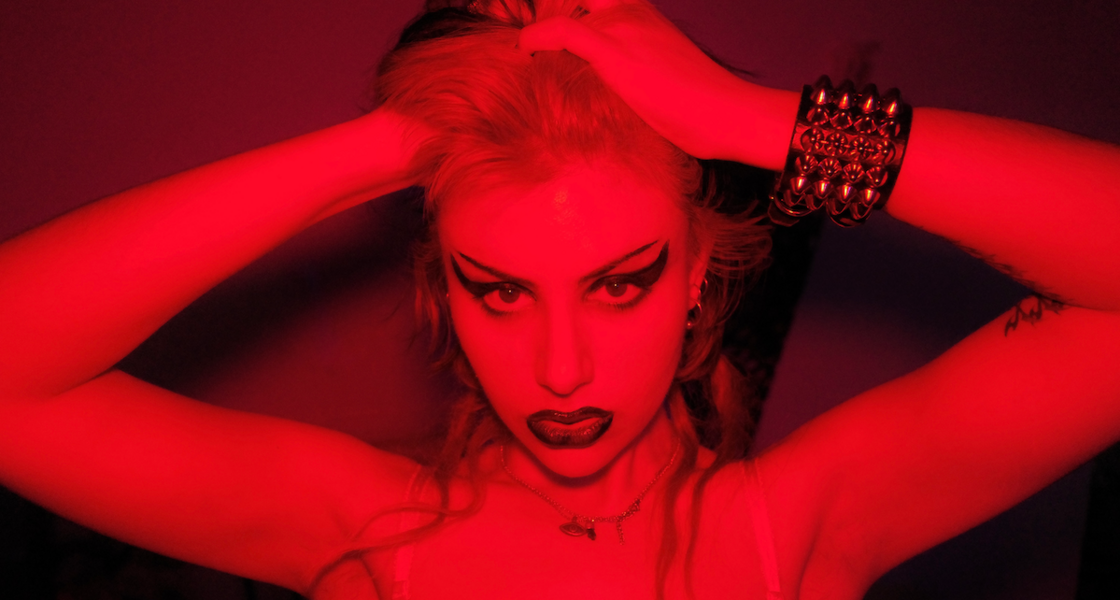
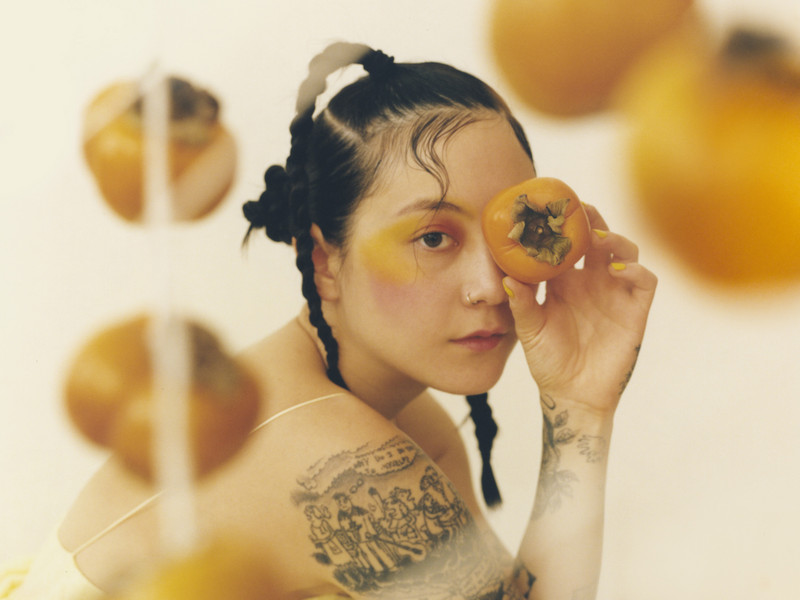
Pretty, like all words, has a history. Seemingly harmless yet rooted in a narrative of power and control. Taraneh channels this in her own song of the same name. Released originally in her bittersweet album, A Fleeting Feeling (2022), she returns with a video that mirrors the song's melancholic melody. She sings hauntingly over drop-tuned guitars and drums reminiscent of 90s lo-fi acts, as if to suggest that the scene is not married to a specific moment in time. She subverts the notion of pretty as a signifier by using the word ironically, as evident when she sings, "Oh, you like my hair, thank GOD." If you couldn’t tell within the first ten seconds of the video, she couldn't care less what you think. The same goes for her clones, a distillation of own dimensions.
Inspired by an eerie dream and Diamanda Galas’ "Double Barrel Player," Taraneh and her doubles crawl, sulking, smoking, holding hands, and dragging around idly in the dingy studio. They don't seek validation; they'd probably laugh if you offered it. By the end of the video, the distinction between the girls — Taraneh, Thoom, Comet, and Miss Madeline — melts away; each could be any girl, just as tired of being met with the same boring compliment.
Video Credits
‘Pretty’ is typically used as a compliment. What is the song about? Are you addressing someone in particular with the lyrics?
The word ‘pretty’ doesn’t mean much to me other than a low-effort compliment. Maybe even a diss. I think that’s a central part of this song. I wrote it when I was 19 and realized that beauty won’t save me, that beauty won’t save us. Or maybe it will, who knows. In some ways it’s about that, but more than anything for me, it’s a song about power and control. I think most things boil down to matters of power and control. It’s rather straightforward and the lyrics are pretty direct, but I’m asking a lot of questions in the song to no one in particular that I don’t really care to hear the answers to — rhetorical questions, if you will. The lyrics are flexible and fluid enough to land with people how they want them to, or how they will, I should say. But I also just love exploring the concept of beauty, you know? We live and die for it. And it’s like sand through your fingers. That’s a crazy concept to me.
The lyrics are repetitive, almost like an anthem, or a chant, heightened by the repetitiveness of the video. You also include a single line that refers to your own hair and the outfits you wear. Why was that?
The song is like a trance to me. A trance that swells and then falls apart and I think a lot of my music is kind of trance-like. That’s a big inspiration always in my work, this notion of submitting to the trance. So the repetitive lyrics and visuals are meant to service that objective in a way.
I got the idea for the music video in a dream I had a few months back, where I saw a bunch of faceless clones of myself and I was their leader. I had recently been talking to Comet who's in the video about this concept of a costume and I realized that my hair and the way I dress is so conducive with that notion. It can be a costume. I think that's probably why I had the dream in the first place. It’s funny because that being said, the video is in many ways built around the concept of a costume that centers my hair and the clothes I wear, but the lines about my clothes and hair in the song are pretty obviously sarcastic. ‘Oh you like my hair, thank GOD.’ Just like ‘pretty’ is a low-effort compliment, ‘I like your hair’ or ‘I like your style’ is just as low-effort to me if not more. Which is fine, it’s just boring, even if it’s honest.
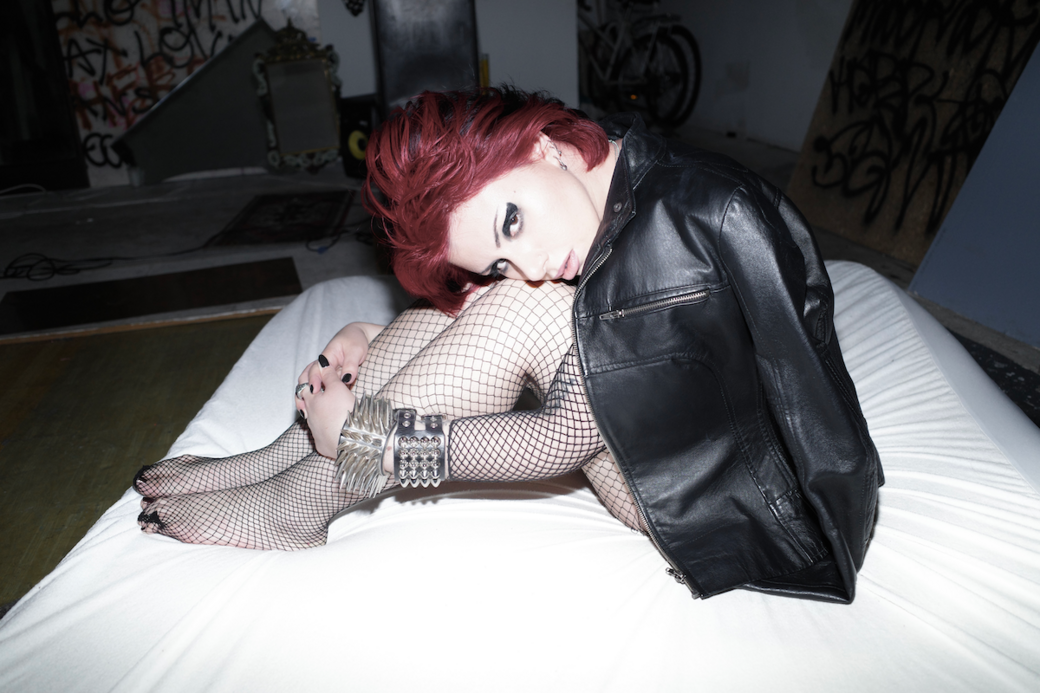
Does each girl in the video — you, Thoom, Miss Madeline, and Comet — represent a different part of you?
I wouldn’t say that they necessarily represent different parts of me, but I think we could frame everyone featured in the video as some representation and distillation of power. The girls in the video are some of my closest friends. I wanted the video to be kind of a depiction of my life in a way but dialed up to the point of theatrics, so I wanted to involve my friends. It only felt right. But then I also happen to have very powerful friends — we’re a very powerful bunch. I think in some ways power can be distilled down into an archetype. It’s a feeling, a state of being more than an attribute. And if you embody it, it’s true.
It’s almost like you capture this universality around the word “pretty” and how it’s used to refer to women in a very specific context, is the video meant to defy that?
Yes and no. I think many things are as good or bad as we want them to be. I personally care about and value beauty, but I think beauty is and can be many things. Just like I care about and value ugliness, which also is and can be many things. I think more than anything it’s about making a concept your own. Both the video and the song are really meant to provide people with what they need when they find it. I think that things find us when we need them to and we see them the way that we want to. Disorientation, empowerment, inspiration, disgust, offense. Whatever. As long as people watching take away something, anything.
There’s also a dark, grungey feel with the lo-fi camera and overall dim lighting. Was this purposeful or an extension of this dream you had?
I like visual media that you can’t necessarily place temporally. At least right now that’s something I really gravitate toward. The video is really a glimpse into my dreamscape, you know? This video is based on this dream I had and ultimately I wish I could have just screen recorded my dream because it looked really cool there but I couldn't so we made the video instead. This is pretty close to what I saw, though, which is great.
Actually, I originally wanted the video to be the same concept but in stop-motion with Barbies like in that Todd Haynes Karen Carpenter biographical film “Superstar” but with all the Barbies dressed like me. I still love that concept but thought it would be cool to first explore this idea of a character and costume on myself and my friends. But those quick cuts are with stop motion in mind. I love the Diamanda Galas music video for her song “Double Barrel Prayer.” That was a big inspiration for the video and informed a lot of the lighting choices in particular. I was just watching it a bunch before we started filming “Pretty” and I wanted to pull in some references from that. I like how stripped down the concept is in that video and you can see just this really strange bizarre character in Galas which I admire and really relate to in many ways. I watched it with Nat Cherry who shot the “Pretty’” music video and there’s this performance shot in “Double Barrel Prayer” that we thought would be cool to draw from. Minimal set, simple layout. Drastic lighting. We shot it at my friend Bobby’s place who’s a really cool painter and we turned his studio into a ‘stage.’ It’s where we always hang out and I dressed how I always dress and wanted it to reflect the image in my head and I think we nailed it. High budget videos are cool, of course, but sometimes you don’t need much to get across what you’re trying to say. That’s a big inspiration.
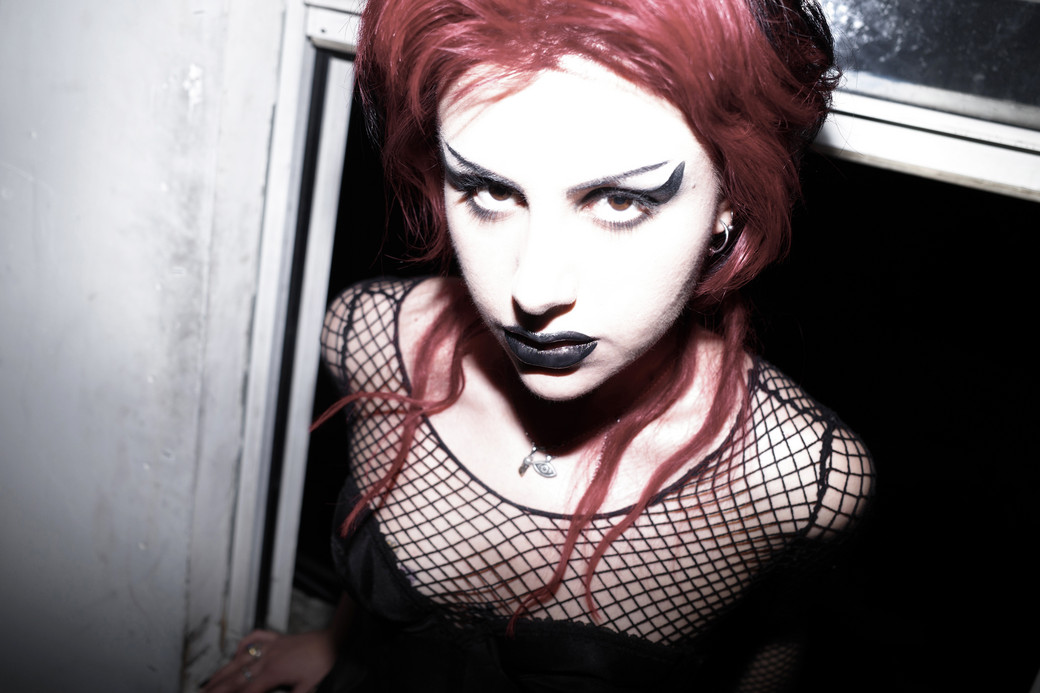
Your stage name translates to 'melody' or 'song' in Farsi. Tell me a little bit about how your Iranian upbringing influences your work.
My given name is Taraneh, it’s the name my parents chose for me. And I was named based on this dream that my dad had before I was born. Not to be too heady or anything, but in some ways I view it as a prophecy of sorts and think it would’ve been a waste to not use it as my stage name as well. The word ‘Taraneh’ is used in a lot of Persian lyricism. Growing up I’d always get so excited when I heard it in songs. I always felt like they were singing for me. I grew up between Cleveland, Ohio and Tehran, Iran. But in Cleveland, I didn’t know any other Taranehs. It was cool hearing a stranger sing my name.
My Iranian upbringing and background influences my work and the way that I frame the world in every way. It’s inextricably tied to who I am and therefore the work I make. Iranians are poets and romantics and revolutionaries. We care about freedom and liberation and self-determination and pleasure — or at least I do. And of course religion plays a pretty central role in post-revolution Iranian society so I play with a lot of religious iconography in my visual work.
This video is no exception — there are a lot of religious overtones in this video. It made sense to throw a niqab in there. I’m sure many people will find it offensive that I’m juxtaposing an objectively very sexy outfit with probably the most modest Islamic covering that exists. But beauty has always been weighed against religion for me growing up. Modesty and sexuality always went head-to-head. It’s worth laying out for me. There’s a cross in the video too — there’s certainly a lot of meaning to glean but I don’t think it’s worth overexplaining.
What's next for Taraneh?
Power and control.