MIRRORS


Why do you think so much of the youth is depressed?
Well by just being observant of the people around me and noticing that everyone has some sort of sadness that takes over them. I believe prescription drugs diagnose you with depression which you’ll only notice when you're not on them.
What does the release of the Glitter EP mean for you, in terms of both your career and your personal life?
It’s just refreshing to put out music. Finally people get to see how the sound is growing and will continue to grow. It feels like a new beginning.


Tell me a bit about the making of the Glitter EP. How did you choose this collection of songs?
We were eager to just be ourselves, do what we want and make something that really came from our hearts—not just lyrically but production wise. So we got in the studio and did just that in a very organic manner.
How do you hope your music contributes to culture?
I hope it changes people’s way of thinking/living. Ideally, I want it to have a role in the world changing.


Do you think it’s everybody’s ultimate goal to make their mother proud?
I think to some degree, but sometimes it’s bigger than that.

You guys have worked with some pretty impressive people. Who would be your dream artist to work with?
SG Rihanna. She’s sort of just the best.
Have you guys ever gotten star struck working with some of the artists that you have?
JP I think you get more star struck if you see someone out of context. But when you’re in a studio setting it’s kind of par for the course. You’re just there to work really, and get the vision expressed as best as you can, and you’re focused on that.
SG I think there was maybe one time, when we met Andre 3000. We weren’t expecting that. He was a total hero of mine from childhood, and still now. We just had no idea what to say.
What’s the process like when collaborating with different artists? Does it happen organically in the studio or is it pre-planned?
SG We do a lot of planning beforehand. Whenever it’s just the two of us, we’re always working on new ideas. That can be anything from simple beats to entire songs. Depending on who we’re working with, we always bring a lot to show them. It’s always the best starting place to have something to riff off of and just get the ideas going. Sometimes that’ll work really well, or sometimes it won’t, and people will want to work from scratch.
JP We just try to be super flexible and adaptable.
SG A lot of the time when you’re going into the studio, you’re meeting people for the first time. It’s a heavy expectation that you’re going to meet for the first time, get along, and make something creative. We found the more you prepare and have an open mind to a lot of potential directions and vibes usually leads to the best thing.

You’ve worked with a lot of people in hip hop, but your music leans more towards house and techno. How does that influence each other?
SG I was thinking about this last night actually. Our first album was really techno more or less. But for us as a producer, we were always working with the same moods or ideas, but just figuring out a way to get those ideas out. In the beginning techno was the most direct for us. If we were a real band with guitars, our first album would have been our garage rock, really raw, 4-track album. It was the easiest way to get out these concepts we were experimenting with. Now, it’s gotten so evolved and I think we’ve gotten so much better as songwriters, producers, collaborators. Even being able to bring in the people we want to work with has expanded so much. But the core feeling in the music is pretty much the same. Just a new sound.
I feel like you work with a lot of up and coming artists, almost right before they’re about to explode. How do you discover them?
JP We’re constantly digging and checking music out. We also get sent a lot of stuff. When we hear certain voices, we know it’s part of our world. There’s some inexplicable tone that we’re searching for, and some people fit into it very naturally. Khalid and Amber Mark are incredible artists and we were fortunate that we vibed with them and were on the same wavelength.
SG A lot of bigger producers wouldn’t work with people that are so small. When we hear something we like, it doesn’t matter if they’re Kanye or someone on soundcloud with 25 followers. If we like it, we’ll definitely go in and try to help them grow and figure it out.
How do you pick the songs you remix? They’re pretty varied.
SG It always going off the feeling, and the same sort of vibe. I think it’s a little hard to describe but I think we’re drawn to stuff that feels a little melancholy, but then is contrasted with production and sounds that are a little rougher around the edges.
JP And hopeful. Melancholy and hopeful. Always elements of both sides, just like life.
Those are pretty complex feelings, especially when you translate them into sound.
SG Another way to describe it, is when we were working in the studio with Kelly [Zutrau] from Wet on our album, and she asked us what we were going for, or what the vibe is. We said, think about being on the run, but with someone you love. And she was like, oh I get that. And that became the cue point for everything. There’s excitement, a little bit of sense of doom, but there’s a real emotional centerpiece for it all.


Do you often think in a cinematic way?
JP 100%. That’s a lot of the genesis of a lot of vibes and ideas. We’re always thinking about things visually. Or storytelling with how the arc of the entire album feels. Bringing people in and out on different tracks, almost as if they were scenes. Maybe it’s because we live in LA, but we’re really thinking about it a lot.
SG It started as a joke, but we would think of the Terrence Malick movie Badlands, and say it’s like Badlands with 808s.
Do you feel like living in LA defines your style?
SG It’s definitely one of our core things. We love a lot of other places, but there’s always something about the city that pulls us back in and inspires everything we’re putting out.
JP Our studio has always been in very active parts of LA. Not like in valley where you have your own space. So we bring in a lot of what we’ve seen, whether we want to or not, you can’t help but be inspired by it.
Would you ever consider living anywhere else?
SG Honestly, no. There’s so many places that I like to visit and get inspired from. But in terms of living, I’d say LA for life.

Despite this belief, it’s hard to imagine Kimbra as someone who can easily sit still. Having claimed her idiosyncratic nook as the emotive siren in Gotye’s 2011 smash “Somebody That I Used To Know,” the New Zealand pop anomaly has gone on to prove that she is more than just a feature, but an all around powerhouse on her own terms. Her sophomore LP The Golden Echo cemented it—the producer, singer, and multi-instrumentalist makes daring pop music that is interesting, intricate, often delicate, and always hypnotizing in its sheer scope.
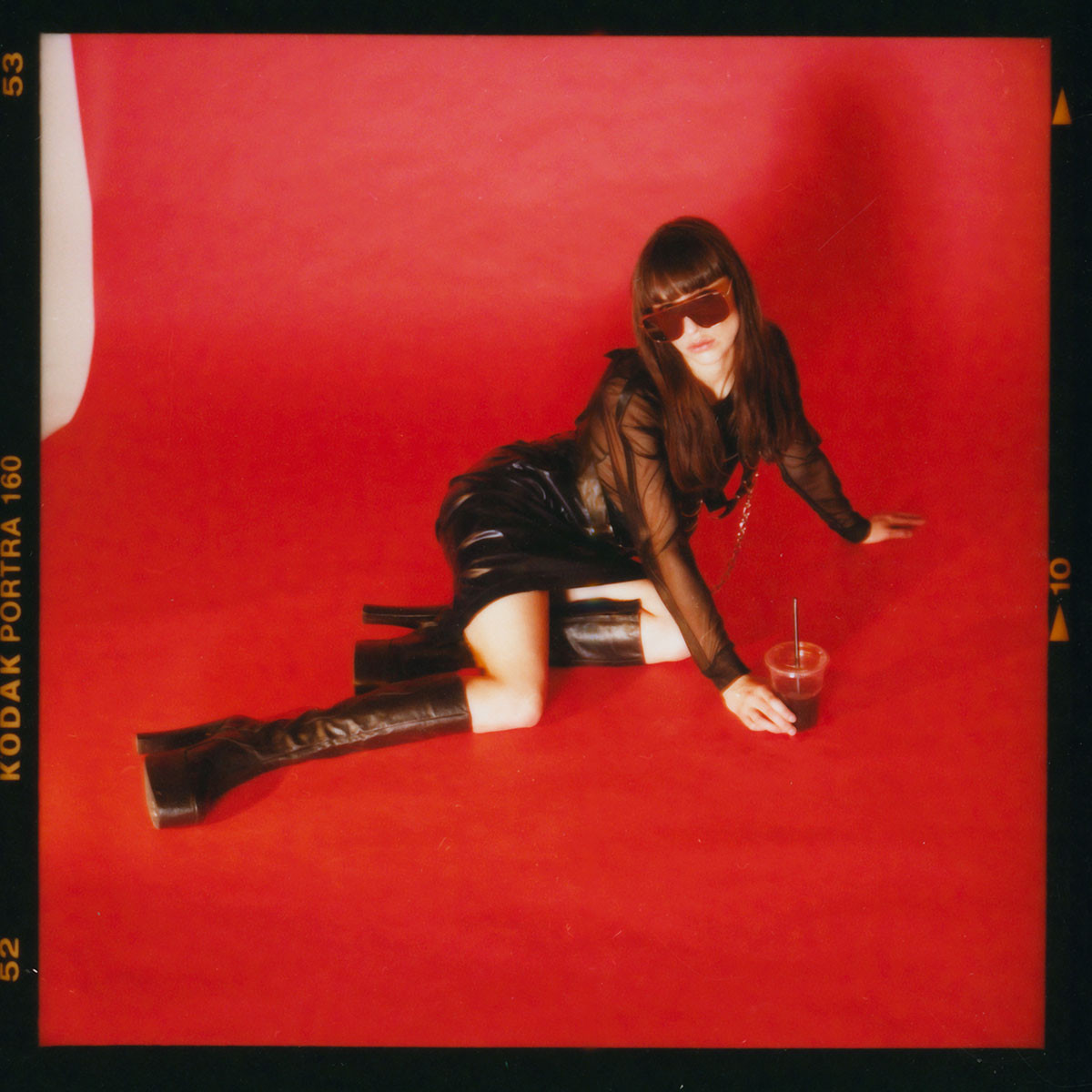

With a new raw image and a sound that channels focused introspection rather than imagination, however, Kimbra is reinventing herself by stripping it down. “It all comes down to feeling like I want to explore something I haven’t before,” she says of the stark sonic and visual shift. “And where is the most challenging and uncomfortable place I could sit in my career right now? It’s here. It’s stripping down the makeup.”
Like any great creative, though, Kimbra is weary of the ordinary. She further describes her practice of a daily centering prayer, which consists of twenty minutes of silence and stillness while thinking of a one word mantra that anchors you throughout the practice—as simple as it gets, she says, “But the simplicity itself is what makes it so god damn hard.” Making this new record Primal Heart, however, gave Kimbra a new sense of simplicity’s stickiness. “I’m really wanting to connect with people in a very personal way, and in order to do that, you have to strip away some of the density sometimes.”


Part of this more grounded nature comes from recently moving to New York City. “I live in Manhattan now—I walk out every day onto the street, and reality is right there,” she says of the inner confrontation that often comes with being an NYC transplant. She recently attended her first protest in the city and says that the new music is partly inspired by this sense of urgency, and by being around the new unknown and struggling to find a way to relate. “I feel like I’ve grown into my womanhood, and I have a newfound sense of maturity and focus, which I think has come from living in New York but also having got that excitement off my chest on The Golden Echo.”
Kimbra is not a rebellious artist, she assures me. “But I do believe in shutting out the noise and really tuning into—What am I excited about right now? What am I curious about right now? What makes me want to write and perform music?” An inundation of noise often makes silence more vivid. Here, Kimbra has relished in this sought-after state of stillness, and in doing so, has stumbled upon revelatory brilliance.
Despite a shift towards the primal, there’s still ethereal magic in what Kimbra does. On stage, you’ll often hear her using a vocoder, her vocals inflected with a soulful yet bionic sheen. Her live shows are a fervent culmination of drum machines, beat looping and carefully placed sound effects in a jaw-dropping array of live composition. Behind it all is Kimbra herself, and given the fact that she built her very own studio to create Primal Heart, it’s no surprise that Kimbra is a self-proclaimed control freak. Her standards are high, it seems, as she describes her detailed process:
“When that stab comes in on the fourth verse, that might be a moment that people are just dying waiting for, and it might be when my hand moves like this on that stab, and that is a visceral emotion that people feel […] They’re all moving parts. So is that being a control freak, or is it just knowing how to fit the puzzle pieces together to create a very physical experience for people?”
I was a bit taken aback by her unapologetic confidence in her craft, but there’s a reason Kimbra is constantly at the top of her game. She has an unmatched sense of agency in everything she does, and would make a kickass life coach.
Remember as kids when we used to make “potions” out of mud and sticks? When the mere inkling of an idea was enough to make us throw caution to the wind and explore it further? This is exactly what Kimbra does when she creates, and with a refined sensibility of what works not only for herself, but for her audience, too. Her ingredients are inspired and her methods are meticulous, producing an intoxicating sonic potion strong enough to make just about anyone a believer in the metaphysical.
Primal Heart is available April 20.