MIRRORS


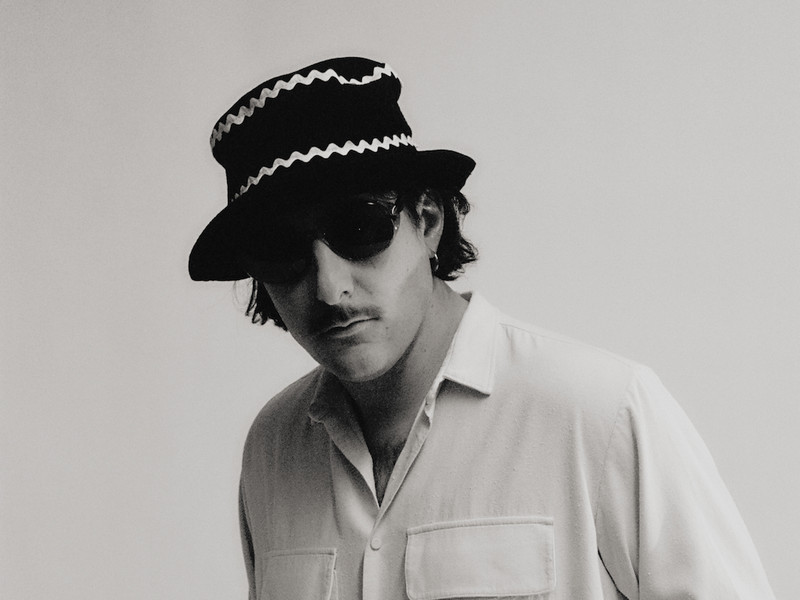
After experiencing that impeccable clip of kitschy joy, we were all intrigued by Faberyayo. Born Pepijn Lanen, 34-year-old Faberyayo has been a huge presence in the Netherlands’ rap scene for years as a member of the prominent and critically acclaimed group De Jeugd van Tegenwoordig—which loosely translates to “Kids These Days” in English. In addition to the group, which has been together since 2004, Faberyayo has embarked on multiple successful solo ventures, including fronting a French-style lo-fi band called Le Le. In 2013, he released a book of short stories, and he recently came out with his first novel, Naamloos.
In January of this year, Faberyayo, along with his wife and their young son, moved to Brooklyn. And so when we asked if he’d like to meet up, he suggested one of the most Brooklyn places imaginable: historic diner Junior’s Restaurant. Over bites of their legendary cheesecake, we talked about the rap scene in the Netherlands, communicating with fans on tumblr, and his work with Big Pizza.


So I’m obsessed with the “One Sentence Serenade” video. Can you tell me a little about the aesthetic?
It’s a song that I made for Domino’s Pizza. Thank you for the check Domino’s!
Is the song about serenading a pizza?
[Laughs] No. I don’t know if they had it over here, but they had this big campaign in the Netherlands where they got actual people who ordered stuff from Domino’s in their commercials. So they idea here was that people could send in one word to describe how much they loved Domino’s pizza, and then I took those words and created a song. And then the director came up with the idea of having a really romantic, crazy, karaoke-type feel. I’m not sure if it made the final cut, but there were some people in the video who just really loved Domino’s pizza. Domino’s fans!
What made you want to come to New York?
It was really just life unfolding in a certain way, doors opening and doors closing. It wasn’t really a decision I worked for in a certain way.
In New York you haven’t really been recording. What’s it like to come to a place where you’re less well known?
It’s sort of nice to not have to deal with people on a day-to-day basis, as I would at home. But then again, New York is a huge city and everybody’s so busy and on their own shit. I mean, I’ve been here before. I came even before I started doing music and people started recognizing my face, and now it’s really just the same. Especially coming from Amsterdam—Amsterdam is a really, really tiny city, and just being here, people are so busy with their own stuff that there’s no time to pay attention anyway.
Why haven’t you made new music while you’ve been here?
There are so many people who want to make music here. And if you really want to break in with no connections, you have to be on that 24/7—no sleep, banging on the door, fighting your way into places. And I’m 34 years old, I have a vibrant career, I have my wife and son. It’s not a path I want to go down.
You released your first novel this year. Can you tell me about it?
It’s a work of fiction about a guy who wakes up with a really, really bad hangover, and doesn’t know his own name anymore. He decides to give up drinking for a month, and then a bunch of stuff happens in that month.


I love that you answer fan questions on your tumblr. What’s the weirdest one you’ve ever gotten?
The questions don’t really get that weird, and I get why people want to ask me questions. Part of what I do is in public, and when you make music it raises questions for people. I figured I may as well just answer them. But for some reason, they started asking me advice about really personal stuff, and it’s just so strange. That’s one thing, and sometimes it’ll be somebody really crazy, and I’ll just try to answer as well as I can, because some poor kid just wants an answer. And then sometimes I’ll just be like, why would you take the time out to ask a random stranger this question, when you can just ask whoever the question pertains to?
In other weird news, I heard you might be doing a puppet musical?
Years ago, someone approached [Kids These Days] to do a puppet musical. We all figured that sounded like a really wild, outlandish idea. We had a few meetings with the guy and then he disappeared, but then for some reason it came back on the table a while ago, and now it’s really happening.
Is it in process?
The puppets are nearly done. The script is nearly done as well. The casting is done, and is the guys are working on the costumes and the stage design now.
Is there any way you could tell us a little about the plot?
The bad guy looks like this. [Holds up a pickle]
As an American, I don’t know much about the rap scene in Amsterdam—
[Laughs] Of course not! Why would you?
Could you tell me more about what it’s like?
It’s gotten really huge in the past couple of years. Back in the late ‘80s, when rap started to blow up over here, that’s when rap became a think in Amsterdam as well. In the mid-‘90s there were a couple of big commercial records, and then it sort of died down again. In the 2000s, there was a strong underground with guys who really made their mark, and made the music a thing that young people listened to again. And when we released our first record in 2005, it opened up a new crossover between mainstream and underground. We’ve been writing that way for the last twelve years, and in the past four or five years, I want to say, [rap] has gotten really big with young kids.
When did you start writing?
I wrote rhymes here and there when I was really young, around or twelve, but it was never really something serious. There were only two or three rappers in the Netherlands, and it wasn’t something you aspired to be because it wasn’t a realistic plan for the future. But our producer—who’s a good friend of mine, like an older brother—did a lot of writing, and he had a mic and we’d record shit over at his place, turn them into songs. I was like fifteen or sixteen. Then I left the Netherlands, because that’s what you do when you get your high school diploma. And when I got back, I moved to Amsterdam, linked back up with my producer, and it turned a little more serious. The other guys became involved, and it all happened from there. Life is ungraspable, and it turns into something you never imagined it would before.
Finally, how would you describe your music, in your own words?
I really don’t know. It changes from record to record. The only constant with our music is that we’re the ones making it. The last record was more mainstream, and so that usually means that the next record should be darker and grimier, a little more niche. But you never really know until you go into the studio.
Does your baby like your music?
I don’t know. [Laughs] I hope so!
Text by Jocelyn Silver
Photos by Rasmus Luckmann
Produced by Sjoerd Cuypers

What’s it like living on the island of X-coast?
X-Coast kind of came to life in 2012, in a very specific period. I did a lot of traveling, I visited the East Coast, the West Coast. Then I played a show in the UK, then produced a conference in Lebanon, Beirut. It was a period of introspection for me. In November or December of 2012, I was in my studio wanting to work, and I needed a space of solitude and kind of a healing place, you know. X-Coast is an island, your perfect tropical resort. Even the promotion is something that soothes you, something that gives you a peace of mind, no hard, sharp tones. It might be fast, but not gritty, not distorted, so all these sounds that are put together are the sound map of X-Coast. When you want to ask how it’s like living on the island of X-Coast, you just listen to the tracks and listen to the effects and hopefully it will come to life.
So X-Coast is more a state of mind.
It is! It’s a state of mind that I want to share with the people. It’s actually a revolutionary approach for me as an artist. I just found the concept and I found the source of inspiration, and I kind of cemented it in the right way for me to function properly. So it’s definitely a state of mind.
The whole process of creating the tracks within it is like, let’s first think: What am I going to use? Sound is a way of expression. It’s not making a tune, for the sake of making a track. It has to have some meaning. This is why the motif that repeats the loon bird call in a bunch of tracks, and some natural soothing sounds.


So I’ve noticed that you’re really into the 3-D and net-art aesthetic. How does that relate to X-Coast?
Because it’s a virtual island. In the description, it says it’s somewhere in the Caribbean Sea, but nobody knows where. There’s a whole story about this guy finding the island around ’94, and why even ’94? Because back in 2012 most of the tracks I liked were from ’94. In ’94 a lot of solid releases got out. For me, it’s an important year for creativity and I think it kind of formed that aesthetic. But because the island does not exist in the real world, it needs to be virtual. I even geotag all the studios I dwell in and my homes on Foursquare, with locations like “X-Coast Tours - Agency of Delights.”
X-Coast tours?
Yeah, because these are kind of “gateways." My studios are "gateways” to the island and whenever I perform I want that to be a gateway, so maybe in the future this will act like a tourist agency in a virtual realm. The images I use are not mine, I don’t make them, I don’t have the skills. I find some stock image that will kind of describe the feeling, but this feeling is not only nature sounds I was talking about, it has a lot to do with club culture that I grew up on. So it’s kind of a mix, but then it didn’t come from me, it comes kind of naturally. Even the ecstasy tracks and everything come down together and it’s all about the feeling. I want to evoke [the feeling] of if a person has done ecstasy or amphetamines in their life. They have another sense to them, it’s definitely another thing. I’m not for using it, definitely, but I’m actually trying to make music that makes you feel like you’re high but you’re not. Not physically high, but at least evoke something within you. Even the club is like an island. Through history you’ve had clubs that actually provided refuge for all sorts of marginalized cultures and people all around the world. So the club is a safe place as well as X-Coast. These are all safe places that people are looking for.


So, you’ve been working on Mango Bay, the first X-Coast EP, for a few years now.
Oh yeah! It was actually produced in early 2013. It’s surprisingly a track I didn’t even want to put out online, which is totally crazy. The track “Mango Bay?" Yes. I never put it online on SoundCloud, but there were some people who searched for my stuff. The audience is there, and they will find it. I think that aggressive promotion will destroy it. Not to be elitist in any way, but [I’m interested] in who digs deep enough. This is how I started listening to electronic music—you have to dig deep to find good stuff. It was really rewarding.
So I want this to exist, but be not so easy to find. Somebody connected me with Cheal, who runs the UK Funky Channel on YouTube, and we were asking about ideas, and he’s proven to be a really good friend. We kind of had a similar upbringing, even though he’s from the UK, and I grew up in Serbia (Yugoslavia). We just connected really well over numerous genres, and he’s someone I can talk to about anything. Just late at night, I’ll send him Yugoslavian 3-D 64k demos. And he always replies with something interesting, just a never-ending exchange. He approached me with the idea—because the “Mango Bay” track was only supposed to be heard at the Boiler Room set, which I did in 2014. So he was like, wow you’re crazy, why not get “Mango Bay” out there? But I was still not to be persuaded. I’m pretty stubborn when it comes to this project. But he really wanted “Mango Bay,” he really believed that it was the track that should have a video.
We also had a talk about what aesthetics would be involved in this video. He knows that I’m a fan of the X-Mix video series and cheap 3-D from the 90s, so I wanted him to do something like that. The first video wasn’t actually very good, so it was never uploaded. But later for the next version, we said let’s just tear this apart completely, and go for a different theme, why don’t we have people dancing to MTV Grind, this tv show from the ‘90s. The idea was so stupid. In the first five months, the video didn’t get a lot of views, maybe 10,000. But then in January 2016 the video got discovered [through gamers]. And that’s basically how it came to life!
So the X-Coast project needed that push, which I was not even ok with. But we got here somehow. Not by my will, but somebody did it, and spread the whole X-Coast thing. At the time I wasn’t even aware that it could go well with computer games, but I played computer games my whole life, and games are definitely a territory that’s pushing the industry: audio, visual, VR. So it’s good to be on the cutting edge. If the gamers are into that stuff, it’s a good crowd to be followed by. I started receiving X-Coast fan art, and people just loved it. "Mango Bay" became a meme in their world.
So that exposure lead you to create the rest of the tracks?
No, the rest of the tracks were also old. There were labels who were offering something, but I didn’t feel comfortable with signing anything, because I didn’t see myself on these labels. They were mentioning, “hey I want the XTC series tracks” or whatever, but nothing else. I would listen to their style and it just wasn't right for me. X-Coast is more than one type of music; I’m doing ambient to jungle.
X-Coast is a feeling, it’s not just a house track. Ok, “Mango Bay” is a typical, New York-style house track, the style I actually missed playing in my sets. And I had a good crowd to check out these tracks back home. Because once you play everywhere, not only in the underground—because Serbia has a good underground scene, but it’s small, so in order for the bigger capacity venues to get full you need to bring out more people. There are awesome artists coming out of Serbia, definitely. So all these tracks were created in my studio in Serbia, from the period of 2012-2015. I think the last track I did in my studio back home was “Don’t Stop,” which is the last track on the EP. And it was wrapped up in like March 2015. So basically that’s it. The whole EP that’s coming out now, these tracks are at least a year and a half old. I haven’t signed anything now that I’ve been doing in New York, and I kind of changed the style and everything. Right now, I’m inspired to do something else.
Your EP has tones of tropical and house. How would you describe it?
That EP is just X-Coast. We call it actually Riviera Groove, it’s like a seaside thing. But it’s not actually tropical house. For me it’s a unique mixture of that European rave music I grew up on, and me probably fantasizing about what it was like in the States and in New York in the ‘90s. Because I read some books on that topic, I listened to a lot of music, just tried to get myself informed. And even these streets that we walk on right now kind of carry the names of some remixes and labels from this period. It’s kind of sad that it's almost been forgotten. It seems like there’s a collective amnesia in New York, because only the current generation counts. I don’t care what was happening before or in the future, what’s happening now is the shit we’re profiting off of. This is not a good thing for art. To neglect the past would be stupid. Imagine discovering the wheel for the thousandth time. [Laughs] Do your homework, do your research, create some stuff. I’m not afraid to sample. X-Coast is a sample-based project. It’s not taking the whole goddamn thing, it’s definitely a remix culture project. The sounds that I use are somewhat typical. Even the bird call, which is most characteristic, was first used in maybe ’88 or ’89, by Sueno Latino or 808 State.
And that’s something you use a lot in your music?
Yeah, that has become something of an X-Coast signature. I studied at the Academy of Arts in the drama/film department. In the movies, they often have sounds that you wouldn’t ordinarily hear in nature. So I took these sound stereotypes and used them. For example, the loon call is a bird that dwells in Canada, it’s a northern bird. But for some reason when you hear it, you think of the tropics. So it doesn’t even have to be a real thing. Creating sound for any media, it’s an illusion that you actually have control of. You play with these elements and create something that doesn’t even exist, but it feels right.
How do you explain the current house/techno scene to someone in Brooklyn who’s not familiar with it?
I have strong opinions, but it depends on who I’m talking to. Is this person my mom, my grandpa? Is it a person from Europe, and I’m just comparing this scene to theirs? Depending on someone’s background, sometimes I won’t even talk about it. But if somebody has a clue what they’re talking about, I’ll get into it. I love talking about it. My work, and other people’s opinions, that’s what we’re here to discuss. But this is actually the problem. People are self-centered, and there’s not enough exchange going on.
People are into themselves, and they want to succeed in the underground. But what is the underground? Is Facebook the underground? Is this promotion underground? In America, everyone wants to be famous. I think it’s a curse. Even the music I produce is not really underground. I want it to be acceptable to a wide range of people. And that’s why I work with different genres, so I don’t end up going so deep inside one that I end up deconstructing it.
But back to Brooklyn, I think it lacks diversity. Even though we’re all talking about it, and we’re all cool with it on paper, in real life it doesn’t really exist. I would love to go to a party where I could hear ambient sounds together with all these other genres, and there’s not a single party that’s doing that. In Serbia we do that. I have a friend, a great DJ, DJ Flip, and we used to host a b2b night on boat 20/44 in Belgrade. It is an amazing venue with an awesome sound, and according to The Guardian, it is one of the top 25 clubs in Europe. Only 100 people could fit inside, but that was the charm of it. And we would literally just start with something so calm, and then end up with who knows what—techno, trance, jungle, drum and bass. I just want an open-minded crowd. I don’t even think the crowd is close-minded, DJs are just afraid to experiment. People are so worried about looking and sounding cool that they’re trapped.
Photos and text by Kevin Buitrago
This interview has been edited and condensed