- Become a Model Citizen here.
Stay informed on our latest news!

Holly is one of many talented young creatives representing the changing face of London’s design scene and industries alike. With a formal training in architecture, deep experience in front of and behind the camera as a successful set designer and fashion model, and her own design studio — ROLSTUDIO, founded in 2021 — Holly is in the first phase of what will likely be a long and successful career — in many fields and disciplines. Like the designer-model-creative director, many young Londoners are seeking a new kind of creative pathway: a cross-industry career that culls a diverse array of jobs, incomes, and identities, rather than a singular one. And her hard work has gained her some notable accolades: modeling work with clients like Jimmy Choo, Burberry, and Agent Provocateur, plus features in T Magazine, Prada Young Designers, and The Face.
There’s a real power that lies in Holly’s kind of interdisciplinary approach, connected to a strengthened sense of community and the waning of the age-old solitary creative genius archetype. I had the opportunity to spend a week with Holly and her crew this past August during my time in London, and it was exciting to see the breadth of each person’s influence: models/designers, photographers/neuroscientists, stylists/clothing designers; people not only accepting their multifaceted nature, but embracing it.
Working in a creatively dense and expensive city like London comes with its own set of challenges, and Holly isn’t one to shy away from sharing her own experiences. Working as a model in an ever-evolving fashion industry offers a multitude of both pros and cons, while working as a designer is costly and filled with long days, especially when things go awry.
The Aura exhibited as part of Ronan Mckenzie's "To Be Held" exhibition earlier this year at Carl Freedman Gallery.
A perfectionist at heart, she speaks about working to be more open in sharing her process — both the highs and the lows. For this interview, I asked Holly to put together some imagery: photos, screenshots, tweets, and more from her voluminous phone archive, wanting to tell her story not just with our conversation but with all of the weird and lovely things that draw her attention day-to-day. For a multihyphenate like herself, days can look very different one to the next: Monday might be a full day of shooting, while Tuesday is taken up with reviewing samples at her production house.
It’s all in a day’s work for Holly — read on to explore her world and our conversation on IKEA, crying on camera, and reaching a creative flow state.
David Eardley— There’s something interesting in your work — this particular balance of comfort and edge. It feels like you value the usability of the piece but aren’t willing to let the comfort overpower the actual presence of the pieces.
Holly Rollins— I think there's a certain juxtaposition that I'm trying to convey. Have you ever heard of Zen brutalism? It’s the concept of something that’s aesthetically cold and not very inviting in its shape and color palette, but that also brings you a sense of peace. I think I'm trying to convey that, in a similar way. Execution-wise, I design differently: my work is more playful, but the colors are more brutal. It sort of emulates the urban environment that I've grown up around. But still softcore and playful and inviting.
Where does that come from? I’m curious about your relationship to London.
I don't think — unless you grow up outside of the city — you don't realize how overstimulating and harsh being in a city is, to your senses constantly. So subconsciously that is programmed inside of you, right? You're reflecting what you see every day and you're taking inspiration from that. So I think the city has really influenced a lot of my design choices subconsciously. Another part of it is my personality, how I view things and what I like to have around me: a lot of organic shapes and lines. That's not something I necessarily had growing up, although I will say in West London, it's greener and a lot more organic. And there's a lot of nature. You could say that plays into my subconscious as well. It’s a balance of influences.
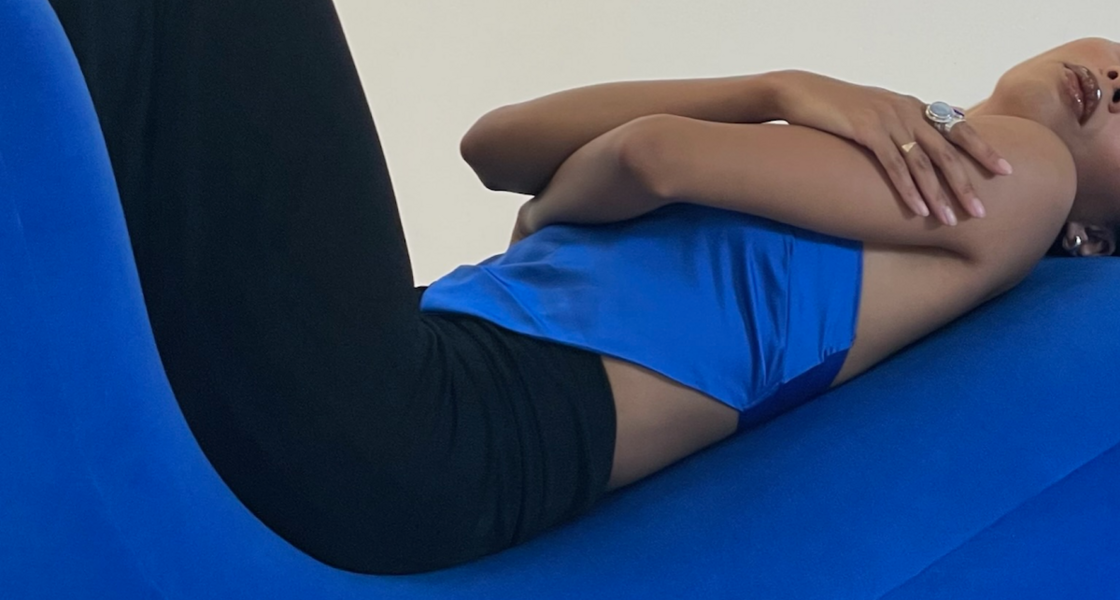
I really appreciate your attention to detail — it’s been cool getting to know you after my brief encounter with the Aura when we were screening pieces for our Wear Your Chair 001 tshirt. Then seeing it on the shirt, and then meeting you, getting to know you, and seeing how that chair connects to your other pieces, like the sofa you’re sitting on now. I enjoy seeing the aesthetic through line because I'm always interested in how expansive or how someone's eye is — in their own work — and what characteristics are carried through in each of their designs.
From what I’ve seen, there’s a sort of icy palette that is a core part of your catalog.
Yeah, it's cool toned, for sure. Kind of frosty. With these recent pieces, I was super intentional … I wanted everything to really coincide, so it looked like a complete collection.
No matter what I produce, it will all always go together. I think naturally I gravitated towards that sort of palette, but in the future I'm going to try and branch out.
I really like it — it's refreshing. Just being online, you’re probably hyper aware of the overpowering presence of all-neutrals in design today. It’s sort of exhausting to me, though the colors aren’t necessarily offensive themselves. It’s just like: “Not another creamy beige …”
It’s seeping into children's toys and nurseries. And it doesn't have to be like that. It's quite frustrating actually, because I feel like if you have something really playful and you put it into those beige tones, it's kind of sucking the playfulness out of it. And then it's just conveying different messages. I think the kids that will have grown up with this beige generation of things might have some warped perception of playtime.
100%, It's actually a weird reason that I love Ikea — seeing the children’s section and how maximalist it is. I have this orange plastic stool that I just love … and it’s from the kid’s section.
Yeah, I have the bright yellow one sitting in the corner.
As someone who looks at a lot of finished design works, I think that it's always important to think about everything that came before a piece — all the iterations before a final product. I like that you and I have had the chance to have these conversations, about the way that when you design for an intended purpose, sometimes your plans don't always work out the way you intended. Things have a life of their own.
I think those conversations are really important to publicize. Seeing all these final products on social media, it can feel so isolating when things go wrong … when you see all this beautiful work on Instagram.
Have you had any sort of lessons or conclusions this year about the unpredictable nature of being a designer?
Yeah, definitely. When I first started out, I was designing less practically. And then once I had a kind of plan of where I was going, I would try to incorporate more practicality into the design, or work out the flaws. And I guess that's what sampling is for. But there's certain things you can't do; you have to work with practicality and “purposelessness” hand-in-hand. So, functionality wasn’t something I always considered — I'll be straight about that.
It's always been about how things looked or what they meant, or the choices behind the materials and the shapes. But when you're designing like that, you run into a roadblock because there's certain things that people either don't want to help you manufacture, because they haven't done it before. They can't see how it's going to look, outside of your renders or your head. You can explain to them as much as you want, but it won't stop them from doubting how it's going to function and how they're going to build it for you, or how you're going to build it yourself.
So it can take a lot of time back and forth to help people see the vision before the actual creation. And I think that's where my road stops — finding people bold enough to want to help you create it. And then once they're creating it, there's these stops in the road — tackling shape and materials.
It's really a labor of love. And it takes months and months and months to develop pieces. I know, on Instagram, you just kind of see the final product and you're like, “Oh, her brain just works like that. And she just made it.” There's so many tears, and long nights and stressful, stressful conversations that you have to go through and tests of materials … that people just don't see.
I think certain people are really good at showing their process — I will say I am not one. I'm a bit of a perfectionist. I’m like, “If it's not perfect, I'm not going to put it out.” But I want to get better at showing the process and making people understand a bit more. I'll get there.
I mean, it's so difficult, especially when you have worked so hard to create something that's so polished. It can be really tough to kind of step back and be like, “Okay, but how do I go against my instinct for perfection and share the vulnerability …”
I’ll be in the moment of creating and be really overwhelmed with the emails and the tests and the conversations and the choices. And I wouldn't ever think like, “Okay, I'm crying in my studio right now because something's gone wrong with my manufacturer. Let me snap a pic and show everybody this is real life.” [laughs]
One thing I’ve come to respect so much about you is your laser focus — you have this deep ability to dive into your work.
I don't know where it comes from, but it's been something I've done for a really long time. I need a lot of solitude as a person, especially when I'm making something. I remember going into my university workshop days: they'd brief us in the morning and then I'd sneak out of class and work in my room by myself or go to the library, because I just couldn't have the external noise.
I think I’ve carried on with that need for a sense of solitude, to create.
I feel the same way. I feel like it’s an example of how systems in traditional education can be tricky, because you're kind of expected to be very tolerant of distraction and still focus.
Yeah, and this constant critique environment — it was so normalized. I mean, I wouldn't say this is a bad thing. But it's normalized to share your work and you know, critique everything, which I think is helpful. But for me, if the idea isn't developed, completely in my brain, and I haven't written about it and completely rolled out what I'm doing, and someone gives me an external opinion on it, it can honestly either throw me super far off course, to the point where I have to get back to where I started. It's weird — I have to execute something to know that I've executed it and then move on to the solution.
I think there are valid concerns people can have, about the one-size-fits-all model of education. When the track is that you have to participate in this same sort of schedule of creative process as other people in your class or your cohort — sometimes that doesn't work for people. I do think that traditional training in design is so deeply valuable; in many ways, this is more just a question about education in general. I've always been a person has had a very difficult time in any kind of traditional educational setting, no matter what I was studying. And because of my ADD, I just have my own kind of process. I do think it’s worth it to investigate the idea of applying one kind of learning model to everyone.
We all learn differently and absorb so differently.
Everyone's brains are so different. And as a person who really came into my creative career and in my 30s, there's always been a lot of pressure, from myself on myself; like, “Oh, my God, but like, everyone's 22 and they're doing so much.” But now that’s turned into using social media and sharing these kinds of stories with people, non-traditional creative stories, seeing others who have a similar experience. Sometimes it just takes longer for some people to cook.
Absolutely. It just takes a while to, but when you find your people, and people you can relate to and feel supported by and uplifted by — that's all … that's all you really need. And it's also just about not comparing your journey. I know that's so cliche — everybody says that — but it really really is. I started my modeling career rather late, in comparison to other models. I was 21. And there are people who started at 14 with developing their books.
But I found other other girls that are my age — you find community and strength and confidence in that. It’s easy to compare yourself, especially in design as well, because everyone has such a different journey into the field. And everyone has different levels of knowledge because of that.
I’m glad you brought up your work as a model, because I think this duality in your work is an experience a lot of people share. A lot of creative people are working two or more jobs, either out of financial necessity or creative necessity. I always want to make this truth transparent, in my journalistic practice. I'm curious to hear about modeling and what it brings to your day-to-day experience — to your work as a designer.
I won't give all the credit to modeling, but I do think it's part of the reason why I am a designer at this age and not later on in my life. I did have an educational background in design, in architecture, and in product and furniture design. And I started my modeling career quite late because I wasn't allowed to model until I'd finished my degree; that was the agreement I had with my parents.
Once I finished my degree, I was like super burnt out from it and kind of lost in the world after university. I knew I didn't want to go straight into the design field — I just wanted to explore the different parts and where I would fit. So, when I started modeling, I was exposed to lots of different job roles: set designers, lighting specialists … things that I knew in my head that I was qualified to do. And modeling gave me a door in — to seeing this — so I feel like it was never just modeling by itself. It was always modeling/set designing, modeling/staging or, you know, art direction.
And by chance I met another furniture designer, Kusheda Mensah, from London, one day on the way back from work with a set designer I was assisting. We got into a conversation and I said, “You know, it’s something I've always been really interested in, I just didn't know you could have a career in it by itself.” And she was like, “Well, why don't you assist me and see how you like it?” And that's where my furniture journey kind of began. I don't know if I would have ever gotten into furniture and being a designer, for myself, if I hadn't seen that representation. And that door opened to me through modeling and the network it brought me into. Everything felt really serendipitous.
But at times, modeling, I’m just sort of judging myself. Like, “Oh, I don't want people to think I got here by using my ‘womanly charm’ or something.” But now I feel like, “This is how I came here. In the grand scheme of things” It's allowed me entry into a world that I probably wouldn't have known had I not been in the career that I'm in. And it's allowed me to get some really great connections and to learn to be a people person and be able to talk to people. My job is never the same every day, I'm always with a different team, a different photographer, and stylist. I've noticed that everybody in the creative field has one or more projects they're working on, and it's normal to discuss them. And then you can kind of start a network of people that you know, and yeah, your skills and experience are expanding every day. So I'm very, very thankful for it.
To me, that is actually the power of being a person with a range of experiences. You're not just in this bubble of the design community — you’re out there in another world and learning from that world. It’s given you these tools to come back and make me a better designer.
What excites you, looking at London and the larger design world and more?
Everyone is multifaceted now. So you can be a designer, you can make visuals, you can make furniture, you can make rugs, you can design fashion — all under one hat or name, with credibility. Being hyphenated and multifaceted is something that's accessible and amazing. And I think that's what's really exciting to me — to see the people that are doing it all. That’s what's really gonna come up.

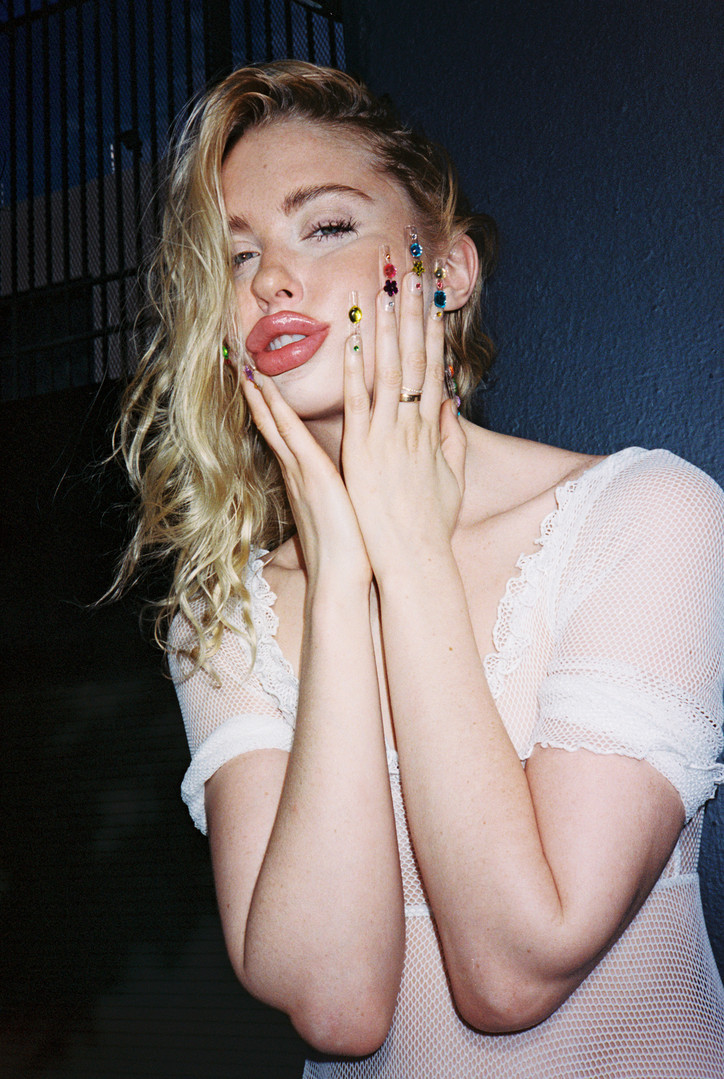
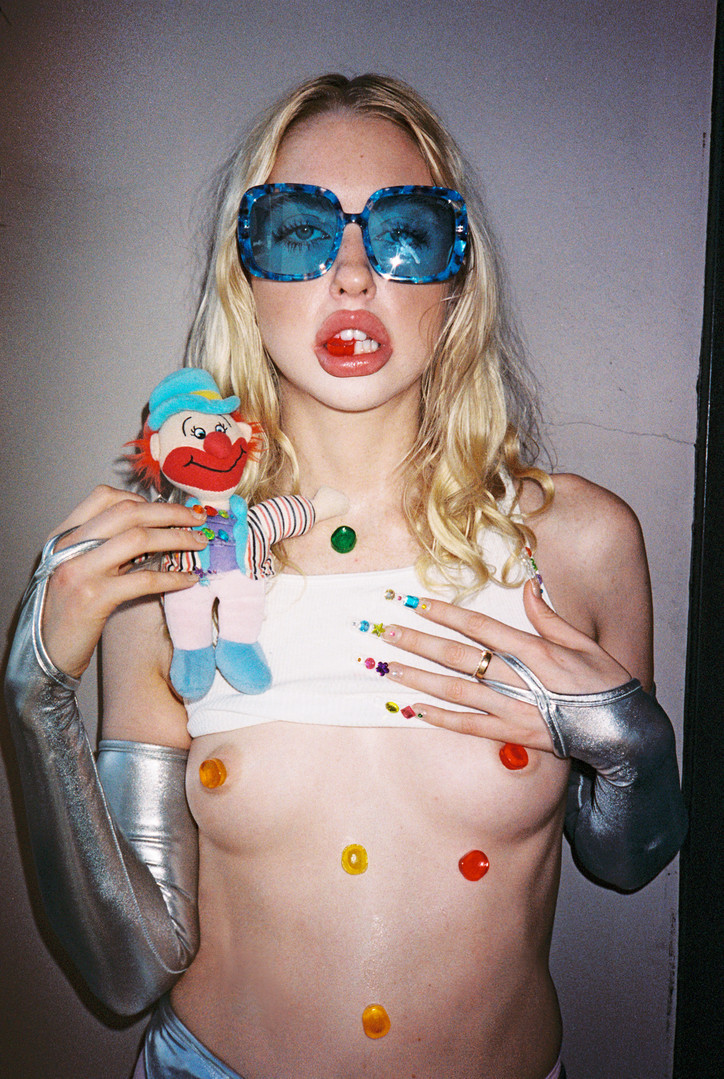
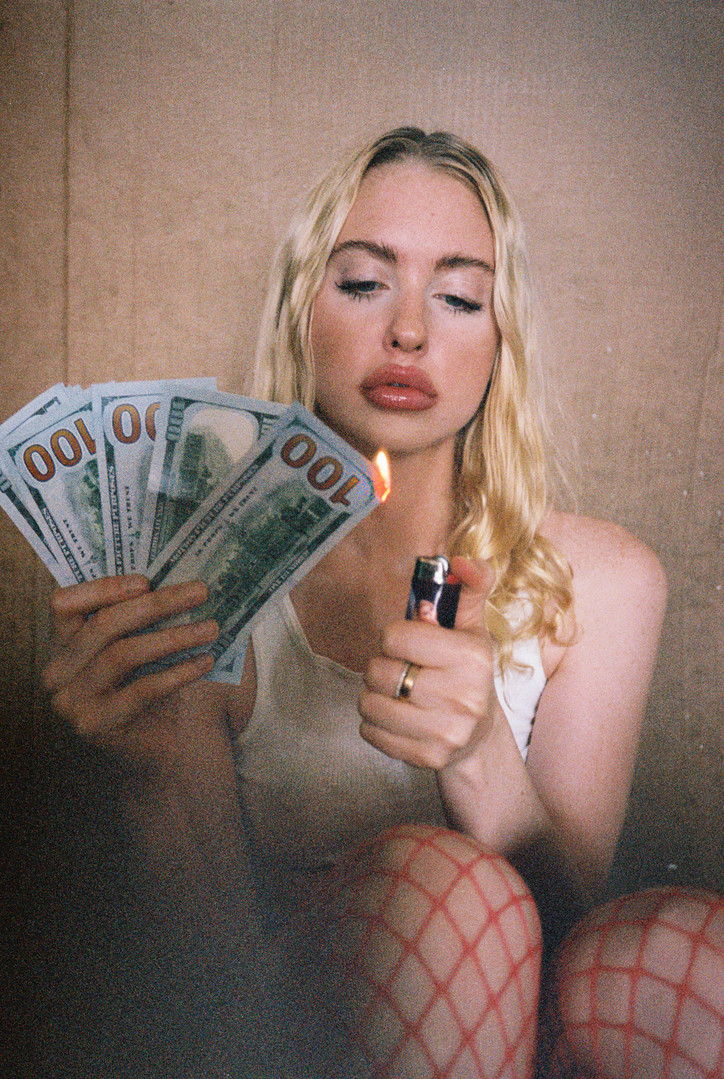
Cherry’s brightness comes through as a total constellation. She writes poetry and maintains close connections with her muses, makes collages from old fashioned women’s magazines, and dishes on the adult film industry’s secrets to having voluminous sex on podcasts with mental health advocate Eileen Kelly and writer/model Emily Ratajkowski. I can’t wait for what Hollywood collabs she has next. Cherry is one of the few post-It Girl actresses that has sincere cinema afterglow. And, she makes you feel like you're in the presence of supreme coolness.
Chloe Cherry— I can't talk about Euphoria or any current or past Hollywood projects that I've done. I stand in solidarity with my union and what they are fighting for.
Johnny Belknap— That’s right, okay. Weird times.
It’s really weird. We could talk now or just have this conversation again when the strike is over.
Cool. Let’s chat now.
Yeah, that would be great.
You’re been in the Hollywood film industry now after some years in the adult film industry. Your shift from the former to the latter began right before the 2023 SAG-AFTRA strike. What has that been like?
It’s really weird timing for me. I got into the industry and there's suddenly a strike. It's really weird. But, the writers and actors have to stand in solidarity during this important time. There's so many issues that my peers have finally vocalized for and mobilized around.
For sure. I’m happy to hear that people are paying attention. Writers are under-compensated and under-resourced. I like when actor and national president of SAG-AFTRA, Fran Drescher, asked what everyone was doing taking advantage of writers all the while doing what, “moving around furniture on the Titanic?” We hit the iceberg; the furniture sinks along with the rest of the stuff hanging onto an old system. Those who are looking out for one another are building something new and that’s exciting; I’m hopeful about where things could go next. Do you do any writing yourself?
People tell me to write a book so I’ve thought about writing one. I haven't tried writing scripts but I would try that one day, too. The only writing that I've really done is sketches. I write those for my Instagram and stuff.
Would your book be a novel or a memoir?
I want to write a memoir.


You totally should.
It would be cool just because there's a lot to talk about. My career starts off in the adult film industry. I was in it for like six years and I really enjoyed it. I'm not in it anymore. If I wrote a book I want to explain to people how the adult film industry works.
Watching adults on film do the deed is something many of us do all the time. Like, we watch it at least several times a week, if not every other day, or more. I’d love to learn more about it.
Totally.
There doesn’t seem to be too much conversation about the adult film industry beyond those working in it or the text I see on my laptop screen: Cum Inside, Domination, Big Cock, Natural, Cucked. People love to categorize and fantasize. But, there’s got to be so much more stuff to talk about. In another interview you’ve done, you shared about the industry’s #METOO movement and how that’s provided a real sense of accountability in the industry.
The me too movement in porn was huge. We had our own me too movement in about 2020 where every girl in porn shared on twitter their personal stories about anything non consensual that happened to them. It was a lot like the Hollywood me too movement. Directors that abused their power, co stars that were too rough.
Was working in the adult film industry your first job?
I briefly worked in restaurants before working in the adult film industry. Restaurant and food service work is really, really hard. It’s very physically demanding and I was so bad at it.
Right? Restaurant work is super demanding. It’s exhausting managing so many different appetites. So, I guess, what did you like about working in the adult film industry?
I really liked the amount of freedom that it brought me. One thing was the schedule and freedom. I was able to work a couple days a month and had so much free time for myself and time to see others.
That rocks.
Another thing that I liked was the different types of people I met. Just like, I don't know, it was cool to connect with people. I got to learn about my sexuality and my scene partners got to learn about their sexuality. We got to learn about each other’s sexuality. That kind of openness is like not shared so often beyond romantic or strictly sexual partners. I mean, for me, personally I enjoyed confirming that I was bisexual by shooting lesbian scenes. I figured out I liked a lot of different stuff. But mostly the biggest one was that I’m bisexual.
What was memorable was how passionate people were. The performers especially took pride in their work and worked very hard. Just like any part of the entertainment industry people would have crazy workout regimes and diets. Performers would practice what they wanted to do on camera. They invested in their wardrobe. Performers had good relationships with directors which got them more work (I mean friendships not sexual). And the directors put in long hours and lots of effort. A lot of performers were on call at all times meaning their agent could call them any day and they would go do a scene. I did that a lot. Porn taught me how to be a hard worker.

That sounds special and a lot less stressful than keeping up appearances in the way you have to do while working in a restaurant. It’s physically exhausting to keep a smile on for all the eaters. It’s like restaurant workers are the ultimate vibe curators. Let’s back up some. What was growing up like? Were you close with your family?
My mother always said I had a talent to wear what’s going to be in style before it is. And in Pennsylvania, where I grew up, people didn’t know trends. Not like they do in New York and London. I’ve been parting my hair in the middle since middle school. People made fun of me for it back then but now it’s totally in.
Where did you grow up?
I grew up in Lancaster, Pennsylvania. Pennsylvania was very religious and traditional. People also said the strangest things. My favorite was once in school when a teacher was asking us students to name every continent and one boy said, “Texas.” He actually thought it was a continent. Another time a teacher asked us to share about our families and a boy told a story of his lineage and the teacher asked “what side of the family is that from?” And he answered “the left side of the family.”
No way. I totally recognize that kind of mixed up language-speak. I went to middle school and high school near Lancaster and I recently spent some time out there. It’s quite a provincial place and I think those of us that leave it still have a close relationship to its funny language-speak. M. Night Shyamalan, Taylor Swift, Jonathan Groff, Pink.
I really didn't love it but I've grown to appreciate it. What were you doing there?
Hanging out with my sister. Jumping into therapy. Writing some fiction. I’d wake up every morning to a hot pot of Wawa coffee and watch the horse and buggy of Amish and Mennonite children roll down the street. You always know they're coming because you hear the horse’s trot: clip-clop, clip-clop.
And there’s horseshit, like, everywhere. What were you writing?
I’m trying to tell a story where a bunch of characters take Viagra all the time. It’s funny that it’s a drug that redirects blood flow. There’s something sort of vampiric about it. At one point in the story, a character's vision goes totally blue, it’s called cyanopsia. It’s a bewildering side effect of Viagra.
Sounds so fun.
I had this realization a few years ago that so many people take it. Someone’s dad, their daddy, or a trans dude; a John or his hustler; a doll or a porn star. I know some cis girls that take it with their boyfriends, too. They have weekend-long bedroom adventures.
I was gonna say Viagra is really popular in the adult film industry.
Yeah. What is your experience with it?
I remember guys that were new to the industry would show up on set and they would take it. They would be so nervous that it still wouldn't work and their face would get really, really red. They would be really sweaty, too.
Did you ever get nervous while on set?
I wouldn’t really ever get nervous. I guess, maybe, I would get nervous with higher-end porn. I would get kind of nervous that I wasn’t gonna perform well enough for the bigger scenes for the more popular companies. I was nervous but I was also, like, excited.
Were there co-workers were you really excited to work with?
My favorite male actor was probably Small Hands and my favorite female actor was probably Lola Faye.
Small Hands is pretty sexy. Guys covered head-to-toe in tattoos get it: Boomer Banks, Big Harry, Jack Delany. There’s something about being so visually marked up that translates to me as fleshy vulnerability. I don’t know. Do you miss porn at all?
I guess so. What I miss about the adult film industry is that it was always going on. You didn’t have to wait so long between work. Like, that industry is always happening. It’s not like filming a movie or walking Fashion Week. Currently, I have a lot of free time between things.
What have you been doing with your free time?
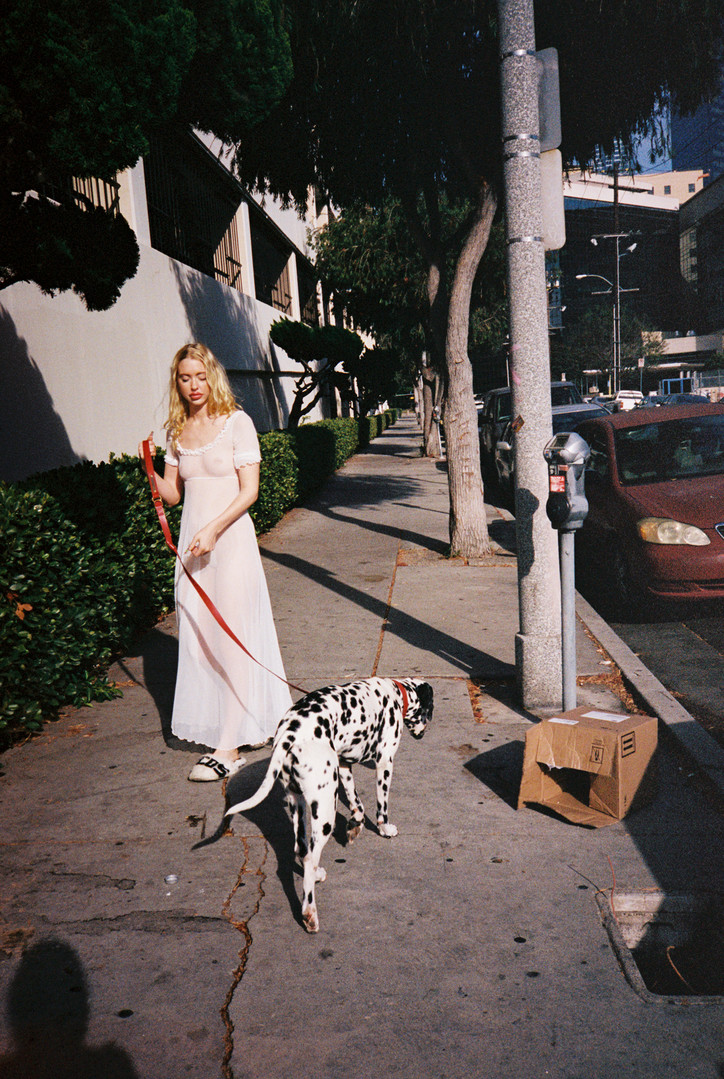
I’m reading Happy Go Lucky by David Sedaris. David Sedaris is my favorite author. I’ve been making art. I've been hanging out with friends and hiking. I just got a dog so I’ve been taking care of him.
What kind of dog?
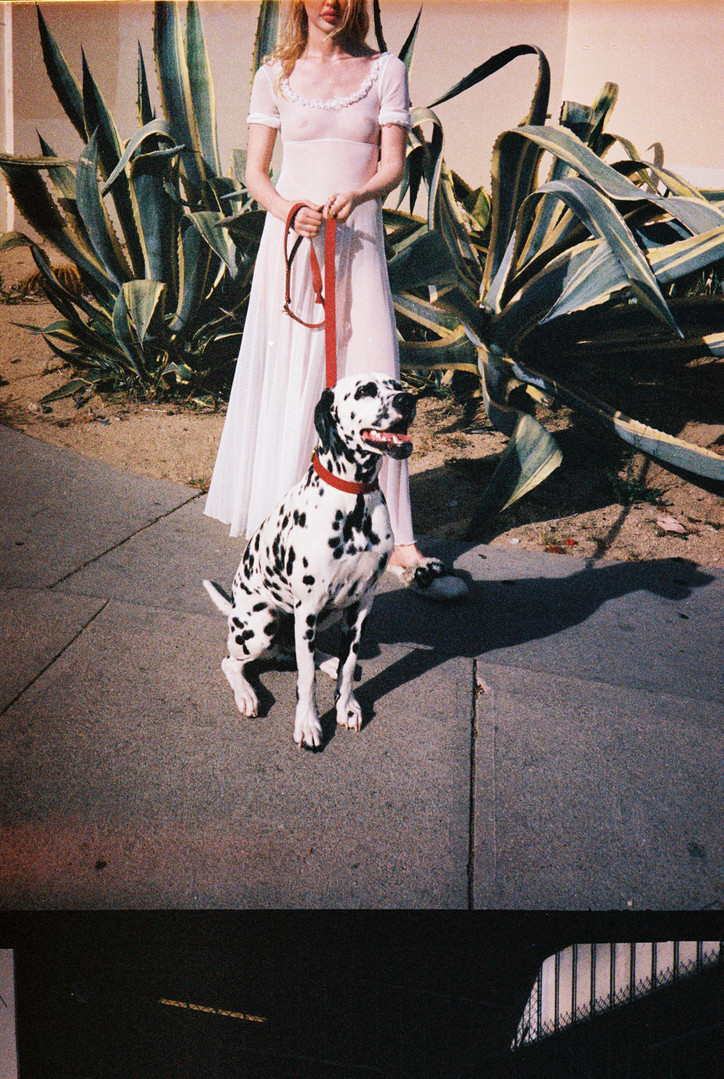
I got a Dalmatian.
What's his name? I imagine him being a nice companion when out picketing.
His name is Domino. He is really nice.


Domino: tall and thin with beautiful ink spots. Tell me a little about art-making.
I make collages. There’s this discontinued magazine called Penthouse Forum Magazine from the 2000s, and it has really raunchy stuff in it. My dream is to have people send me their songs while they're in the studio making albums. Then, I can make a collage based on the songs they send.
Totally. Would Shygirl or 100 gecs or wait even like Charli XCX send you stuff? You could do one of their next album covers or something.
Yeah, that'd be so fun.
What do you have coming up?
Mostly working a lot. I have a few indie movies that I am working on so there’s a lot of shooting in the coming months.
Do you have to travel for the shoots?
Yeah. We’re shooting in London, New Mexico, Rome, and Greece. I really hope things get worked out and the writers get paid fairly soon. Also, I hope that actors get paid fairly, too. Actors don’t get paid what they used to get paid. Many actors can’t get by on just acting anymore. It’s pretty crazy.
How has your summer been?
It’s been fine. I guess I want to talk a little about Angus. I really miss him. He is missed by so many people. It’s really sad.
I’m sorry. It must have been quite a shock. You guys were fairly close?
It was really shocking. When I first heard about it I thought it was fake news. I was like this is fake news, like, there’s no way that can happen. It has been really hard. He was one of my closest coworkers and confidantes during that time. It's like a special thing that happens, you know, when you get to know someone like that.
The experience of loss or grief distorts stuff like so much. Things slip. Interactions have a sudden scripted quality to them. People you know get quiet and quiet people speak at you, for you. Loss or grief doubles up inside you in this way. After experiencing bouts of loss or grief, I’ve reminded myself to slow time down a little and be present, especially with friends. Take a second cigarette. Give a sixty second hug. Talk in bed with someone you love for three hours straight. Eat all day, dance all night. It’s good to make people feel good. People love to feel good.
Yeah, it's really important. I've been trying to be better about keeping closeness and being in contact with people. It’s so easy to forget.

What’s now, what’s next?
Right now it’s three indie movies. But, we’re waiting.
If you commit to the bit, babe, you’ve got it. Do you have any dream roles? Or, is there anyone you’d want to play in a biopic?
I would love to play Dolly Parton.
Absolutely.
Playing her would be a dream. She’s like nobody else. She’s so cool. I know about her lore, you know? It’s interesting.
I see. What kind of music are you listening to right now?
I'm listening to Tommy Genesis. I’m listening to Frank Ocean and Baby Keem. I’m listening to Padam Padam by Kylie Minogue. Oh, and 100 gecs.
They’re so good. What about you? Would you ever do an EP or album? That process of collaborative art making seems up your alley.
I’m actually working on a song with this NYC artist Blaketheman1000. He’s really talented and he thinks I should do an EP or album. But, I’m not sure yet if I will. I think I’m decent at writing lyrics and poems but not very musically skilled in a technical way.
Tell me about the poems.
I used to write poetry back in high school. I wrote this one:
This is an apology to us both
For how much I loathe you and lost your trust You told me "use this as a chance for growth" Now it's all interplanetary dust
I told you I was drowning in darkness
Just looking at you felt sensational
Until you became nothing but harshness
You were never even motivational
I can't help myself from adoring you
Your kisses used to feel like warm honey
You once turned so cold out of the blue
Then you gave me up like ransom money With a kind heart and soft facial features
You turned into the cruelest creature
That was after my boyfriend and I broke up. He went away to college and of course it was too hard to keep dating at that point.
There’s always that one relationship that ends because of “bad timing.” Which, in a way, is its own self-fulfilling prophecy. Timing isn’t something that can be so easily pinned down with dualistic thinking. I.e. good timing, bad timing, yada yada. You can’t really plan ahead for things like girlfriends, boyfriends, and other types of best friends.
That poem really summed up my feelings on it. Then I fell in love again and wrote this for someone while I was with them;
To the wonderful love of my life
Your face and body is prepossessing
Someday I'll be your adoring wife
Our situation may seem depressing
But soon we will have a glorious life
With my darling zest for adventure
And your brilliant mind and soul
We will spend our lives together
Our love becoming celestial
I know your joy feels obliterated
Soon it will not feel that same way
As if sadness was inoculated
And I'll be there with a floral bouquet
Because these days will happen to you
But I will always help you pull through
Later in life I turned my poetry into songs. I have music on SoundCloud because I mostly make it just for myself to hear. My favorite song of mine on SoundCloud is my song “come through.” It’s about me and also about my best friend and my ex-boyfriend who has become my emotional support ex-boyfriend; he has never left my life since we met at 19. I met him in LA when I was 18. Both him and another ex told me to go to Miami and follow my dreams. They both played huge roles in helping me become more confident. Now we’re 26.
It’s grounding to have someone who knows you from one chapter of your life and then they pop up or stay with you into another chapter. It doesn’t always work out that way. I have someone like that who recently came back into my life. He was my first boyfriend and he was able to shine some lights on pretty dark things around me. It was nice to be reminded of that luminosity, to be seen through. I sometimes wish we had some more words that describe the different ways of relating or kinds of relationships we have with certain people. I mean “Ex” can feel too big and broad. “Boyfriend” can feel constraining. “Lover” is too plastic, slippery. I want more language-speak. Like, more words for specific kinds of connections makes so much sense.
I say in that song “if you wanna come back / I would tell you come through / it’s an ordinary task / like fixing up some food,” which isn’t necessarily true it just… sounds good.
Well, yes. Playing the “what if...” game always makes for good storytelling. Let’s plan to chat again soon.
Right now I'm filming a movie that has its SAG Interim Agreement, so the weekend is best!