The Modern Muse


Stay informed on our latest news!


Watch the short documentary below and read on for more details about the collab.
"There are definitely functional things as a skater that I wanted to be in there aesthetically," Sablone says. "Skaters spend all day looking down at their feet, so if you don't like the look of that, you're not gonna feel good."
Sablone grew up wearing both '80s and '90s skate and basketball shoes. Because of that, she wanted to mesh the designs and the functions together to make the AS-1 Pro a perfect shoe. Being a multifaceted architect, designer and sculptor, she used her technical abilities that many don't acquire to create such a practical shoe.
"I wanted that variety that if you put it in one color or one look, it reads more as a skate shoe, but then in other materials it reads as something else," she says. "I wanted enough detail and paneling in the right spot to make it look simple, but when you actually zoom in, there are really considered details."
Unlike architecture, sculpting and design, Sablone's design process consisted of constant redrawing, sampling, wearing and skating in the shoes, resulting in a perfect shoe for skaters and wearers. The Converse AS-1 Pro is the product of Sablone bringing her two worlds together and constructing a functional, yet stylish brainchild.
The Converse AS-1 Pro will be available in green on May 2nd and in red and black on June 2nd.

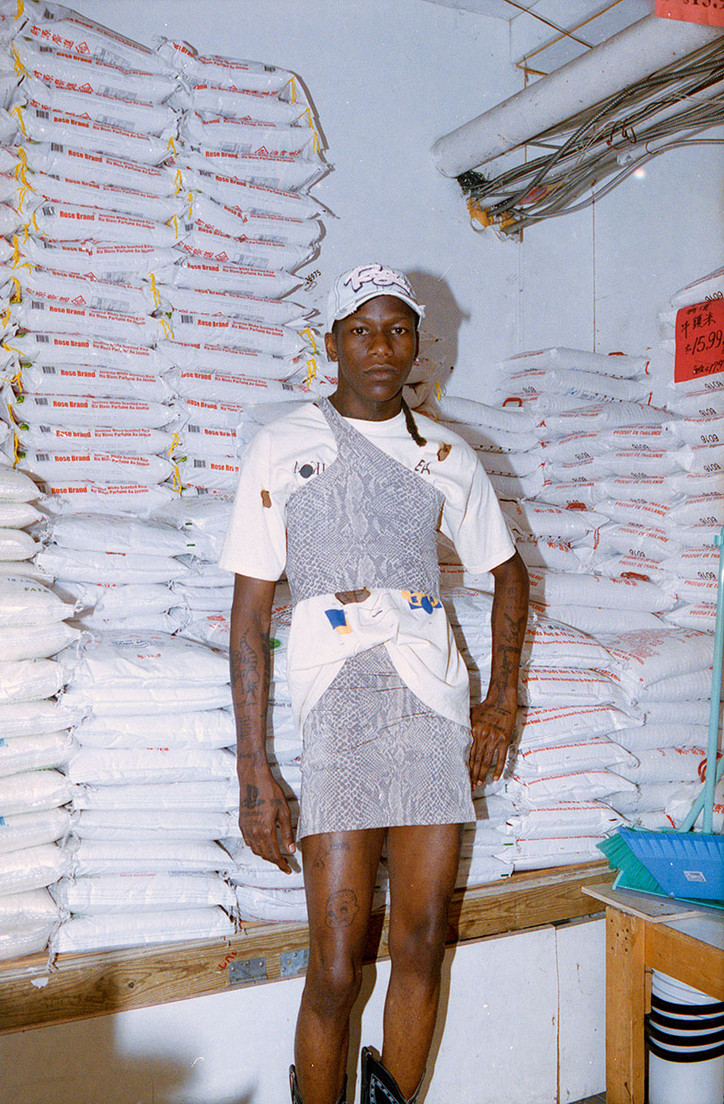
JON wears JACKET by ALEXANDER MCQUEEN, PANTS by ACNE STUDIOS, SHOES by RICK OWENS, JEWELRY and SHIRT are TALENT’S OWN
PIERRE wears JACKET by BURBERRY, SHIRT by SACAI, PANTS by KENZO, SHOES by SACAI X CLARKS
LESTER wears JACKET by BALENCIAGA, SHIRT AND PANTS by 7 DAYS ACTIVE X OFFICE, BOOTS by MONCLER, HEADWEAR is TALENT’S OWN, JEWELRY by BERNARD JAMES and TALENT’S OWN
Eavesdropping in on the conversation and connection that occurred between artist Alvin Armstrong and the members of the illustrious culinary supergroup, Ghetto Gastro, I couldn’t help but think that for a moment, the black men who were talking about their lives in front of me could truly be seen as their entire selves. The main trio behind Ghetto Gastro, Pierre Serrao, Jon Gray and Lester Walker all hail from the Bronx, NY, the birthplace of hip-hop, a dominant culture in the world today. Their way of expressing themselves, from clothing to overall body language, are urban, yet hearing them speak of their lives, from their passion for telling stories through food to their appreciation for art, one immediately realizes that there is a lot more to these guys than the typical narrative attributed to black men from communities like the ones in which they grew up.
Their story is grounded in a shared tie to the borough of the Bronx, but it extends around the globe to places like the Caribbean, Ghana, Liberia and Japan, and those are just the journeys they’ve taken over the past few months alone. The gentlemen that make up the Ghetto Gastro have used culinary arts and the power of storytelling as their tools to change their own lives, and the lives of the people that make up the community around them through initiatives that nourish the body, mind, soul and social climate with a “street-to-table” mentality. Growing up in an urban city, Newark, NJ, I realize how powerful this is — the idea that you can make it out of the hood without rapping or playing a sport. There are other pathways to making it in America. Young urban youth from communities like Newark or the Bronx can also be world-class chefs, artists, entrepreneurs, architects and curators. Additionally, to do so, you don’t have to disassociate yourself from the environments that birthed you. These interviews were recorded as Armstrong, an acclaimed young artist, former member of the Coast Guard and a friend of Ghetto Gastro, painted portraits of each collective member, asking them questions about their lives during his painting process.

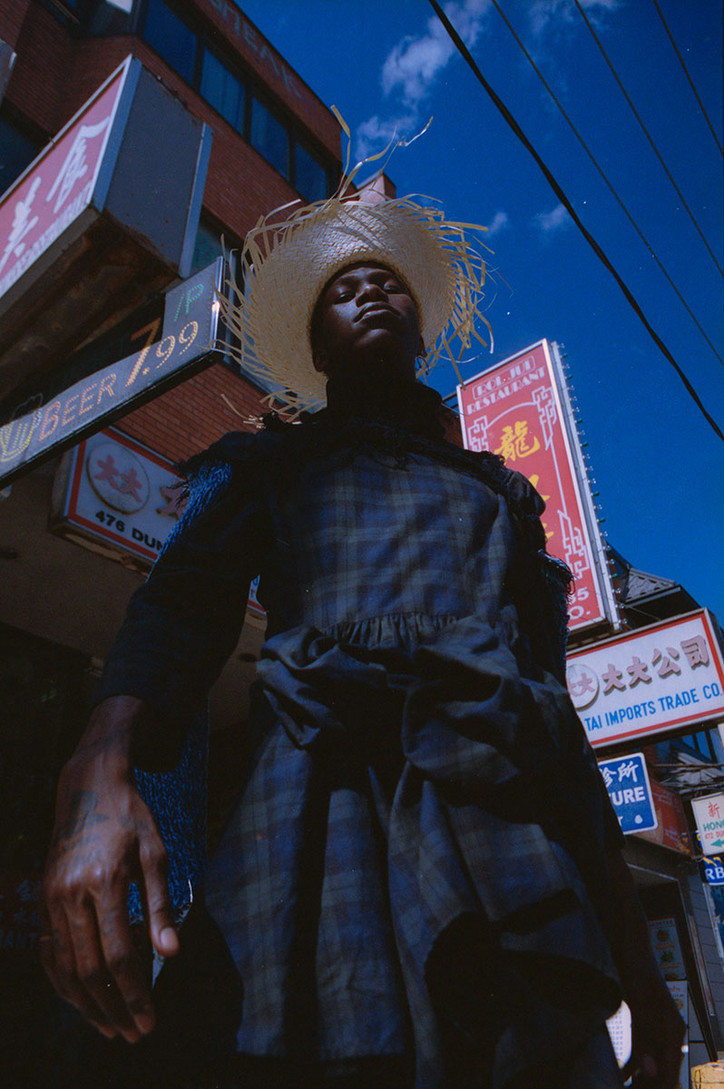
PIERRE wears SHIRT and SHORTS by WILLY CHAVARRIA, COAT and SOCKS by SACAI, BOOTS by ALEXANDER MCQUEEN, SUNGLASSES by FLATLIST X OFFICE, JEWELRY are TALENT’S OWN
Alvin Armstrong— Pierre, how did you and Jon meet?
Pierre Serrao— He and I were neighbors. We met in the gym. We developed a relationship as friends for a couple years before we got into business together.
AA— You were working in the kitchen at that time?
PS— I was doing a lot of private work at that time. I had my own company. I was doing events and things along those lines. I had clients in Central Park, and clients with big yachts in south Florida. I had left restaurants maybe a year or so before. I was tired of that grind.
AA— I feel you. It’s a serious grind.
PS— But yeah, we were homies before we actually got into business together. We’ve been cooking ever since. It hasn’t stopped.
AA— My favorite dish that I had from you guys is definitely the caviar with the cornbread. What else is on that one?
PS— With the crab salad. Triple C’s.
AA— Yup, Triple C’s. That shit was so fire. I had that at Basel two years ago.
PS— That’s one of my favorite dishes as well.
AA— Did you guys come up with that collectively? How does that work?
PS— All three of us work on our signature dishes. Ideas get tossed around. Conversations are had, and then we go to the lab and cook up and create. Usually, one person takes the lead on particular things — if it’s your idea. The rest of us will give constructive criticism on what we think can change, or if it’s perfect as is. These are ways that we continue to refine the craft.
Armstrong stops for a second and looks at the portrait of Serrao.
AA— It’s fire, bruh.
PS— Speed painting.
AA— These joints be quick, but they be fire. I’m acrylic all day. I just love the speed of it. Like today, being able to do three portraits really quick in one session is why I like it so much. I’m pretty happy with this. You still gotta come to the studio, dawg. You were on your way that one day.
PS— Then I got jammed up. I was with my daughter. But will stop through, best believe. Also, I’m glad to be able to see you in your element though.
AA— Have they been traveling with you?
PS— A little bit. I took them to Tokyo. [Then to] Grand Cayman and Barbados. They are in Barbados now. We spent the winter out there, on the islands, working on some stuff on the ground as well.
AA— What’s your daughter’s name again?
PS— Sage. And her art collection is up right now.
AA— Who’s in the collection?
PS— Jon is her godfather, so he still owes her a piece for her last birthday. He has promised her that for each birthday, he’d get her a piece of art… She’s got a José Parlá.
AA— Local legend.
PS— She’s got a Miguel Payano Jr. She’s got a Bryan Fernandez. She has a photo that I believe is by Renee Cox. She’s got a pretty good collection for a three-year-old.
AA— So much is about legacy, that’s why I’m always interested in how the kid’s collection is looking.
PS— She's been to gallery openings, she’s used to being in the mix. She’s three, but she loves to paint and create with her hands. She likes to perform as well. We nurture all those things to keep that imagination growing. It's an important stage in her life, where we can see how advanced she is, just because of the travel and exposure that she’s been getting through all the trips we've been taking around the world.
The interview pauses while the photo shoot of Walker jumps into full gear on the other side of the Studio. Gray wraps up his meal and sits down for his portrait. A few moments pass before the interview begins. Armstrong is getting his paint materials together as we wait for Walker’s photo shoot to pause for a wardrobe change.
AA— Jon, when did you and Les meet?
Jon Gray— I saw Lester around the neighborhood for most of my life because I grew up with his brother, Chad. My grandmother taught Chad in fourth grade. I’m two years younger than Chad, so he was like a big brother to me. He took me under his wing and made sure I was aight, because he was close with my grandmother because she was his teacher.
AA— When did you start collecting art?
JG— I consider myself a custodian of work. The first work I collected was a drawing with Oasa DuVerney. It was a diptych of Al Sharpton and Albert Einstein. We were at the Hunter MFA. So Larry Ossei-Mensah is my big brother in the art game, and he was just learning. We were learning from experience: going to open studios for MFA students, reading whatever literature and going to shows. That’s how I got a feel and understanding of what spoke to me. So, my art history and appreciation comes from looking, watching and listening.
AA— About what you gravitate towards.
JG— It has to speak to me, and also the maker of the object, I like to feel that I gravitate to them, because I’ve often felt like an outsider in many of these spaces. Being underestimated when you work in rooms can be a superpower, but it also gets annoying after a while.
AA— Like you got to prove that you belong there, and those feelings can get challenging after a while, especially when you guys have already done so much. Were you a resident at the Met? I saw you curated a show there.
JG— I curated a show at the Cooper Hewitt, which is the Smithsonian Design Museum. But I was an artist-in-residence at the Met from 2020 to 2022. It’s interesting, because we were the second cohort of civic practitioners, which is basically a program about connecting communities to the Met. Communities that the Met is not speaking to, or would like to have a deeper relationship with. It was about galvanizing people, building with the curators, letting the museum know how they could be better and shaking the bureaucracy a bit.
AA— That’s what’s up, man.
JG— It’s like, growing up in East Harlem, at one point going to school 20 blocks from the Met. It was like a beautiful full-circle moment. Even with Cooper Hewitt, I remember being on Museum Mile, but I lived in the project on the other side. On First Avenue and Metro North.

PIERRE wears JACKET by ALEXANDER MCQUEEN, SHIRT by 7 DAYS ACTIVE, JEANS by DENIM TEARS, BOOTS by TIMBERLAND, SUNGLASSES by GENTLE MONSTER, JEWELRY are TALENT’S OWN
JON wears COAT by WILLY CHAVARRIA, SWEATER by DENIM TEARS, PANTS by RICK OWENS, SHOES by LOEWE, SUNGLASSES by LOUIS VUITTON, JEWELRY are TALENT’S OWN
LESTER wears JACKET, PANTS, BOOTS by BALENCIAGA, SHIRT by WILLY CHAVARRIA, SUNGLASSES by GENTLE MONSTER, JEWELRY are TALENT’S OWN
Emann Odufu— Where is Cooper Hewitt?
JG— 91st street and 5th, and the Met is on 82nd and 5th, so we were really 5th and 5th City, which is what we call section 5 to 5th Avenue. Museum Mile letting them smile, you feel me.
EO— You just got back from Los Angeles.
JG— We did the Black Music Collective, which is a celebration honoring black music. Because it was the 50th anniversary of hip-hop, they honored Sylvia Rhone. She grew up in Harlem. So uptown reigns, you know that. Missy Elliot, Dr Dre, and Lil Wayne.
EO— They were all honored?
JG— Yeah, with the Global Innovator Award. It’s like a Black Grammy. Literally, it’s a Black Grammy. It’s like the same type of statue, but it's dipped in rhodium so it looks black. I don’t know what they dipped it in, but that’s my assumption. That was a lot of fun, and then the year before, we did the Oscars. So, we’ve been catching wreck at the Academy, don’t get mad at me.
AA— And more to come.
JG— Yeah, it never stops. We try to take pause to admire the blessings and how far we’ve come, but we’re just getting warmed up. [Glances at canvas] I’m going to smile. My momma would want me smiling.
AA— Your mom’s going to like it, regardless.
JG— Yeah, she’s going to be really ecstatic.
Lester Walker— Alvin, it’s dope to have this interaction after all the sessions me and you had just speaking about growth. Nothing transactional at all. Just building as brothers. We always spoke about doing something together. It just had to be the right timing and make sense, and here we are.
The shoot pauses for a half hour lunch. At some point Walker, who just hopped out of his photoshoot, sits down in front of Armstrong’s setup. He takes his durag off and re-wraps it to make it perfect for the portrait, and reminds us all that this is the second time Armstrong is painting him. The two talk about Walker’s son’s basketball games, who Armstrong had recently met about two months prior and had also done a portrait of.

AA— It almost feels like we spoke this into existence.
LW— We really did. [Pauses] This is big right here, too. It’s an opportunity to express the multi-disciplinary talents that we have, and give an example of collaboration and how that’s the most sustainable way to do business. Just putting things down together. Just from breaking bread we could build bridges. How’s it coming out?
AA— We good, we getting there.
LW— This color’s different, too. The silky. I think it’s called Ice Blue.
AA— Yeah, it’s definitely starting to come together.
LW— When I first met you, you weren’t really interested in painting, I don’t think.
AA— Yeah, I was fresh out the Coast Guard. At that time, I wasn’t. I didn’t even know what, what the art world was, really.
LW— You was just about having fun and getting that next paycheck. But we all was artists. We were just figuring out. My art is culinary. My man Alvin is a sculptor painter. A wizard with the colors, and I’m a wizard with the food and flavors. This shit go hand in hand.

AA— Almost, almost, almost there. [Alvin smacks the paint brush on his lap forcefully] What’s coming up for you?
LW— We got PAMM coming up in Miami. We’re doing a dinner. We gon’ style em out. We got LA Frieze coming up. We’re opening a restaurant out there with Pace gallery. You've been to Mother Wolf? It’s by the Hollywood strip. We’re gonna have some merch over there, a DJ type of thing.
AA— Which artists are you excited about?
LW— I’m excited to see Chase. I’m excited to see Tschabalala’s work — we were just with her in the Cayman Islands too! Chase Hall, yourself, Aya Brown. My man Jamel Robinson. Amoako Boafo. We were just out there in Ghana with him. We went there for his opening of his new residency in Accra, so we were in Accra for a week. We did Monrovia, Liberia for a couple days.
AA— Was that your first time back in Africa?
LW— That was my first time in Africa. But it was dope because Liberia was where a lot of my ancestors were sent back to. I spent a lot of time just walking around barefoot over there. Just so I could be connected with the dirt over there, and connected with the people more. I did a social media fast. Just to be present, just to soak in everything and not be distracted by any outside situation. We went over there for the Bicentennial for Liberia. We came back to the town for like, 23 hours, and then hopped on another flight to Tokyo, Japan.
AA— In Japan, you worked with a clothing brand?
LW— Yeah, we did a collaboration with Sacai. We did a collab on an apron and some pants, and we opened up a restaurant out there called Burnside. Paying tribute to Burnside Avenue in the Bronx. So, you take the 4 train to Burnside, or you can take the Air Japan to Burnside in Tokyo. The number 4 train to the G4, you feel me. It was an amazing experience. That’s one thing about food and what we do, is how we’re able to translate our story to other languages – through food. I don’t even need to speak Japanese to tell my story to Japanese people.
AA— They get it.
LW— We make sure that we are engaging with the guest and the people that are eating. It’s really off a vibe, and a body energy and a body language that they understand where it's coming from, and how we putting this shit down.

Cassie Jekanoski— So how are both of you guys? Are you excited for tonight?
Yoe— Yeah, I'm really excited about tonight. It's cool to host a Red Bull Dance Your Style event in LA because it's where we're based out of, so I feel like we're going to see a lot of people that we know, and a lot of familiar talent. So, I don't know, we're not from here, but it's been our home for a long time, so I feel like we're home doing this event, so it's going to be cool.
SHEOPATRA— And I'm super excited. I have to agree. I think we're going to see a lot of people that we know, and there's just a lot of high-level dancers here in Los Angeles, so it's always a really great turnout spot, so really excited to be hosting.
Cassie— How long have you lived in LA?
SHEOPATRA— I've been here 13 years.
Cassie— Oh, wow.
SHEOPATRA— Yeah.
Yoe— Eight years.
Cassie— So this is home for you guys right now?
SHEOPATRA— Yeah, we're officially residents of Angeles.
SAHIR AHMED— Is there anyone specifically you're looking forward to seeing?
SHEOPATRA— I'm interested in seeing somebody I don't know. I'm interested in being wowed by someone. A lot of the people I know are amazing, and so some of the people that I know that will be performing are super dope. So... I'm excited to see them, but I'm also super inspired by people that are unexpectedly amazing, and that bring something new. It's inspiring.
Yoe— And it's cool to go to an event in your hometown, essentially, whatever, and you think you know everyone, and then you see a person and you’re like, "Where did you come from?" So I'm going to steal your answer.
Cassie— What would it be about somebody that has that ‘wow factor?’ What do they have about themselves that will blow you away?
SHEOPATRA— For me, individuality, creativity, I think the more a person looks like someone you've never seen the better for me. I think in this culture it's easy because now it's teachable. It's easy for a thousand people to look like one OG. So even though you do it at a high level, it's really exciting when people are just doing new things since that's just kind of the root of our culture, of black culture, and what we do. So I'm always really excited for a new thing. So I'm like, "What's that? I've never seen a person move that way before." So that's what stands out to me. Just saying whatever it is you want to say.
Yoe— I like when people really connect to the music so much so that it looks like it's kind of pouring out them, and it looks like it was based on their body, that almost instinctual, innate connection. You're like, "Oh, you made this song before you came here."
SHEOPATRA— Yeah. It's not them dancing on top of the music. It's them with the music together. I think that's always really cool to watch, especially because all of this is freestyle based. So, for those people to be able to connect so quickly, it's like that's a God-giving gift.
Sahir— What does it mean to you to be hosting a dance competition with such a diversity of talent? Considering how much of your work focuses on uplifting LGBTQ voices, and BIPOC perspectives?
SHEOPATRA— It's really dope. I think it's not new. I think that a lot of businesses and corporations and things are now taking an interest. So I think that's amazing. But I think it's very normal.
Yoe— It's very normal…
SHEOPATRA— ...For us to be in situations like this. I think it's nice that other people, who don't know much about the community, get the chance to see this. I think it's really dope that they don't have to watch Pose or Legendary on TV. They get to really go and be in the space and hopefully be inspired to learn more, advocate more, be out if that's something that you're afraid to do. I think that that's really cool, that it allows people not in this world to have a moment to step in and go, "Oh, this is what you are doing."
Yoe— Yeah, because at our events it's usually just other dancers and then maybe DJs, other artists, but Red Bull, I don't know, it gives a chance for someone who gets off of work to walk by the event and be like, "What is this?" And "I'm going to go in." It just gives people more background on what we do. We're not just going out there and step-touching. People devote their lives to this, so you get to see a competition. People go all the way from 16 rounds to the top. It makes you have more appreciation for it, and I feel like we need that.
Sahir— How does it resonate with the work you do with The Council?
SHEOPATRA— I think it's very similar in the sense of the openness. The Council's such a specific group- It has such a specific point. It's kind of like–
Yoe— It's a niche.
SHEOPATRA— ... "This is me." But I think that I can compare this space in a sense of some collective like the council can come into this space, and I don't feel limited on how I need to be, or how I need to be. I think that I can very much be me, be she, be gay, be black, be outgoing, be all these things, and not necessarily feel like I have to dial it back, and so I can appreciate that in this space. I still get to show up as Sheopatra, and for anybody that knows me, I'm a pretty wordy person. I'm a pretty opinionated person, and I don't really fear anything, so I think that being able to be in this space and still hold that and not rub people the wrong way, I think that is a cool thing. I think that all of us in The Council are pretty much that way–
Yoe— Yeah.
SHEOPATRA— And so I think that this space and providing that for women like us, and voices like ours is something that I find relatable. In the council you can be who you want to be, move how you want to move. I'm supported. If you go outside, and you throw a fist, I'm going to throw it with you. I feel like in Red Bull Dance Your Style, I think that you pretty much can be yourself. I mean, outside of maybe don't boo people and things that aren't traditional battle rules, but I feel like they want people to feel loved because this is a heart thing that they're doing.
Sahir— Essentially giving that safe space.
SHEOPATRA— Yeah, I think it's cool.
Cassie— I feel like we kind of asked a few Red Bull Dance Your Style-based questions, but now I kind of just want to get into just about you guys. How did you two meet, and what is it about each other that inspires you?
Yoe— We met at an audition. I wasn't living here at the time. I was still in Florida, and the audition fell on my college spring break. So I was like, "I'm going to come to the audition, I'm just going to explore, and live my life." But the audition was damn near 24 hours long. It was such a long day.
Cassie— It was "So You Think You Can Dance,” right?
Yoe— Yes. It was such a long day, and you were just with the same group the whole time. Going to interviews. Going to this. “All right group A, go here.” So, she was in my group, and as soon as I met her, we hit it off. And I saw her audition, and I was like, "Oh, she is one of the coldest dancers I've ever seen in my life." So she blew me away.
SHEOPATRA— So this is how we met. She saw me dance, but I didn't see her dance.
Yoe— And I was just like, "Wow, she's crazy," and when she got to see me dance, that's when she was thinking about starting The Council and getting this collective together. She was like, "Hey, when you move to LA let me know. I would love to have you be a part of this collective I'm trying form," and I don't know, I feel like the extra gooey feelings kind of tipped in maybe a year later.
Cassie— So what is it about each other that fuels that inspiration?
SHEOPATRA— I think that I was super inspired because she was, at the time, heavily a contemporary dancer, and she was morphing a lot of popping into her style, and at the time I actually was dating a girl who was a contemporary dancer, and I kept telling her like, "I feel like contemporary dancers have the perfect style to do popping. I just think they have this range." So in my brain I had been imagining this person, and I knew my girlfriend at the time wanted to learn popping. So she was learning a few things here and there. Then I saw her dance, and it was kind of something artistically just came into fruition right before my face, and I just kind of obsessed. I'm a geek about movement, and I feel like more than seeing her as a person. I think I was obsessed over her movement for a great deal of time. And I think that was really inspiring to me. Just seeing somebody with a different range and taking this hitting style and pushing it. I think I was a fan, kind of fangirl.
Yoe— I was a fan.
SHEOPATRA— And I think that was the whole inspiration. Initially, I started fangirling, and then I was like, "I'm going to take a risk and ask her to be in this group, but I know she could say no." So I think that originally was the thing, and then as I got to know her, I think her personality, in general, is what I've learned to be Virgo traits. I learned that I'm very attracted to it. Just working hard, go-getter. Anything she doesn't know, she'll figure it out, and make it happen. So I think now it's more of those things, the little things, the simple things that you have to really get to know a person.
Sahir— Well, considering the hip-hop world, it's tough, hard-hitting, and primarily male dominated, what was it like when first navigating that, and then what advice would you have to women and LGBTQ people who see similar trajectories down the line?
Yoe— When I first started coming up in the freestyle scene in Florida, I was one of three in Central Florida. Even though we were in the same crew, our crew kind of pitted us against one another, and they were like, "Oh, well if you do contemporary, you know so and so says she does contemporary too. So you got to smoke her." I'm like, "Dang, is this my crew mate, or my competition?" So if that still happens today don't let anybody pit you against another female. We should be reaching out to each other, connecting with each other, empowering one another, and really taking up space in this community because we can do things that are impossible. I feel like we're just blessed with different ways of thinking, different ways of moving our weight, and our centers in different places. So we have superpowers that male identifying people cannot access.
Yoe— Any advice for the ladies in the world? Go crazy.
SHEOPATRA— I would just say know the goal. Focus on the goal, and pretty much block everything else out. Every part of life has obstacles. We experience obstacles, but I mean no matter what you do, who you are, you're going to experience obstacles, and you're going to have to decide who you're going to be when the storms happen. I think that building up your foundation is the best thing you can do before you do anything because the moment you start taking that journey, you'll start being pulled in so many different ways. The whole root of being an artist is internal health, mental health. People think it's outward, but it's really mostly inward.
Sahir— Energy.
SHEOPATRA— The last thing would be just truthful to yourself. I think that a lot of people are in a lot of spaces based on a lie, and the lie starts early, and then people stick with that, and they never get better because they become content with mediocrity and not really seeing who they are as a person or an artist. So, I would say find that foundation. Stay grounded. Be honest about your growth, and be honest about what you're giving. That way when other people come to you and say, "I think you can do more," it's not the end of you. Sometimes being given advice or constructively criticized can end people's whole everything.
Sahir— See it more like a new beginning.
Yoe— Yeah.
SHEOPATRA— I feel like the culture's built off of this. In the beginning people had no problem. People that came before you, your OGs being like, "You're hard, but you can go harder."
Cassie— It all comes from a place of love.
SHEOPATRA— Yes, because we want to see the movement get better and continue to evolve.
Sahir— Keep the whole culture alive and see where it can go.
SHEOPATRA— Absolutely, and especially just as a woman, a lot of people lie to women. I'm going to be honest.
Yoe— Oh my gosh, yeah.
SHEOPATRA— They lie a lot.
Yoe— They'll just be like, "You're good. You're good."
SHEOPATRA— Because they already see that the bar is low for a girl. And so you kind of have to look at yourself and go, "No, I don't look like him when he's sliding and I'm gliding. Somebody's lying."
Sahir— It's different.
SHEOPATRA— To truly be the best, you can't really look at the handicap. You got to go for it.