EO – I love the intro, by the way. It starts and immediately pulls you into a realization that this film will be nothing like anything else you've seen before.
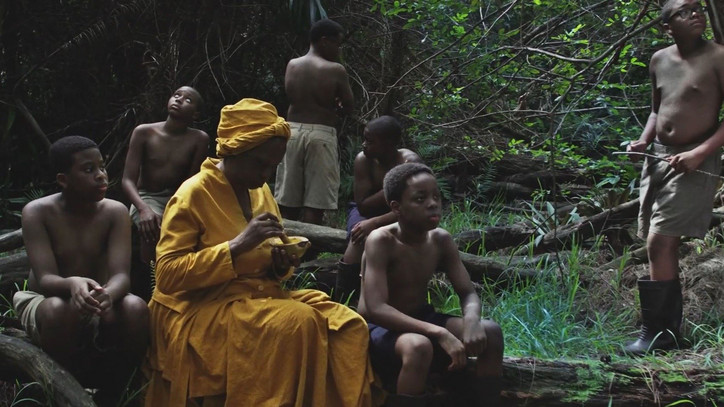
TN – The intro exists as a pallet cleanser. It references the necessity of starting from zero in terms of spiritual practice. Then, after that zero point, the film strives to build something that feels useful in terms of connecting to these beings. Octavia Butler's Earth Seed series is channeled in that film. For me, it is maybe one of the most useful, expressive, and expansive imaginations of a spiritual practice that we've seen and may ever see in our lifetime. God is change.
I see how Season 2 is an expansion of those two films that you brought up. These films jumpstarted a process of me becoming more interested in those idioms around the healing and self-awareness and spiritual practices necessary to achieve a practice of love. I wanted to know how cinema as a language could encapsulate blackness as a cosmological space, thought system, history, and set of experiences and how we could express those ideas audio visually. All those ideas have been gestating for all those years and season two is a testament to where I'm at with them right now.
EO – What was the process of getting a television show like this picked up by a major network like HBO?
TN – I would say the most important factor in getting the show from my brain to on HBO, in this case, was Tamir Muhammad, who I believe you know, and that is an executive producer on the show, my brother, and in the parlance of the season, a king. One of the many things he's a genius at is translation. He's a genius at the interpersonal skills necessary to keep me outside of the translation process enough for me not to get annoyed by it. Because obviously, the translation process requires a lot of omission from what I'm doing and trying to do. It requires a lot of exaggerating things that maybe are not that important to me.
Something else that was really important was that it was green-lit off of a proof of concept that was already made. The season's pilot episode comprises many other clips and films, most of which I made, some of which are made by Nuotama Bodomo, Mariama Diallo, and Shaka King. That proof of concept meant that however the show was described was secondary to what you felt when you watched that and we're now able to imagine it on TV. Ultimately the show itself, while heavily scripted, is a cinematic and audio-visual exercise. I'm using sound and visuals to create an emotional impact, and that emotional impact can only be felt and judged for its merit or ability to be on television, if you see it.
I also think that it was just that time. The show owes a debt to films like Get Out and shows like Atlanta and Insecure, which were in their first season or second season around that time. There was a certain concept of blackness that previously existed in a gray area that was starting to peek through in the form of those projects in terms of tonalities and vibration. These shows were more opaque in terms of their blackness vis-a-vis; they didn't ultimately include images of the white body, especially after the first episode. It helped that a huge step was taken in 2016 and 2017.