Precious Okoyomon on Love, Decay, and Learning to Become Part of Nature

Precious Okoyomon’s work moves between the deeply personal and the philosophical, where childhood memories meet questions of climate, love, vulnerability, and our relationship to the living world. From Monet’s gardens to generations of artists who have turned landscapes into images, nature has long served as a subject for art. Okoyomon flips that relationship, making the landscape itself the artwork and using plants, seeds, soil, insects, growth, and decay as raw materials that continue transforming long after the artist’s hand recedes. At the core is the creation of a garden as a form of future storytelling rooted in Okoyomon’s poetic practice.
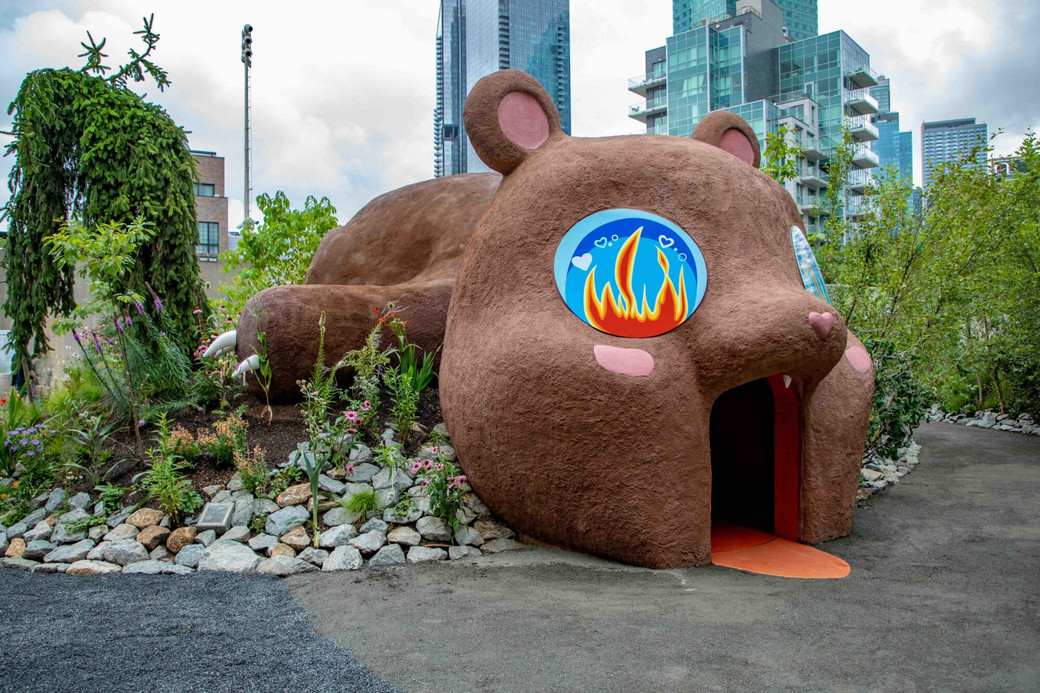
I caught up with Okoyomon to discuss their new installation and garden at MoMA PS1. At the center of the garden is The Pleasure Principle, a larger-than-life teddy bear that museum visitors can enter and be metabolized by, serenaded in the process by Okoyomon’s vocal meditations before emerging with a renewed understanding of how we are bound to one another and to the more-than-human world.
Our conversation wandered from their grandmother’s influence on their practice and their mother’s Nigerian restaurant, where the artist worked growing up, to Simone Weil, Sigmund Freud, Janet Jackson, The Magic School Bus, and what it means to be digested by a work of art.

Emann Odufu: I read that you were inspired by Simone Weil’s theory of decreation for this installation. We often think about spiritual surrender as surrendering ourselves to something larger. But reading about decreation made me think about a more symbiotic surrender, as if we’re surrendering to the universe, but the universe is also, in some way, surrendering itself to us. How does that relationship play out within this garden?
Precious Okoyomon: I’m a huge Simone Weil-head. My dog is literally named Gravity after Gravity and Grace. So much of what I think about and what centers me is love and God and a relationship to the cosmos. That’s really the ethos of the practice. Everything that falls out of that becomes its own object language, but that’s what I’m usually digesting and working through.
Decreation is my ethos for how I allow God and the wind to blow through me. It’s a relational practice that I’ve been with for years. Making this garden is a kind of love language to my home, my space, the place where I’ve lived for the last ten years, while imagining the futurity of the next ten years.
So much of decreation for me is about needing space. Space for others to enter me and for me to let go of my ego, to become a new version of myself. Change is difficult, but I’m interested in being opened up. I’m asking others to open me up constantly.
Emann: I guess that’s what love is.
Precious: Yeah. The whole thing is maybe a pursuit of understanding love for me. It’s giving things to other people who don’t want them, and they don’t even know they want them. I don’t even know I want to give it to them until I’ve lost it. I think it’s an exchange.
Emann: And it feels like vulnerability, too. The ability to be open enough to allow somebody to encounter you as you are, or to put yourself outside of your own understanding of someone else. That, to me, is also what decreation is about; removing that sense of ego.
Precious: Exactly. That’s the hole we have to enter into: vulnerability. It’s a practice of constant vulnerability. I’m always asking: How can I get back to my nucleus of love? How can I open up to the possibility of the unknown? Where am I falling into, and what do I remember when I fall?
Emann: I want to pull that back into the garden. Do you think about the plants and the larger ecosystem as materials, or as co-creators? When you’re working with life, the idea of “I created this” becomes less stable. How do you navigate that relationship?
Precious: It is a co-creation. That’s the joy of making a garden. It’s the seed of possibility.
I’m putting situations together in my head that work almost like a painting of a landscape, but then it becomes a possible situation whose outcome I don’t know. A lot of my gardens are three- or four-year projects. It really is co-collaboration.
When I work with crazy invasives like kudzu, it becomes this involved process of conspiracy. All of these plants are my co-conspirators. I’m fundamentally changed by the things I work with. I’m thinking, Oh, this friend needs to come back,or, This was really interesting; I’m saving these seeds for something in the future. Gardens are future storytelling in that way.
It’s a relationship I’ve had since I was very young because my grandmother taught me to garden, and she was a seed saver. Sometimes the things you do for survival don’t register as radical practices when you’re living them. But I think back and think, “You came from Nigeria, you saved these seeds, and every place we moved to, you planted a new garden”.
That was fundamental for me. You don’t control where a seed grows. You plant it, cultivate it, and hope that it spreads. That became a language for understanding people, too. Humans aren’t separate from nature. It accidentally became the core of my practice.
And it taught me a lot about love.
Emann: I also read that you were a cook and worked in restaurants when you were in college. I’ve been thinking about food and the magic inside the mundane. Cooking brings together all these different forces. Even fire, at some point in human history, must have been completely extraordinary.
Cooking also deals with transformation. Something dies to give you energy, and then you use another form of energy to transform that material into something new. That almost echoes what artists do. How did working with food inform your practice?
Precious: When I was growing up, my mom had the only Nigerian restaurant in town at the time. She was a nurse, and then she ran the Nigerian restaurant during the day. My job in high school was working at the restaurant.
Even before that, my mom’s house was the house everyone came to for dinner. My mom was the person who could really cook. I grew up in a kitchen cooking with other women, so the house I grew up in was a community based around food.
Everything important happens around a table, around food. It’s where you fall in love. It’s where people break down with vulnerability. I learned the bounds of love very early through that.
Food became a space for transformation, for this transference of love. Even after I entered the art world, one of the first practices I had with my friends was a cooking collective called Spiral Theory. We made crazy dinners, and that became how I found a lot of my friends and community in New York.
People forget that food is actually energy. It’s such a powerful act of love, care, and resistance. I don’t see it as separate from making a garden. It’s the same textures and colors, with the addition of flavor.
The way I cook is kind of the way I make a garden. Everything gets blended together. Mash it up. That thing you don’t think should be next to the other thing? Throw it in there. All the invasives? Let them blend.
It’s this continuous melding, this spiral upward of everything playing together.
Working in a kitchen is also beautiful because you follow one person’s vision. You might not see the vision in your own head, but you have to understand the flow of somebody else’s love and carry the thing.
It was a beautiful ecosystem to grow up in. I had many good seeds.
Emann: That brings me back to The Pleasure Principle. We’ve been talking about digestion and food, and in the installation you literally enter a body. It reminded me a little bit of The Magic School Bus, when they get really small and travel through somebody’s body. You become something that is digested and metabolized. I saw this resonance between food and the experience of entering the installation as a kind of digestible material.
Precious: I wanted you to be digested by a thing that was bigger than you. That was the thing I wanted you to fall into.
I love Ursula K. Le Guin. I love Octavia Butler. When I think about The Word for World Is Forest, a key theme is that when you fall into a dream, all of the memories are actually another parallel world that you’re in, and it’s teaching you something.
I always think about that: Where did I fall to? What did I learn? What did I remember?
I wanted you to fall into this giant that will hold you. You slide down, and then you’re exited out into another portal. I wanted you to be digested into revelations.
My poems are in there, and the music, and then there are all the plants. Something is always in bloom and something is always dying.
Emann: You mentioned the title and its relationship to Freud. Associatively, I immediately thought about Janet Jackson’s “The Pleasure Principle.” Was that in your mind too?
Precious: I was really inspired by everywhere the pleasure principle leads you. To Freud, to pleasure, literally to Janet Jackson, to falling.
The key was falling. You’re falling in love, you’re falling into things. What does it mean to let go of total anxiety and fall into pleasure? It’s big pleasure play.


Emann: In your previous work, kudzu operated as this alien presence within the American landscape. Here, you’re working with plants that might be considered invasive or weeds, but within an ecosystem localized to New York. How does the metaphor of the invasive operate differently here?
Precious: So much of it is New York side-of-the-highway weeds, things people think of as weeds, or things that have recently become considered invasive.
Japanese knotweed is really annoying to deal with in upstate fields, but it’s also such a beautiful binding vine. When you mix it with clematis and passion flower, which is one of my favorite flowers, the flower of Christ, you get this beautiful color palette.
I’m interested in these weeds binding together with other things and making a new, complex environment of play. It’s my space of hypothesis.
It’s also thinking about New York’s futurity in ten years. Apocalypse isn’t one moment. It’s all the slow, everyday change that’s already occurring. It’s getting hotter. The apocalypse isn’t overnight. It’s a slow, everyday thing.
So how do we make it? We need more trees and tree cover, more spaces becoming meadows, more plants that purify the air. The way I think about radical planting is as a kind of rewilding of the city.
I don’t try and fight the thing. I think: How do we move through it slowly?
Emann: Is that different from how you were approaching kudzu a couple of years ago?
Precious: Kudzu was its own special thing because I was making an environment for two invasives that had been continuously displaced through history: sugar cane and kudzu.
Kudzu was supposed to fix the South after the overplanting of cotton connected to the transatlantic slave trade had destroyed the soil. It went from this miracle vine to this monstrosity that “ate the South.”
But what was it saving?
It was saving the things we had destroyed with our own hands, not only through the enslavement of people, but through what we did to the land. Sugar cane was another exploited thing, connected to another destruction.
I thought: I’m going to make space for these two monstrosities. I’m going to give them a space to thrive.
Those two carried very specific, heavy histories. So yes, it’s different, but I’m still digesting some of the same things.
Emann: The teddy bear takes on radically different material lives across two of your installations in New York right now. At the Whitney, there are these soft stuffed animals and angelic figures suspended between innocence and violence. Here, the teddy bear becomes monumental and architectural. How do those two representations speak to one another?
Precious: I work with soft mediums and hard things, and I like the relationship between them.
What’s different here is that I wanted to make a space where you go inside something and it holds you.
Then there are these angels at the Whitney that are almost untouchable figures. I was thinking about the Miltonic angel, a thing that can’t be destroyed. What does it mean for an angel to die? It’s almost an impossibility.
But here I’m asking you to fragment and enter the bear. I’m asking you to be digested, to be dissolved inside of that thing.
They’re two different worlds, but they’re similar play spaces. Here, I’m taking the Winnicottian giant, the transference object of the bear, and exploding it, saying: Enter it. Be digested by your childhood fantasy.
At the Whitney, I’m saying innocence is inherently violent. There is no separation.
So we’re still playing in the same world, but they’re two different fragments.
Emann: There’s something interesting about poetry existing within a work concerned with creation and decreation. You’re surrendering so much of the work to natural systems, but the poetry feels like a place where you assert authorship again, where you give the ecosystem a kind of language. What role does poetry play within something that continues to make and unmake itself?
Precious: It’s funny because I always say I became an artist by accident. I’m a poet at heart.
The title, Among the Flowers I Learned to Love: A Garden of Decreation, comes from a fragment of a Hölderlin poem. It’s about finding an escape from humans in the garden and learning an original language of love.
The poem I’m referencing in the bear is my “Sky Song,” which is my original language of how I learned to love: the sky and nature. It’s my reference back to Hölderlin. It’s my love poem to him, and I wanted you to fall into that.
Poetry is my seed, and it probably always will be. The only thing I know how to do is be a poet, and everything else flows out of that. Art, language, love, it’s all poetry.
I’m just receiving transmissions from God, and however I can vomit them up and digest them, so may it be. They come to me in flashes of language. If I can jot them down, remember them, or draw them, then I can get back to them.
So you have to get in the bear. You have to slide down its butt. You have to be in the poem. And then you have to get spit back out into the garden of futurity.
Emann: As the garden moves through growth, death, and regeneration, what are you most curious to learn from what it becomes?
Precious: This is probably one of my favorite gardens I’ve done because I’ve gotten to work with Isima, and they’re breeding a lot of things for me. So it changes every year.
This summer isn’t going to be the same as next summer. I’m excited to see what’s going to take over. Things are already creeping. That back wall is just going to become all vine.
I’m excited about it as a laboratory for possibility, and about deepening my relationship with myself as a master gardener and with my breeders.
It’s going to change how I see a lot of things. For the next five years, when I make gardens, I’ll be able to say, Oh, well, that was possible there, so I know this can be possible.
I like the change of possibilities, always being a new horizon.
