Sofia Isella: Snow Angel in the Mud
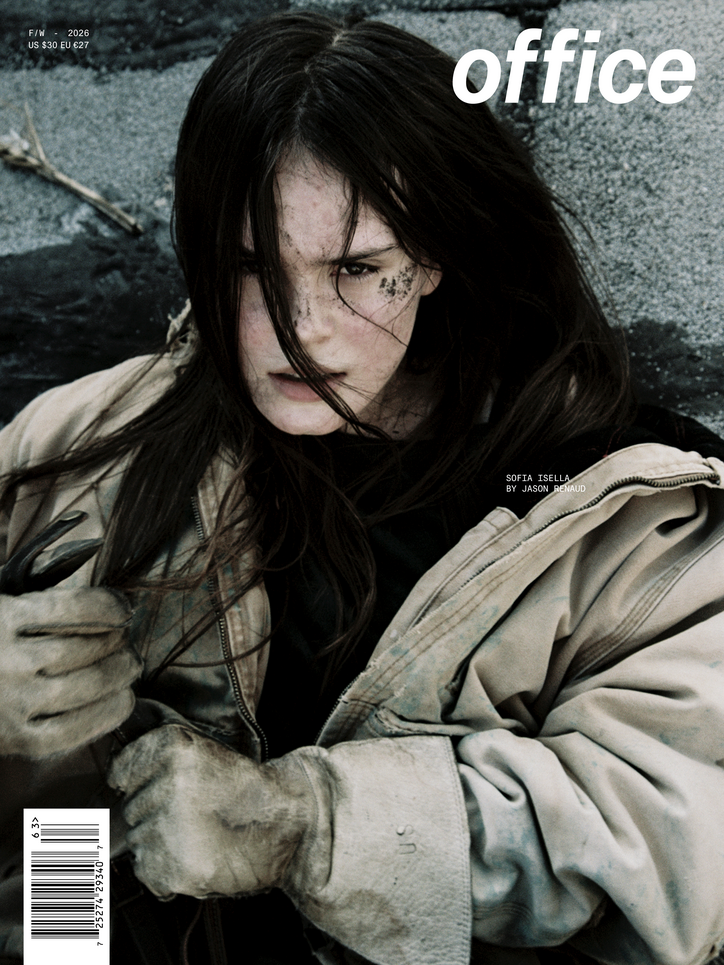

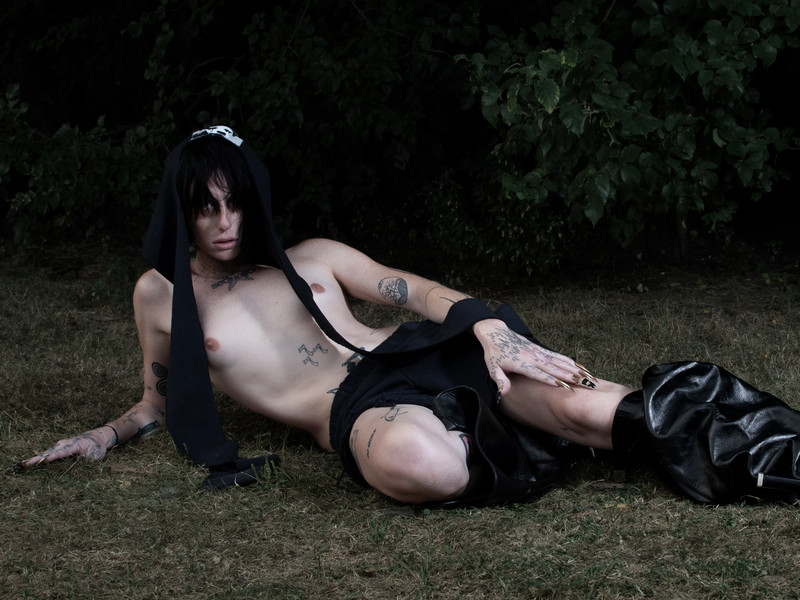
SOFIA wears JACKET STYLIST'S OWN, ARM CUFF by HIRIKO ATA @ BAD SHOWROOM, GLOVES, PANTS, BOOTS by SOMA FAITANIN
When I meet the altrock artist, she is in Los Angeles, where she was born and raised, recounting to me all the other various people, places, and philosophiesthat raised her. Feminist literary fiction stars take the cake on the list of who or what has been a muse for her. They emboldened her throughout her youth so she could go on to write hit songs like “Everybody Supports Women” and “The Doll People,” which criticize the intense scrutiny and objectification women undergo.
The 21-year-old singer-songwriter very much started off as a song- writer. “I have a mile-long notes app,” she says, before adding, “I’m on my second notebook this year.” Some of her note threads go back to 2018, when she was just 13 years old, jotting down ideas from her bedroom, long before she was touring with Melanie Martinez, Taylor Swift, and Florence and the Machine, who are all similarly known for their lyricism. Sometimes, the words carry her away for lengths at a time. “[I have an] unreleased song called ‘Vinegar’ that I performed live, that was just a giant poem. It just went on and on. And there are so many lyrics from ‘Vinegar’ that are not in the song because that poem was just so long.” And it’s no wonder she ended up with such a deep curiosity and love for words. Growing up, her mother (who is also an author) used to leave poetry books in little trails for Sofia to stumble upon. They were like hidden gems she could gold mine further and further each time she read.


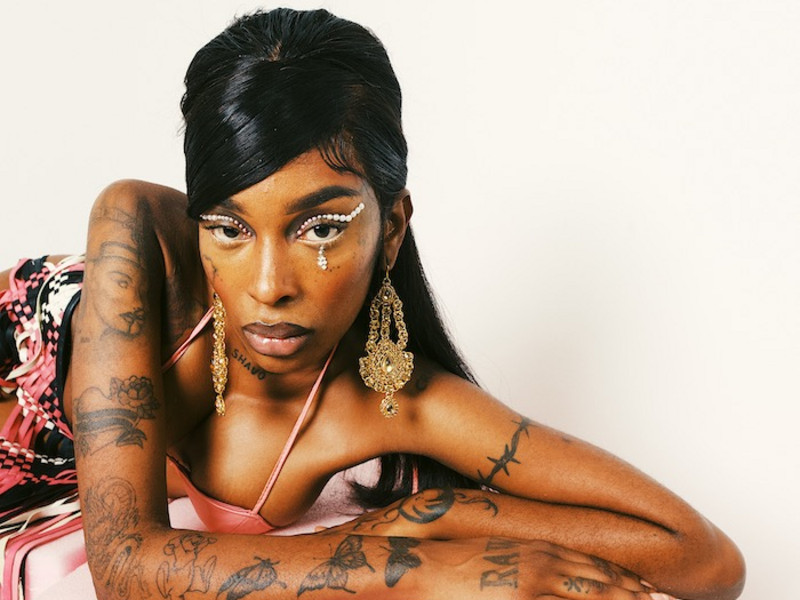
SOFIA wears HOODIE by ALEXANDER DIGENOVA, DISTRESSED WHITE T-SHIRT by BOHEMIAN SOCIETY @ BAD SHOWROOM and TOP by RICK OWENS
PANTS STYLIST OWN and SOCKS by SOMA FAITANIN
Now, many of her songs start as poems and morph into sonic experiences by their own free will. She’s always been most taken by the words of Sylvia Plath, Margaret Atwood, Mona Awad, etc. She’s enamored by women who acknowledge that they have a voice and want to put it to use. But also generally by people who can spin words like silk. “I love words, and people that are really good at arranging them, especially when they can hit something really honest.” Engaging with the truth is a priority of Isella’s, even when that truth is dirty and hard to look at.
Her image is just as privy to the grime of the world around us as her lyrics are. When she comes out on stage, there’s no question about whether you’re looking at Sofia Isella or not. She’s covered in dirt, head to toe. When Sofia Isella gets muddy, she doesn’t squirm at the idea of looking or feeling mucky; she rolls around in it. She grabs a handful more, slaps it on her face, her clothes, and her hair. Being covered in dirt has become her signature look, but it began as an accident. “I was at a festival, and my pants were just getting destroyed. It was so muddy. Then I realized I could just roll around in it.” What’s the method behind the madness? Once you’re dirty, you aren’t worried about becoming dirty. It’s a submission that feels freeing. Too often, we avoid the truth of the world because of its messiness. Sofia’s ideology is the exact opposite. “If my pants are [already] destroyed, might as well just snow angel in it.”

SOFIA wears DISTRESSED BLACK T-SHIRT by BAD SHOWROOM, PANTS and BOOTS by SOMA FAITANIN
It’s the same philosophy she utilizes in her feminist practice. Femme rage is often a thing that gets beautified and glamorized in an effort to be heard by the masses. Isella challenges this. In fact, at her live shows she prompts the crowd to get as ugly as possible. She isn’t one for shying away from pent-up fury. And she isn’t afraid of the negative labels that people place upon outspoken feminists. Her unrest coalesces around her own experiences, the experiences of women close to her, and the experiences of women at large. So no, she won’t be quiet about it. “I grew up in a very loud feminist household, and I didn’t realize that people had any weird connotation with this word until I ventured out into the big brave world. I thought it was pretty self-explanatory. I didn’t know why anyone wouldn’t agree with it unless they’re off their rocker, right?”
Her songs touch on everything from the social scrutiny women face to the sneaky fact that society normalizes pedophilic undertones, which harms both children and adult women through this infantilization. In “Above the Neck”, she writes, “When the women act like both a child and a sex beast / Men are titillated by that delicate line / Between sex song and nursery rhyme.” The song ramps up in emotion as the topic of purity culture within virginity is ruminated on. She goes on to write, “You think your penis is very important / But if something’s dirty after you touch it / The problem is your hand, dipshit / Cut it off.”

SOFIA wears JACKET by MEMIR, DISTRESSED BLACK T-SHIRT by BAD SHOWROOM, PANTS and BOOTS by SOMA FAITANIN
In “Us and Pigs,” Isella weaves a metaphor of women as livestock being raised for slaughter. With a steady drumming and deep vocals, the song rings as one that is undoubtedly haunting. What makes her songwriting so unique is that she doesn’t outright tell the audience how she feels. If anything, Isella herself is removed from the narrative. She simply tells the story as it is, in all its filth and agony. She lets the imagery speak for itself. When asked what changes she wants to see in our world, Isella tells me that “most immediately, it’s to stop a lot of things. Like, why are we debating about women’s right to vote? What are we fucking talking about?”
Isella has grown up watching women get torn apart, inside and out. Whether done in a physical sense or in a societal one, it’s always felt like bearing witness to brutality. This is why she admits to being “protective” of herself now, as a public figure. “I think women are watched with stronger glasses than we watch men.” Despite having a guard up most times, there are moments she feels safe enough to be tender. Sharing space with her fans is one. Isella loves singing to a “tiny, tiny room. It feels like holding hands, like our hands have [grown] ten times the size, and we’re just really feeling it now.” She’s adamant about consent, so when she holds hands with her fans, making eye contact as she sings, it’s important to her that she’s asked if she can touch them first. Isella knows that the only real way to connect with another human is when that attempt at connection is mutual. In this same vein, she loves a one-on- one conversation because she loves “brain melding with people.” But when she does connect with a group, she notes feeling like she is connected with the universe.

She’s always been artistically spiritual in that way. Isella recounts that she doesn’t feel like she is writing her songs. “It feels like something else is writing the songs,” she says. “Which sounds really creepy. It’s not! It’s vibes. It’s flowers.” The words come into her as if she is taking messages from a higher power. She describes this process as something physical, saying, “Lyrics hit me. They just slap me, and then if I really like the lyric, I’ll wrestle it to the ground and then figure out the body, right?” Just as in her “sex with sentences” belief, Isella bolsters the idea that songwriting is an innately physical dance.
Though there are moments when the ideas don’t flow as naturally, and she has to resort to other means. “I just sit there, no stimulation, and it’s like a consequence room. You’re gonna sit here for two hours, and we’re not gonna do anything. And there’s a guitar if you’d like to touch it, but other than that, there’s nothing going on. It’s like inspiration by force, and I’ve written some of my favorite songs using inspiration by force.” She was homeschooled growing up, so solitude and silence aren’t new to her. The echo chamber, the boredom, is sometimes a necessary growing pain.

Isella is kept an ever-flowing channel of creativity because of the way she has transformed herself into this unabashed character. “My greatest muse is probably the creative. Myself, [that] I personify,” she says. I ask her if this persona becomes tiresome or ever feels too narrow to fit the breadth of herself. She tells me that the aesthetic is truthfully pushed to an extreme as a means of protection. It’s the culmination of all those ingredients that have made up her inner world: her kinship with poetry, her rage toward the war on women, her affinity for connecting with humans, and that fundamental inclination to be honest and raw, all wrapped up in one dirt-covered woman laying her thoughts bare before the world. So yes, people are a mosaic of selves. But the “Sofia Isella” image does remain true to self. And she tells me, “It’s not like as soon as I’m off the clock of my nine-to-five, I turn into a pink sparkly unicorn. I mean... I may... only at like midnight for five minutes.”