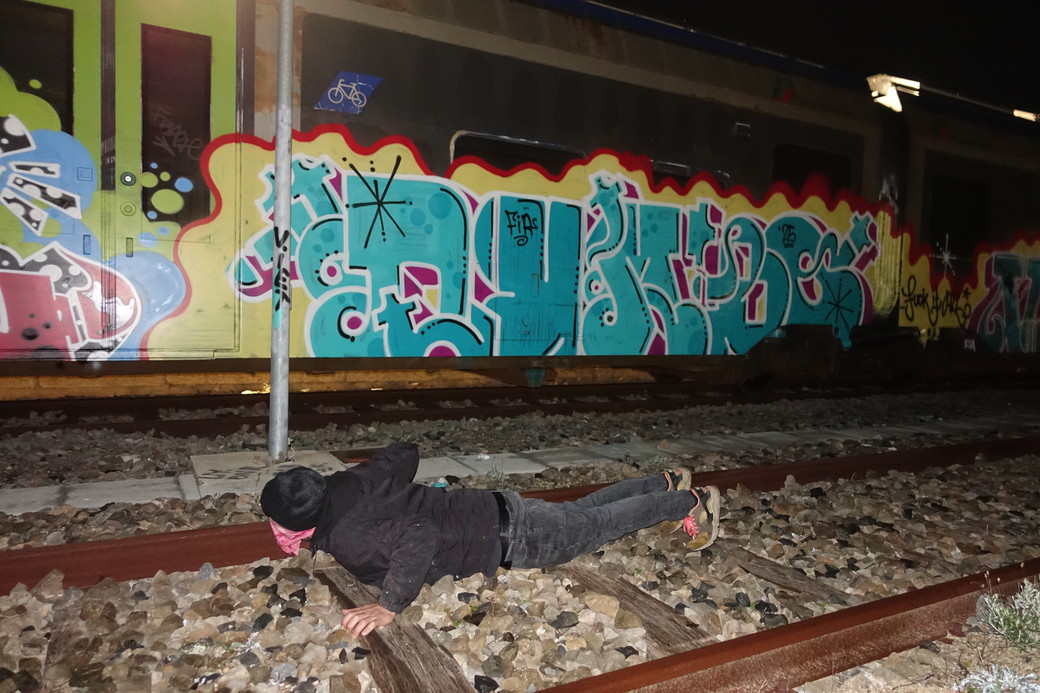
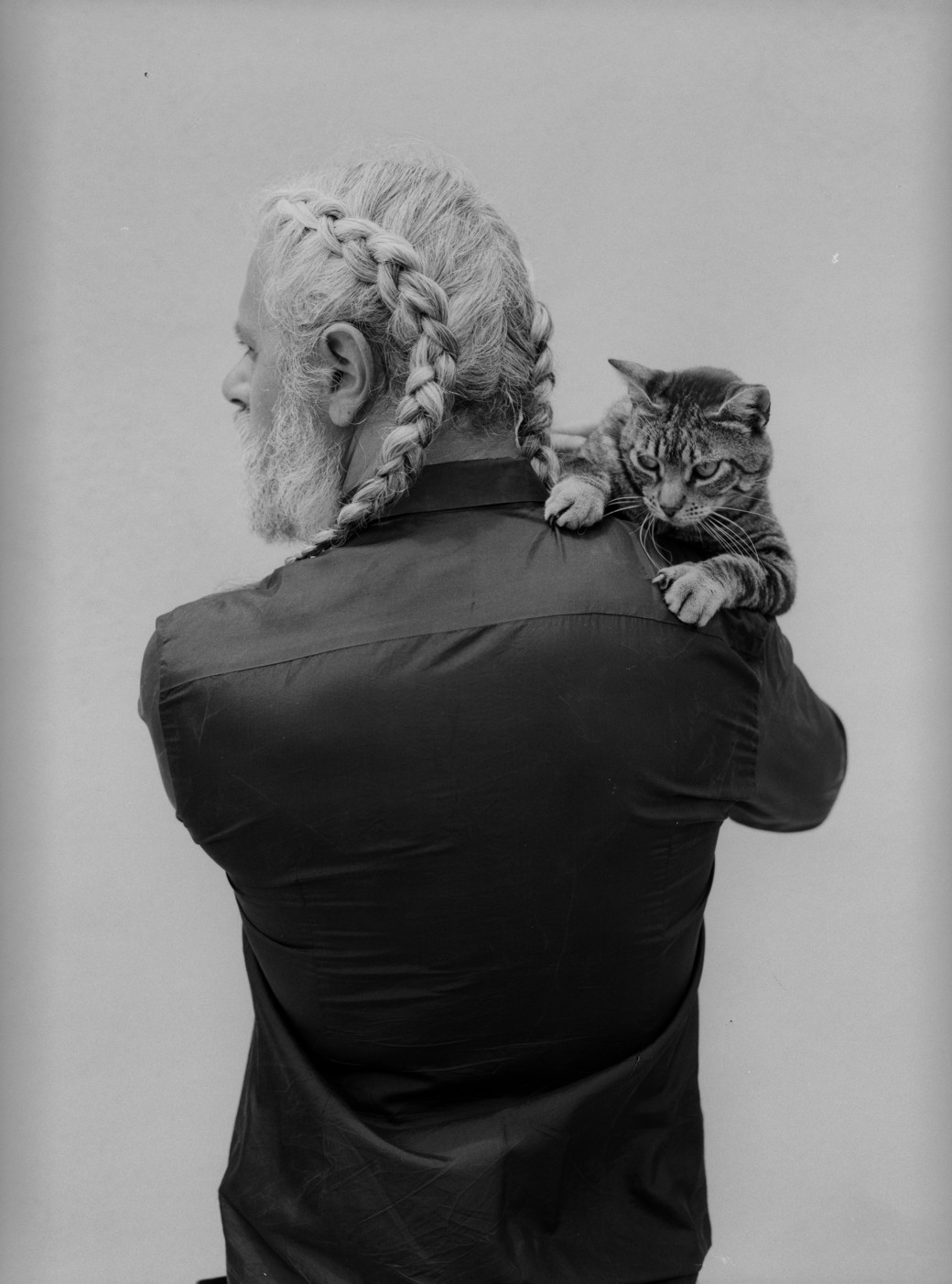
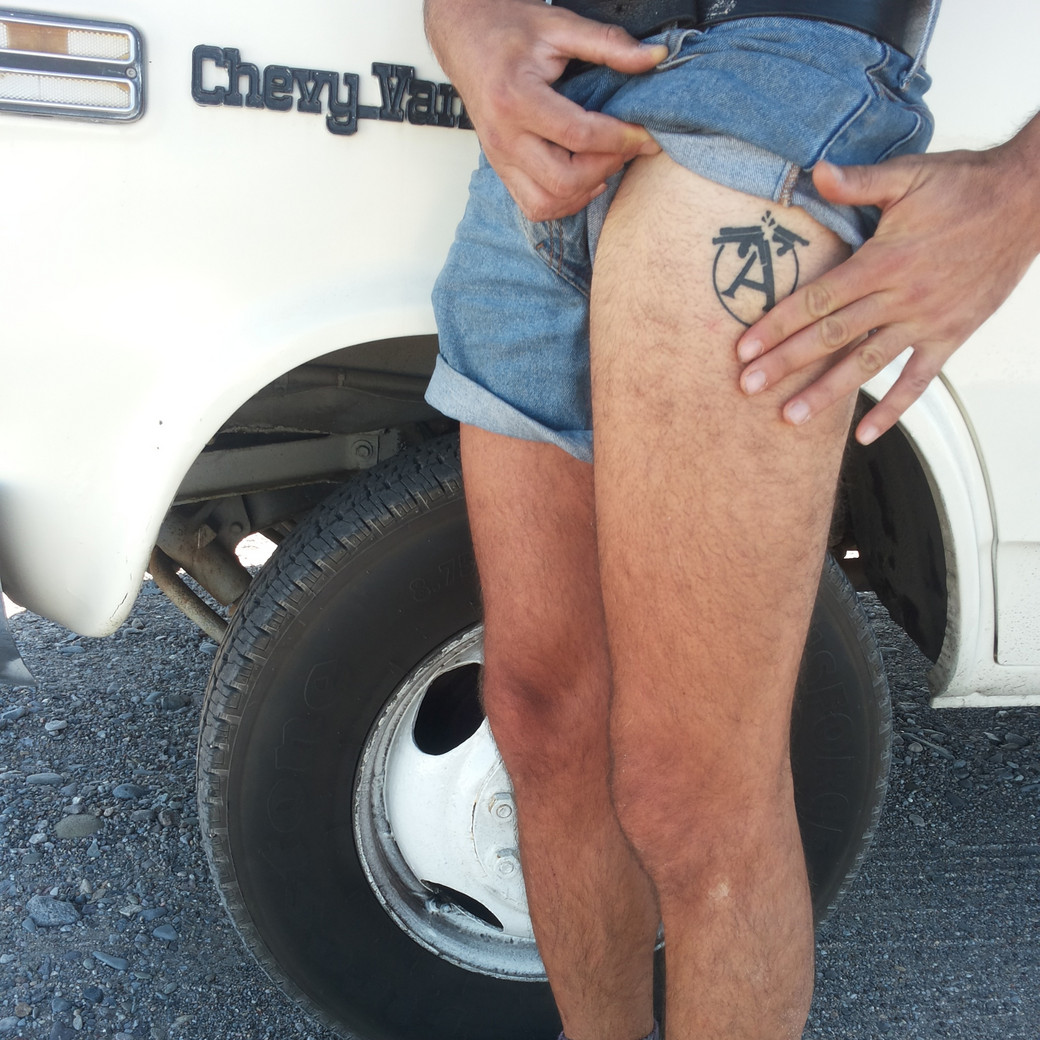
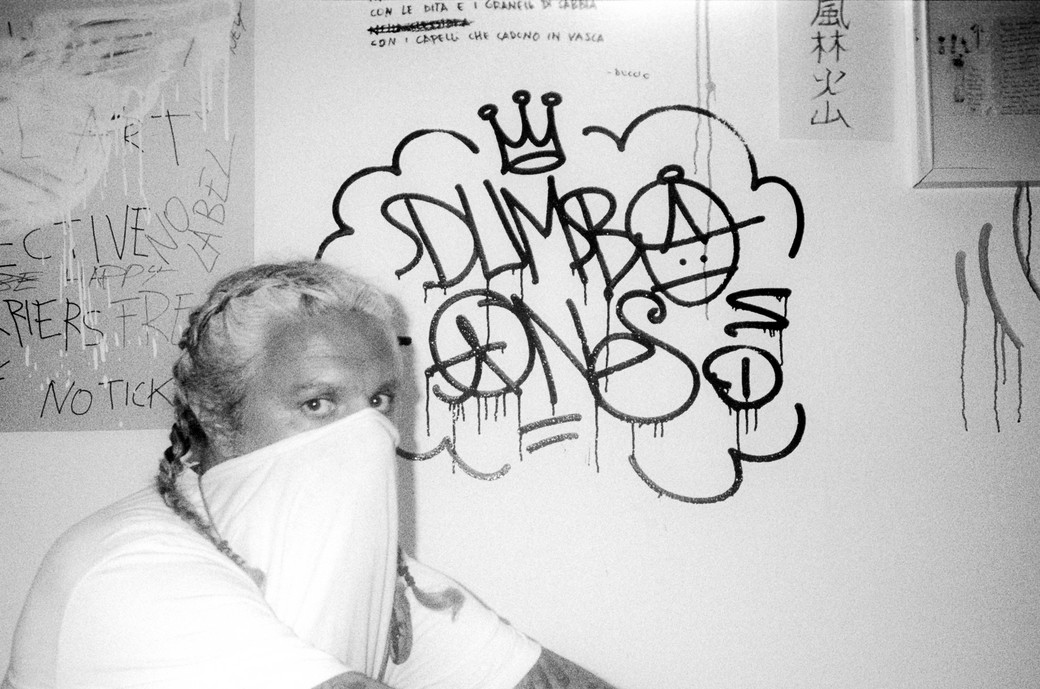
PRESENTE CONTINUO: the intimate ties between then&now

Starting May 30, PRESENTE CONTINUO will be available to purchase on presentecontinuo.com, cpcompany.com, and at the C.P. Company flagship store in Milan, Corso Matteotti 7.
Stay informed on our latest news!

Starting May 30, PRESENTE CONTINUO will be available to purchase on presentecontinuo.com, cpcompany.com, and at the C.P. Company flagship store in Milan, Corso Matteotti 7.

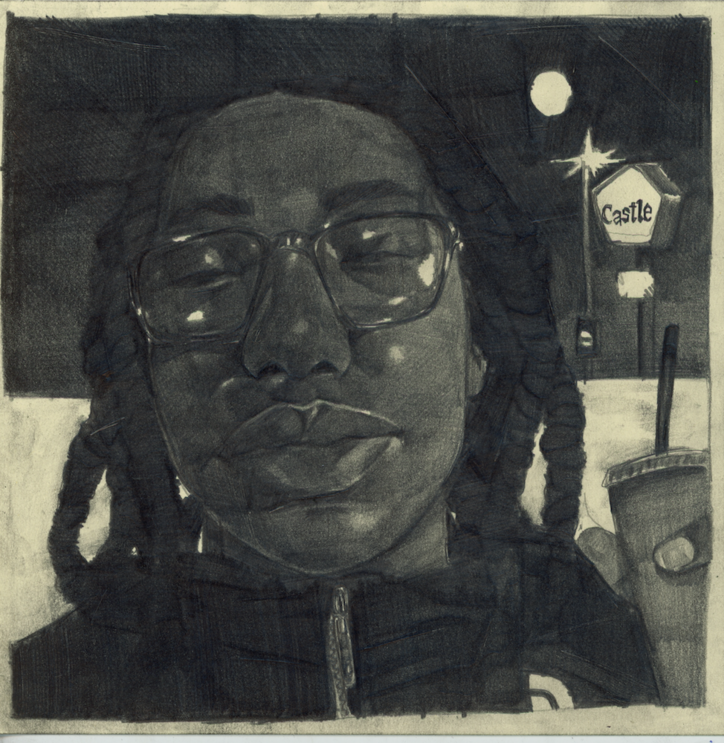
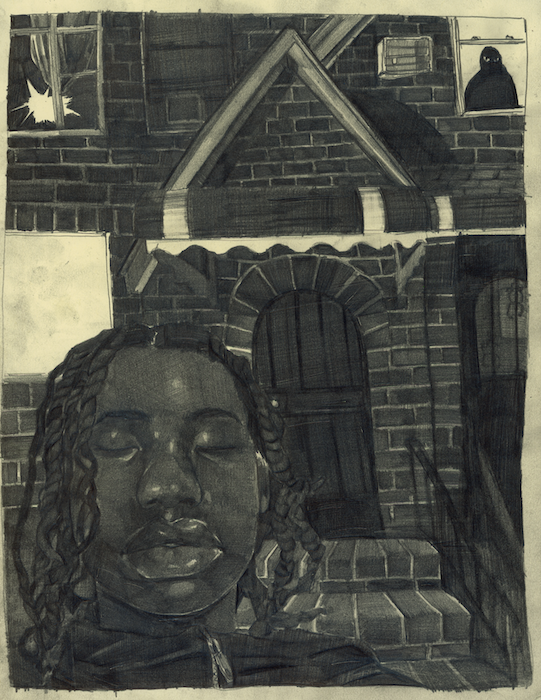
His artwork is lush in feel, exemplifying the seasons we throw away the most and the identities of Black people that have lived in the shadows. This artist uses occurring themes of winter as a projection into not just his self-portraits but of portraits of Black life. Canvasses are hydrated in emotion and realistic drawings that sit a mirror in front of its mirrors. It tells the viewers to no longer hide from themselves. When I looked at Alexander’s work, I was instantly mesmerized, and that can feel like a cliche statement, but it’s my only truth. His work left me blank in awe that it took me three weeks to write what I felt. And there is much to say.
Art is such a peculiar arrow of media because many artists don’t receive that bone of appreciation until their work presents as iconic. After all, it’s posthumous. It’s sitting between the past and the present. Julian deserves to be loved now. His voice lurks through graphite and acrylic, and the stories told in his work display a talent to be observed boldly in museums while also clutched physically from a loose sheet of sketchbook paper. Alexander’s Connecticut and New York backgrounds have molded a connection to Black people in the most authentic ways. I see myself. I see my siblings. I see the people on Jamaica Avenue or those coming off the four train at Crown Heights. I see the truth of Black life and respect that isn’t optional for our culture; it’s mandatory.
For office, we sat down with Alexander, discussing his artistic process and the love he has for art.


Most of your work centers around black and white imagery — what is the purpose of eliminating color?
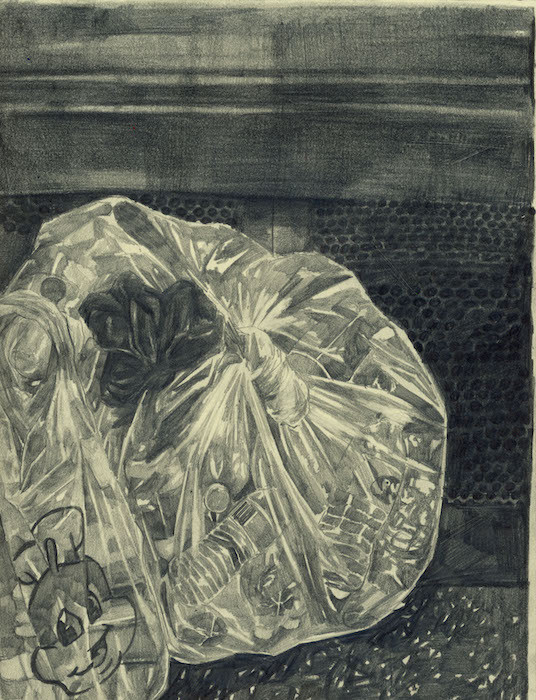
The black and white was just personal and true to me. I used to paint more, but I think that was mostly based on expectation of what's popular in art. To be honest though, a lot of my favorite artists are pen and ink comic book and manga artists, so I was always familiar with that visual language. I also felt like painting was such a complicated process compared to how automatic drawing is. I can put down a mark and it's just there, exactly how I drew it. Paint complicates that. The drawings became kind of like my journal because they were just raw expression without any medium getting in the way.
To expand on that question, your work that does include color is distributed through the usage of acrylic. Which style— graphite or acrylic— do you like working with the most?
I think I got to a point with acrylic painting where I'm confident and I can do it, but I have a hard time justifiying why I should sometimes. I used to paint the same subjects I would draw. Now that I'm trusting my gut and trying to really master drawing, I realize that when I paint it has to be different from the drawings but equally as good. I have a couple of experiments, but they're still developing and they're more abstract than the drawings are. To answer your question though, I absolutely prefer drawing because it's the most accurate way I can express what's going on in my head.
When did you begin drawing? When did it shift into something you could do career-wise?
I've been drawing forever, and I feel like people always told me I was good at it. It was kind og like a party trick though as a kid, but I used to really want to be a writer. I would get notebooks and fill them up with stories. I thought I was going to write the next Lord of the Rings or something. This was all back in Connecticut. When I was in the sixth grade, I moved to Brooklyn and that's when I saw art as a viable career. In New York, kids go to specialized high schools, so I decided to audition and submit a portfolio if I wanted to go to an art school. This conditioned me to start taking art really seriously from the time I was maybe thirteen years old. The original plan was to be a comic book artist, but at some point I realized that I fumble too much with words, and I kind of felt like they were unnecessary. All I needed was an image to tell a story. I just turned twenty-four and somehow I'm still doing it.
How do you use portraits of Black people as a descriptor for your artistry? How do you vocalize Black life in your work?
I grew up in Bloomfield, Conneticut. It's a small, mostly Black town right outside of Hartford, which is a slightly bigger, mostly Black city. Most of my early childhood memories are in that setting. I remember that I never really thought about race in a meaningful way as a child because it seemed like my community understood each other on that level. When I moved to Brooklyn, I started going to school with all types of ethnic neighborhoods. That's where I started having experiences that would make me think about Blackness differently.
I experienced racism in the form of outright aggression, and I learned how to identify micro-aggressions. I learned to code-switch, but that became exhausting. In my art, we can just be ourselves. There is no person waiting for us to do or say something on the behalf of an entire race of people, we can safely nd honestly experience the full spectrum of human emotion. We're happy, we're sad, we're angry, we fall in love, we fall out of love. Being a representative for an entire culture is a weight that no one should bear, so in my drawings, noone is bearing that weight at all. They're depicted in the midst of a particular moment and the viewer is present with them in that feeling. I'm creating a safe space for Black people in any way we choose to expressourselves, without expectation. We don't always get that grace.
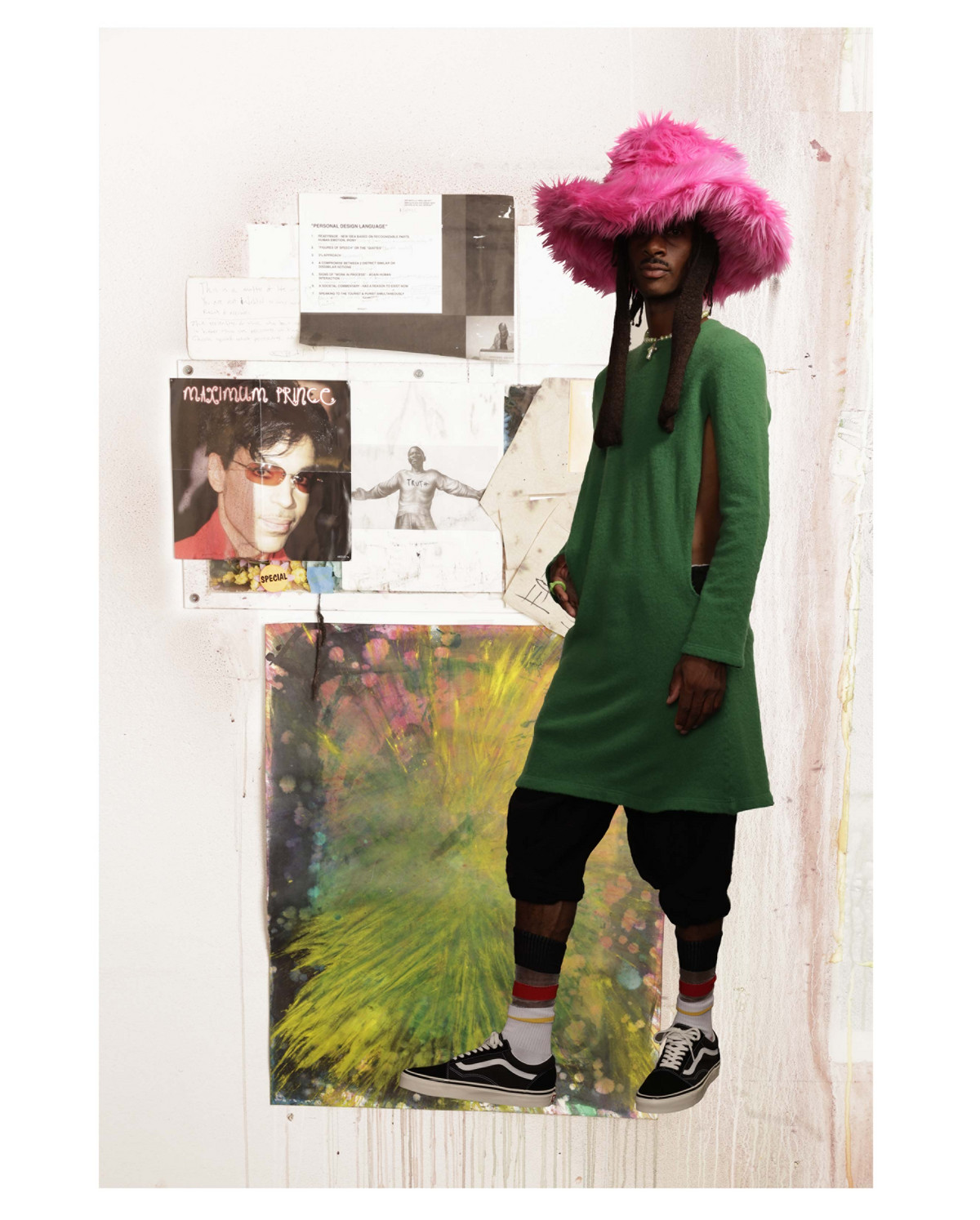
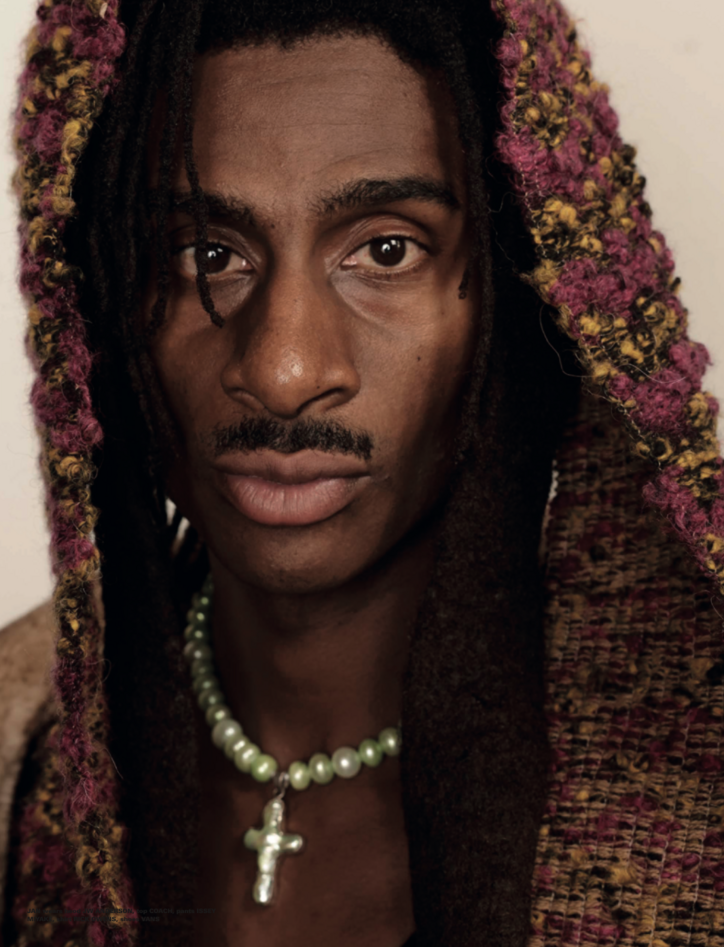
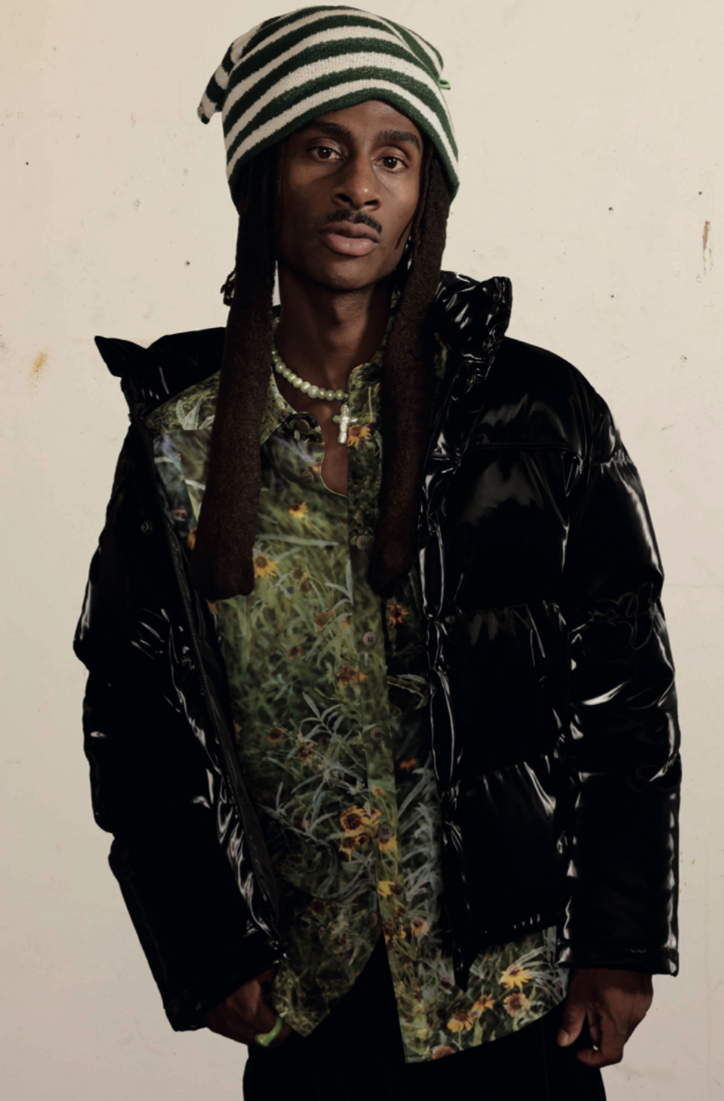
JAN wears Jacket LOUIS VUITTON, Shirt ACNE STUDIOS, Skirt COACH, Hat POCHE and Jewelry MUDD PEARL Talent’s own
Growing up in Aurora, Colorado, the Los Angeles-based artist spent his youth involved in the local skate scene photographing his friends, a culture through which he was introduced to creatives crossing over into fine arts — such as Mark Gonzales — and exposed him to his own, deeper aesthetic interest in music, art and clothing. “It teaches you to look at the world differently,” he says, and credits his dad’s massive record collection that encompassed “everything but country” with providing him his sense of eclecticism. After attending the University of Colorado for just two months, Gatewood ditched higher education, opting to head to LA in 2013 with a friend, where against all odds, he was quick to land on his feet. An early job in fashion led to an internship at Moran Moran gallery, placing him at the center of an art scene he knew almost immediately he wanted to be a bigger part of.
Thinking back to his early days trying to get his foot in the door, Gatewood says, “I remember when I first found out about some galleries I liked, I didn't get it. I was like, oh you could just go to a gallery, there's art, you can look at it, and it’s free? I didn't know that was public knowledge essentially.” The art world can notoriously be an unwelcoming place, especially for newcomers. “I was definitely put off by some of my first experiences,” he says. “I think if it's something you don't come from, it's super alienating. I just loved it so much that I was just like, I'm not, not going be here. So I'll just assimilate into all of this.”


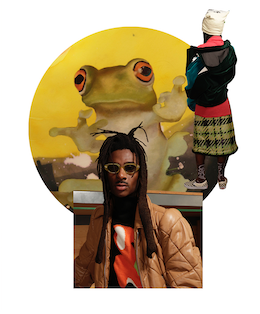
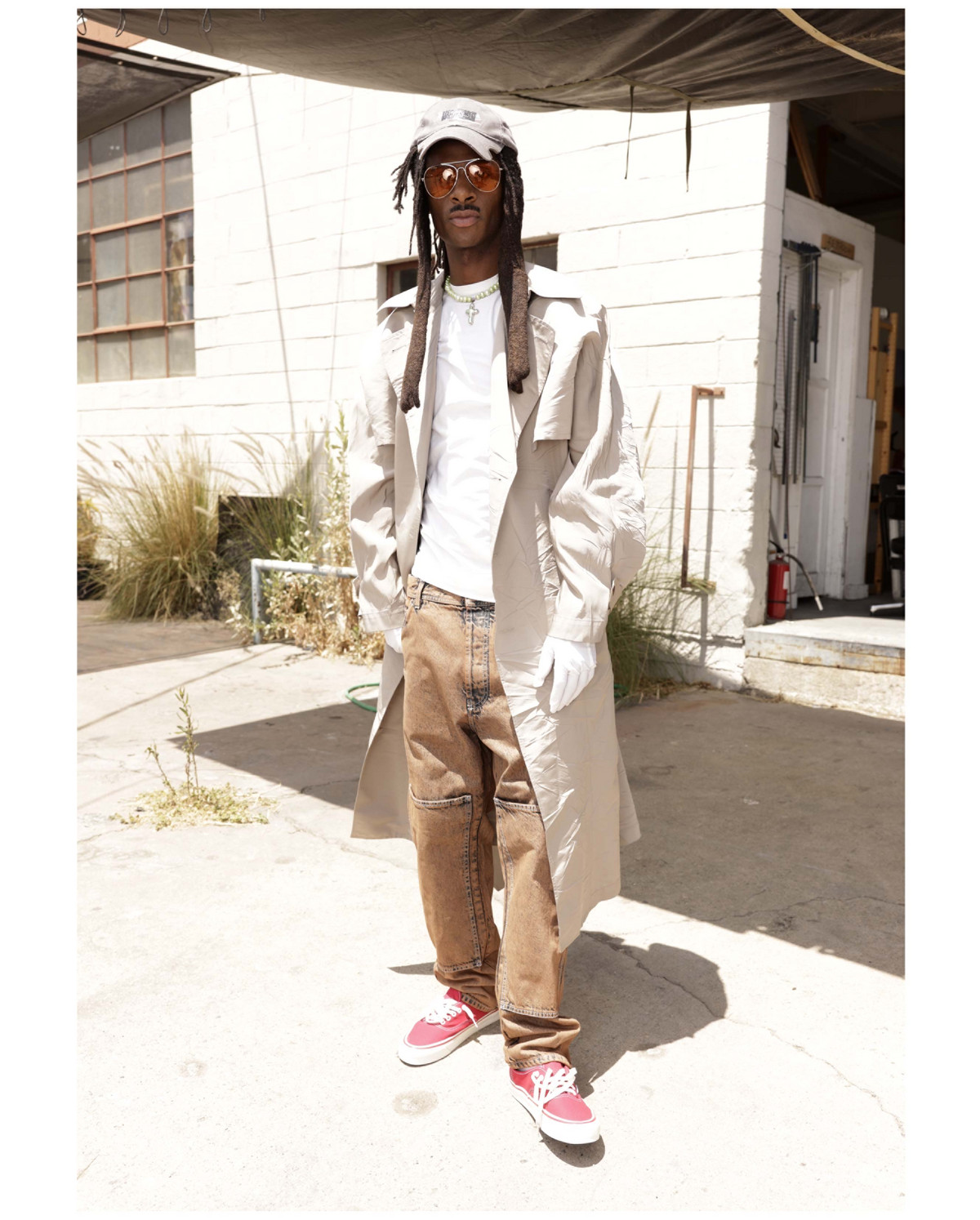
Right: JAN wears jacket, top, and pants BALENCIAGA, shoes VANS, gloves stylist’s own; Left: JAN wears jacket DRIES VAN NOTEN, top JW ANDERSON, sunglasses GENTLE MONSTER; JAN wears jacket LOUIS VUITTON, shirt ACNE STUDIOS, skirt COACH, hat, jewelry, and socks talent’s own, shoes VANS
Luckily, Gatewood’s confidence and ability to make friends with just about anyone has worked in his favor, leading to some incredible opportunities, especially for someone who’s mostly figured everything out on his own. He’s collaborated with the streetwear label Come Tees on a t-shirt, had a piece commissioned for the newest Dries Van Noten store in Los Angeles, and lent his face to fashion campaigns for the likes of Givenchy and Stussy. All the while, he’s maintained a full-time studio practice in his Vernon space and shows up to what seems like every important gallery opening across the city— invariably wearing an avant-garde look by the likes of Eckhaus Latta or Poche with such aplomb it’s impossible not to want to know who he is. Breaking into an industry filled with unspoken codes and social politics didn’t seem to discourage Gatewood. “I kind of was like, I'll look weird, I don't care. I want to be here, so I'm going to be here and just never stop going. My thing was like, I'm going to go to every show I can. If there's a show, I'm going to go see it, so I can familiarize myself with all of this.”
Gatewood’s resourcefulness, both artistically and socially, is impressive in its fluidity. When he knew he wanted to become an artist, he taught himself the technical skills necessary by watching YouTube videos on drawing and turning his kitchen into a makeshift studio. He’s fond of using found objects in his practice, relying on his surrounding environments to fuel his process. “I didn't want to use strictly things you could find at an art store,” he says. “The people that really inspired were always using material from all over.”

JAN wears Hood JW ANDERSON, Top COACH, Pants ISSEY MIYAKE, Shirt RICK OWENS, Shoes VANS
His recent solo show, Tiptoe Hassle, which debuted in February 2022 at Smart Objects gallery in Los Angeles, presented a body of large-scale works on paper. A cast of oversized, cartoonish animal figures lined the walls, set against colorful, water-based backgrounds. Although they appear painterly in form, these bizarre-yet-humorous images of a fox holding a paintbrush or a crane dangling a lizard in its mouth are created without paint brushes. Gatewood instead uses oil sticks and his fingers to dab gestural strokes into paper, explicitly referring to his works as drawings rather than paintings.
He focuses as much attention on his backgrounds as his subject matter, aware of the tonal shifts between them and how they appear holistically in a gallery. They each stand apart individually, created using materials such as bleach, lemon juice, fabric dye, salt and other debris in a spectrum of tie-dye earth tones, paint splatter and monochrome patterns embedded with mattress coil textures. Gatewood’s compositions are intentionally spare, yet his images are as approachable as they are intellectually deep, using the writings of philosophers such as Deleuze and Kierkegaard as points of reference.

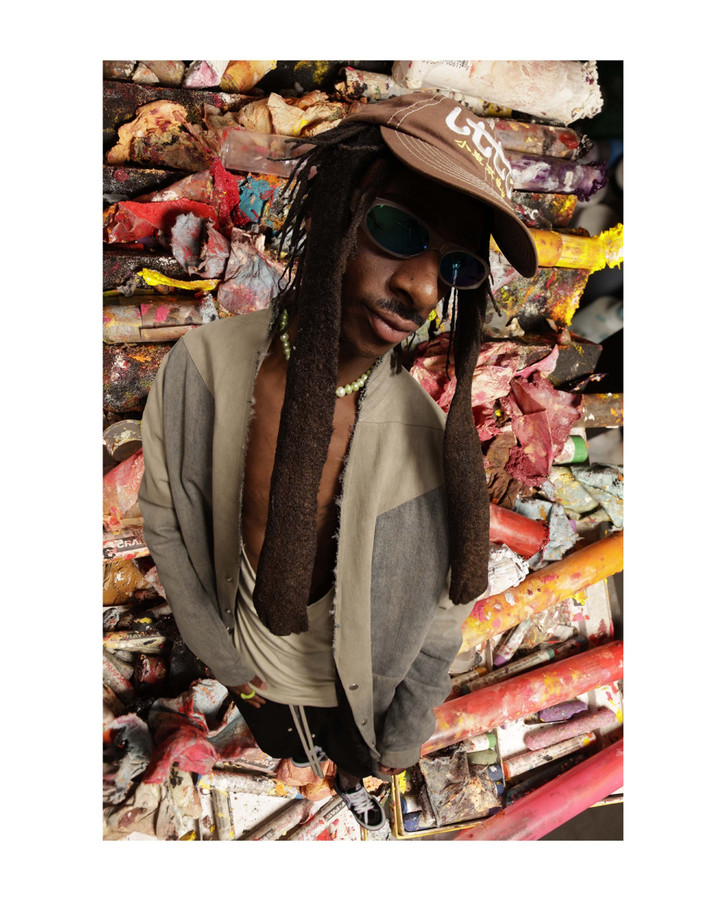
JAN wears Jacket, Top, and Pants RICK OWENS, Sunglasses FLATLIST, Hat and Jewlyer Talent’s own, Shoes VANS
“There’s a certain eclectic nature I have about myself that finds its way into the work,” Gatewood says. Piecing disparate elements together is a large part of the way Gatewood assembles things, using found materials and ephemera and a DIY, collaged aesthetic that appears in his fashion sense as well. Even an early interest in comedy provides inspiration for a way of thinking about art. “I was always attracted to the linguistic element. It whittles down something to be clever, to get one desired response. It’s really crafting out a joke until it hits,” he says.
A love of words appears simultaneously throughout his drawings, acting almost as artworks themselves. On a work titled “Delusional enough to declare this as collective concept fabrication. Magic trick on my terms.,” the word ‘DRAWING’ appears in a self-referential black scrawl, set against a stark white background, at once reminding viewers that yes, they are in fact looking at a drawing.

JAN wears Coat SAINT LAURENT, Top S.R. STUDIO. LA. CA., Pants LOUIS VUITTON, Hat and Jewelry Talent’s own
It’s a nod to Surrealist artists such as Rene Magritte and Marcel Duchamp, who used language as a way to break down the “third wall” in art — a suspension of disbelief that audiences commit to when they enter a gallery space.
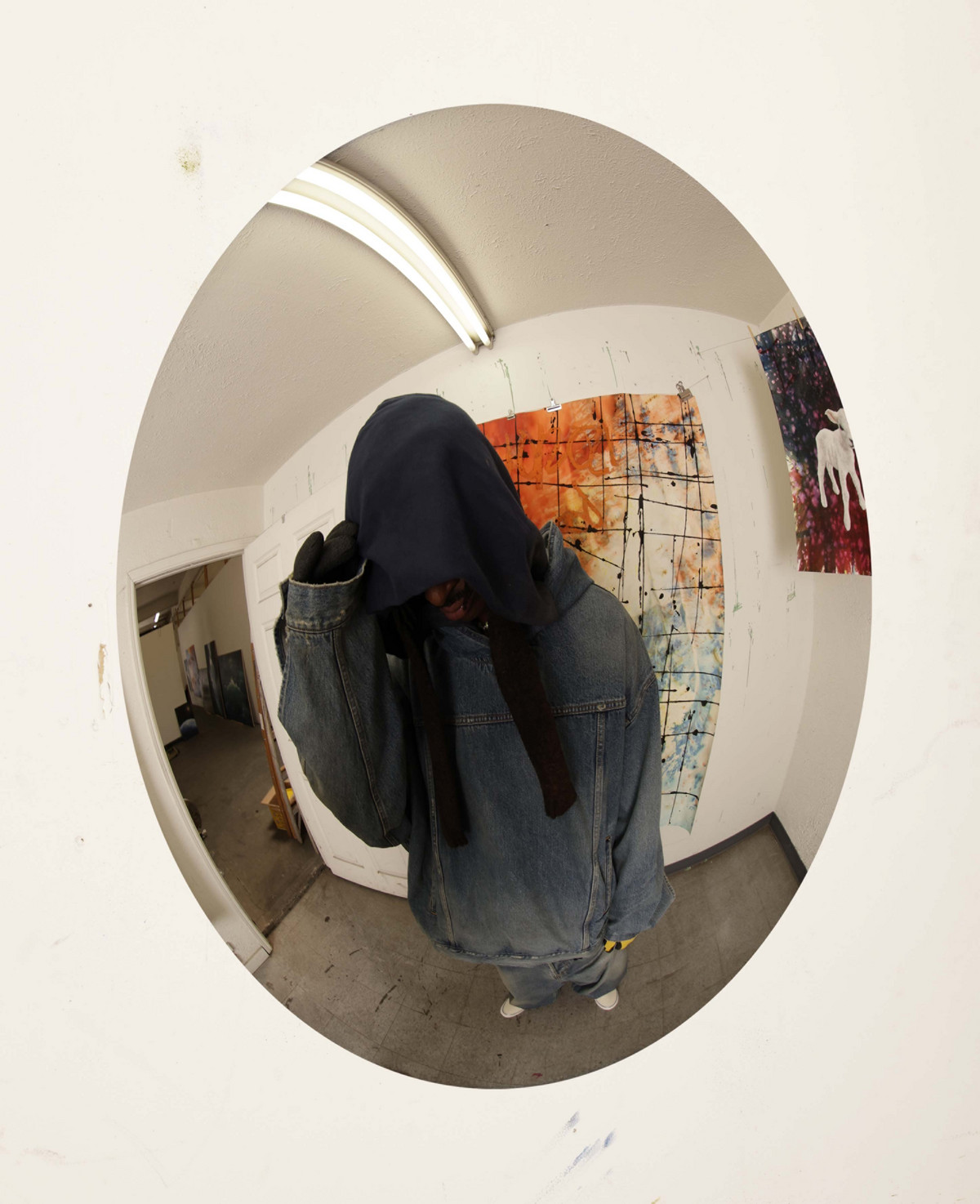
During a studio visit, a friend warned Gatewood about the pitfalls of falling into the “young artist” trap of giving “too much” — that he didn’t have to say everything in a show. Rather than being disheartened by this sentiment, Gatewood used it as material for a piece titled, “A friend told me ‘you don’t have to say everything in a show’ Obviously, but is an exhibition one of the rare moments where you’re at least granted the attempt? Narcissism?” The titles of Gatewood’s works are almost like novellas, mini storybooks that take viewers down a rabbit hole of the artist’s mind. “For any show, I want to give a lot,” he says. “The title is another layer. It's a way to bring people in, to the things you were thinking about while you were making the exhibition. I really don't want that to go as an afterthought.”


Right: JAN wears Hat BENNY ANDALLO, Top and Pants COMME DES GARÇONS HOMME PLUS, Socks JW ANDERSON, Necklace and Ring Talent’s own, Shoes VANS
Left: JAN wears Coat ALEXANDER CMQUEEN, Top GIVENCHY, Bottoms LE PÈRE, Hat and Jewelry Talents one, Sunglasses Stylist’s own, Shoes VANS
In this sense, Gatewood’s exhibitions are more than just retrospectives of his talent — they are a Gesamtkunstwerk, or “total work of art.” In all aspects of his life, Gatewood is both giving and forgiving, qualities that seep into his drawings. Generosity is a common throughline, guiding his decisions towards choices in his works that will continue to provide for people, beyond the blip of a show. Even the exhibition’s press release serves as a further extension of Gatewood’s world. “I want to use words to guide thoughts a little bit, so the work becomes more than just a semi-charming image of an animal on a colorful background,” he says.
Stylistically, Gatewood’s work is unabashed, mirroring his own persona. It leads with its technical qualities, followed by an intense use of color and form as well as the language he poetically weaves in.

JAN wears Scarf ACNE STUDIOS, Coat COACH, Jewelry MUDD PEARL Talent’s own
But recently, a shift in mindset has reframed Gatewood’s way of thinking about his work. During a walkthrough of his show with a fellow artist, he says, “I thought they were going to grill me on all the concepts I was saying the work was about — the formal qualities, the decisions I make. They didn't really talk to me about any of that. All they talked about was emotion. I was like, wow, that’s the one thing I never think of and the thing I thought we wouldn't talk about all.”
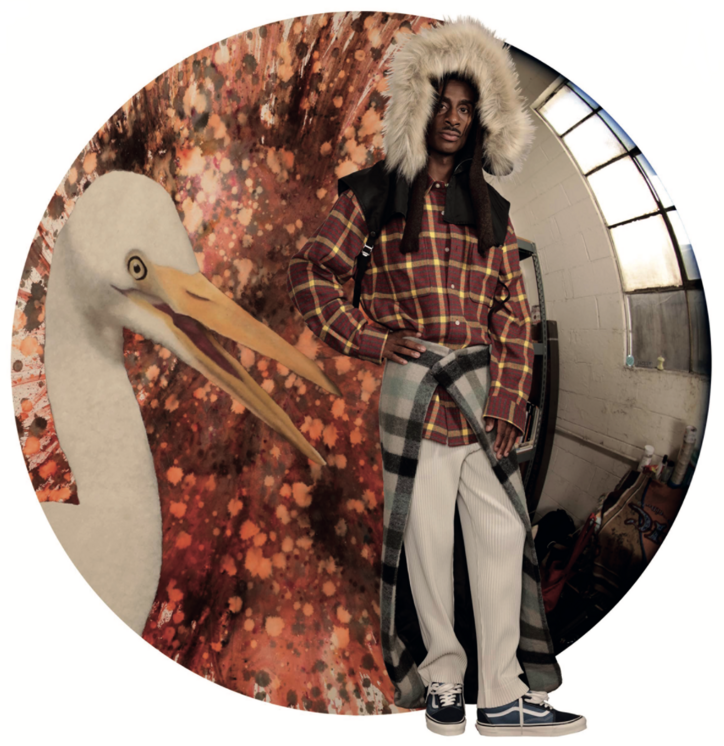
As a thank you from the artist himself, attendees to Gatewood’s last show left with a parting gift — one of over 300 handwritten, one-of-a-kind posters bearing his press release and emblazoned with an oversized selfie of Gatewood bearing an exhilarated, wide-mouthed grin. It’s akin to a souvenir photo one receives after an amusement park rollercoaster — a memory of being equal parts scared to death and high on adrenaline. It’s funny, weird, and does the job of what he’s intended: that you sure as hell won’t forget him. Knowing what Gatewood has managed to accomplish in the short span of time and the trajectory he’s headed towards, it’s going to be nearly impossible to.