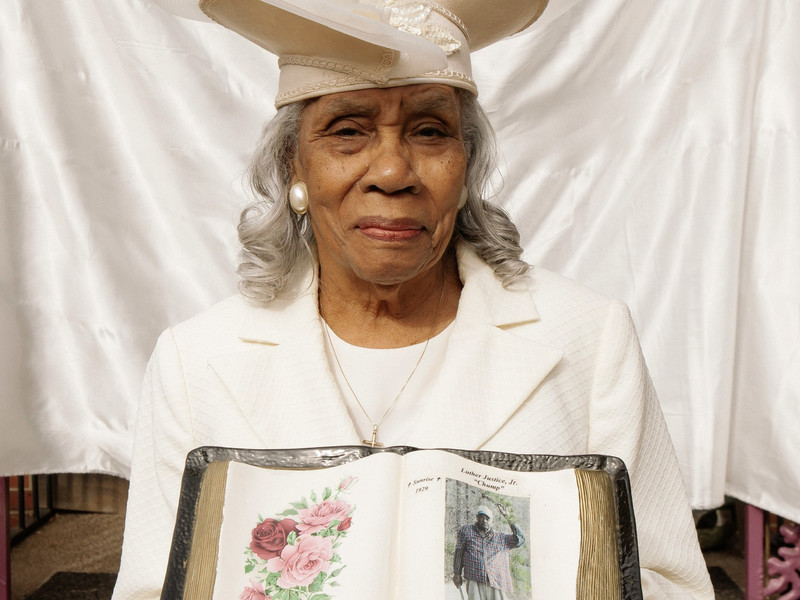
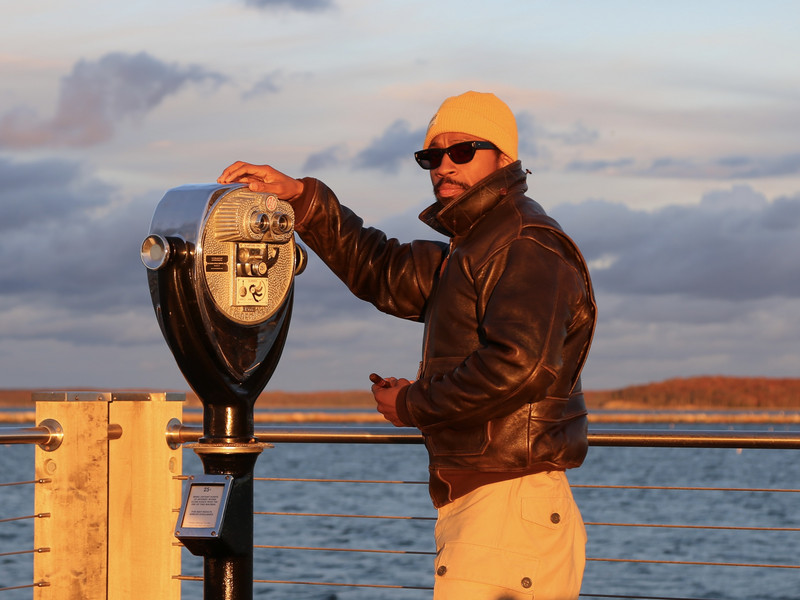
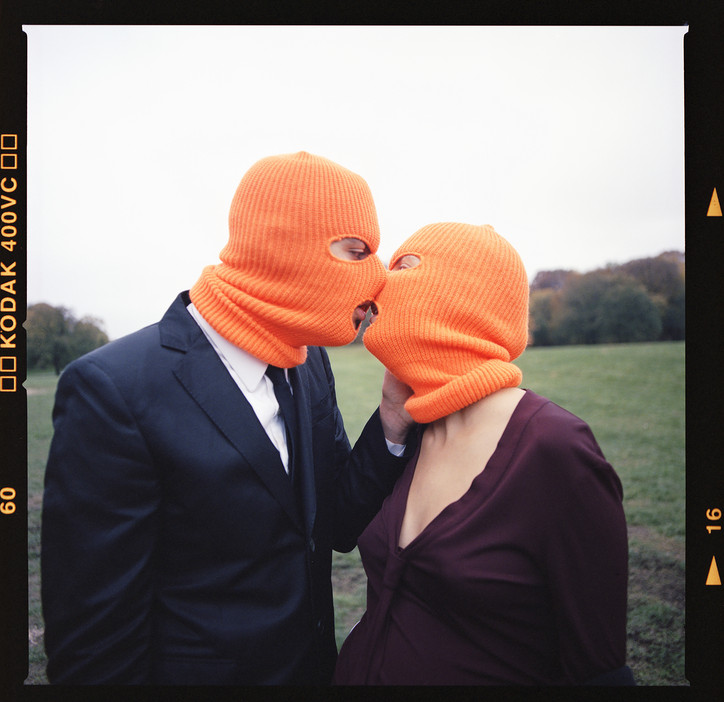
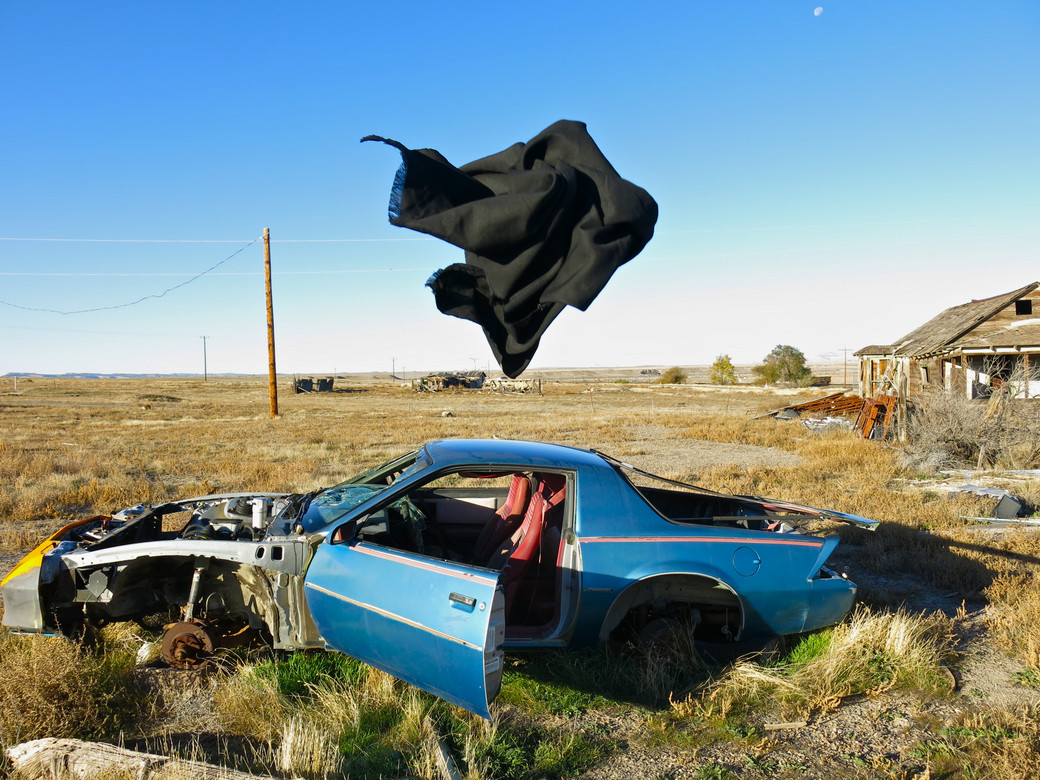
PRESENTE CONTINUO: the intimate ties between then&now

Starting May 30, PRESENTE CONTINUO will be available to purchase on presentecontinuo.com, cpcompany.com, and at the C.P. Company flagship store in Milan, Corso Matteotti 7.
Stay informed on our latest news!

Starting May 30, PRESENTE CONTINUO will be available to purchase on presentecontinuo.com, cpcompany.com, and at the C.P. Company flagship store in Milan, Corso Matteotti 7.

office caught up with the artist to discuss the wondrous possibilities of footwear, art, and puzzles.
Tell me about your work.
My work in general, since about 1989 or 90, has been about taking objects that clearly from Western culture and recasting them in a tribal narrative, often with things that look African art, but because of the idea of tribal, they start to look like other cultures as well, especially Mexico and Asia. In my mind or the back of my imagination I proceed as if I’m trying to extract the spirit from the original object, so I don’t work with a sketch or a plan, I just play with them for hours until something emerges. So in the case of the shoe masks, I feel that each shoe had the personality and the history of the person who wore them—they’re all used shoes, gently used I should say—and they kind of make their own personality, I just have to remain open to that and put them together.
Another aspect of that same work is that I’m very interested in making work that looks like they come from the past, the present, and the future—I call that collapsed time, where everything comes into a single point called the now. And that makes them look very futuristic, but they might be put together in such a way that reflects a more ancient tradition. I’m also interested in multiplying objects, so I do a lot of work with water bottles, which is the probably the most exact on my formula for analysis—I take a single water bottle and multiply it, so now it’s a thousand or three thousand water bottles, and it becomes something else. In that case, I tell myself that I’m doing what nature does by taking a single molecule and multiplying it to make something completely new.
I didn’t even think of it as being tribal, but now that you say that it makes sense. I just saw the shoe faces and thought they were silly and refreshing.
Yeah, they just popped out. In the front of the gallery, I have a bronze, full-bodied figure. I think of them all as female because the shoes were females, so there’s a female energy that I’m extracting from these objects.


Above: 'Eye Candy' and 'Black Panther'.
Yeah, it’s amazing what you were able to create—it doesn’t seem forced at all, either. Did you set out to make faces or a body, or is that just how it ended up? That’s just what the shoes spoke to you?
In the beginning of the process, back in the late 80s or 90s I had a show in Philadelphia, and I wanted to make a bodysuit—my friend had given my five pairs of his sneakers and I needed so many more to cover the entire bodysuit, these were high-top, quality sneakers, I wanted the wearer to bounce up and down and see the shoes kick. So I went to a thrift store and I saw the high-heeled shoes. So, right away I switched from sneakers to high heels. I didn’t know what I was going to make with them, but I knew they had great potential because they had great color, they had great shape, great history, great symbolism. I collected probably around 100 pairs at that time, and I played with them for about a month or two before I was able to recognize that the stiletto heel could be like a fang. And that led to the face aspect of it.
Now, at that time I made a chair out of high-heeled shoes because of Imelda Marcos, she had so many shoes, she was the wife of the President of the Philippines, so I made a throne for Imelda out of high-heeled shoes. And I made two faces, not masks for the wall but free-standing faces, and then many years went by, but in 2005 I received a fellowship at the University of Georgia—I was on campus for four years, they gave me a stipend, etc, but I didn’t take any art supplies with me, not even paintbrushes. So while sitting at my empty studio there, I said, ‘Maybe I’ll take up the shoes again.’ So I went to the local thrift store and told them that I wanted to make things out of shoes and that I would buy every shoe they had for fifty cents a pound, and they gave me like a million shoes, and the University of Georgia paid for them all at fifty cents a pound. So I continued with the shoes in 2005 with no real intention in mind. By the time this show came along, I knew I could make faces out of shoes—so I intended to make faces, I just didn’t know what the faces would look like.
I would go into my studio and be confronted by rows and rows and tables and table of shoes, and I don’t know what my intention is going to be, but I know I’m going to be there for three hours playing with the shoes. And some shoes suggest, perhaps a very long heal or a platform shoe might suggest a body, where as a pump might suggest a nose or an ear. So I let the shoes lead me to the final result.
It’s interesting that it started out as sneakers and became high heels, because I feel like right now a lot of people who used to wear high heels are now wearing sneakers instead. You said the high heel has a lot of symbolism and power, what do you think those are?
The high heel for some women becomes a power shoe. This morning, I was at my fiancé’s house and she gets up to go to work and I could hear her shoes coming down the hallway. It’s almost like the drum announcing the coming of the king or queen. Even today with her colleagues it’s like she can say she’s high because she’s wearing the high-heeled shoes. Those are some of the more positive symbolisms of the high-heeled shoe, but it also has the opposite suggestions as well. It could inhibit one’s ability to run. And nowadays, with the branding and the depending on the maker of the shoe, it becomes a status symbol related to economics, like, ‘Oh, she’s wearing Jimmy Choo,’ or whatever. And the designers sometimes do things to the shoes to suggest power or domination.
Above: 'Happy' and 'Street Dragon'.
Do you think you’re playing into that with your tribal faces?
Well I’m letting the shoe lead me. If the shoe is pointing that way, I go that way. I’m pulling out the spirit of the shoe, or the wearer of the shoe. I’m not really dictating anything. When I was a kid, I played with Erector Sets and Tinkertoys and things you put together, and these were essentially the same thing—it’s like a puzzle but the box has no picture on it. I know there’s something in there, so I’m just looking for what that is.
I can feel that from the sculptures. They look like puzzles almost.
Yeah, I really move them around until they fit perfectly on their own. I don’t cut them or change them in any way. So if two fit together and suggest something, I go with that. I work on several at once, so I’m able to just move around the room and if it doesn’t fit here, okay, move on to the next one. Another thing that attracted me to shoes, was in high school my major was fashion design, so that helped me to appreciate the beauty of the shoes as well.


Above: 'Woman In Heels' and 'Sole Flower'.
It’s funny about shoes too, because they’re definitely fabulous but of the articles of clothing that you wear they’re kind of the grossest. That’s the thing about shoes.
The good thing is that women will buy shoes and wear them twice with an outfit, and then not wear them a lot. So when I went to buy shoes, I looked for the ones that had been worn the least. I live in New Jersey, and my local thrift store gets new shoes from one of the chain stores that gives them to the thrift store—so I was able to buy a lot of new shoes as well for a really low price.
But they are the foundation. They’re close to the Earth. And they have memory. I can see the shoe take the shape of the foot that’s in it sometimes. So all those things are feeding my choices. Also, I’m not the first artist to use the shoe. Dalí made a hat out of a shoe. It’s almost like a readymade with a history. I make a lot of pieces out of steam irons, and Man Ray did the famous piece with the flatiron.
'Bella Figura' is on view at Alexander and Bonin through June 22nd, 2019. All images courtesy the gallery. Lead image: 'Ashley Bikerton'.

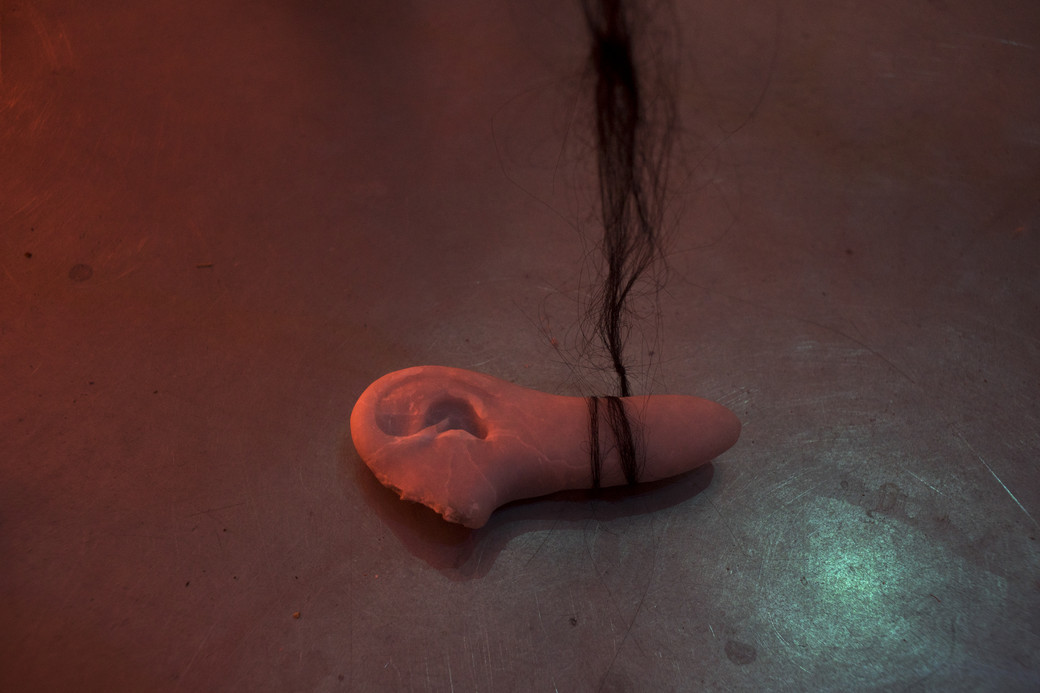
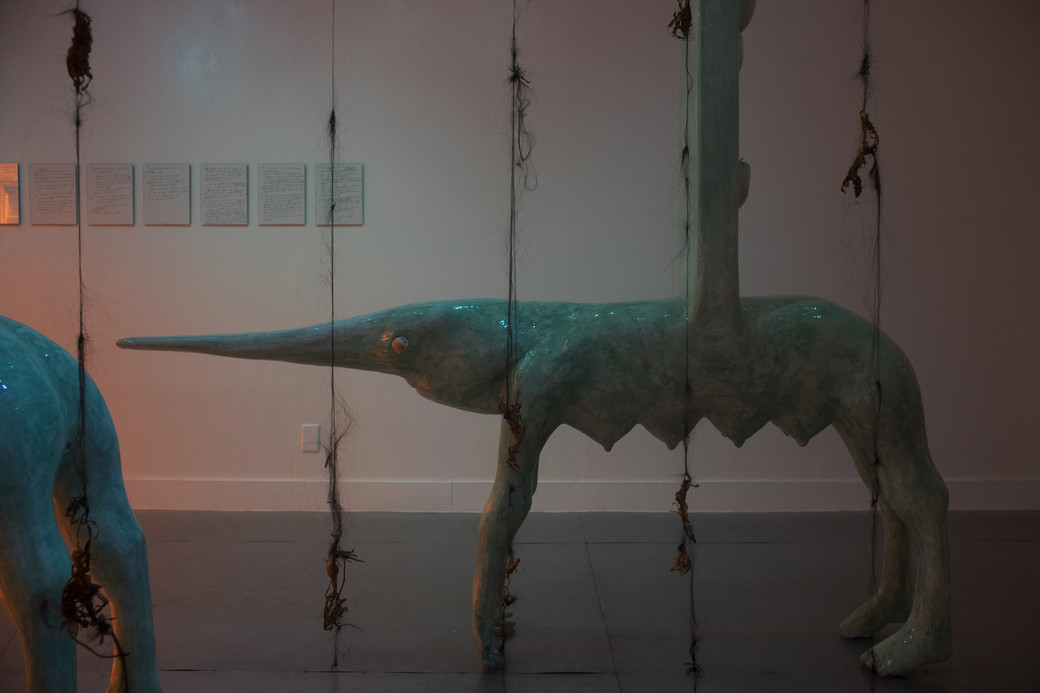
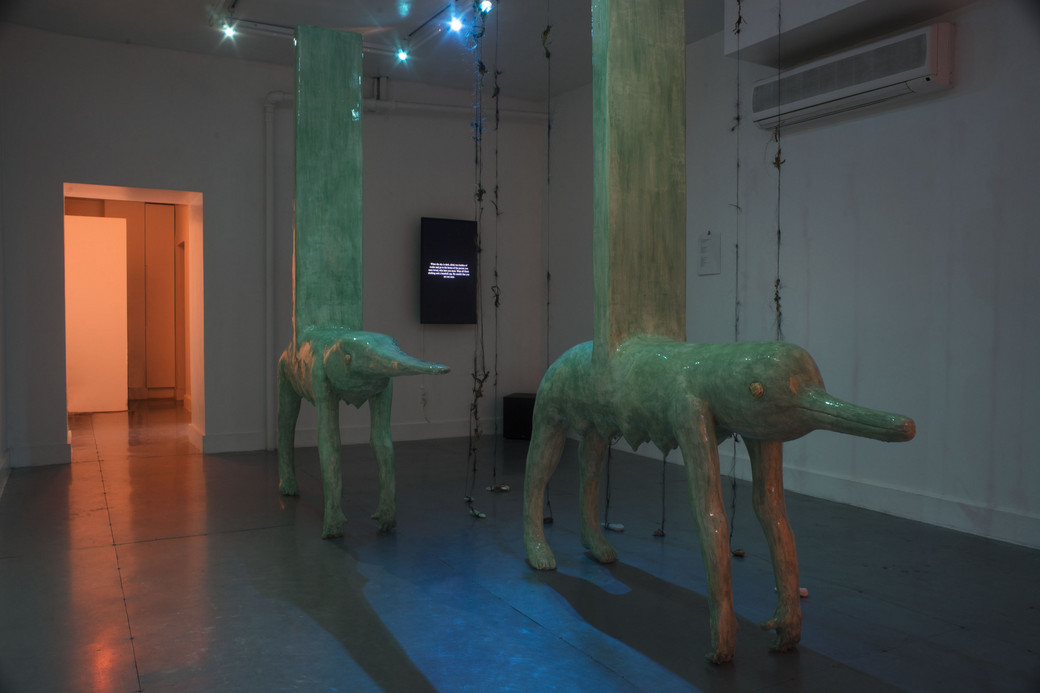
Other body parts emerge as well: ears are attached to slinking strings that resemble hanging moss. There is a peaceful afterglow of a potentially violent division of the body, which could also be a slow, marvelous decay—like the words that have been mistranslated into something potentially lovely, so the body is transformed through a chaotic time lapse.
Ouyang was thinking about something called ‘shifting baseline syndrome,’ a socio-ecological phenomenon where scientists are unable to accurately determine a species’ population size, and often must determine their data based on word of mouth, literature and art from the area—basically, they must rely on cultural mythology. Science relying on ephemera elevates ephemera in a kind of magical way—it becomes worthy of inclusion in the hallowed realm of ‘research.’ Ouyang’s work plays into this sense of expansive cross-disciplinary wonderment.
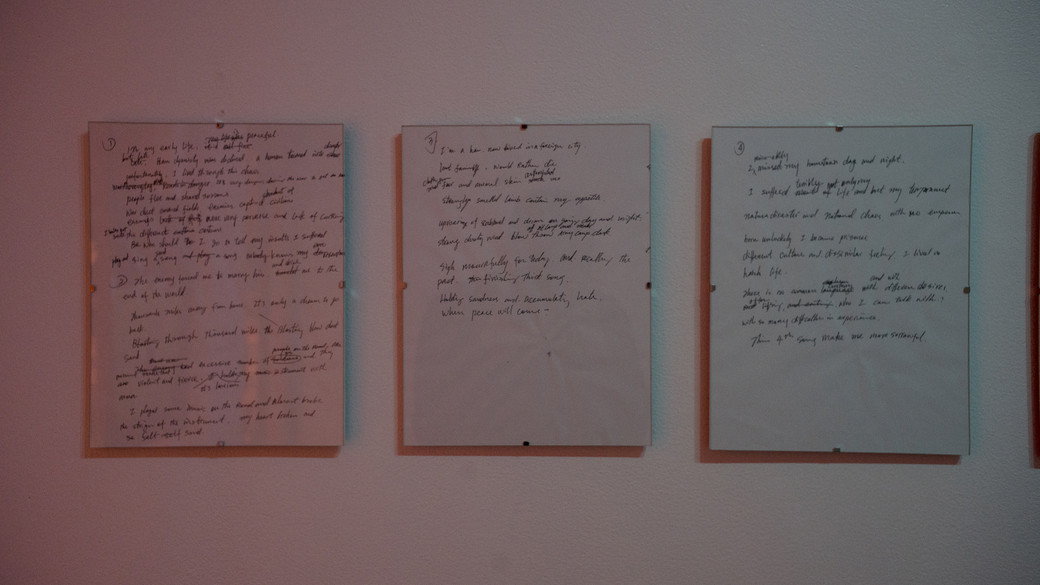
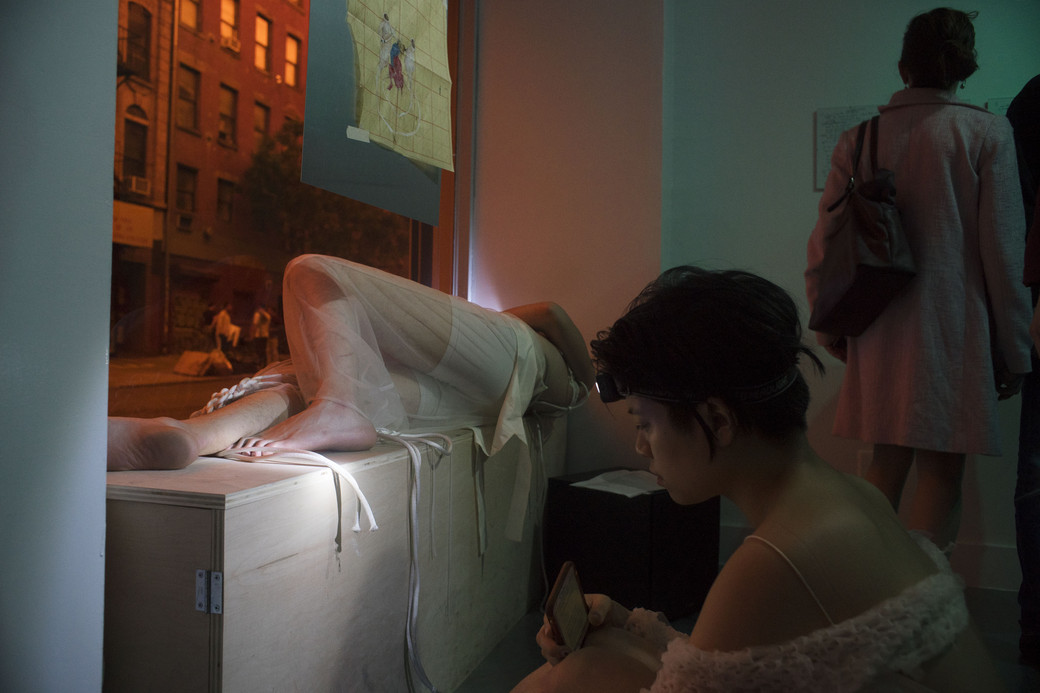
And then there’s the durational performances. Not only has the artist altered the lighting of the gallery (the window is tainted orange, the fish-like sculptures lit in blue), included analogue writing samples alongside a screen that plays incredibly evocative poetic commands, but has extended her hand into an activated performance. Language is the focus—the structure of questions repeated, atonal songs chanted, and the bodies of the female performers bumping into the walls like stuck Sims characters evoke the strange cross between joy and confusion that bounce and play off the artworks and the small space. Words are like trash: they have incredible power when used the wrong way for the right reasons.
'fish mystery in the shift horizon' is on view at RUBBER FACTORY through June 22nd, don't miss the durational performance tomorrow at 5pm at the gallery. All images courtesy the gallery.

Cheryl Pope spoke, and office listened. See what she had to say below.
When were you first struck by “the concept of Leisure,” in relation to you and your partner’s biracial relationship?
We spent a month living in Miami, both taking a break from our studio practice, we went to the beach every day. It was the first time for either of us to take so much time out of the studio and just relax. We read, went to the gym, and literally just chilled at the beach the entire month. It was natural to notice the luxury of this leisure time and also the positive effects. I was looking around to see who else was there, who has access to leisure, what is the history of leisure, what is the language of leisure, and what are the effects of leisure.
Why did you feel called to create this series?
I think in times of crisis, love is needed most. I wanted to create images of love, of the natural and normality of different people being together, being intimate and vulnerable, and being in love. I wanted to create works that are sensual and primal, a reminder of how our fundamental human desires connect us.
Did you envision this series before you created it, or did you discover it along the way?
It was a combination. This technique was also totally new for me, so I was also learning my language with the medium in the process of making the works. And I knew the imagery I wanted in general, but there was and continues to be so much discovery along the way. I think that’s what keeps the work feeling alive. When the artist is discovering something within the process of making the work, the work is the evidence of that discovery, it carries the spirit of that discovery and I think that energy evokes a specific kind of response because of it.

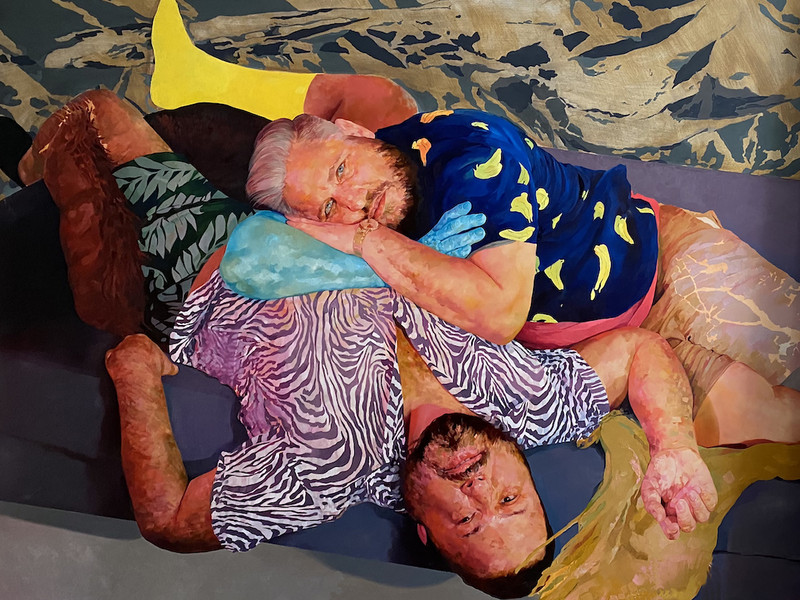
Above: 'Woman and Man Reclining on Striped Mat XI' and 'Woman and Man Reclining on Striped Mat X'.
How did you begin this series of pieces?
The process is really sculptural for me. I love being physical with my work, this material really allowed me to enter the two-dimensional plane in a three-dimensional way. I first lay out the ground cloth (cashmere) and then use long strands of the roving (unspun, raw wool) to draw out the figures.
Why did you choose to use needle and felt as your medium? How do you feel the material you chose affects the viewers relationship with the piece?
I think one of the most beautiful and important qualities of this work is the material and the process. That fact that it is all hair. That it is all natural and simply created by hair locking to other hairs (the needle-punching literally binds the wool and the support together). I think this material evokes a sensuality, the tactile surface asks to be touched, and though that impetus is denied in a traditional gallery setting, that desire still brings the viewer into their body.
Could you describe the relationship between the human forms in each piece?
The two figures lying together are intimate, vulnerable, exposed. They are close in relation to one another in comfort, and yet there is a humor, a complexity, there is a sense that they are still finding each other within that plane of comfort. But they value love and vulnerability, and they know that through their exposure, they are sharing and celebrating it with the viewer.
Do you find that social and political issues often shape a lot of your work?
Absolutely! It would be impossible for it to not.


Above: 'Woman and Man Reclining on Striped Mat V' and 'Woman and Man Reclining on Striped Mat VII'.
What is the symbolic intention behind the background colors and nature elements?
The cropping and composition of the work maintain an indistinguishability between an interior and exterior location. So, it co-exists as both a private and public space, similar to how a towel at the beach becomes your private space, your real estate for the time you are there, yet it is very much a public locale. The color stories emerge from travel in warmer, tropical climates with colorful architecture, specifically in the Dominican Republic and in South Beach Miami.
The plants are also really important. They are tropical plants and for me, being from the Midwest, when I see a palm tree for example, I automatically think holiday. I have a feeling of vacation, of leisure, time away, the beach. And my partner is from the Caribbean, so palms for him have a feeling of home. I think this duality of associations within the history of leisure, holiday, geography, and a love story, is compelling.
Why did you choose to leave both figures faceless?
I want to keep a looseness to the identity. It is biographical and also not, it is not just about me and my partner, it is about many, it is about the histories of love stories across time. It is universal.
What message do you hope will translate to your audience through your work?
Gordon Parks said: “There is something about us that goes deeper than blood or black and white. It is our common search for a better life and a better world.” I hope that people feel love, see beauty in vulnerability, humor in attempted articulations, and a joy in the magical love stories that defy all politics and wars.
'BASKING NEVER HURT NO ONE' is on view through August 17th at Monique Meloche Gallery in Chicago. All images courtesy the gallery. Lead image: 'Woman and Man Reclining on Striped Mat VII'.