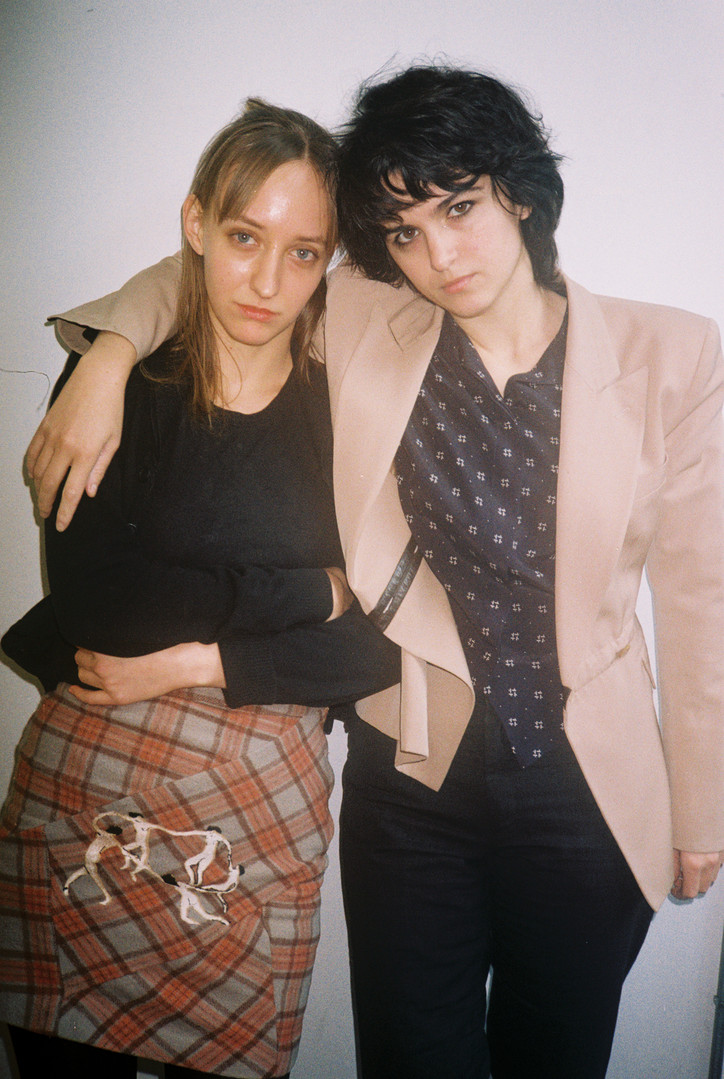
PRESENTE CONTINUO: the intimate ties between then&now

Starting May 30, PRESENTE CONTINUO will be available to purchase on presentecontinuo.com, cpcompany.com, and at the C.P. Company flagship store in Milan, Corso Matteotti 7.
Stay informed on our latest news!

Starting May 30, PRESENTE CONTINUO will be available to purchase on presentecontinuo.com, cpcompany.com, and at the C.P. Company flagship store in Milan, Corso Matteotti 7.

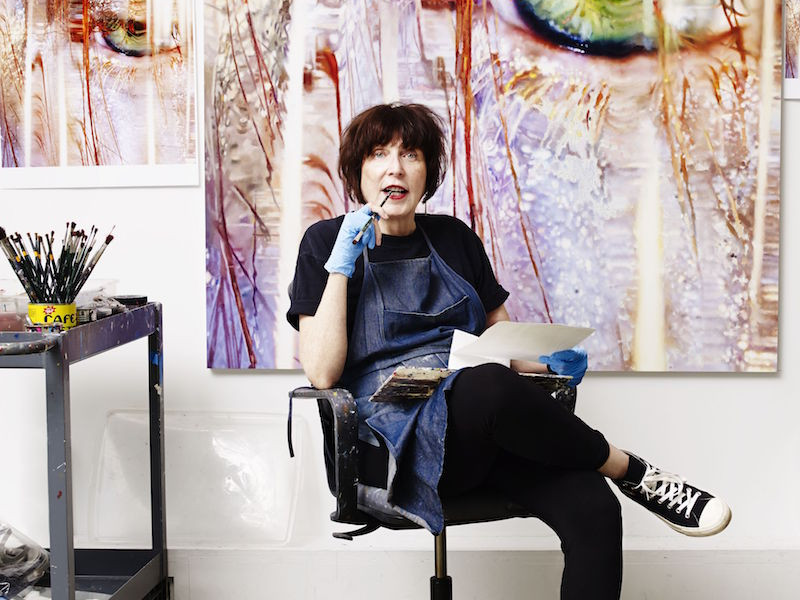
And it shows. Auerbach's art is meticulous. Whether she's working in video or sculpture, photography or paint, the San Francisco native dwells in the details, creating pieces that fall somewhere between mathematical and abstract. Her work, which is at times conceptual, is always concise; but more than anything, it pushes viewers to look past the medium or the final rendering—it's the tiny molecules, each stroke or pixel, that make up the whole.
On the heels of A Broken Stream, Auerbach sat down with office. Read our interview, below.


You've had a busy year.
It’s true. I decided to go hard this year so I could go away for a while and think.
Do you ever turn off?
I seem to have two gears, and I really need to work on having a third, more moderate gear. I’m either way on or way off. But I don’t know what ‘off’ means exactly. Maybe it means not being productive in a really obvious way, but it still isn’t really off… I don’t know. I’m hoping to explore this.
I think for creative people you're always in the process of taking in material.
You’re right. And that obviously never stops, but while I’m away I need to do something that I’ve never done before—I’m planning a survey show in a couple years I need to sit with all my work so far and try to make sense of what it adds up to, if anything. Somehow I know I’m heading into a trip where I will confront my biggest weaknesses.
Is it for a residency?
No, I applied for one and didn’t get it, so I decided to make my own.
Do you think these intense work periods are actually important for your creativity—these deep dives, going a bit crazy?
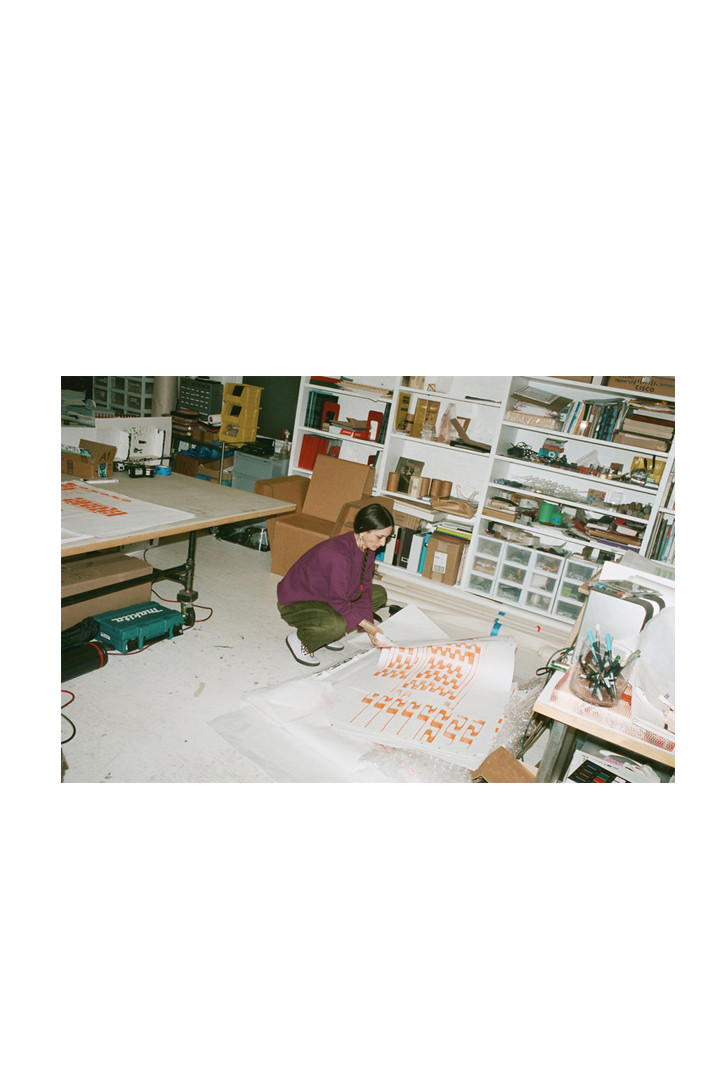
Yeah, I mean, it’s such a privilege to be able to do what you want to for a living, and then there is also some kind of demon in me that makes me need to just make things, or fix or build things all the time, so I can’t imagine putting anything less than every ounce of myself into a show or a project. Particularly if very special opportunities come my way, like painting a fireboat! Right now I'm just on the other side of a very difficult preparation period for a show [A Broken Stream at Paula Cooper Gallery], and I can't tell if I feel energized or exhausted. I guess both.
Have there been past exhibitions where you felt it was smoother?
Smoother, yes, but I have never felt that it was smooth. Ever! I have never been done ahead of schedule for anything. This show was especially challenging because a lot of practical things that came up. For example, one of the glass sculptures was broken while traveling back from another exhibition and I had to repair it in the week and a half before the show. Somehow I found myself without any time to reflect on anything. I had to make decisions quickly and so I doubted about a lot of them. I had worked for months on a new series of paintings and a few weeks before the show I couldn’t tell if they were… anything.
So, I decided to take them out of the show. I had my mind made up but a few days later I was persuaded otherwise. I didn’t even know if that was the right decisions as I was doing it, I was really uncertain about it until, like, now, basically. But I knew I was going to go through a lot of hand-wringing with these paintings no matter what, whether it lined up with outside things like deadlines or not. There just isn’t a shortcut through that time of shuttering uncertainty with something new, and in my experience, the most worthwhile things are often the most painful to deliver.


When I heard about the glass breaking incident, I automatically thought about that Duchamp work, The Bride Stripped Bare.
Because it lives in its broken state?
Yeah, because the glass cracked in transport. I forget the reaction exactly, but Duchamp felt in the end the cracks completed the work.
I wish I could have taken that approach here, but the sculpture is sort of cantilevered and it wouldn't hold itself up without the part that broke. There was no way to just ‘roll' with this one, unfortunately.
Science, mathematics, physics: these themes come up a lot in in your work. Have you always been interested in these areas?
Definitely.
Were you good at science as a kid?
As a young person, yes, but then my attention got absorbed by art. In college I intended to pursue physics, but didn’t. I don't like competition, and the science classes were graded on very competitive curves. Plus I just wanted to be in the studio. At times I’ve regretted this, but fortunately school is not the only place to learn things. I watch a lot of lectures and classes online, some of them by the people I feel I missed out on. But yes, those have always been interests of mine. I also grew up next to this really wonderful, hands-on science museum in San Francisco, the Exploratorium. I would go often, and it definitely inspired me. One of the things I like most about that museum is that everything is designed in a really functional way. The exhibits are not made ‘cute,’ it doesn't talk down its visitors, and it’s not just for kids. I still go there.
What I've also noticed is that you’re oftentimes tying science and physics to deeper ideas of spirituality or transcendence. That plays out in your current exhibition at Paula Cooper.
If you think about science long enough you inevitably run up against questions questions that generally also get addressed by theology. Being able to put these things together in a smart and human way—that’s what I admire about people like Hilma af Klint, whose show at the Guggenheim right now is totally transporting an incredible.
I felt there was so many interesting parallels between what both of you do. The geometries, the references to science, the mapping of energies. Did you know much about her before?
I was familiar with her work, but I’d never gotten to see it in person. And in person, it has a kind of aura, a charged power. The work is so effective in getting across these kinds of cosmic and microscopic structures, and in a very specific, felt way. It’s not just a set of diagrams. She talks, or the wall text talks, about a book that I have somewhere in here called Occult Chemisty, by two Theosophists—Charles Leadbetter and Annie Bessant who worked to focus their “yogic vision” to see and learn about the chemical elements. This was in the 10s and 20s, I think. This might sound absurd to some, but it doesn’t to me. I think there is a lot of information about whats “out there” that can be mined from within—we’re made up of these elements, afterall.
And what's fascinating as well is how her work existed outside of the art market.
She didn’t even want people to see it for a long time!


Well, I mean in your exhibition right now. When I look at the videos and the drawings, I get mesmerized—there’s this hypnotic effect in the patterns or the motions. It seems to suggest some kind of spiritual something.
A trance state is a real thing. We get into them all the time because of like driving or scrolling on the phone. Everyone is hypnotized! These states can have a spiritual interpretation, or a purely physiological one. I personally find the droplets I filmed for the video extremely hypnotizing. For me, it was partly about getting you into a hypnotic state—delivering a kind of tremor—but also about showing some kind of reverence for the fringier or discarded theories of the universe, like Pilot Wave Theory. And despite the fact that the experiment does not prove Louis De Broglie and David Bohm’s theory, it does show us some pretty weird “particle” behavior, as this droplet interacts with its own wave.
If you look at the droplets from above, it looks like they're moving around in a way that doesn't make any sense. It seems random but weirdly purposeful, because they'll move one way and then change direction abruptly. They just seem to have a mind of their own. If you record them for a long period of time it becomes clear that they end up in some areas more than others—in rings of varying probability. The equation that describes the probability is the same as the one that describes particles position on the tiny quantum scale—like electrons and photons. So even if it doesn’t prove anything, it MAYBE gives up a taste of quantum weirdness. I want to be with that weirdness—with the qualitative features of the experiment, not the quantitative ones.
I really appreciate people’s—even failed—attempts to make sense of the universe. To me that endeavor has a spiritual flavor even if you’re a hard core, materialist. To think about everything that is, how it all connects and works, well that’s what religions concern themselves with too.
I also want to talk to you about Flow Separation, the show with Public Art Fund that I had the pleasure to work with you on, where you painted an entire fireboat. Have you ever worked at that type of scale before?
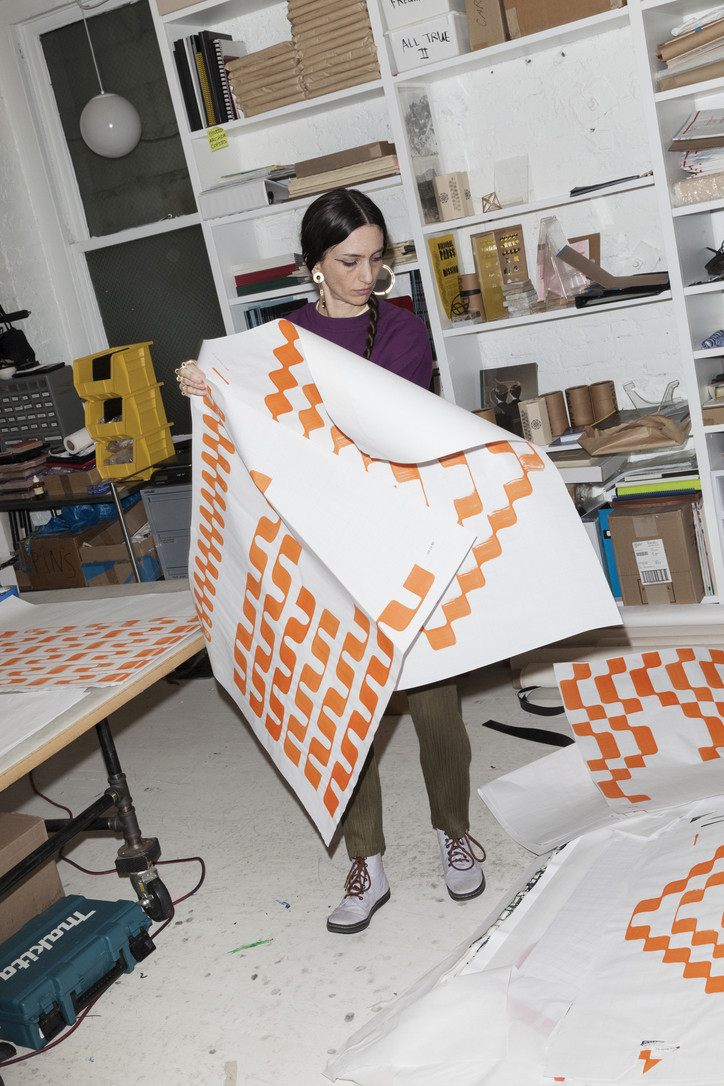
I made a curtain for the Vienna Opera House, which was physically large but it was a flat, printed surface. The fireboat was curved and we painted every bit of it by hand. It was technically a big learning experience!!!
How was that experience overall?
Just incredible, start to finish. I mean one of the most memorable, special things in my life so far, honestly. Just getting to be part of a community that I had no contact with until a few months ago has been so special. I went on a trip with the fireboat and its volunteer crew up to Albany and Waterford this summer. We pulled up next to another dazzled boat, the USS Slater, which is painted in its original dazzle, and then lead a boat parade up the river with dozens of tugs to a “tugboat roundup”. Everybody was so welcoming and kind and we all come from very different walks of life. And the work of making the piece… it was so fun and so difficult. I learned how to marble—not necessarily well, but well enough to make the design. I and I worked with an amazing, almost all female crew—a group scenic painters (Infinite Scenic). The conditions where physically very challenging and we didn't have a a lot of time, so we worked very long days. I’d kind of shuffle home sore at the end of every day, but it was the best kind of tired.
You’ve called New York home for a little while now.
10 years.
Coming from the West Coast, what what brought you here, what what made you stay?
I always thought I would be a New Yorker for life, but now I’m thinking, maybe not.
Why not?
I miss nature so much, Not being able to see a long distance, breathe fresh air—I miss that. I want to walk on dirt and learn about trees. Why do humans come to a place and just kill everything around?
I love that I grew up in the Bay Area, but I felt it was sleepy at the time that I left, and I had a lot of energy and I wanted to be in a place that had a lot of energy. So I wanted to move into the middle of it, right into Lower Manhattan, and that felt great until pretty recently. Experiences like the fireboat make me still love this place though. There are thousands of little universes in New York, you just have to discover them, and remember that yours is just a drop.
Part of the reason I’m going away for a while is that I hope I’ll get some insight on where I want to be. I'm also noticing that as people around me are having children—and I don't intend to do so myself—I am envious of one thing, which is that they have this page turn in their life, like a total paradigm shift where reality changes and a new way of thinking is required. I want to create that next chapter for myself in some other way, and to sink my teeth into a new way of living and thinking.
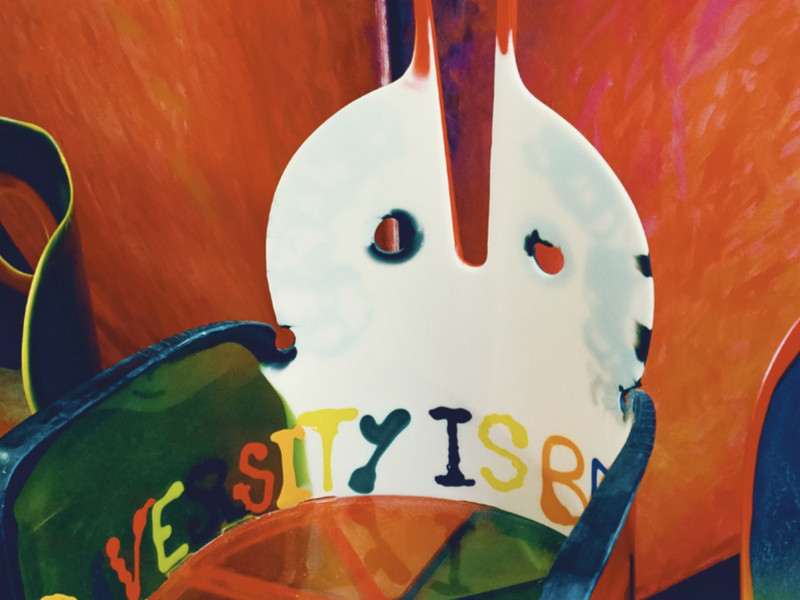
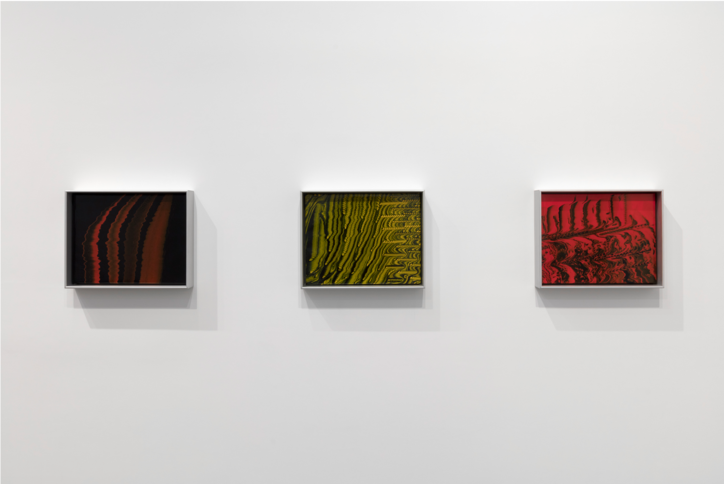
'A Broken Stream' installation view, and 'Where there had once been a snag in the fabric,' (detail) 2018; courtesy of Paula Cooper Gallery.

Unlike a lot of other art, in which the act itself can, for a lot of artists, be as powerful as the finished product, a self-portrait offers up equal value at both ends—during, as a process of reflection, and after, as a means of understanding, or in Sweeney’s case, subverting, the ways in which we present ourselves to the world. As a long time figure in the art scene, Sweeney has a history of inserting himself into his work and thus, letting viewers in on that complicated process. With Self-Portraits, however, he proves that it doesn’t really matter how others view us—all that matters is how we see ourselves.
Below, the artist sounds off on his latest solo show, and the biggest changes to the art world over the last two decades (hint: more artists now wear Hood By Air).
You often feature yourself in your work, in one way or another—take your 2010 installation [in which Sweeney moved his living quarters inside a gallery], for example. Why is that important to you?
Self-reference is something that I find almost inescapable in an artwork. The mark made by one's hand is telling. Even if one decides to work in a way that removes the appearance of the artist's hand, that in and of itself is also very revealing. These self-portraits deal with the surface and the emotional interior at the same time, as well as the relationship between self and surrounding environment. The self-portraits are spurred by Kembra Pfahler's idea of availabism—the image of myself was very available.
How do you think this series fits in with your overall body of work?
At times it fits in and at other times it doesn't. How does any of the other work fit in with it? That's how it does and doesn't work. [It’s] a reflection of life.
Since you do work in so many different mediums, in this series, how did the medium—painting—impact your vision and overall process?
Painting is a medium that came to my attention intuitively very early on in my life. The will to paint and draw, play music, dance and cook—[it] all came to me very early, as if they were waiting there for me.
Does your process differ across mediums?
I feel whenever one is engaged in a creative act, be it object related, performing or composing music, cooking, writing or whatever it may be, it has to call upon a certain similar heightened level of sensitivity and perception. Of course, the skill sets will vary relating to the specific act, but the level of sensitivity one must employ seems to be a unifier.
Would you say there's a through-line across all of your work? Are there certain themes you find yourself returning to often, no matter the medium?
Yes, different themes occur and reoccur. It would be interesting to keep a running list of recurring themes—stop at one point and take that shit to your analyst.
How has the art scene changed over the last two decades? I know that’s a broad question, but what are the most noticeable things for you?
It most certainly has changed. Many more artists are wearing Hood By Air than they were 20 years ago.
Your background is in performance art. Do you still see your practice, in some ways, as performative?
Not so much with the same audience-performer dynamic. I do perform with the improvisational music band IUD whenever they want me to. IUD is Sadie Laska and Lizzi Bougatsos, both visual artists and founding members of the performance art noise outfit Actress. We started that project in the late nineties after meeting at American Fine Arts. You might not have heard of us because Colin Deland was our only fan.


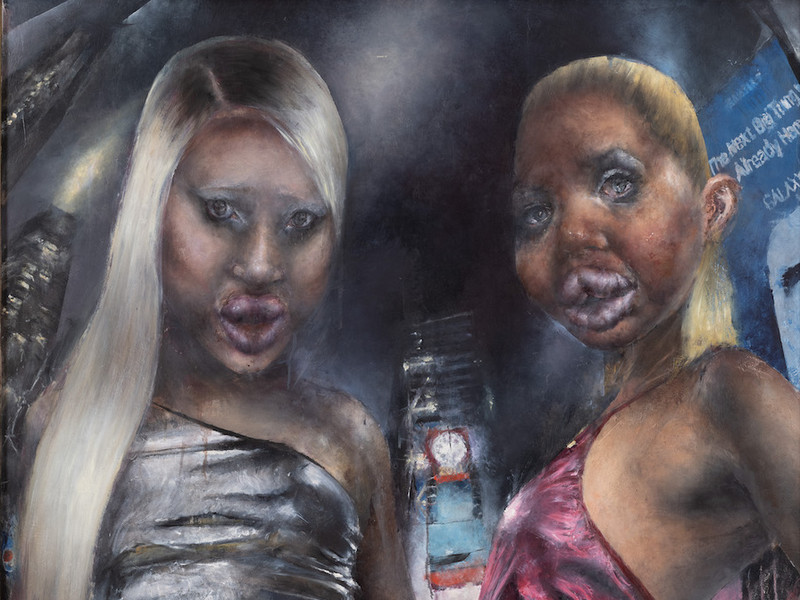
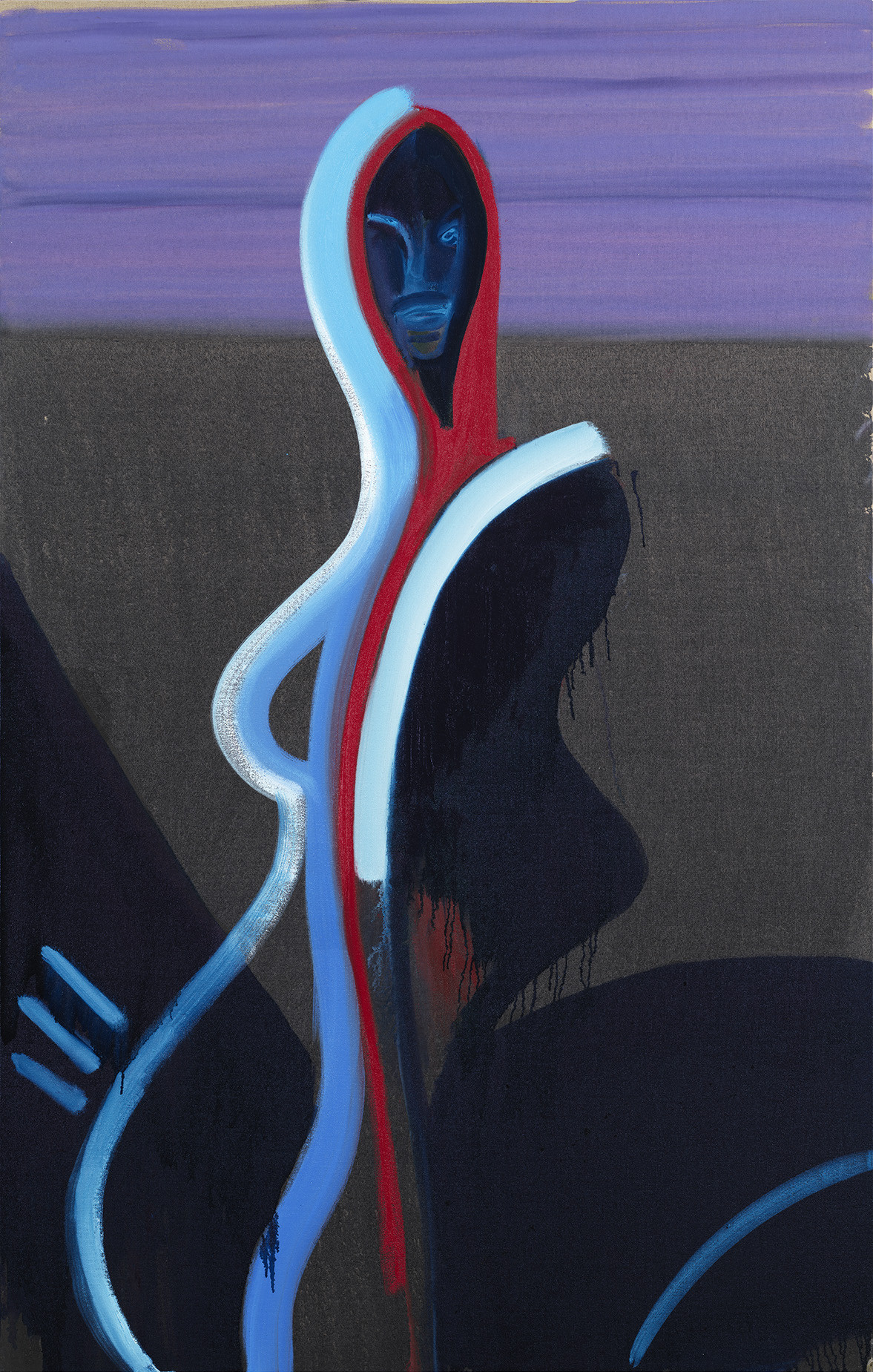
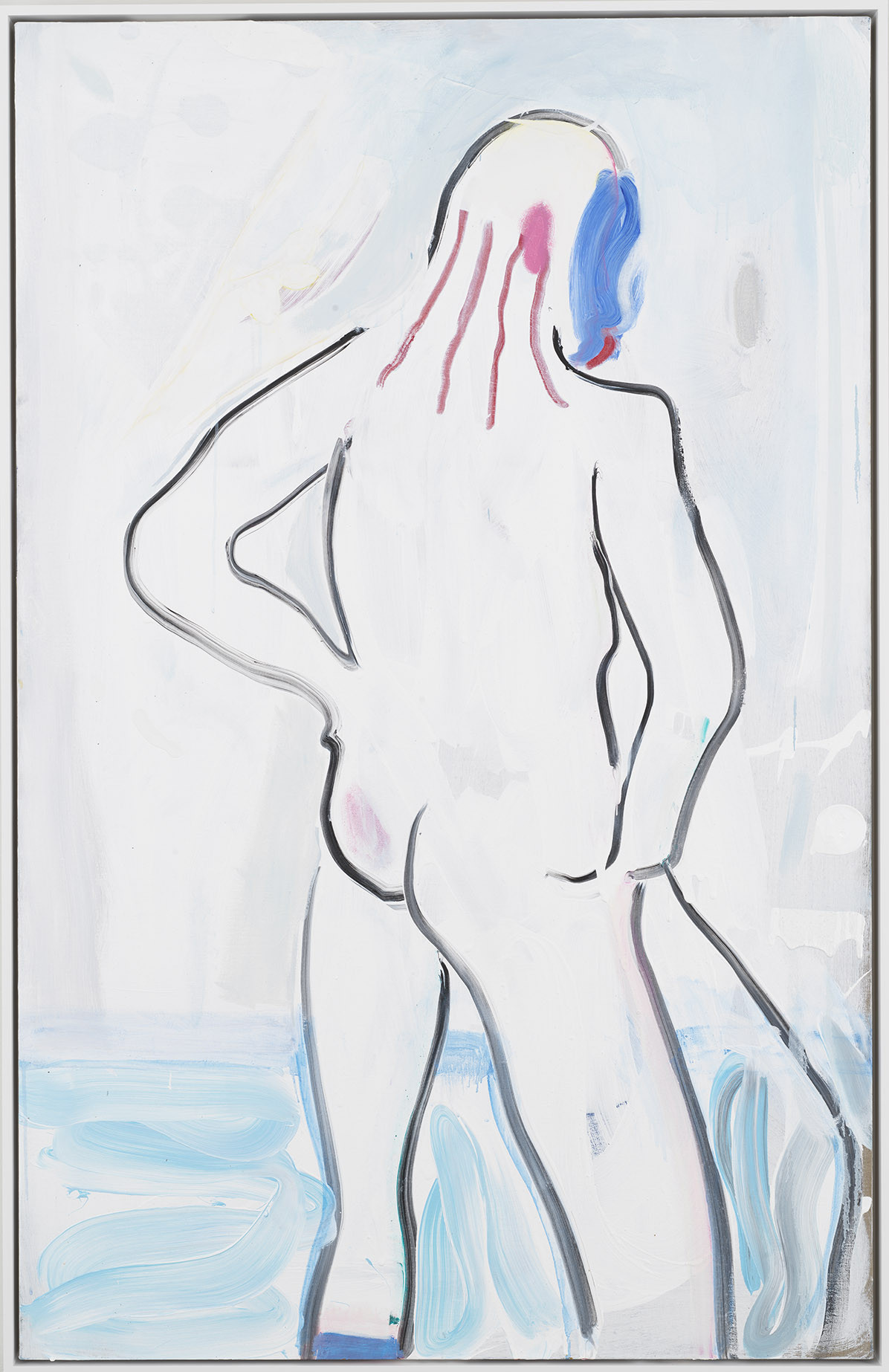
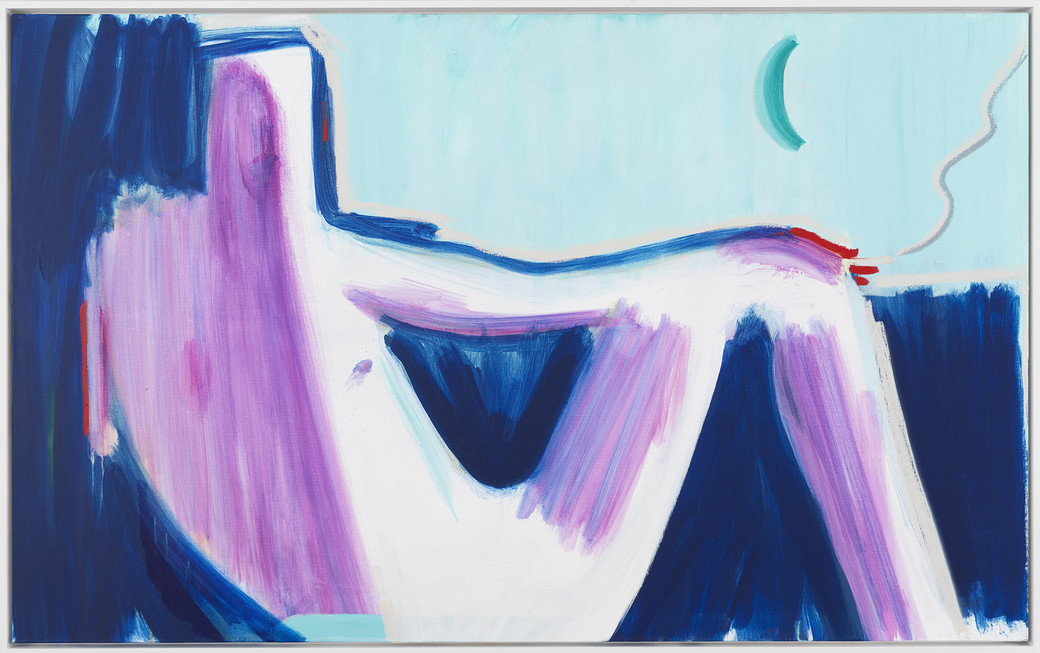
'Sensual Shade' and 'Rouge, Bather,' 2018. © Spencer Sweeney.
You recently collaborated with Urs Fischer on a series called Headz. How was the transition working on such a collaborative piece to focusing on something as solitary as the process of making self-portraits?
Headz was an open studio where people could draw, paint or sculpt whatever they wanted. Initially, the idea of turning the often solitary act of creating art into a shared experience was a focus of the experiment, but as the thing gained momentum, the idea kind of dissipated and became an irrelevant non-issue. So maybe we just blasted that wall. Another important factor was the live improvisational music being played at the same time. When the two of those acts got together in the same room, a chemical reaction occurred and it blew the roof off the joint—the sum being much greater than its parts in this case.
Do you think there’s a power in self-portraiture? In being the one in charge of the way you present yourself—and your image—to the world?
I think there is a power in self-portraiture. Any self-portrait, no matter how successfully or not it's executed, will have a power to it. Sometimes it’s powerful because the artist is in control of how they present themselves, but often it can be powerful because the artist is not fully in control of how they present themselves, no matter how hard they are trying. It's almost as if when you sit down to record your own image another force takes over.
Do you consider your work conceptual?
All artwork is conceptual, although not all conceptual art is art.
Some of the portraits in this series are more abstract, while others are clearly more realistic. Walk me through that decision—does the abstraction serve as a larger metaphor in the pieces, or simply as a visual tool?
It’s simply another day, another feeling; then allowing myself the freedom to follow that other feeling wherever it may lead.
Along those same lines—while some of the portraits are very clearly you, some of the others are totally different; some even look female. What role did gender play in the making of these self-portraits?
I believe that every human being has a feminine side and masculine side. At one point, during early human development, we are very literally both of course. I feel we are still both, but somewhere along the line, fear of the other enters the picture. This fear of the other is the root of most of the problems the human race suffers—misogyny, racism, classicism, you name it. My self-portraits take on female characteristics at times because that's the way I am feeling and that's how I understand myself and human beings to be.
Do you think all art is introspective in some way? Or does the act of creating self-portraits incite that feeling of self-reflection?
That's an interesting question. You might think that there is a moment of introspection before anyone starts a creative act, but you can also imagine that it could happen without any self-awareness whatsoever. I have no way of crawling inside of everyone’s head to figure this out. For me, the act of creating a self-portrait is most definitely introspective and self-reflective, as I am often looking at a reflection of myself in the mirror.
Was that process cathartic for you?
I understand the creative process to be inherently cathartic. The creative process seems to have a dramatic arc similar to that of a Greek tragedy. There is always a certain amount of pain involved as you embark upon this kind of challenge, often finding yourself navigating through the murky waters of self-doubt and repeated failure as you reach either resolve or catastrophe. If you make it through, then catharsis.
'Self-Portraits' is on view now through December 22 at Gagosian New York.
All photos by Robert McKeever; courtesy of Gagosian.

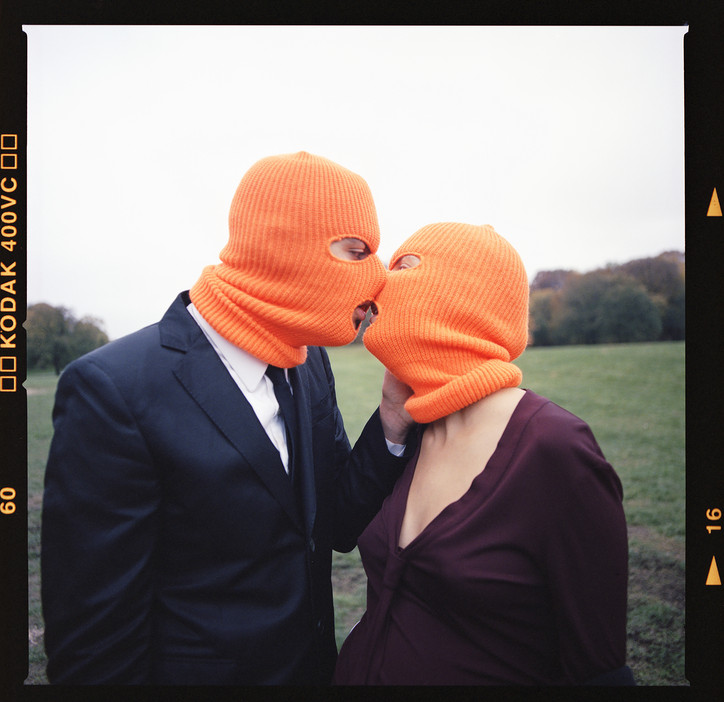
Homoerotic tension is the binding theme—be it between beloved fictional characters, iconic historical figures, or intellectual heavyweights, most scenes build toward the two characters acting on the sexual urge bubbling between them, but transition to the next scene just before the would-be moment of realized romantic connection. The binding homoerotic thread returned to again and again is Captain Kirk and Spock, of which there is an extensive romantic literature authored almost entirely by women—if the factual-seeming moments of the play are to be trusted.
It is a cool and accessible take on the weird and intense current cultural focus on all things gay, all things trans, an essayistic revelation of the underlying sexual tensions that have always existed between friendly characters of the same sex. At one point you feel a thesis developing, one that feverishly contemplates the fraught question of what our culture collectively desires, and the many fractured versions that this entails.
After a recent performance, Hennessey and Allan stopped by office to talk all things Slash and fan fiction.
What draws you to theater and playwriting?
Leah Victoria Hennessy: We’re both recovering theater addicts and this play would constitute a major slip in our recovery. I swore that I wouldn’t do any more theater after I wrote a play and directed it a few years ago. Emily was the star—it was so stressful, it made me realize that doing theater without institutional help is just too hard. It felt like it took years off my life and I promised that I would never do that again. But somehow, we got sucked back in.
How?
Leah Victoria Hennessey: We have a web series called Zhe Zhe—it’s the name of a band in the show, but it’s also a cutesy gender neutral pronoun. So, we had the show, but we would be asked to do live performances connected with the show, not theater, but performance art. So, we started doing those performances just the two of us, ahe first one we did was the first version of Slash.
What was the idea behind Slash?
Leah Victoria Hennessey: We thought of it as cosplay. We wanted to take something that wasn’t usually considered theater, like a cosplay performance, and do it in a theatrical setting. That was the idea. Originally it was performance art, and it was much more ironic. Then we had a monthly show in the West Village, and that’s where we developed most of Slash, but I still wasn’t thinking of it as theater.
How did you get into theater, Emily?
Emily Allan: My first piece of theater that I directed and conceptualized was when I transferred elementary schools and I would take a bus across town and pass by Jefferson Market Library, which I learned had been a women’s prison. I had a group of five friends that I would take the bus with and we developed this piece of site-specific theater. There was one bus driver who was into it and he would announce it for us.
When did you two start working together?
Leah Victoria Hennessey: For a long time, I was disillusioned with acting, then a teacher introduced me to new method—one based on impulses. It was anti-Stanislavski, anti-the method. It healed me and reawakened my passion for performance and got me writing plays. After school, the friends I had who were in his class and I started our own writers and actors workshop to develop new work. Emily came into that, which is ultimately how we developed Zhe Zhe. We’ve just been working together for so long, it kind of feels like you don’t just find your soulmate, you make them. We Frankenstein each other into our collaborative ideal. It wasn’t that chance encounter—it grew slowly. A lot of the stuff we’re passionate about we got into together.
What’s your collaborative ideal?
Leah Victoria Hennessey: We want to be funny in a subversive way that questions normalcy. I think a lot of comedy right now is upholding the status quo—it’s losing its bite. I don’t think of us as comedians at all, but it’s important for us to be funny in a way that challenges people’s preconceived notions. Also, we want to explore the way experiences are conditioned by the media that we consume. There’s no pure experience of reality. So, we don’t have any interest in purifying ourselves of cultural influence—we’re much more interested in affirming the collaged reality.
Emily Allan: In a way that’s sincere.
How would you describe Slash to someone who hasn’t seen it?
Emily Allan: Slash is the name of our play, but it’s also a genre of fan fiction. The play is a deep dive into the world of homoerotic fan fiction on the internet. If there’s a narrative, it’s that there is a blonde and a brunette and they feel trapped in their world. They have a feeling that nothing is real, and if it is, how can it be? They feel that there must be something else. So, it’s their attempt to escape or test the limits of reality through roleplay and ritual. They go through a series of ritualistic cosplays of two usually male archetypal pairs, living out this prolonged romance.
Leah Victoria Hennessey: I’m interested in games, ritual and fantasy. Slash is very much a game that we play and it gets very confusing who the real characters are, and who are the characters that the characters are playing. The original or authentic is left open-ended—it’s open ended if there is any escape through games at all. This kind of roleplaying is the kind of thing that if I could still do with my friends—we wouldn’t have to do it in a play. Emily and I can obsess together, but I wouldn’t be able to say to Emily, let’s ‘pretend’ I’m him.
Do you remember, when every sentence started with that word? I remember when I was young, I was in my room playing and realized that adults don’t do that. So, I promised myself I would never stop imagining and pretending.
Emily Allan: That’s what the play is about.
Is fan fiction mostly written by women?
Leah Victoria Hennessey: Most slash fiction, which is homoerotic pairings of possibly straight characters, is almost entirely written by women.
Did I see a critique of that somewhere in the play? You guys were addressing that women write homoerotic relationships because traditional hetero relationships aren’t depicted as dynamic.
Leah Victoria Hennessey: It’s not a critique, it’s a take. In the play, we incorporate big chunks of this piece by Joanna Russ, called "Pornography by Women for Women with Love," and she posits that women fantasize about homoerotic male relationships because men are allowed the complexity and depth and equality that, when she was writing this in the ‘70s, she didn’t feel like women had. Kirk and Spock’s relationship, for instance, was portrayed as more equal, more fulfilling and more noble, and that love between man and a woman can never escape the context of life and patriarchy.
So, it’s a desire to see noble love without limits?
Leah Victoria Hennessey: Without those power dynamics.
Emily Allan: It’s about projecting a fantasy onto something that’s more equal in power. Some people pointed out—and Joanna Russ does too—that a lot of the slash stories wouldn’t fit into the canon of homoerotica. Some people would say it’s not about a gay sexuality—it’s about the sexuality of two characters. And yes, it’s about seeing two people with agency who can love each other free of these dynamics of oppression, but there’s also something that approaches the singularity, in making them one thing and one pair.
Leah Victoria Hennessey: Because when you fall in love with someone, you feel like one of a kind, like the last two members of a dying species. When I’ve fallen in love, I don’t feel like a woman among women who has fallen in love with a man. I feel like one of a kind, and that the other is one of a kind, too. And I feel like that’s part of the appeal of slash. It’s people falling in love and being attracted to each other, despite their sexual orientation, or asexuality, or being different species, alien or human.
It’s about obstacles. When I was a little kid, I read something that said, ‘Eroticism is the overcoming of obstacles.’ I remember being like eight and something clicking in my mind, and thinking, ‘Oh that’s the difference between pornography and eroticism.’
I think the most erotic thing I’ve ever seen was at a Catholic Church—a woman was kneeling and receiving the sacrament, and her eyes rolled to the back of her head as she opened her mouth. It was something that she’d been waiting for and finally received.
Leah Victoria Hennessey: That sacrament is theater.
Emily Allan: Because it happens again and again—there’s no resolution.
Leah Victoria Hennessey: I don’t think you can capture that in film because of the way it exists in time. What makes it theater is, that it’s not a single performance—it’s something you’re going to do over and over. You always know when you watch a play that it will begin again.
Tell me about the actual process of writing the play.
Emily Allan: A lot of our ideas our adapted from real slash fan fiction from the internet—The Beatles bit, Morrissey and Marr, and Trotsky and Stalin.
Did you have to ask permission?
Leah Victoria Hennessey: Well, we’ve tried. The thing about slash fiction is that it has an inherently anti-capitalist essence. You can’t capitalize on it, because it’s illegal due to copyright laws. So, the writing process was kind of a curatorial scavenging. There is one funny thing we do—I can’t write a first draft on the computer, I must write by hand. So, what we do is, we sit next to each other and write and talk it out while we’re writing. We will be talking and sometimes we'll pause, and we will both be next to each other sitting and writing the same thing. So, then we have two copies.
You guys are just so in sync.
Leah Victoria Hennessey: Also, I believe that writing is thinking. I need pen on paper—it’s a control issue also. It’s like, subconsciously neither of us trusts each other to get all the words down right. But I can only think of two other times in my life where I’ve laughed as hard as I did when we were writing. I lose my mind, we scream, we throw the notebook, we get so scared, we think it’s the worst, we think there will be riots—
Emily Allan: And then we’re like, ‘Where’s the Nobel? Where’s the genius grant?’
Leah Victoria Hennessey: We get so worked up when we’re writing, and then we crash and get lazy and have to rewrite it—it’s very extreme emotions.
How did you think people would react to the play?
Emily Allan: Up until opening night, I didn’t know if anyone would be able to sit through it. I had a lot of doubt because there was already so much satisfaction in doing it ourselves. Also, I don’t think anyone has laughed as hard at is as we have. I had no idea how people we’re going to react. I didn’t even know if it exists in the real world because the creation is so insular.
Leah Victoria Hennessey: I thought it was funny, but I thought people were going to read it as pretentious and alienating. I didn’t think people would think it was funny. But I was fine with that. I didn’t have high expectations about response. The play makes people happy to watch—I see them come in and I see them leave, and they’re happy. They don’t just say that they liked it or that it was good, but that it made them feel joy.
That’s exactly what I felt! It made me want to go home and write. And I think it’s because your performance on stage is so genuine—it so obviously comes from a place of love and commitment to what you’re doing.
Leah Victoria Hennessey: I think that some of the fear about people not liking it came from knowing that we were revealing a lot of ourselves. I was like, ‘Well, this is me, so people probably aren’t going to like it.’ It felt honest in a way that nothing else I’ve done has ever felt like, and doing the play made me realize how much I discounted things for being too girlish. There’s something indulgent about the fantasy aspect, in a specifically girly way that felt scary. It’s not like a modern guy play—there’s no macho resolution.
There’s no traditional climax, either, which is kind of a phallic idea to begin with. Theater and literature are such male-dominated institutions historically, that when women take that banner, it’s always experimental, because how do you find your own voice? How do you show yourself who you are on the page? A lot of that for me is fan fiction, slash fiction and Slash the play. It’s creating worlds so that you can see yourself in the world around you.
Leah Victoria Hennessey: The fact that girls have been writing fan fiction for so many years and not needing to have it validated by the outside world or get compensated—there’s big problems with that, but it’s also such an inspiring way to get around the fear of being a writer. Like, when I read fan fiction as a kid and even now, I was like, ‘Wow these people are so fearless about putting words out there.’
What do you want people to take away from Slash?
Emily Allan: I want people to think it’s funny, and to whatever extent, I want to get our ideas and sensibility through. So much has been said about this, but taking this slash format that’s so extreme, and intense, and romantic, and adding things to it and making it theater—that allows for moments of lucidity where I feel like I can express parts of reality that I can’t express in real life. Beyond that, I think that the most important thing about it is that it’s a funny show. The most important thing is laughter.
The next ‘Slash’ performance will take place Thursday, December 20. Buy tickets here.