PRESENTE CONTINUO: the intimate ties between then&now

Starting May 30, PRESENTE CONTINUO will be available to purchase on presentecontinuo.com, cpcompany.com, and at the C.P. Company flagship store in Milan, Corso Matteotti 7.
Stay informed on our latest news!

Starting May 30, PRESENTE CONTINUO will be available to purchase on presentecontinuo.com, cpcompany.com, and at the C.P. Company flagship store in Milan, Corso Matteotti 7.

What happens when the two meet? office spoke with artist Nina Beier to find out.
Tell me about the installation at Metro Pictures.
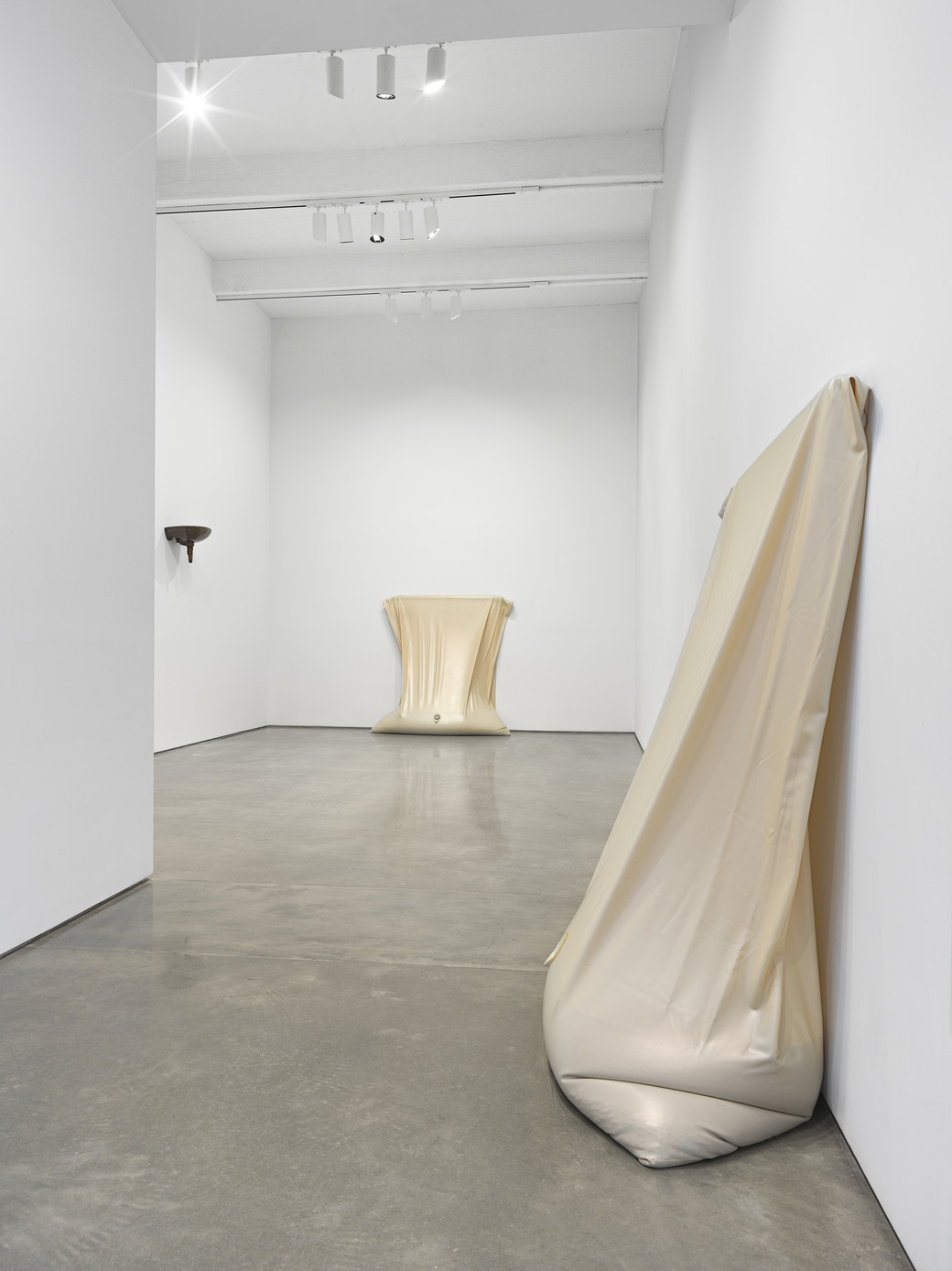
This show is very much a sculpture show. It’s a culmination of an interest in materials and objects that travel. I have been looking at how a material is extracted from wherever it’s from, how it’s traded, how it’s taking shape, and the intentions that go into the making of objects as opposed to how they’re used, and how we then understand or interpret them, and finally how they can then turn into symbols over time. I am interested in how everything that happens to the object along the way somehow sticks to that object and the way we understand it—I tend to work with objects that have encountered problems along the way and involuntarily have changed the way we understand them. For example, I’ve worked with baguettes in many sculptures. That’s just one example of something that, from one perspective, is basic nutrition—but it’s also become a symbol of colonial power and the way French culture has traveled all over the world and made a mark everywhere. So, the object has a different identity depending on how you look at it—it could even just be a sculptural material because it is shaped by hand and made into particular forms.
And you use sinks in this show?
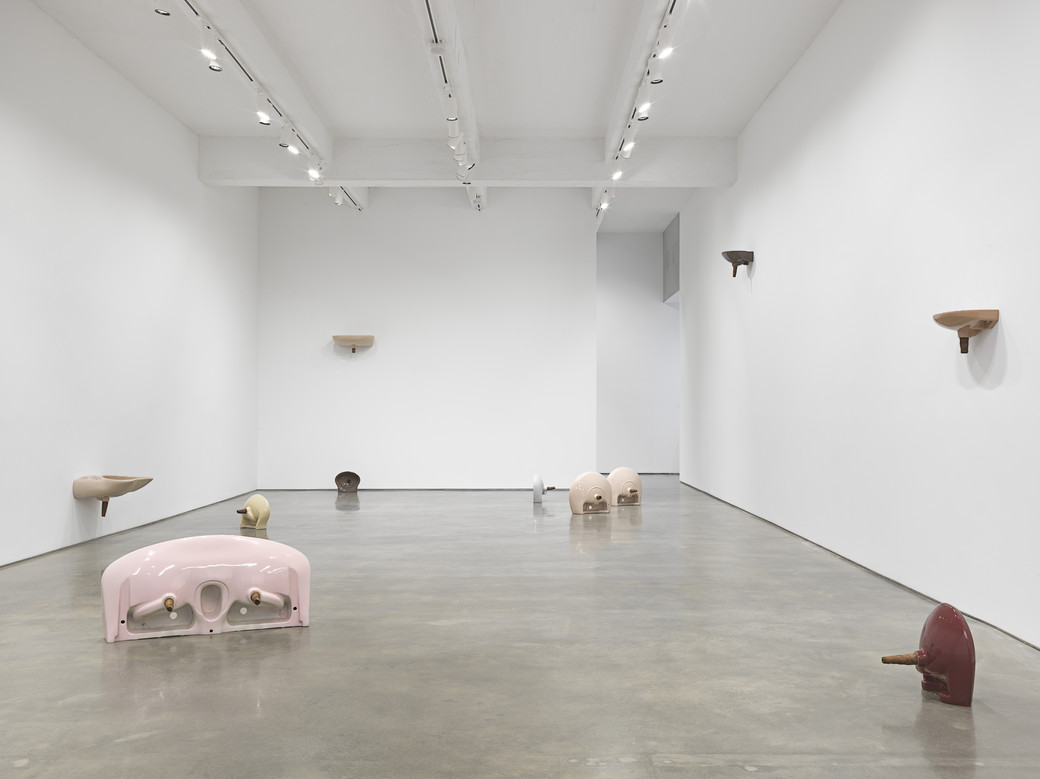
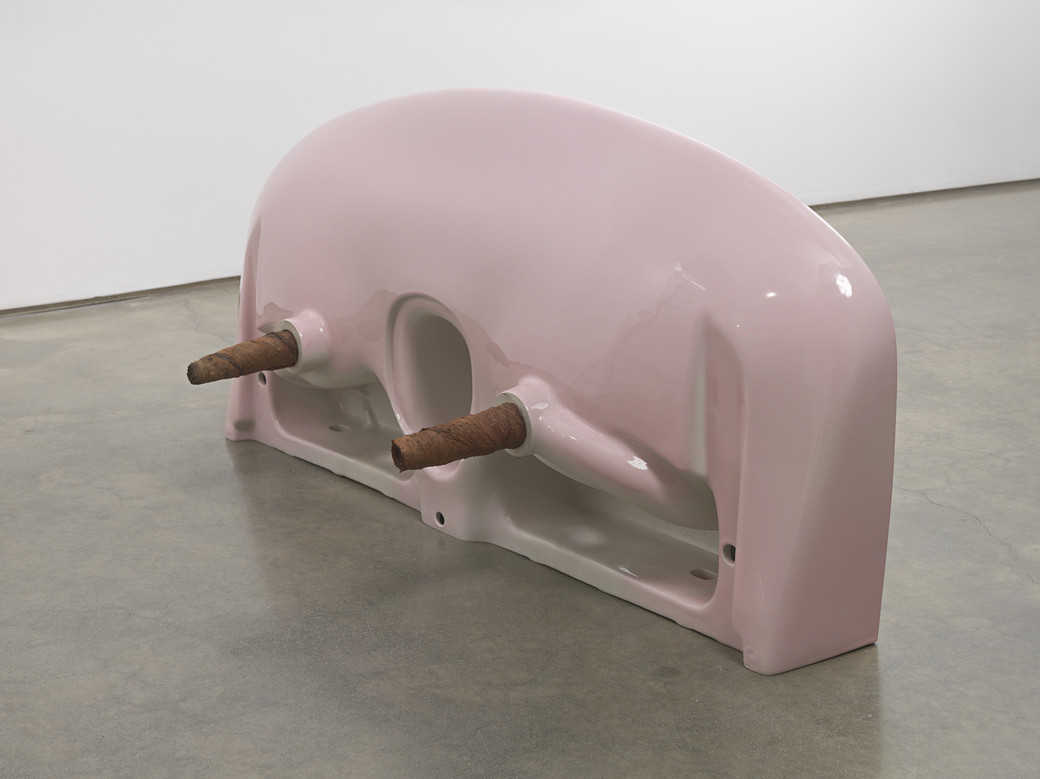
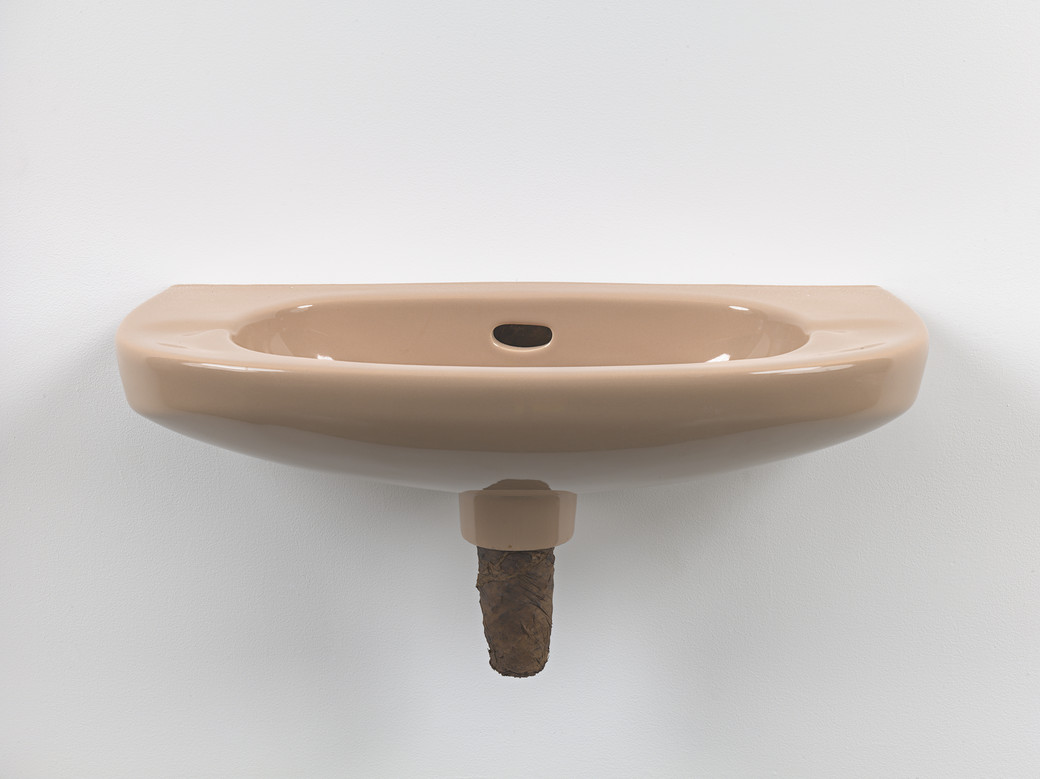
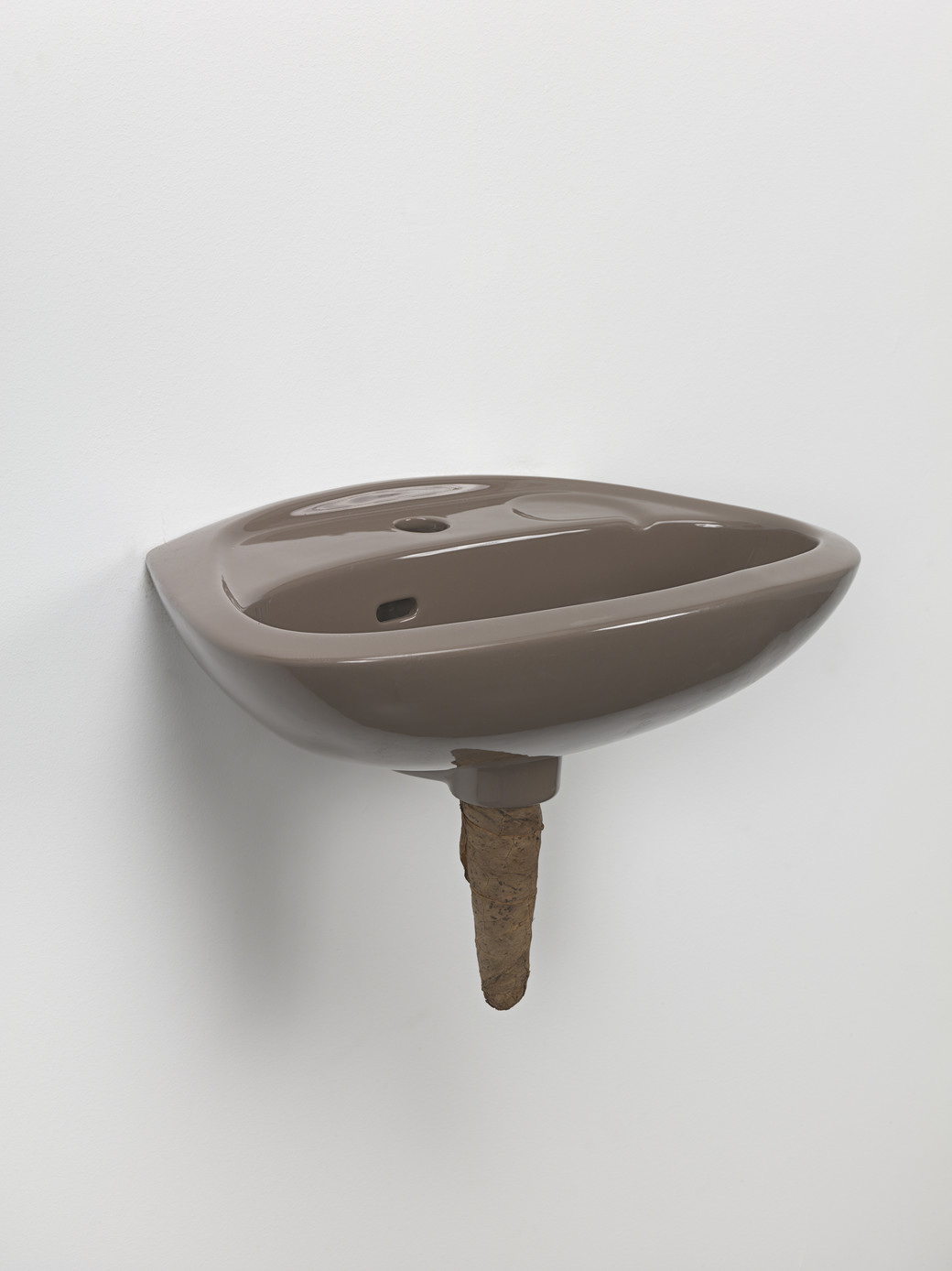
The sculptures downstairs are based on ceramic pastel colored bathroom sinks that I’ve been collecting. They're stuffed with hand-rolled cigars, an object that carries a lot of different meaning, both as a good that has traveled the world and a power symbol, but also as a problematic trade object with a certain history. Another thing that attracts me to the cigar is the fact that it’s hand-rolled—the human effort attaches itself to how we perceive the value of the object. I’ve worked with Persian rugs with an interest in how value is constructed and perceived..
Do you feel like there’s a comparison between something that’s made by hand and something that’s mass produced?
Yes, there’s something about these ceramic sinks, which are mass produced, but are extremely sculptural in their shapes. They’re also design objects. When you look at it from the top, from the front, this is the design object—this is where the attention has been focused—and then, when you look at the underside of the sink, there's a lot of form there based on practical issues—all the piping and tubing, the hanging systems, which have come about from a practical motivation. These two ways of giving form are meeting in this one object, and depending on what side of it you’re standing on, you’ll experience one or the other. But they actually go together so well. It’s such a voluptuous shape in the end—it can almost only reference a body.
Which is kind of like the title of the show—Baby.
It’s also the title of a piece that is made out of waterbed mattresses that have been filled with water, pebbles and coins. So, there are these muddy pebbles that have been pushed in through the little hole of the waterbed where the water goes, and they’re hanging on the wall, heavily carrying all this content.
Kind of like a pregnant woman.
There’s definitely a feeling that the water may break. It’s also a very direct sculptural presence of the mass and this thin membrane that holds this heavy material inside. There’s a slight transparency to the plastic, so you can see the line of the water, and at the bottom, you can see there’s like a cellulite texture, because the little pebbles are pushing against the membrane.
How did you come upon this idea?
I watched these videos of waterbeds—the advertisements for waterbeds where they have tractors running over them without them breaking. I guess the big fear within the waterbed industry, which is a shrinking one—another part of why I’m interested in it—is the fear that they will break. The most important thing is to prove that they won’t—that they can really hold a lot. So, how an object like that, a big hat that promises to hold whatever you put into it was a sculptural proposition that I couldn’t resist. This is how I usually work: I get interested in a material, my studio is overflowing with stuff that I collect, some stuff returns, like Persian rugs or human hair wigs, there are things that I can’t seem to finish, or they’re around my studio—I don’t know what it is, but they keep popping up. I don’t always know why, when I start collecting objects—sometimes I need to live with them for a while, and then they find their way into being a sculpture.
Have you ever actually slept on a waterbed?
I’ve actually never slept on one, no.


Above: 'Plug' and 'Man's Mind,' 2018.
I love the sinks because they look like little people smoking.
The starting point was the meeting of the materials, but I love when this thing happens—there is a very direct logic of the plug, the drain hole and you close the drain, but a compressed bit of tobacco is also called a plug. I think I was thinking of these almost as ears, with the plugging, like a very straightforward gesture. But the fact that so many images come to mind once the object is there with the plug inside—there’s a broad range of references that pop up, from sexual imagery to the digestive system. Some people see corroded pipes. So, it has this potential to show you things about yourself.
I’m thinking of a little cartoon character, and the title being Baby.
So, a baby smoking a giant cigar?
Yeah! Have you ever seen Who Framed Roger Rabbit? There’s that baby that smokes cigars. That’s what I picture.
I’ve never heard that before. That’s good! But that’s what I really like, or what I’m interested in—if you focus on different aspects of these objects you can have different experiences. If you just think of them as materials, or if you just think of them as currencies in this world, or if you think of them as design objects, or as symbols, you’ll have different things to take away, and I like that those can coexist without any of these understandings having any authority over the others.
I love the pun with ‘plug'—it’s a fun reference to wordplay and language.
The most impossible object that I started collecting are thee marble lions—the guardian lions that stand in front of buildings. I have a show up in Copenhagen at GL Strand with some of these works, and here I have one, as well. I’ve been collecting the beards of some of the guys working here at Metro Pictures. I made a little nest in one of the creases of the lion, as if an animal had collected this material, or if the wind had blown the beard trimmings and they landed in these areas. But it also creates an image at the same time, that recalls this optical illusion of Freud, called 'What's on a Man’s Mind,’ where you see a naked woman in his face. I was reminded of it while I was looking at it. The nest of beard trimmings translates the marble, which is an organic shape, into a different organic shape because of this marker of the pubic hair.
Which is an actual organic material.
It’s also a nice reference to the fact that we never see pubic hair depicted in marble. It’s the one material that cannot be represented, for different reasons—there’s both a very practical one, and a bunch of other historical reasons.
It’s so conceptual and fun that you interacted with members of the gallery to remove their hair.
They were donors! It just so happened that quite a few of the people here have beards.
But it's funny too, because it’s men’s hair and you're saying it recalls a female form.
There's something about a beard that is really a mystery to someone who is not able to grow it. I’ve always had a deep fascination with this material, and I’ve been wanting to work with beards for a long time. Now, I finally got a chance.
'Baby' images courtesy of Metro Pictures.
'Baby' is open now through December 21 at Metro Pictures in NYC.

Her aesthetic is drastic simplicity crossed with florid intellectual eloquence: internet Clipart and a robotic digital audio voice clash, mesh and blossom through concepts of God and country, nuclear power and nature, family ties and, of course, the digital interface that has become the go-to medium through which we navigate it all.
After a walk through Rubber Factory, office spoke with Majeed about Islamic kitcsh and theoretical physics.
Tell me about the show.
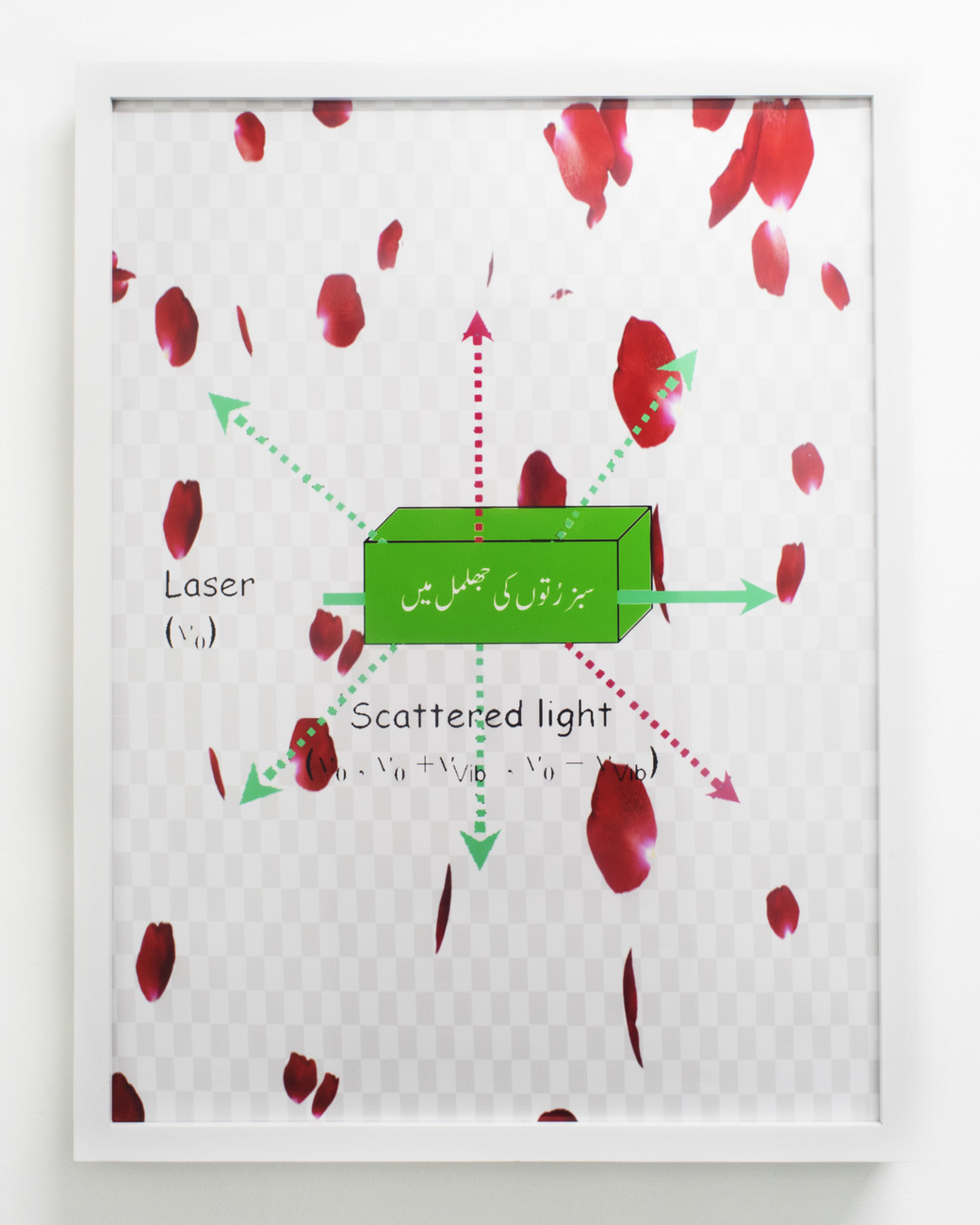
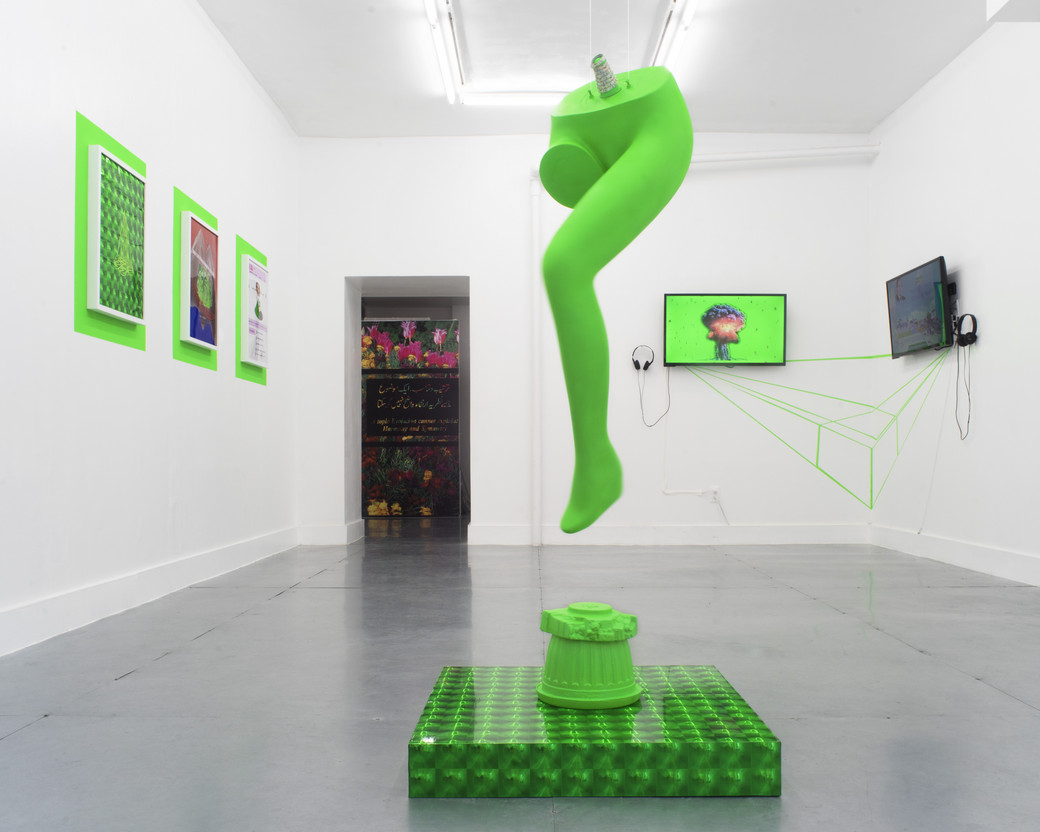
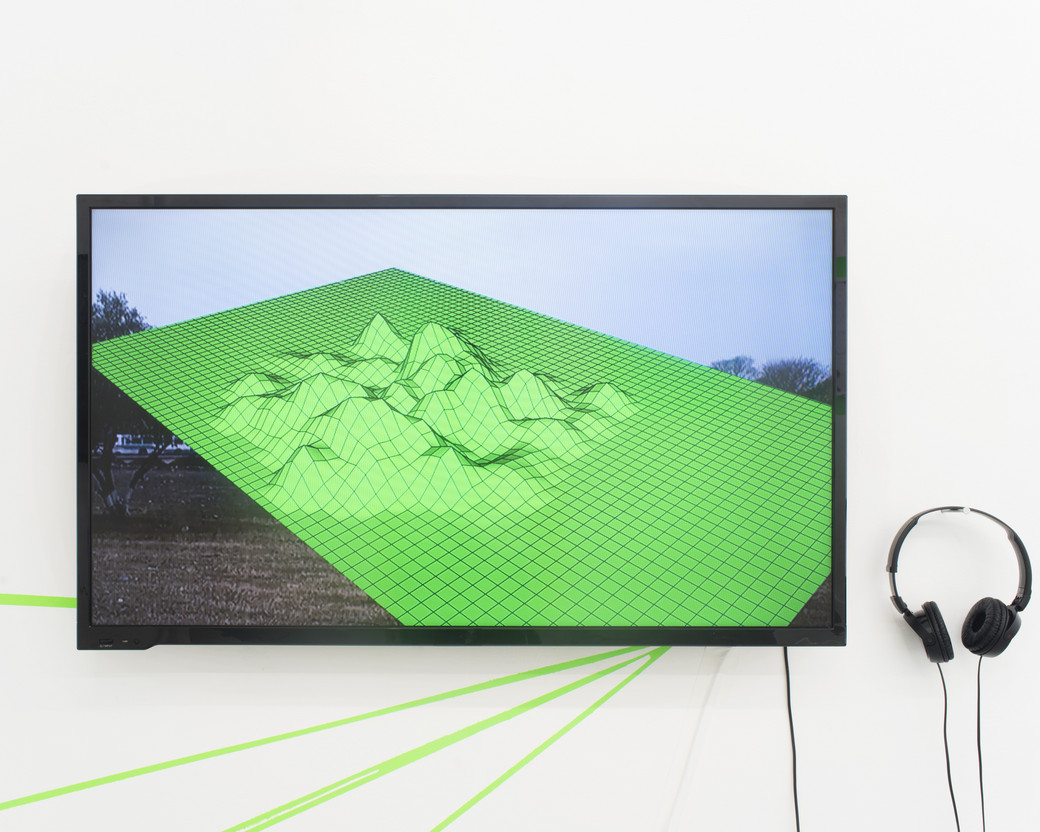
So, the show is called In the Name of the Hypersurface of the Present. It’s based on two years of research I did around the nuclear history of Pakistan. The investigation started with looking at a monument that commemorated the nuclear armament that happened in the 1990s, and the monument doesn’t exist anymore, so in a way, the research and the work retrace this recent past. I use both material I got from Facebook, nationalist groups around Pakistani military, and also I looked at my grandfather’s photographic archives—he was an analog photographer, and he had nationalist leanings, so his political stance was very pro-Pakistan. Then, I also looked at Urdu literature around science and poetry—Urdu is the language of Pakistan.
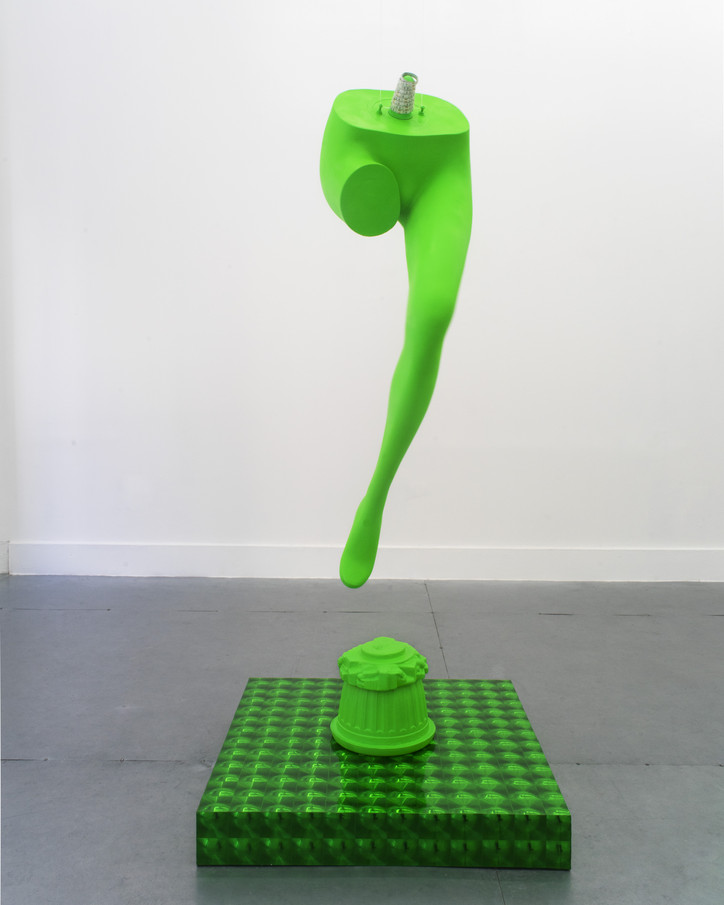
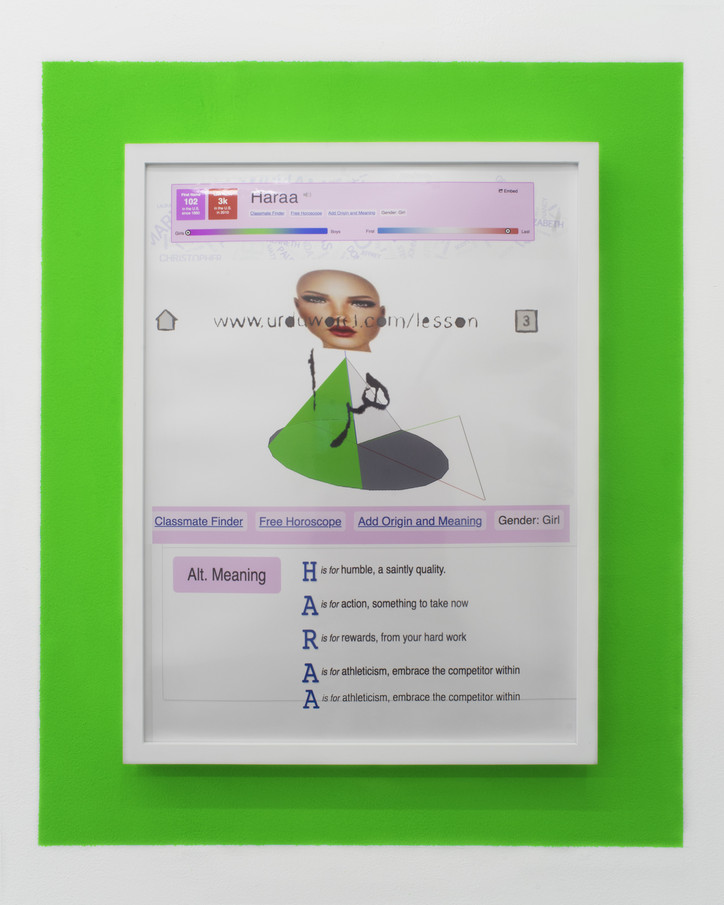
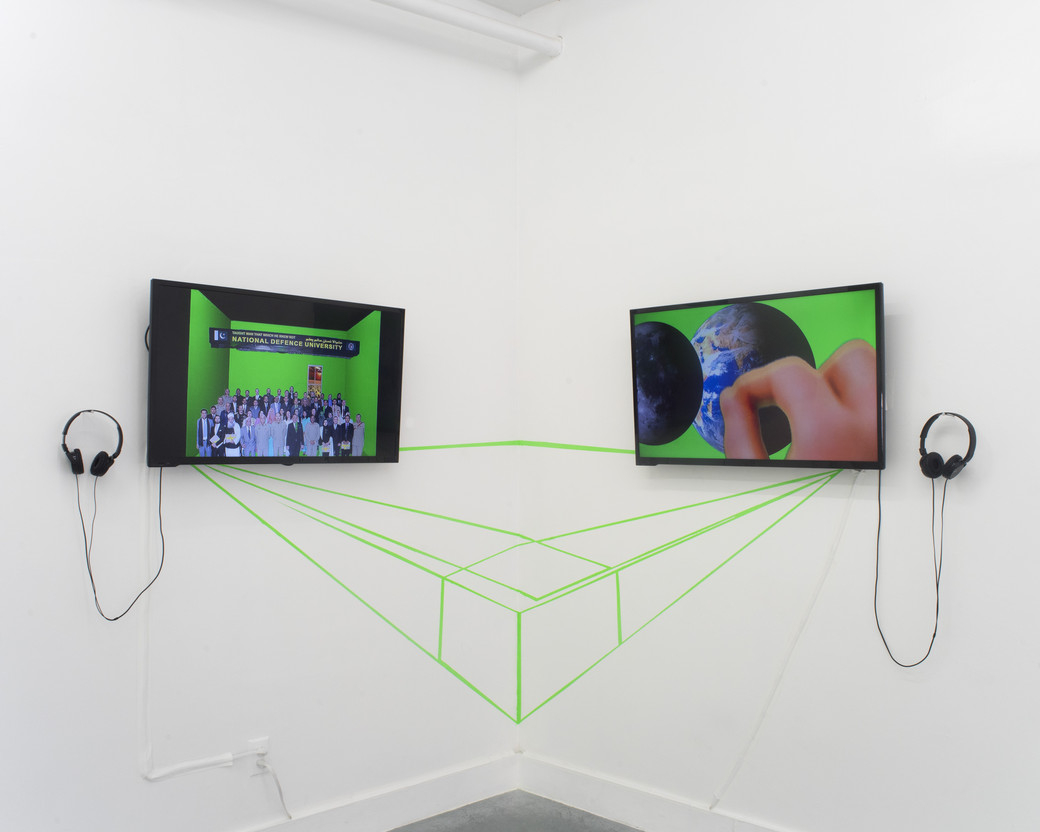
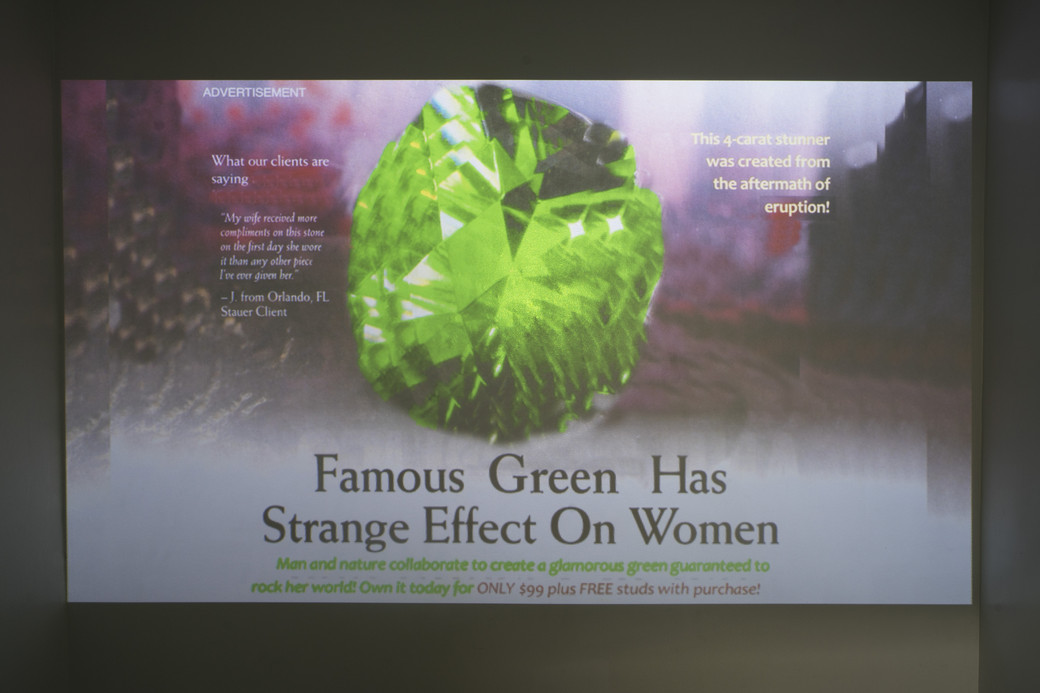
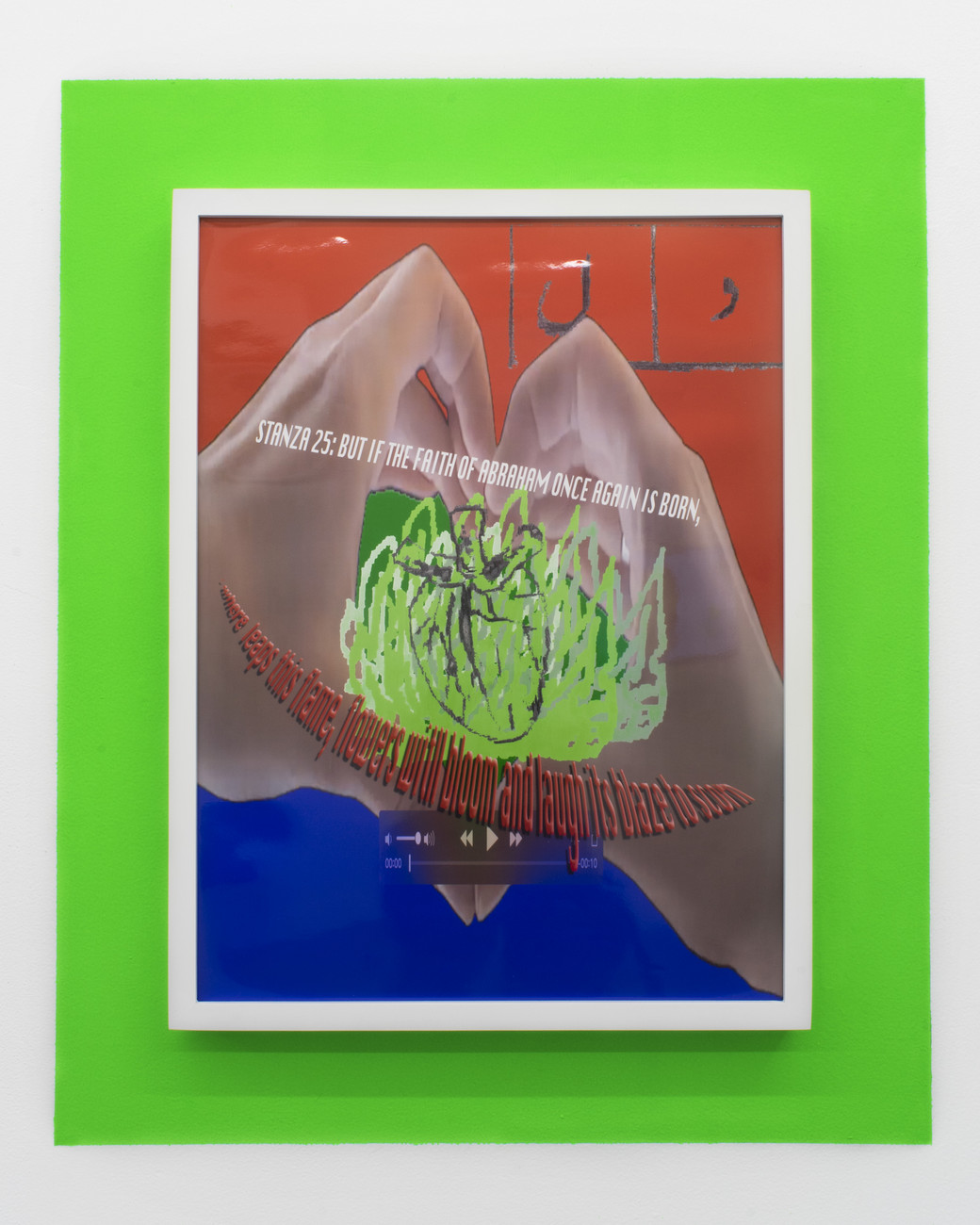
So, it’s an amalgamation of all these things, but when you go to the show, it’s based around this idea of green, and the green kind of represents an intersection of Pakistani nationalism. But it’s also the color of Islam, which it’s known as. Saudi Arabia uses green as a color, and Malaysia—multiple countries look at the color green as the color of Islam, so it gets used in a lot of Islamic kitsch. I also refer to green as the digital interface, this idea of green-screening, a space for projection. Green is also representative of the military, and I'm looking at the nuclear history, the military history. Using the color green also refers to landscape, homeland, so in a way, when you enter the show, it’s an unfolding of that—where green refers to landscape and body, and this intersection of poetics of love for homeland, as well as science and state propaganda that’s used to uphold nationalist love. So, it’s a mix of all these things.
Do you know what happened to the monument you were referring to?
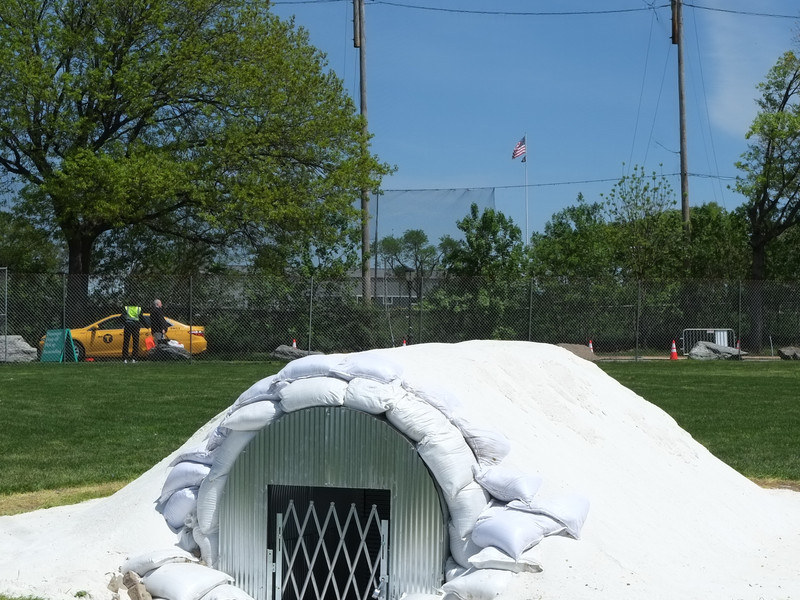
I’m actually working on putting together a lecture performance where I chronicle the history of the monument, looking at the rumors. Because the state monument is this really ugly fiberglass reproduction of a mountain, it basically is not taken seriously by architects, academics. So, the the motif of the mountain itself becomes like looking through the perspective of a monument, a kind of alternate history. That’s how I was trying to look at it—through this monument. One part of the lecture performance is basically gathering all the pieces of information that have been put out there by the state. So, for example, the monument was built in the 1990s and it was built to commemorate a holiday that translates to ‘The Day of God’s Greatness,’ and it happens every year, and the monument was built to bring the public—meaning men, who occupy public space—to come to the monument to celebrate.
So, it was built in different metropolitan cities—in Karachi, Lahore, and Islamabad. In Karachi, it was destroyed in the early 2000s because the father of the atomic bomb in Pakistan—the guy who headed the nuclear project—he got arrested by the state because there were rumors that he leaked nuclear scientific knowledge to other countries. So, he was under house arrest for ten years. During that time, because of the weight of nuclear history and religiosity is so intertwined, they look at this person kind of as a figure to represent their religion and nationalism all in one. So, when he was arrested, the public—and by ‘the public’ I mean very specific male patriarchal, the dominant class—they ended up burning the monument. In Lahore, the monument was built near a railway station and it was taken down by the state because there were rumors that the station was invaded by terrorists and they used the monument as a shield and attacked people in the railway station. Then in Islamabad, the capital, in 2016, the monument resided in this roundabout, and due to the current urbanization policies of the recently deposed prime minister, they were expanding roads throughout the country, and the monument was supposed to be relocated. It was removed and destroyed so they could expand the roads, and it was supposed to be relocated in a major park in another part of Islamabad.
One of the main videos I made for the show starts with the relocation of this monument. It’s thinking through this monument that is returning to a kind of pure, natural—even though a park is not necessarily a pure landscape—but in a way, it’s a return to origins, a return to nature. So, that’s where the entire show is encapsulated—these references to flora and fauna and landscape and the garden and the way of the garden.
There’s a kind of female re-imagining of history happening as well, correct?
In the first two videos in the first two rooms, is my voiceover, but my voiceover is through a fictional poet. So, there’s a querying of this poet, who represents the state. It’s a feminist re-articulation, but also making visible how women are used as containers for state propaganda. The atomic bomb or landscape can also be intertwined with the idea of the woman, the rebirth of the nation—so, in a way, making that visible is a part of the project. The female form is visible even in the reference of the flower—in both of the videos in the front, there’s a constant reference to flora, and that is a direct reference to the woman. In the back room, in the projection piece, there is the visibility of the female as a kind of sampler of the way in which you can gain the purest national love, the performativity of pulling the ear, and allowing the green light to enter certain parts of your body. I actually published a spec fiction piece about green light entering the body igniting the motif of the cone. This overall large, two-year project is continuously expanding, so what I’m showing at the gallery is like an excerpt to test your taste about all these ideas.
It almost reminds me of a video game—it feels like there’s a plot.
One of the narrative tools is looking through the interface. I used certain imagery, certain memes, and collaged them and played with them to see that there’s a kind of violence within this imagery that is disseminated and passed down.
I just read this article about how the internet and social media’s original goal was to make a more open society, but actually it’s helping autocratic urges more than it is helping people to be more open and democratic. Do you feel like this connects to your show?
Definitely. There’s a connection to these nationalist uprisings and conservatism—these uprisings that have been happening for the last few years—and it’s looking at ways in which the digital interface is subsumed by those nationalist movements—it becomes a tool used as an extension of state propaganda. You can look at the ways, beyond the context of Pakistan or any specific state, that these patterns form. Post-Arab Spring in Egypt, for example—the state has so much control over censorship, over the internet, and that was the very tool to bring people together and mobilize people to protest, but then that very tool has become detrimental to the very people that mobilized in the first place. It’s very easy for the state to target these individuals.
What’s interesting to me in regards to the digital interface are the subtleties. My interpretation when looking at the nuclear history wasn’t this kind of spectacular dominant narrative, but looking at the smaller, the micro-lens—looking through these memes that are disseminated that are kind of subversive techniques of state propaganda. I’m also looking at say, my grandfather’s photography, that is quite beautiful, but the fact that he showed at a government institute in the '90s in Pakistan reflects his politics at a certain time as someone who’s an artist. So, in a way, it’s a very difficult line to draw between the military, art infrastructure—it’s all subsumed. That’s how the nuclear project came about: in the name of God. So, in the name of God, the nation of Pakistan had to protect itself because of larger threats. So, there was a lot of material through media that was disseminated about becoming a nuclear power, and at the start of it, the rhetoric around it was ‘This is the only way,’ which is how state propaganda works. It was embedded in love, and beauty, and in the name of Pakistan, so therefore it’s a very thin line to distinguish what's real and what isn’t. And we can see the implications of that in other nations today. So, I use Pakistan as a site, but I’m also thinking about larger, global ideas, of how the state functions and how the interface is used. I’m also interested in how the body, as a citizen, reacts to that, and how it’s used in that whole process, even through the digital interface.
I’m interested in this idea of Islamic kitsch you mentioned earlier. I love the idea of kitsch—what do you define it as?
Right. I was talking about the color green and how it’s used in a lot of religious iconography as a symbol of Islam. Throughout the show, there’s a juxtaposition of internet art—I wouldn’t necessarily want to label it as kitsch—but there’s a lot of collage. There’s a lot of material from books—for example, the Urdu books I refer to all have appropriated imagery from let’s say Google, pixelated imagery. The colors, the luminosity, they’re actually from the materials I gathered myself. So, it’s not necessarily labeled as Islamic kitsch, but it’s a form of publication that is used in Pakistan, and the internet—I appropriated from that.
The title of the show is really bizarre and fun. Where did it come from?
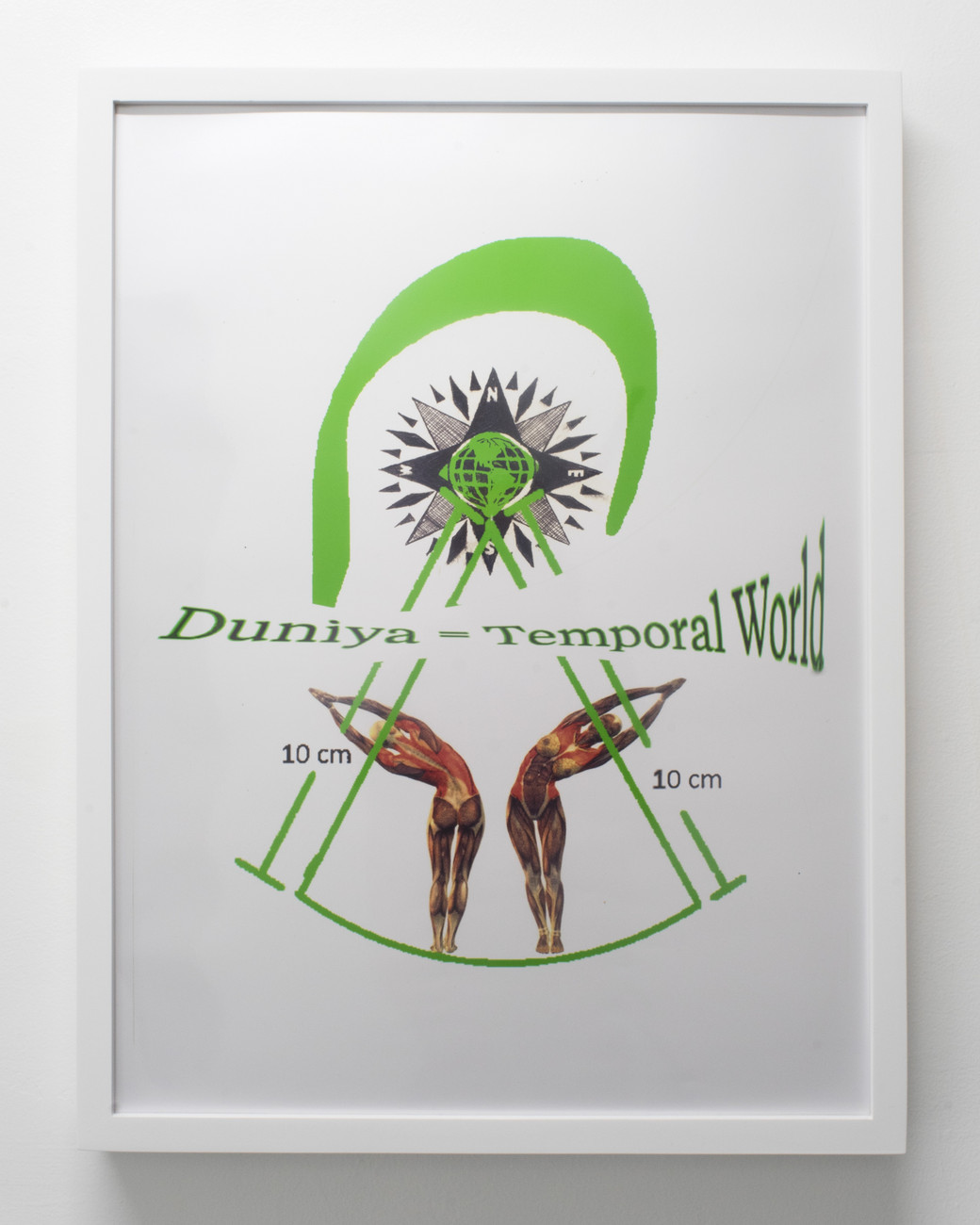
It actually refers to ‘In the Name of God’ rhetoric. ‘Hypersurface of the Present’ refers to theoretical physics, it’s an actual theory—it’s a measurement of space and time. There’s an actual formula. I, basically, in the digital publication I’d mentioned, take diagrams and references of the cone, and write this fiction around it. So, the show is a combination of these poetics—of science and how the state represents science, and this state religiosity.
I’m still stuck on this monument you were talking about.
It was the start of the whole project, actually. I can see why—it’s a replication of nature, tied to a religious holiday and commemorating nuclear arms, and it no longer exists. There’s a lot attached to it. In the lecture performance, I use this fictional poet to speak about the poetics of that—when is the moment that this monument exist? Is it the moment that it’s destroyed? Similar to the atomic blast—the atomic blast, or nuclear power, is only visible in this kind of destruction. The fact that none of these monuments no longer exist—is that a reproduction of that power? One of the lines in the videos is, ‘In this creation there is destruction, in this destruction, it can be created.’ There’s this fine line—which is what nuclear power is—there’s this suspension and anticipation. That’s the narrative around nuclear power.
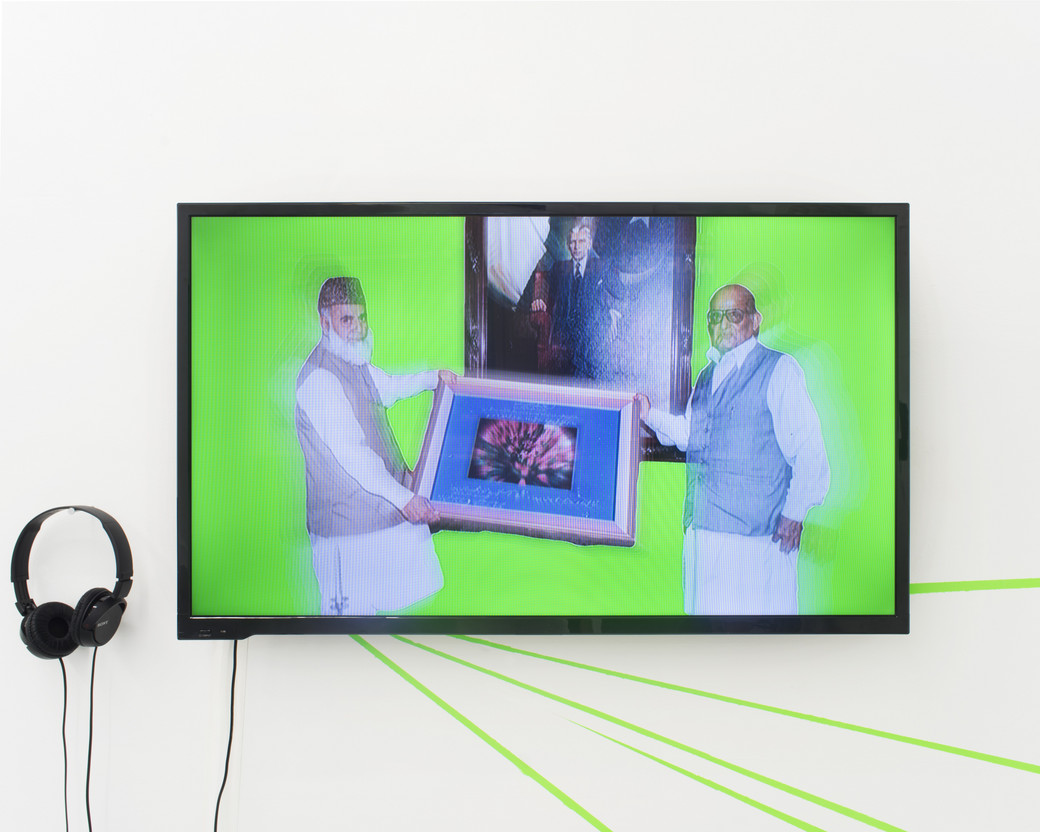
I’m actually going back to Pakistan in December for another project. I’m interested in expanding another chapter of this project in relation to a specific poem that my grandfather used. So, the reason why I introduced my grandfather’s archival material was that I found out that my grandfather gave one of his photographs to the father of the nuclear project. There’s a photograph of my grandfather giving his photograph to that guy, and there’s a poem that’s written on the bottom of the photograph, and it’s a reference to Abraham when Abraham was thrown into the fire and flowers bloomed, and that’s one of the verses I used in the collages. It refers to a nationalist poet, Allama Iqbal. So, I’m interested in writing another chapter talking about the photograph itself, and the relation of that quote referring to Abrahamic fire, and this nationalist poet who was censored with this poem, but it is still, somehow, a part of the nationalist imagination.
'In the Name of the Hypersurface of the Present' will be on view at Rubber Factory through November 11. Visit the online gallery here.
All images courtesy of the gallery.

Tell me a bit about why you made the book. Like, what prompted the topic of kissing?
It was just something that I noticed a lot of people were taking photos of or had in their personal collection of photos. It was also around the time when a lot of people were breaking up, kind of at the end of last year. It seemed like everyone had these six year relationships ending—like, everyone was like, ‘I can’t take this anymore.’ So many people I know broke up, and I also broke up with my boyfriend. I mean, I didn’t break up with him, we just broke up. So, for the writing in the book, I asked people to send in their ideas on relationships or their ideas on love—and this was all happening before the time when everyone was breaking up. The book started before that happened. But then it was all coming together while that was happening so I was like, ‘Oh shit.’
That made it interesting to read everyone’s perspectives and they were all really personal. Even when they were funny, they were generally pretty sad—regarding love and how it affects people. A lot of people were really insecure about their writing too. But I just connected the writing with all of the photos. Sometimes the people writing the pieces weren’t the photographers who shot the photos, but there was something overlapping with the themes—laughing or tackling someone or spitting in someone’s face. And then the writing would be about like, ‘licking the sweat off of them.’ So, it all overlapped well and came together really nicely.
There’s a lot of different photographers in the book. How was the process of editing all those different artists’ work into a single book?
It took a long time! And I put it together with my friend Aida [Nizankovska], who I do Film Hooligans with. We asked people to send in their photos—some people only sent in a few, so that was easy to just be like, ‘Okay if you sent three then they’re all in.’ But other people sent in like fifteen or twenty photographs and it was like, ‘Okay, let's go through them and see which ones work best.’ So, it took a little over a year.
What were you looking for in the photos that you chose?
I wanted to have the work encompass a lot of different feelings of love. Some of the pictures are really tender, there’re people who are having sex, there’s a photo of a mouth kissing through Skype—which is relatable. There are also people who are not enjoying the kisses, they’re like, ‘Ugh, get away from me, don’t kiss me.’ I wanted to bring a lot of different perspectives together.
Talk to me a bit about Film Hooligans. What is it?
Film Hooligans also started as just an idea to showcase people’s film diaries, because so many people take film photos. For Instagram things are always really edited—it shows the ideal of someone’s life and it’s usually a way people are trying to come across. A lot of people still take film photos and they are so excited about them, but then they just keep them to themselves—which is awesome, that’s the point of taking them. But I started taking photos to remember things that were happening in my life that I would forget. Because I do actually go back and look at film photos more than scroll through the old photos in my phone—though I do that, too. But so many people have these diaries laying around, and sometimes you sit down with friends and share them, but not always. So, we just wanted a place for people to submit their photos, then we put them up, and it’s public so anyone can see them and enjoy these photos that are really beautiful, or funny, or show an interesting perspective on life.


There’s a serious magic in the film process—I think it’s got something to do with the fact that you’re working with chemistry, as opposed to pixels or other methods.
You also can’t see the photo immediately after you’ve taken it. With phone photos, people are often like, ‘Oh let’s see!’ or ‘Fix this, fix that—let’s look like this now,’ or people get really staged. That happens in film photos, as well, but I try to get shots that people aren’t expecting—that they don’t realize I’m taking. Just capturing moments—what’s really going on.
How many people are involved with Film Hooligans?
It’s a lot, and it’s always growing. It used to just be close friends, but more and more people have been submitting rolls, so we’ve been able to expand and have more and more types of people involved. I find it interesting because it shows people’s lives—people who are photographers, people who are into music, fashion, or who are artists. These aren’t the perspectives that everyone has in the country, but sometimes I’ll get emails where people are like, ‘Oh this made me pull out my old film camera that I used to use,’ and that’s really exciting.
What made you want to turn Kiss Me into a book as opposed to a section on the Film Hooligans site?
Aida and I have always wanted to do print. It seems like a contradiction sometimes because we run a film website—like an anti-digital space, but our platform is digital. So, we’ve always wanted to have some things in print as a memento. There was one zine we did before this that didn't really have a concept—it was just a mashup of photos and drawings that people sent. So, this was the first one that we had a concept for and actually released.
Do you think people will interact with the work in a unique way because it’s printed, as opposed to what it would be if it were just on the site, where people would view it on their laptop or phone?
I think so—I mean, I hope so. People come into bookstores and connect with work in a way that's totally different from the internet. Plus, they can take it home and look back at it later—I think that makes it more meaningful than just seeing it on screen.


I know you said you were going through a breakup part way through completing the book. Where did making the book put you emotionally?
It was interesting because some of the writing in the book was mine, but it was older, so not all of it was directly about things that were happening in my life at the time—but some of it was. I find that my writing can be vague and interpreted in different ways, but some of it did have to do with my relationship at the time, and my ex-boyfriend also has one piece of writing in the book, as well. It says, ‘Two lips crash landing, neither one left standing,’ and I decided to include it. Then we broke up.
Did you ever want to stop working on the book because you were going through that breakup?
Not really, because I’d been working on it for such a long time and I was really excited with how it was coming together. So, I never really thought about stopping it. Also, there were other old relationships in the book. Marcel [Castenmiller], for instance, sent me photos that include past girlfriends. Luckily, people seem to be chill about moving on.
Have you ever had an unforgettable kiss?
I mean, most of my kisses—not all—but a lot of them have been really meaningful. I’ve always loved kissing—I’m all for it.
My favorite piece from the book is on page 49. It says, ‘Love may be imagined. But the outcomes that it brings are real. If it’s ever screwed you over, at least it taught you how to feel.’ Have you ever experienced a love that didn’t go as planned?
That one’s mine! And it was probably about the relationship I was in before the last one, though it’s relevant to both of them. I feel like when I sense things are going bad, I often do something to make the other person mad and screw things up, which is kind of what another one of my pieces in the book is about. It’s so stupid, and I’m trying not to do shit like that ever again, but I definitely have done things like that, where I’m like, ‘I don’t think you love me, I’m going to kiss this other person in front of you.’ And sometimes, that ends a relationship and you're like, ‘Oh, yeah, that kind of backfired. I guess I deserve it.’


I feel like kissing is less intense than sex, but in a lot of ways, almost more intimate.
Yeah, completely. I find it, in many ways, the most intimate thing—kissing. So, I do get jealous sometimes—I’m trying to be not so jealous now. But I have friends who are in relationships and have threesomes or have open relationships. There’s some people who can do that and some who can’t because they just get too jealous. I’ve always found it really interesting—I guess the mystery of your partner being with someone else creates a jealousy that can keep things new and interesting. I don’t know if I’ll get to that point just yet.
Are there any photos from the book with a wild story behind it? Tell me about the lead image—the one with the two guys kissing that you took.
That was a fun night. That’s my ex-boyfriend and one of my best friends. The three of us, and also with my roommate, would get together and just like, go crazy. On this night, everyone was just kissing everyone. We were playing truth or dare, people were spitting tequila into each other’s mouths—at one point we all kissed every other person. It’s just fun!
Kissing can be way fun if you do it some place you’re not supposed to be doing it. Have you ever kissed somewhere that's like, ‘I should not be making out here but I am doing it anyway.’
I don’t know if there's anywhere you’re truly not supposed to make out. I mean, I like having sex on roofs. I have a couple times and it’s just fun—you’re like, ‘Someone could totally see us, but probably not. Still, they might be watching.’
What’s next for you? Will there ever be a Kiss Me 2?
I’ve mostly been working on music, so it’s a very different endeavor than this. I play in a band and I have another band with some friends. But maybe there could be a sequel. I feel like it would need to have another component to make it different. But there could be!
‘Kiss Me’ is available now at the office Newsstand.