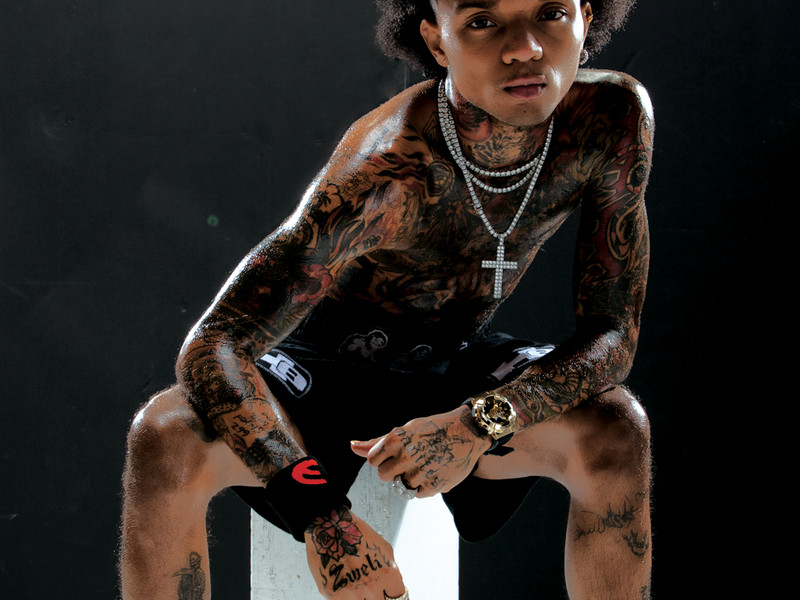
And to me, breaking those boundaries, in terms of masculinity, it's not only providing for others, but the ability to be vulnerable with yourself, take accountability, and actively working on your mental health. How are you exemplifying that?
Well, I started seeing a therapist who actually told me that he doesn't think I need to see him very often because he felt like in one session, he said to give it three more sessions to double-check, but he felt like in one session, he realized that I have a level of consciousness and a grasp on my being that he doesn't come across often. But outside of that, I'm looking at it like 'hey, anything can change, I've been through a lot of things. I'm doing a lot. I'm extremely busy. I'm more busy than the average human.' And yes, I'm an artist, and artists are busy, but I'm even more busy than the average artist because I'm not just doing the music, you know? And so I think I'm scratching the surface of something a little bit new. Whereas most people are scratching the surface of something that's also new, which is just fame in general. I think I'm taking it another layer deeper. And I think that it's going to affect my mental health if I don't know how to deal with it.
So for me, I'm trying to see him before things happen, not when things are happening, if that makes sense. Being proactive. So yeah, seeing a therapist is one of the things for sure. And then also awareness, man. Just talking to people, seeing people's minds, like understanding what they're thinking about, what they care about, or what they want. And then really soaking that in, understanding human beings, and understanding that life is simple. We are the ones that make this thing difficult. Everything, every problem that comes, there's a simple way to solve it, but we make everything difficult. And I think understanding that and truly understanding that helps a lot.
At the fitting, we talked about emotional intelligence, and I feel like maybe those two things go hand in hand, but can you explain briefly why actively practicing emotional intelligence is important to you?
I think practicing emotional intelligence is mainly important because we just don't get that, man. We, as in Black people. I just found out what the word "emotional intelligence" means. I'd never even heard that word two years ago. You know what I'm saying? We're talking about building black families, reproducing, enhancing, and strengthening the dynamic of a black home, but we don't have the emotional intelligence to even begin to start that healing process. I think it's very important for us, and for me, and I had to learn that by understanding the simplification of life, like understanding how to simplify the way we think of things. And that is probably the first big step to gaining emotional intelligence.
But it's important for us, man. It's probably the number one thing, if we're talking about the dynamic of the homes, because once the dynamic of the home is cleaned up, then the dynamic of the child's life coming out of that home starts to improve. And then when that starts to improve, society starts to improve. And when society starts to improve, it all repeats it. It's so important for us right now to do that. It's so important. It's like the number one thing, to be honest, because it's not about us. It's about our kids. Right now, we're not going to fix these things in our lifetime. We're going to start the change that's needed for it to happen possibly in the next lifetime. And if not the next one, if we start now, if not the next one, definitely the one after that. Emotional intelligence is everything.
Right. When speaking about things like emotional intelligence, or just modern takes on building black homes or the black family dynamic, Black children are often the odd one out. So when they're speaking about things, you can seem crazy, or like the black sheep of the family. Is that also how you grew up?
No, I didn't. I followed my friends more than my parents, and then my parents were second. I didn't learn until I started moving and traveling to places that were more diverse. Where I'm from it's just black people. My school had maybe five white people. It was just black people everywhere. You barely see white people. When I started going to New York and LA, I started seeing other people, and I started meeting people with different ways of thinking. And then I came back to where I'm from. And then I started being able to educate.
That is really what it all boils down to. Like I had to kind of leave to start seeing that. I didn't see that before. I just copied what was taught. I wasn't a black sheep because my friends were the same. Like I was the black sheep in the sense of getting in trouble, having guns. My family didn't have guns, my family never been in jail before. I was the first one. But I wasn't a black sheep in terms of trying to change toxic thought processes. It just was more like, whatever. I wasn't bringing anything positive to the table, if that makes sense.
I kind of want to bring it back to the music though, because you are coming up with the album, which is exciting. So to talk about your process a little bit more, when you're first making a song, do you start with the beat, the lyrics, or the chords, or the melody? You seem like a very like melodic rapper. So what inspires you to experiment with those different sounds?
I think that beat, yeah, definitely inspires me. It's always the instrumental, the more left the instrumental is, the more left what I'm going to do is. Or sometimes I find that balance of— let's say the instrumental's left, but I rap some just regular street shit on it. I just do that too. Finding that balance is also cool. But the beat dictates what I do, always. It just starts with the beat. Then it comes to the melody, and then I think about the lyrics.
What was it like working with the Neptunes and what was that process was in the studio?
Yeah, man. I was in the studio with them. I didn't know it was a Neptunes session. Pharrell was like "come" and I was like 'fuck it, man. I'm coming!"
I pulled up and Chad was there. I was like, "Oh, this is what we doing?" Okay. I got it. Shit, I'm not complaining. From there, we just cooked, man. Made four songs in one day. And I was supposed to come back the next day. But Pusha T was coming in. And he was like, "Yo, we getting in tomorrow?" Like, "if you say it, then yeah, I'll push my flight back."
He had another session that he didn't realize. We didn't get to do it again. But man, that was the best day of my life, man, musically. I've always wanted that. Pharrell's my favorite producer. I was like "Yo, I don't want to drop this album unless I have a beat from Pharrell" Like I need that. And I got lucky and got Neptunes. And they're killing it, that Brent Faiyaz shit. Man, that shit is hard, man. Reminds me of "you don't have to call, it's okay girl."
When you think about it, it's similar to that. So I'm so glad I did go on that thing and I'm so glad that I lucky enough to have a beat from them. And I was playing it for 'Ferg one day, and Ferg was like, "Bruh, he gave you a 'It's Hot In Here' record, bruh."
Did you get an iconic Pharrell speech that he usually does?
Hell yeah. Yeah, it's on camera. Yes, I did.