JM — Bolex. Bolex was 30 years ago. Yeah.
NL — Did you guys go to Sony straight away then, after the Bolex?
JM — Actually yes, Sony. Bolex is history, the film just came out. [laughs] But the history of the Bolex camera tells you that Bolex is part of history. The factory is closed, they don’t make it anymore.
NL — And you went through quite a few.
JM — I went through five Bolexes! One Bolex lasts seven years or so. The spring gets used up.
NL — And what about the Sony?
JM — The Sony changes every three years. [laughs]
NL — Really?
JM — No, I’m joking. Because the new digital technology, in order to make money, corporations keep changing their formats, et cetera.
NL — I think last time you shot you had, what was it, a Nikon? The little pocket camera you had?
JM — Yes, I had my current camera. This is it! This is my Nikon. Now it’s not Sony. Nikon. Nikon. Now it’s rolling. You are in. So, we are now where you can have in one pocket a pencil, and in the other one your camera. That was the dream of Cocteau. Where movie cameras become like pencils, then cinema will be equal with other arts. That’s where we are now.
NL — Did you ever think when shooting on a Bolex that those cameras were going to become so small?
JM — I did not think so, but it’s the natural development. Everything gets big, and then gets smaller and smaller. Even humans are smaller than when they began! The Neanderthal man, two million years ago, was much bigger, taller. We are shorter. Humans have become shorter, smaller.
NL — So, back to the question of your workspace, how important is this space to you as an artist?
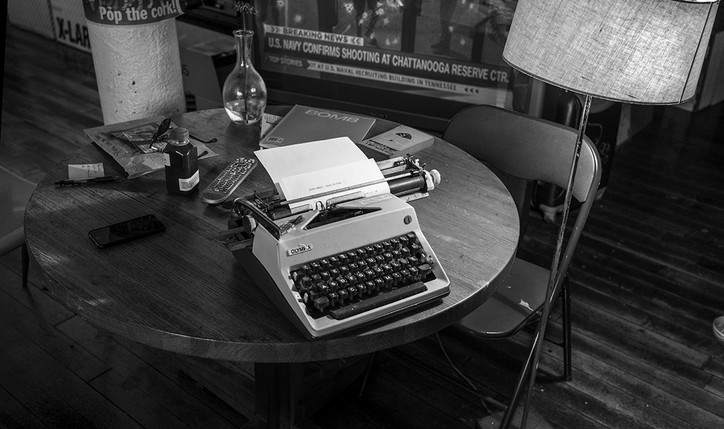
JM — I do not consider myself an artist. That I should stress. Because I just like to make things, and they’re not necessarily art, they’re just something that I like to make. I like to make things. And people like to have some things that other people make. That does not help to make art. Art is a very vague, very nebular kind of term, I don’t like to use it. But I need this space because I do a lot of stuff. I wear many different hats. So I need a lot of space. Actually, telling the truth, I’m planning to move out. This place is too expensive. So I have moved out five truckloads already from this place. I consider it now almost empty. A lot of junk, because I do many things.
NL — When you moved to New York initially, because you were doing so many things, did you live and work out of the same space?
JM — Well, I was dropped in New York by the United Nations refugee organization. So I just had myself and a suitcase. And no place, no office. I slept in friends’ homes. Initially I was in Williamsburg, Brooklyn. That was 1950, ’51, ’52. And then in the spring of ’53 I jumped to Orchard Street, to Manhattan. I left Brooklyn in the spring of 1953, and never went back. It was miserable. It was the most miserable area of Brooklyn, Williamsburg. Now, Manhattan has conquered Williamsburg. Williamsburg is part of Manhattan, part of Wall Street.
NL — So you were in Manhattan for a long time?
JM — Until 2004.
NL — Why did you feel the need to leave?
JM — I had to escape it. It was too much like Wall Street. In Brooklyn there are still people, real people who are of many different nationalities, and it’s still messy. There are places that are still pretty messy. The best restaurants and eating places are in Brooklyn. Brooklyn is real. Also, Brooklyn is like an extension, like the new Paris, while Paris is becoming the new Brooklyn. So Manhattanites—keep out of Brooklyn.
NL — How do you feel just about the physical aspects of Manhattan?
JM — Boring. The buildings and everything are just boring.
NL — I just feel a bit too confined there.