Griselda provided the soundtrack to Virgil Abloh's Off-White 2020 premier at Paris Fashion Week, Virgil also did the cover art for your most recent album, Pray for Paris. Though, you guys have been linked since Pyrex. Can you speak a bit about your relationship?
I've been a fan of Virgil for the last seven years. It's been a mutual respect. When Virgil dropped Pyrex, it was a high fashion street brand. People was in the hood, but they were in a three-hundred dollar hoodie. It was high level fashion but was still in the streets. I respected it. And it was like, if Virgil could do it, then I could do it. Because at the same time, I was designing on the street level. He just took it to a whole different level. I was wearing it in the streets, and being from Buffalo, I was probably the only person in Buffalo with it at the time. That was also the time I started rapping as well. I used to rap a long time ago but I had to stop for eight years. So that was the time I actually started my first project. It was just like we grew together—my career in music and his career in fashion. I'm heavy into fashion, you know, fashion-rap. I'm probably the biggest when it comes to fashion-rap. I always named dropped Off-White™, he caught wind of it, started re-tweeting everything, and we just became cool. When I dropped "DR BIRDS" from the Griselda album [WWCD] and I said, "Tell Virgil, write ‘brick’ on my brick," that just spread it like crazy. When we shot the video, the legendary Hype Williams really wrote "Brick” on a brick. After that, he was like, "Hey man, you need to come to Paris. Let's link up, let's start doing what we need to do." And it's been on ever since.
What about Virgil makes you want to work with him?
I just love his drive. Virgil just remind me of myself. Taking it from Pyrex to the head of Louis Vuitton is amazing. Watching him grow from that to where he is now is unbelievable. You know, it's the same way for me. Like I said, we started at the same time, now look at me. He's the head of Louis Vuitton, but he's designing my cover. Going from where I was at to now is amazing. I'm with Jay Z; I'm about to be creating and designing with Kanye. Those are things you dream of. We just both worked hard and it's a mutual respect. When I was doing my first photoshoot, it was wearing Pyrex. It's a connection.
You mentioned that you were designing back in middle school. What were some of the first pieces you designed?
It's crazy, we used to get in trouble in school. My first crew was called PIMP. I always been a leader, I always been a hustler, man. I was doing things way ahead of my time. I used to sell jerseys in sixth grade. You look at kids now in sixth grade, and they probably playing a video game somewhere online. I was the jersey plug. It was always about fashion. And I had a crew. This was when Wu-Tang was big, so we'd have the "W" carved in our heads [laughs], know what I'm saying? And write "pimp" on the other side. It was just culture, bro. I had my friend Victor draw the logo, and even at that age I was calling and screen printing at places, finding out the minimums, and how much per color—all of that. We did the "Pimp Worldwide." It was a world with "pimp" across it. I started selling to family members, then it grew to forerunners. It was crazy.
I literally had a teacher tell me, "I wasn't gonna be shit." You know how you hear stories like that which you think are fake? Like, "Man, no teacher ain't ever gonna tell you nothing like that." This was true. A teacher slammed me up against a locker because I was the leader. It was like, "This guy's bad. He's the one making all the other kids in the school say 'pimp' and put 'pimp' in they head and wear these shirts." It was like that. Then once I got to high school (that's when the Wally Clarks was big), we just elevated, seeing who had the best Wallys, dying them ourselves. I started getting jean suits, and we started going crazy on the jean suits. I was doing letterman jackets, too. You know you had to play for a sports team to get a letterman jacket; I was in high school and was like, "You know, I don't play for no team. I'm gonna make my own letterman jacket." I was just always creating. This is what I want to be. This is what I want to do.
You have some pretty identifiable chains. You mind speaking about them and what they mean to you?
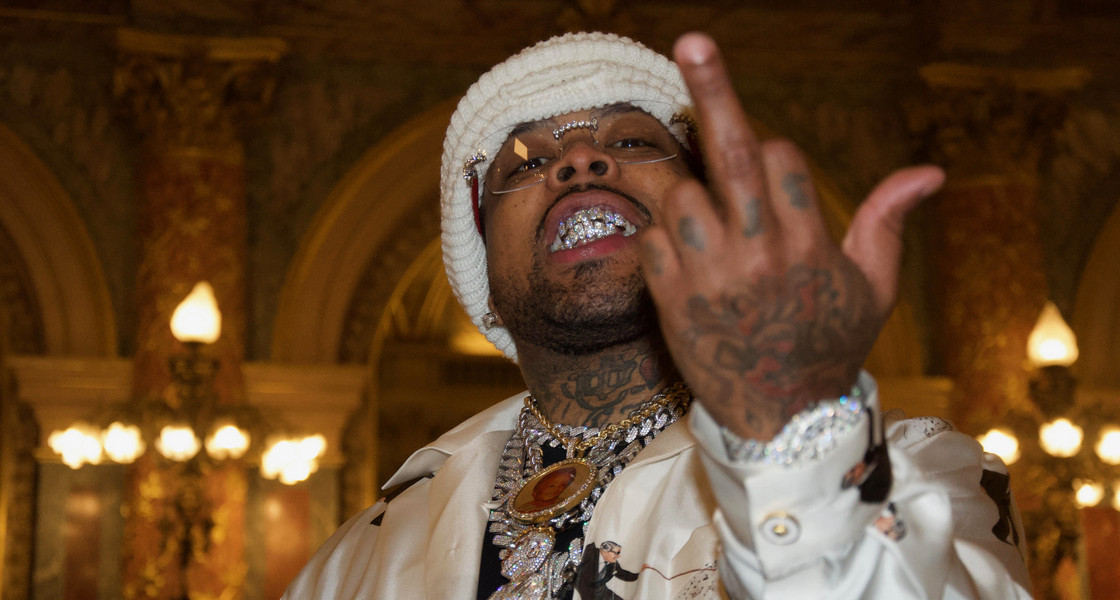
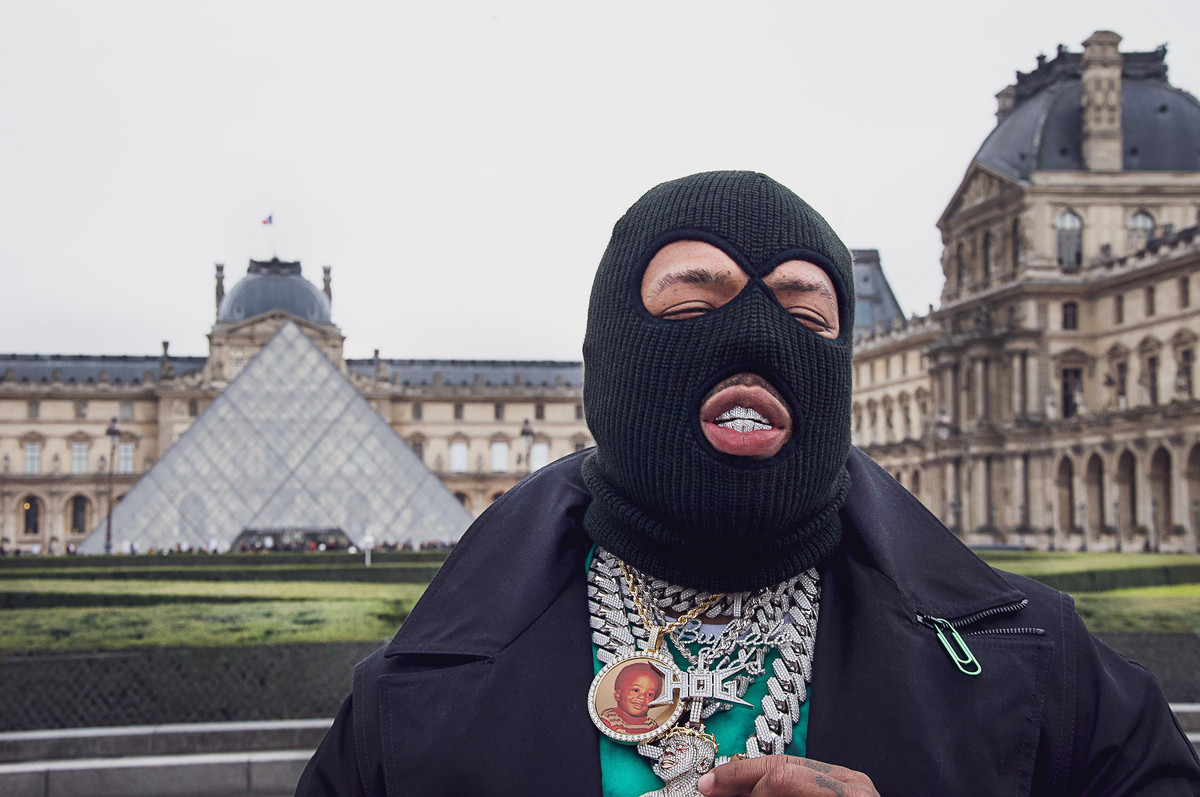
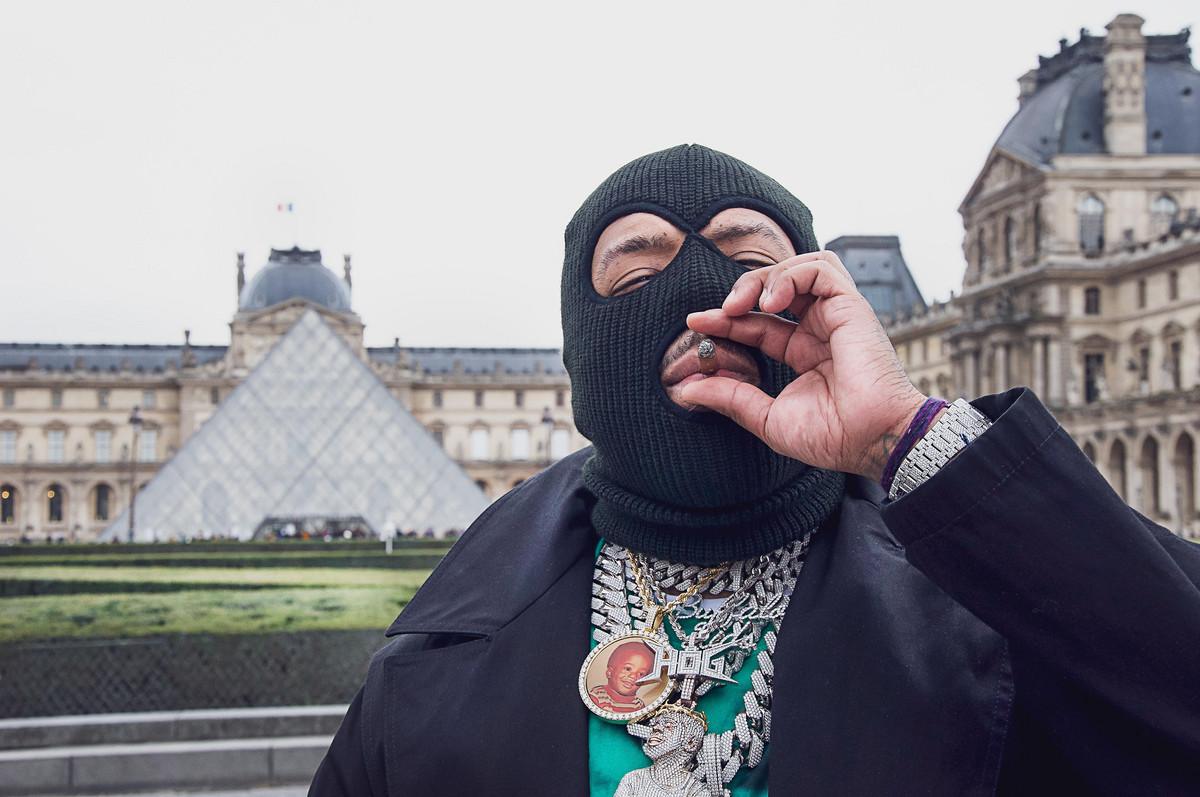
Yeah, my FlyGod piece—anyone who knows Westside Gunn knows the FlyGod; that's who I am—so that piece right there, that means a lot to me. It's like if somebody wore a Jesus piece. To people who think I'm egotistical, wearing myself—cuz all my chains are of myself [laughs]—I just love what I represent to the game and to the culture. I bring that second coming of real hip hop. FlyGod has the resemblance of a Jesus piece, but the meaning of it is me being doubted but working hard to bring back a sound that was missing from the game for a long time. When I first started, everybody was listening to Southern music, then Chicago drill music started getting big. Nobody wasn't checking for my sound. So that gave me more drive. Like, "I'm gonna show y'all better than I'm gonna tell y'all." Fast forward a few years later, I'm talking to you [laughs].
What did it mean to you to bring the FlyGod image abroad?
Yo, man. It was crazy. I was the only guy out there that looked like me. If you didn't know me, you'd be like, "Who is this dude?" Because there's a difference between when you see my jewelry in pictures and when you see it in person. That shit gone light up a whole room. The pictures don't do it no justice. I literally look like a walking lightbulb. Wearing all that on my neck, and my style—I was out there wearing one-of-one pieces. People was seeing clothes on me that they never seen before. They might have seen me in Off-White™, but this was a one-of-one Off-White™ piece. Or they might seen me in some Casablanca, but this is a one-of-one Casablanca. I was going everywhere with the newest drip on, all this jewelry on, and the paparazzi was eating that shit alive. Even when I went to New York Fashion Week after Paris, a lot of the paparazzi who were at Paris was in New York, and they was like, "Yo, you killed Paris, man. I was hoping you was coming here." And they start taking pictures of me there. I'm being accepted now in the fashion world, which is beautiful, because I've always wanted to be accepted in the fashion world more than the musical world, honestly. But both those things go hand-in-hand with Westside Gunn. With me, when you think of hip hop you think of fashion; when you think of fashion, you also incorporate hip hop.
To touch on your comment about wanting to be accepted in the fashion world more than the music world, you've mentioned that you don't want to be considered a rapper. What do you want to be considered?
I'm just an artist in general. When I approach every project, it's like I start off with a blank canvas. And however I end up, that's the album. You know, I ain't never want to be put into a box. There are things I still wanna do, and it may catch people off guard. They may be like, "Oh, what is he doing? This is wack!" Because so many people put me in a box of being an MC and a rapper that they're like, "He can't do this. This isn't him. He fell off. He's changed. He's Hollywood now." I'm already expecting that. That's why I can even speak on it now; I know how they think. You know, pretty soon I'm going to strike on a lot of things I want to do.
What are some of those other things?
Different sounds. I was freestyling on a damn EDM beat the other day. This is the one thing I learned from Kanye—I mean I always felt like this—but just me talking with him, he think like how I think: Always just be yourself. Whatever you want to do, and it makes you happy, do it. You're gonna have people who hate on everything you do. Even if you do the impossible, someone is still gonna hate. So just do whatever makes you happy. If I want to rap over EDM beats, people gonna say I changed, I'm Hollywood, I'm fake, yada yada yada. But if I still happy doing it, and I wanna do it, why can't I do it? Like I wanna start writing R&B records—I do that in my spare time. But you don't know that.
You obviously have a love for fashion, but you've said before that in addition to that, you also love art, design, and executive producing more than actually rapping. What do you get out of these mediums that you can't get out of rapping?
It's less pressure. When I'm doing all those other things, I'm just doing things I love to do. And it's just fun. It's fun executive producing, picking beats for other people—that's dope. Putting the songs in order, getting skits, naming tracks, doing artwork for it—those are things I love to do. Rap is pressure.
How so?
Rap is always competitive. It's not even that Griselda is competing; we're not. It's just the simple fact that we're a group, and Dreamville is a group, and TDE is a group. The moment you start making trash, your career could be over. Right then and there. That's why I continue to get better and put the pressure on myself every time I release a project because people are listening to me to see if I'm gonna fall off, not even to celebrate. It's like Floyd [Mayweather]. People watch Floyd to lose, not to win. You're not even excited for him winning; you done watched him win fifty times. You trying to see Floyd get knocked out. It's the same thing with me. We have a rap on a song with Conway [the Machine], with Benny [the Butcher], with Tyler [the Creator], with Joey [Bada$$], with Freddie [Gibbs], with Roc Marcy—these are all elite MCs. You have to come, or it gonna sound horrible. Tyler just won the Grammy for best rap album, and I have to go on the song with him! And he's just fresh off the Grammy! That's the pressure of being a rapper. Everything else for me is just fun.
With all that said, what do you see as the benefits of rapping? What does rapping do for you?
I touch the world when I rap. There's a kid probably in the middle of Indonesia playing Pray for Paris right now [laughs], you know what I'm saying? That's my communication to the world. You never know who's listening. I get people in my DMs from every walk of life, every nationality, every age group. It's like, a kid, three-years old, in the car seat going, "Boom, boom, boom, boom, boom!" That's love. That's culture. That's what keeps me going. That kid might not understand this two-hundred dollar sweatshirt, but that kid gets the music. The rap actually helps everything. I owe it all to the rap. If it wasn't for rapping, none of this would've happened. Westside Gunn, the rapper, is me connecting with the world. This is what I have to do for you to understand the fashion, for you to understand the art, for you to understand the wrestling side. You have to hear it through the music first.