EM—That brings me to my next question: Can you speak to your intended viewership? Who is the intended audience for these paintings, this exhibition? I love thinking about your work having come so much from your father’s, and I imagine he would be somebody on your list.
RS—Yo, hugely man. Hugely. Me and my pops, it’s so great, because I feel like when you’re a kid, you idolize your father, and then you go through this—at least, for me, I went through this stage where I resented him in a weird way and held this grudge against him deep down. Now, the conversations we have are so in tune with the work and so in tune with how we as a people are being treated around the world, and just the systematic barriers that are set up against us, and that have been so detrimental and so influential to the world.
RS—Overall, my introduction to abstract painting has been through the abstract expressionists that lived and worked in New York. But to be honest, the more I’ve educated myself and the more I’ve learned, I get hungrier and hungrier for more painters that are representative of who I am, and my background and where I come from. I’ve always wanted to be a representation of my tribe—our tribe—through abstract painting, and I just never necessarily knew how to get there, and I didn’t necessarily have the knowledge of the forefathers before me that were doing it. I’m just now starting to find out about Raymond Saunders, and Jack Whitten. Or even—
EM—[Robert] Colescott, or—
RS—[David] Hammons—all these guys.
EM—Gilliam.
RS—Yeah, Sam Gilliam. I’m so novice in this area and this range, but I know that I’m speaking to somebody that spoke before me that looks like me. Because I want to speak to the Black and Brown person living our experience through abstract painting. I know I’m not the first to do it—I know I’m not the only one doing it right now—but it hasn’t been necessarily celebrated. So, I don’t want to leave anybody out, but when I think about these works, they’re spiritually meant for Black and Brown men and women. That being said, they can still be relevant for every other race and every other person on this planet.
EM—It doesn’t diminish that. It’s just that these images need to connect to the people that they’re about, and Black folk need to be remembered and celebrated.
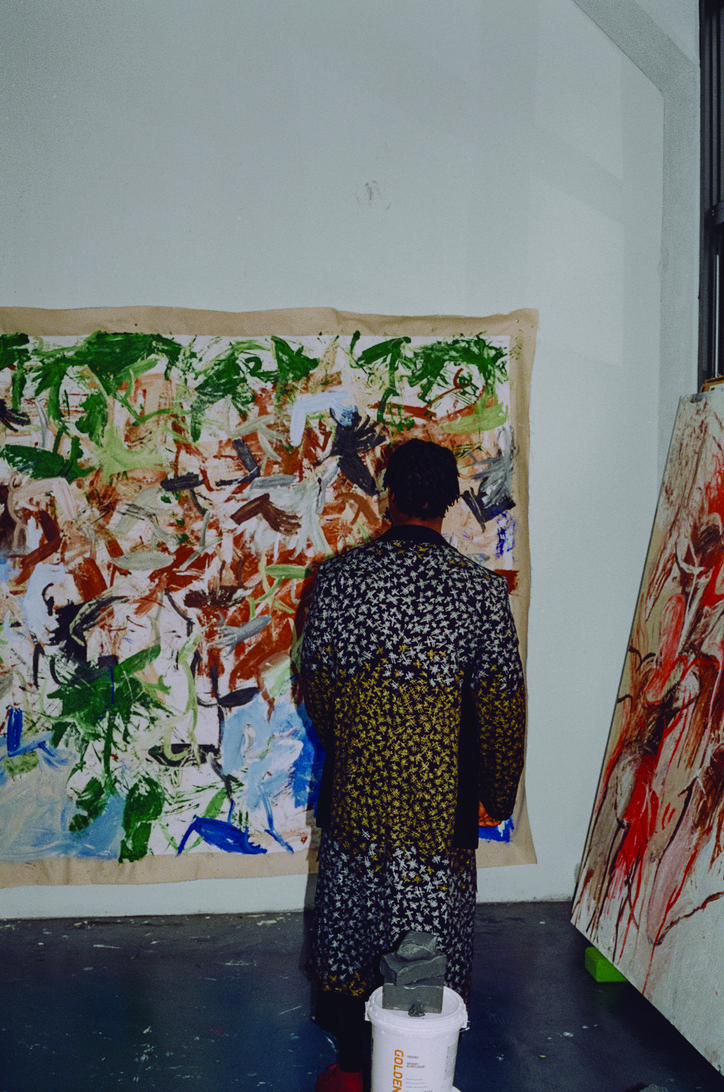
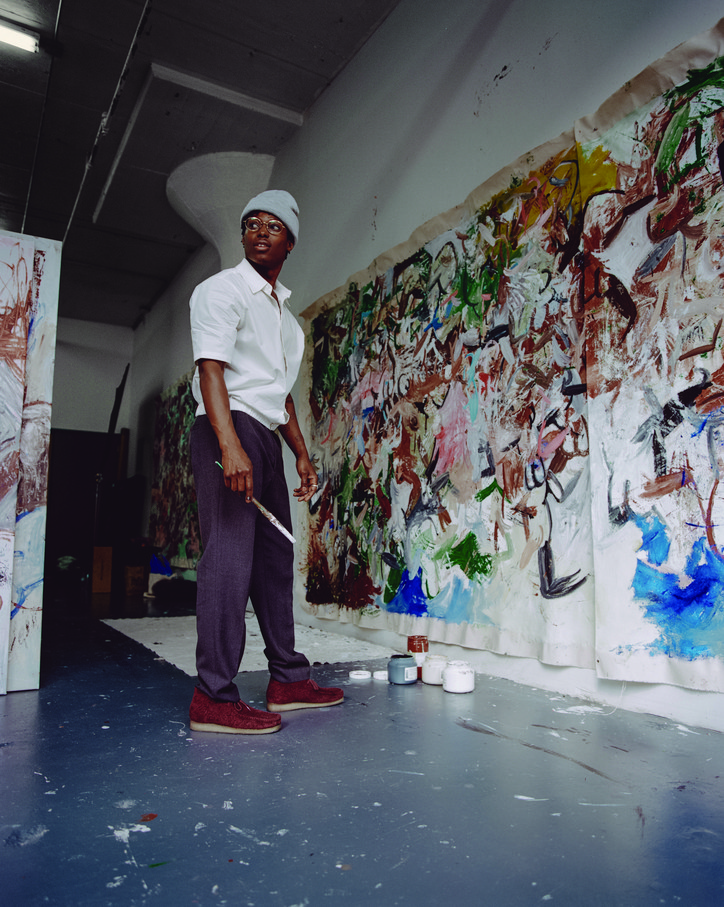
RS—Yeah. When I’m making this work, I’m listening to “American Dreamin’” by Jay-Z or “So Many Tears” by ‘Pac, and I listen to those records because they almost touch on, not so much the trauma, but the lack of that we have in society. And I’m thinking about the state of our people. Some of us might be good, but the majority of us are not, and I try to lock myself into that emotion in order to get in touch with my own pain, and to touch on the pain of others that look like us. I hope that by trapping myself in those emotions, and reflecting those vibrations onto the surface, I can facilitate the means for people to pick up on that when we come face to face with the work.
EM—I feel like there’s a basis of trauma, and a lot of people would say that that would be the pressure that would produce a diamond. But I think there is, in spite of it all, the traumas of today and yesterday as they were directed to African American folk, Black folk of the world, Brown folk of the world, the importance of focusing on structuring aesthetic, thinking about beauty, being allowed to produce and find something of beauty made out of—
RS—Made out of pain.
EM—And coming from nothing but aspiration and intention, which identifies that maybe there is no such thing as a deficit. It’s not about a deficit or an emptiness, but a kind of beautiful potential. I remember years ago watching this Philip Guston interview, where he talks about having ghosts in his studio space, and in his images, and it being a process of the works exorcising the ghosts in his paintings. And when the ghosts leave, he’s left with himself—and that’s the connection to the works that he finds most meaningful. So, I guess it’s a question about influence, about the anxiety of influence— the ‘there’s nothing new under the sun’ train of thought, on which I beg to differ, especially with us. But…are there ghosts in your studio?
RS—You know what, yeah. Because I’ve definitely been speaking to Max[imillian William] like, “Yo bro.” When I’m in the studio, I know my painting forefathers, or even some of those original mark-makers that were us, that I may not even know about yet, I feel like they’re with me. From a de Kooning or a Twombly to a Jean-Michel [Basquiat], or maybe some ancient forefathers—we all have that connection. But as far as influence, I feel like the career that I’ve had so far with painting, I’ve always been critiqued on influence. “It looks like this, it looks like that. He’s trying to be this, he’s trying to do that.” But really—
EM—That’s anybody.
RS—That’s anybody! You fight through the influences in order to find your true self, which kind of reminds me of what you’re saying with Guston—maybe those ghosts were his influences hovering over him until he painted his way through to get to something that was truly left—himself. I feel like I’ve been battling to get to that, and I’m just now being able to get to that space, because now, when I’m going into my work, I’m not necessarily thinking about my painting forefathers from their imagery. I’m more so thinking about them from their perspective and from the life experiences they had in order to make the work that they made.
EM—Right. Like a kinship.
RS—Exactly. And I’m more hungry for that now too, now that I have a better understanding of my own practice. Do you feel the same?
EM—Yeah, definitely. Unfortunately, the difficulty with that question and the reason I say it with some hesitation, is because I think it’s been used as a means of critical dismissal of young Black artists historically.
RS—Say it again!