Bodysuit VEX LATEX, Rings GEORGINA TREVINO
Stay informed on our latest news!
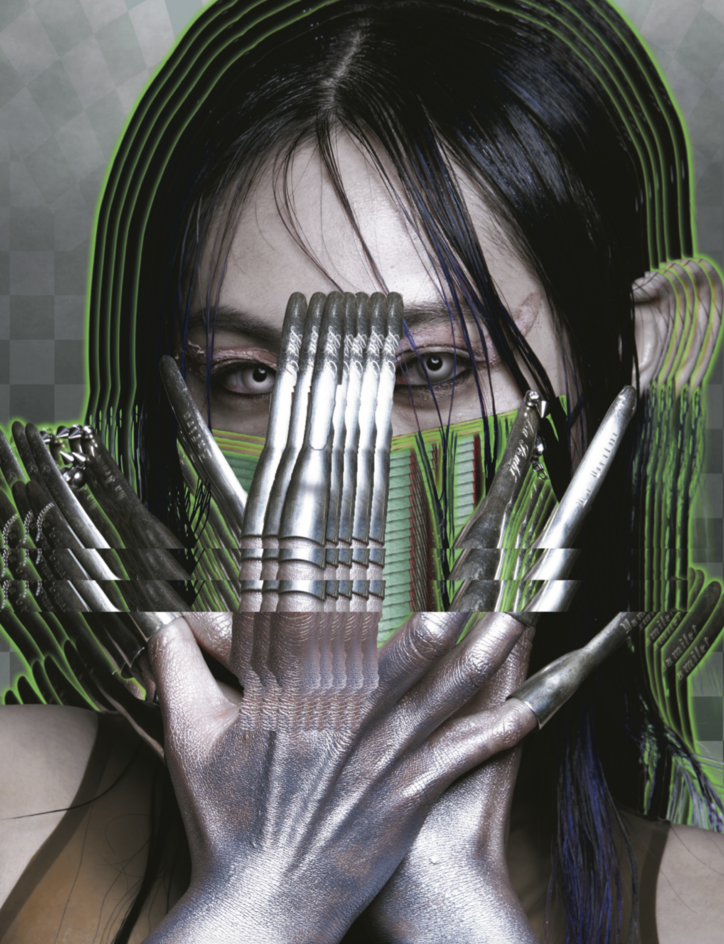
Bodysuit VEX LATEX, Rings GEORGINA TREVINO
As a child, Seneca had lucid dreams that were so dark at times, she questioned her own mental health. But to make peace with the traumatic bedtime experience, she would “draw it out” the following day — taking her visions and drawing them onto paper, advice from her mother that became a daily coping mechanism. And these drawings looked like otherworldly comic book characters — sometimes appearing as illustrations of dolls with distinctively exaggerated eyes — because she preferred to live in her imagination, rather than her physical reality.
They represented how critical her third sense (vision) was in navigating her own world. Seneca was so shy during that time, that, according to her, she was effectively “partially mute.” “I was very withdrawn, so I would just sit there and mostly observe everything going on around me, and also observe what's going on in my head.” Two decades later, Seneca’s visual interpretations of eyes still figure prominently in her name — the usage of “All Seeing” in her persona in combination with “Seneca,” alluding to the Roman stoic philosopher Lucius Annaeus Seneca — and her work. In one of her five paintings from her Genesis Series, which debuted during Art Basel Miami in 2021, Seneca filled the eyes with intertwining interpretations of birds, green vines, and human limbs. And in another, filled the eyes with what looks like sweating flesh with blurry and flickering paint splatters.
The final one-of-one piece of the collection sold for over 39 ETH, about $116,000 USD, in February 2022. Yet, the most famous eyes she designed are the droopy ones belonging to the bored apes of the Bored Ape Yacht Club, capturing a disaffected IDGAF disposition that hit a cultural nerve. Today, Seneca is one of the NFT generation’s art stars. Coindesk placed her on their “Most Influential 2021” list, Rolling Stone profiled her in a lengthy story, Vanity Fair name-checked her, and she went to the exclusive Met Gala afterparty. She is represented by one of Hollywood’s most powerful talent agencies, and has a bright path before her. On a steamy July afternoon, Seneca sat down with me at The Beekman, a hotel in the Financial District of New York City. While sipping on an iced latte, she explains why being anonymous is essential to her identity, why she doesn’t mind people printing out her artwork, and reveals what aspiring Web3 artists need to be wary of.
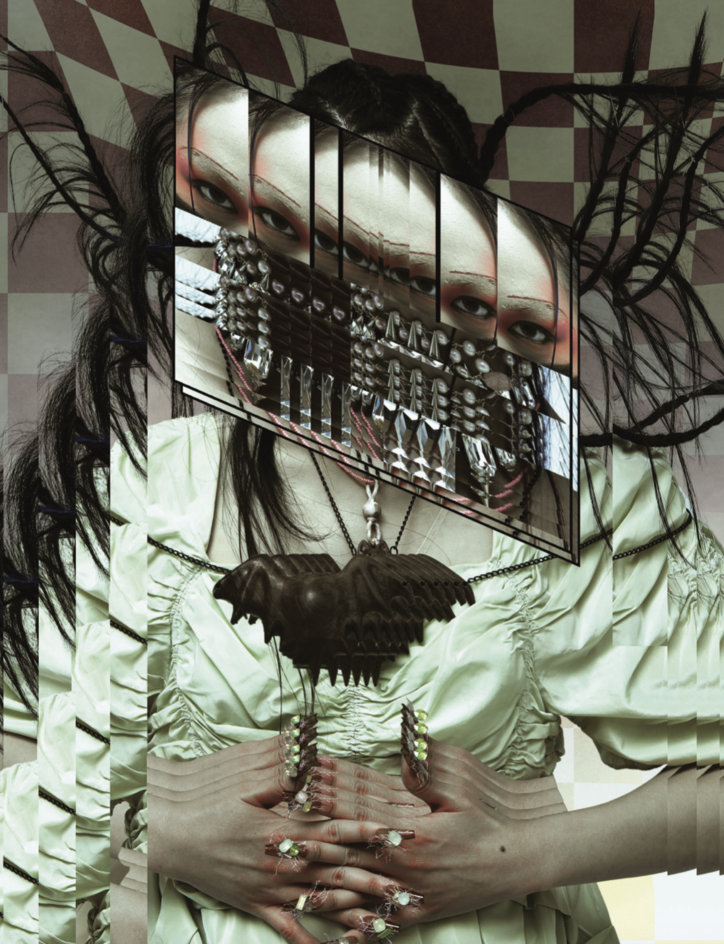
Dress SIMONE ROCHA, Harness PUPPETS AND PUPPETS, Diamond Choker AREA, Necklaces VOONS
I find a lot of creative people’s work was shaped by their childhood experiences. Does the surreal quality of your paintings have roots from that time?
All Seeing Seneca – I loved horror, and I loved dark things when I was very young. And honestly, this is something that took me a long time to come to terms with, but I suffered through a lot of lucid dreaming. And I say suffered, because people generally think that lucid dreaming is fun and cool. But for me, I had nightmares every night. And I was so conscious of it, and it was so draining. And this might get a little bit morbid, but I think it was a matter of a bit of mental illness. And I killed myself every night as a kid.
Why would you consider that a dream as opposed to a nightmare? If that happened to me, I would classify that as a nightmare.
I think I just call it dreams in general because the type of dreaming — lucid dreaming — is very specific, because you're aware and then you have control over it, as opposed to letting the dream take you places. And because I was traumatized every night, I was trying to figure out how to leave my dreams every day, and that consumed my life and consumed my thoughts. I was fascinated by why this was happening to me. I just was more concerned with my imagination than being present.
What did you do to cope with your dreams?
I come from a very creative family, and they also taught me about visual arts. And maybe that also added to why I express myself the way I do through drawing and painting. There were times when I told my mom, “I suffer. I have nightmares every night and they’re special kinds. I see things and I hear things.” She said, “you should draw it out.”
What did these initial illustrations look like?
I drew a lot of comics as a kid, and not all of my art is dark, I will say. But I do recall, just, it's all made up, and there's nothing from reality. And my mom actually told me recently, she's like, “you know, you used to draw these big-eyed girls with stuff in the eyes.” And I'm like, “really? I had no idea.” So it feels like a full-circle thing. I wasn't even conscious of it. I didn't remember. I have no recollection.
Why are these eyes pervasive in so much of your work? They seem to be a canvas for you to distort them, or fill them with objects and other kinds of images.
I was exploring this portrayal of how I felt as a kid, no mouth. I didn't speak much as a kid. I was pretty much partially mute. It was all about the eyes, because that's how I felt as a kid. I was very withdrawn, so I would just sit there and mostly observe everything going on around me, and also observe what was going on in my head. I think in some of my drawings, I am drawn to the mouth, but this is something that I explored in some of my physical work, like non-digital work, where I'm like, okay, that's how I view myself as a kid. And sometimes it makes me very emotional, like, staring at that portrait of myself.
How do you want your spectator to feel?
That's really hard to answer. Good question, though. I think that for me in particular, I don't want to dictate what my audience feels for the most part, especially with my personal work. I think it's different if I create a concept, I'm like, okay, I'm trying to create an experience. These are much more intimate with my own personal life. And so, if people find a connection between my story, my work and them, then that's wonderful. But that's not everything for me, for this body of work in particular.
You went to Rhode Island School of Design, and you learned traditional ways of creating art, but you've decided to become a digital artist. What do you like about the media?
I started digitally painting way before that. This was before I had found out you can draw on screen. It was kind of like Microsoft Paint, and just really clicking with that medium.
I’ve used Microsoft Paint, but it was hard to learn [laughs].
I know. I used the trackpad and the mouse, and you make do. I don't know why it just clicked with me. And I guess when you grow up in the age of technology and the burgeoning new inventions, like social media and whatnot, then you start to kind of live in that world. I was somewhat trained traditionally, I went to RISD, and I love that experience. But I think it was important to know and respect tradition. I love painting, I love drawing, I love designing. But then also not ignore digital art. I remember the last year, for our senior project, one of the teachers forbade us to use the digital medium. And I really disagreed with that. However, I do love painting, and I still do that. But am I really passionate about digital art? I am. Web3 champions the technology behind NFTs, and works so much in the favor of digital art. However, I still make traditional work, so I want them to be seen as equal to each other.
When I first started writing, a lot of my work was published online, and there were a lot of people who were naysayers about written work published online, that it wasn't as good as print. And so, I still remember people saying, “oh, this online thing is going to blow over.” But obviously, it didn't. Do you feel like we're kind of at an inflection point to the rise of digital art ?
Yeah, pretty much in the past year. You're talking about the technology of NFTs when it was put on the grand stage and connected with culture. We're right at the beginning of it, and I am not the spokesperson of it. I can only say why it makes sense for me, and my journey into NFTs, and why I decided to go full force into that. It's a technology that is so new, but the genie is out of the bottle. You cannot put it back in. Same thing with the Internet and being online. It's not a trend. There's so much you can do with it, and people are going to find ways. And I do believe that it will integrate more into mainstream culture.
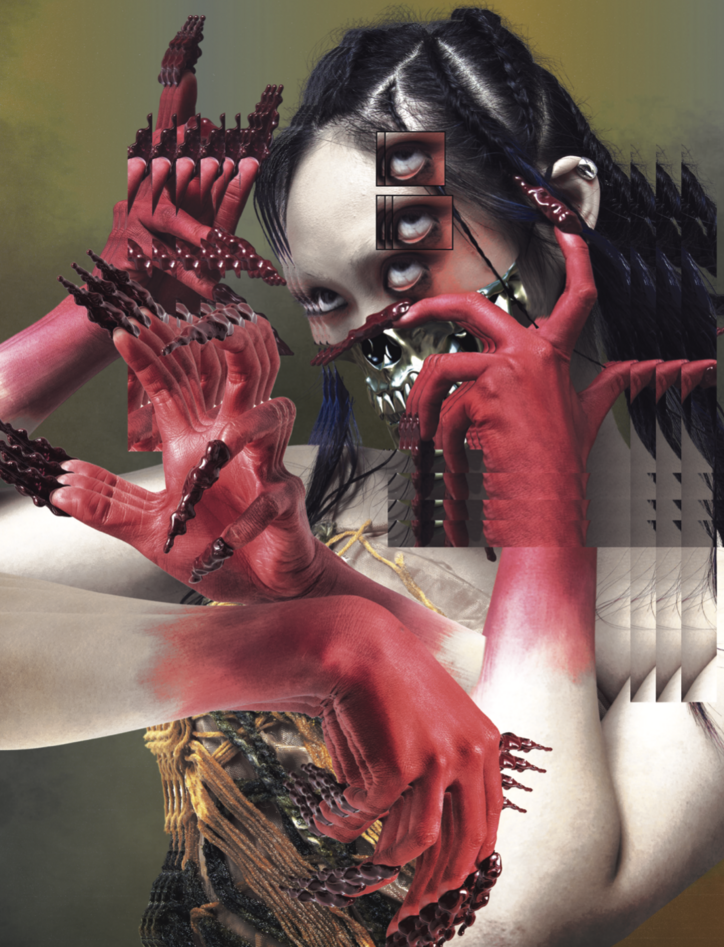
Sculpture cast KIM MESCHES, Earrings BONHEUR
How did you find your way into the Bored Ape world eventually responsible for designing the characters?
It's a cool story. It's both a lot of hard work and a bit of luck. I worked as a freelance illustrator right out of school, which was tough. But I really worked my ass off, and I loved doing it. I love Applied Arts. That was definitely a path that I was pushing for. One of my early clients gave me my first big job in New York, and I worked with them for over five years. And I remember luck played a part that month, because I really needed work. With freelance, it's unstable. Sometimes you have four different jobs in one month, and sometimes you have none. And that month, I was like, I'm hard up for work. But that early client referred me to the eventual collaboration with the founders of Yuga Labs, the creator of the Bored Ape Yacht Club. So, these guys (founders) come along, and they had this idea. I didn't know too much about NFTs at the time, but I just viewed it as, this is great. It's like a character design collaboration — that's what I do. There's an interesting story behind this. And the moment that they had told me, okay, we want punk apes, I had this vision in my head.
But again, it goes back to the eyes, there's this level of disaffection to the apes’ eyes, which had a certain appeal to the Web3 community. Was that intentional?
Oh, totally. This practice is considered an applied art, so I look at the audience, I look at the culture. And another reason why I got into Web3 is because I clicked with its culture. I got it. I understood it. There's a bit of self-deprecation and just not taking yourself so seriously. And that's how the Bored Apes came to be. I’m a rocker, so when I hear the description “Punk Apes,” I imagine this character. He's jaded and bored with life, but he has all the time and money in the world, which, when you're successful like that, you have all the time, but really bedraggled. And you're right. The Apes’ eyes show a certain lifelessness.
What's with the name Seneca? Is that your birth name, or an allusion to the Italian philosopher?
I took on the alias "All Seeing Seneca" on my journey. And yeah, I can talk all about it because I have so many facets to that name. I'm like a bedroom guitarist, and one day, I wanted to create a secret Instagram guitar account. I was like, this might be fun. Why not come up with a rock star name for myself? And at the time, I began studying Stoicism, and I had Letters from Seneca right next to me. And I was like, Seneca. It's a great one-word name, and it's unisex. And I click with the philosophy, and it feels like me. So then I took on that name, and then down the road, I was like, well, I can't just have people look up Seneca. They're not going to find me. So the "All Seeing" part comes from, again, the motif with the eyes about seeing into another world. I like to say having a vivid imagination is kind of like having a third eye. That's where that came from. And this connects with the sort of attitude of how I created the Bored Apes, too, with self-deprecation. It's also kind of a troll. It stands for, I'm not going to say it out loud, maybe you don't write in an article, but the initials are something funny. So it's kind of like half taking myself seriously, and also not, because at the end of the day, who am I, really? Right?
We're living in the age of selfies and self-promotion, but many NFT personalities or digital artists try to conceal their identity. What's your reasoning for wearing a mask? And why do you think a lot of creative people are doing this, too?
For myself, it comes from many different places as a conscious decision. On one hand, I'm a very private person. Yes, I grew up in the age of social media, but I really do not like to put myself out there that much. I normally put my work out when I think it's ready, and I don't really show the process, and that's just how I am. In a way, I'm creating a little bit of a barrier so that I save a bit of myself in order to reserve that energy from my work. Otherwise, I'm drained. Another reason why I hide my face is that I really respect iconography and timeless design. And, having the mask just leaves space for the viewer to project themselves onto you, whatever that means.
I think you're removing the kind of judgment that people place on your physical appearance by concealing yourself, too.
Yes. I want people to see my work before they see my face. Please judge my work before you judge how I look.
In this digital age though, they're both intertwined.
I think that answers the question of why you see more and more artists concealing their identity, because there’s an oversaturation of people just putting themselves out there. They were forced to do social media, and forced to share every aspect of our lives. So now people are craving that sort of distance and reserving a bit of that for themselves.
We still talk about art movements of the past, such as minimalism and pop art, with reverence. So, in 10, 15, I don't know, 100 years from now, what do you think people will say about this digital art movement and about your own work?
I have no fucking idea. I'm such an anxious personality. If I think too far ahead, it's going to get in the way of my work now. Do you know what I mean? I'm not trying to dictate what happens later on. I certainly hope people will look back, and look back fondly, around this time. I hope that people enjoy my work. However, I don't think that's the purpose of me making art. I'm not seeking, well at the end of the day, we want to have validation, but that comes from within. I need to make sure I'm doing it for myself first. I'm going to champion digital art for as long as I can because I'm very passionate about it. However, I really want to believe that good work and the good people pushing this medium ahead are going to define what it means, instead of all this hoopla around it. There's still so much to grow and develop in terms of digital art and this movement.
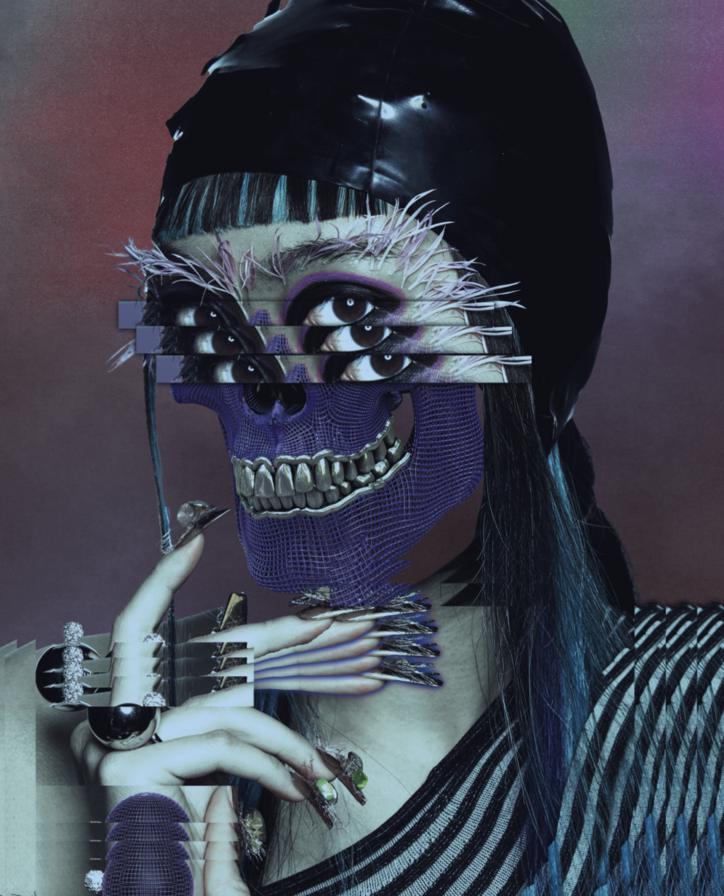
Talent wears Dress ISSEY MIYAKE, Cap VEX LATEX, Rings GIVENCHY, BOND HARDWARE, BONHEUR
A lot of creatives read this magazine, and they are wide eyed about Web3 for a couple of reasons. One, it’s another tool for creative expression. It's another canvas. Two, there's a promise of them getting compensated for their work in perpetuity. What should they be excited about, and what should they watch out for?
I think the idea of promise is very dangerous because success is not guaranteed. I think first and foremost, satisfy your idea and just try it out, experiment, have fun with it. You're going to have barriers to break. You're going to come across challenges, but that's very much like in the vein of anything else in the world. Whether you are business savvy, or you're focusing on the art, however you want to do it, just go with the flow. I mean, I had to do that for myself. You don't know until you do it. So just jump in with both feet in and make mistakes. But be settled with yourself and your work, and then just have fun with it.
What's next for you? How do you plan to evolve what you've built thus far?
I think first and foremost, my paintings are the foundation for my work. I think of myself as a painter, both digitally and physically. I do 3D work as well. But painting is my first love, and that's where all my ideas come out first – illustration and painting. So I will continue to develop that body of work, but then also, it will extend to many other forms. I think it's just about building experiences. And I have so many ideas I would love to do, like an animated film one day. I would love to create an installation experience, whatever that means, to the story or concept that I'm trying to figure out and manifest.
Digital art can be experienced on any mobile or computer screen anywhere in the world at any given time, its inherent ability to engage many people is beautiful. But it can also be easily screengrabbed and printed by anyone. How do you feel if someone printed your work out and hung it on their wall?
I'm not against it. I think digital art should live in the digital realm. That's where it's at its peak performance, color-wise, and the way it's portrayed. If there's movement in the piece, a printout is not going to do it justice. But I have no issues with prints. I will say, printing is the bane of my career, because the colors are never correct and you lose some of that life. I think a person should enjoy it. I think that's part of the ethos of digital art, how much you can share it. I think ownership means a lot to people, and it's a great thing. But art should be enjoyed by all. It should not be stored in a basement, in the dark. I think that's a real tragedy.
Or in someone’s home, where it’s only experienced by a few people.
At least museums share them with the public. But if it was sold directly to a collector, then put away for decades, that's the tragedy. The beauty of that work could never be interpreted, can never be shared and celebrated. So, do I mind people printing it out and putting it in their homes? Not at all. When it comes to monetizing and making money, there are other ways to do it. And I think people value things that I'm putting my stamp of approval on, maybe by signing it. Or taking quality control (of printing) under my own hands. I think that has more value, and people appreciate that. We can be in harmony with each other with printing on your own and also me doing my own prints.
Watch the office exclusive premiere of 'Prelude to Deluge: A Studio Visit with Jeff Sypherd' below.
What does your work aim to say? What emotions do you hope to evoke with your paintings?
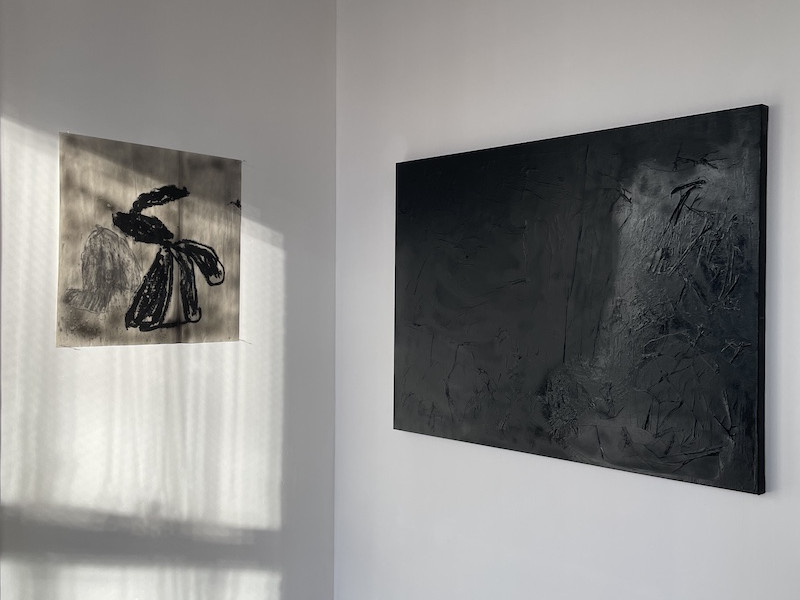
I’m very inspired by a Van Morrison song called “The Way Young Lovers Do”. In it, the instruments are very chaotic and eerie sounding, but the lyrics are really beautiful and about love. In my painting I think I would like to do something like that, dancing between doom and hope.
Tell me about yourself. Who are you? What’s brought you to this moment in your career?
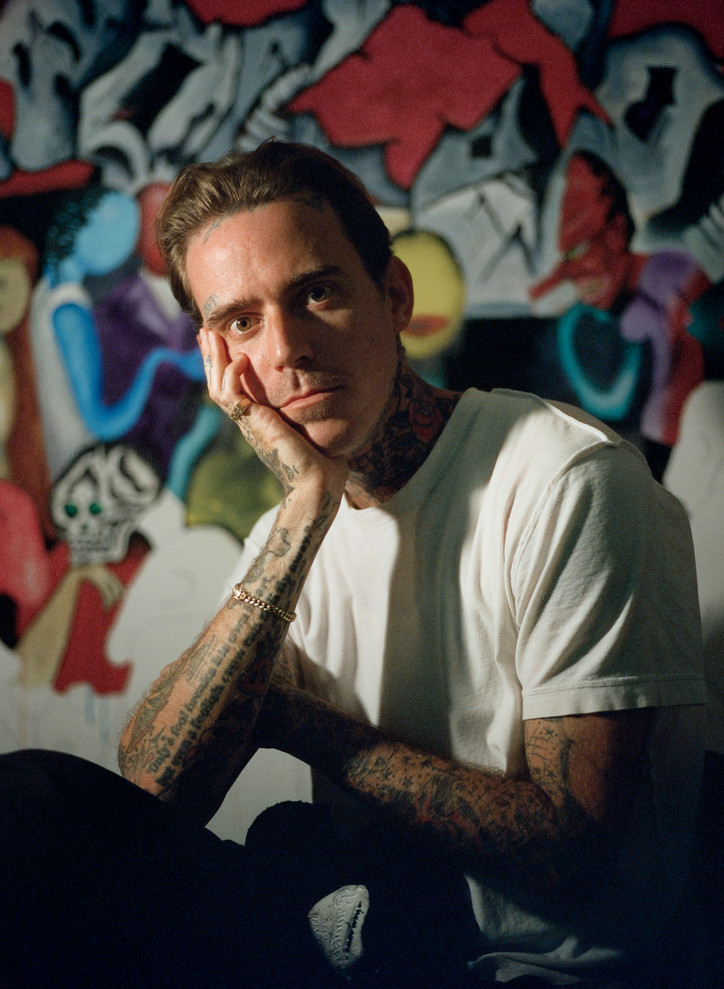
I'm from Riverside, California. Son of a surfer, I grew up around a lot of music. I wanted to be Van Gogh in the third grade. Today I'm painting and tattooing in New York City. I've been chasing the dream for a pretty long time, and would like to continue to do just that. It's always changing. You mention that the experiences in your personal life are reflected in your paintings.
What have you learned about yourself through your creative process?
I guess that I can be a little impatient.
Where do you go to find inspiration?
My girlfriend's place, Strand Bookstore, back to California, any beach, Tony Polito’s acetate stencils, the Human Recreational Services website or Will Sheldon’s instagram. I like to pretend I'm in the lineage of Chaim Soutine and Willem De Kooning.
How does painting influence your tattooing?
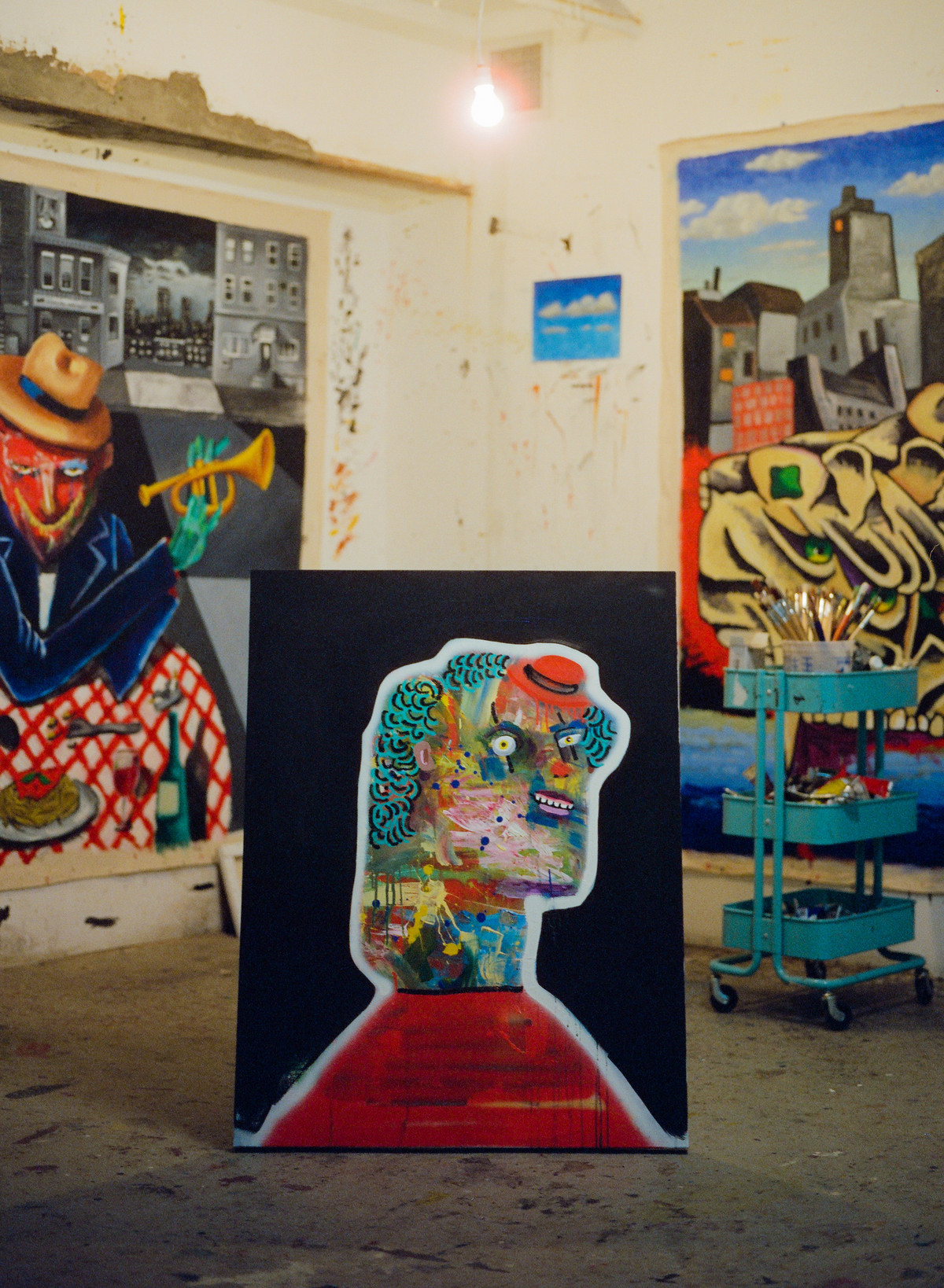
I look at a painting from art history and then I think, hm, how would this look as a tattoo. And then I would try to apply it on the skin in more of a tattoo language i.e black outline black shading bright colors and exposed skin.
You often reference other paintings and tattoo designs within your work. How does this influence the message you aim to communicate?
I like to use references as a vehicle to take the viewer where I want them to go. I aim to communicate that inspiration is the absolute best, and these images are all around us and have been forever. I love that we get to look at them. It’s like doing a cover song or something. If you like the way it looks, try to sing it in your own voice.
When do you know a painting of yours is finished?
I normally get a feeling leading up to it knowing it's about to be done, but to be completely honest I’ve never thought about this ever, I don’t think. I could only imagine that I would know a painting is done when all of the strokes are in their places.
What are you working on right now? Are you focused on any new projects that you can share?
I’ve started a series recently titled “Everyone” that looks like a graduating class photo or cast of characters in rows that could be just like all of us. Some of them are warped , some of them are elated, some depressed, others are content, but everyone’s a little off. I’m also working on a couple paintings that are heavily inspired by people eating nice meals out in the gutters and on the sidewalks. I'm always painting, I love painting.

The question the show asks is in itself much more interesting than a show that simply centers on an exploration in activism. The works course with drama and life, living and breathing to confront the place of rebellion in the modern day. Apropos of the opening, office got exclusive insight on rebellion from Anna Delvey, Nick Rhodes, and curator Indira Cesarine themselves.

ANNA DELVEY
It’s been said that all great art comes from pain. Do you agree? If so, how do you relate?
I've used creative pursuits such as drawing and writing as a way to process what's happening in my life at any given moment. These outlets have to a certain extent helped me rationalize and put things into perspective. It's a two-way street - I was both compelled to interact with the events in a manner I normally wouldn't have by trying to create something, and I wouldn't have come up with any of the ideas without having been through what I have.
It's difficult to say if leading a 'normal', adverse-free life is detrimental to one's creativity since I hardly remember what it feels like, but I definitely see pain and adversity as a catalyst for creation.
What do you hope the viewer will understand about you through your artwork “No Regrets” created for for the REBEL exhibit?
With this sketch I'm trying to address the controversy around some of my statements that were perceived as lacking remorse.
I equally would 'regret' looking back and not accepting who I am today, something I see as self acceptance although my lack of contrition is sometimes interpreted as rebellion. I am trying to learn from past mistakes and move on while making better choices.
What is your goal as an artist?
I use my art as a nonverbal way to communicate my perspective on things that are happening to me and to hopefully provide the viewer with a different perspective on me as a person. My original goal for my sketches was to take ownership of my story - there were so many voices and versions of it out there that I decided to take the route none of the others did by building a narrative through drawings.

NICK RHODES
What drew you to photograph Lottie Moss?
I had worked with The Untitled Magazine several times on different assignments and I always find Indira Cesarine’s ideas for subjects inspiring. When she first mentioned Lottie Moss, I took a look at a few images and instantly thought that I could shoot her in a different way to create something special. We put together a mood board and everything fell into place. Lottie has a great attitude and a big personality, she was easy to photograph for me because I wanted that to come across in the images.
How do you feel your work in fine art is similar to your work in music?
I never really separate different disciplines within the arts. Whether I’m writing a song, making a short film or taking a photo, they all require fresh ideas, focus and a fearless approach to get the best results. I love being able to switch between different projects, it always keeps me curious and excited to see what I can discover or unravel.
What is your definition of a rebel? How do you fit into that, and how does your work for this show fit into that?
An individual who isn’t afraid to be different. Someone with their own unique ideas who does not need to follow trends, but sets them. I don’t like to to stare into the mirror for too long considering my own work and contributions, I’m happy to let time be the judge though!

INDIRA CESARINE
What unites all the artists included in REBEL?
The REBEL Exhibition celebrates art activists and creative game changers that are inspiring positive change and progression with their artwork. Each of the 35 international contemporary artists featured in the exhibit give their original, boundary-pushing take on what it means to be a rebel in our contemporary world. The group show presents a collective of visual artists, each with a unique message, fighting in their own way for what they believe in, and using their artwork as a tool for that expression.
What was your process of selecting the participating artists?
Over the last six months, I have been researching the most unique, controversial, and talked-about living rebels. The Untitled Space gallery presented a global open call for artists to share work that engages themes of rebellion. I personally reviewed thousands of artworks in search of the most compelling narratives that were relevant to the theme. I invited a number of artists that we have previously worked with whose art speaks the language of protest and progression. The exhibit presents a mix of represented artists and new ones with more than 50% of the selection from the open call. I also worked with Nick Rhodes from Duran Duran who is a really talented photographer to create an original artwork for the exhibition. We produced a shoot in London with model Lottie Moss and between his global tour dates he found the time to do the shoot for us. Right as I was wrapping up the curatorial for The REBEL exhibition, I confirmed Anna Sorokin (aka Delvey), and she made an original artwork from behind bars - as she is currently being detained in a county jail by ICE.
How do you define rebellion, both creatively and outside of the art world?
I feel like the concept of rebellion and term “rebel” used to have negative connotations, although in the current world we live in it takes on a vast deeper meaning. It is about challenging the status quo - following your heart and fighting for what you believe in despite the obstacles we are currently facing in our society - both culturally, creatively, and politically. We are being confronted with so many issues right now - from abortion rights to Black Lives Matter and MeToo movements. I think it is important that there are rebels who challenge the status quo, and activists - including artists - who are making a difference, getting their voice heard. To me rebellion is not only about standing up to oppressive forces, but also about true, unbridled authenticity, and perhaps taking risks that many would call crazy. It’s about believing in yourself no matter what anyone else thinks and having the courage to follow your own path.
What draws you to Anna Delvey’s work and narrative?
I think Anna Delvey’s story is fascinating for a number of reasons. Anyone who works in the art world or lives in New York City would probably agree, as it’s pretty unbelievable what she managed to do. After watching the Netflix series “Inventing Anna” I had heard about some of her art exhibits in NYC and initially I wasn’t 100% convinced by her artwork, although after interviewing her and learning more about her side of the story, I realized that a lot of what we are presented about her is highly exaggerated and sensationized. I think that she is actually a really talented artist, and am thrilled to include her work in the REBEL exhibit, I think she is perfect for the theme. Her artwork has a very humorous irony to it, rather self-deprecating vignettes of her life and experiences as well as how she imagines other people perceive her. She also confronts head on some of the experiences she has had in prison or while being detained by ICE. I have always been interested in art by incarcerated artists as I think it is important to shed light on what is going on in America with mass incerceration. Often artwork by prisoners goes unseen and I think it’s very interesting Anna is not only able to release her work while deing detained but also is speaking up about prison reform.