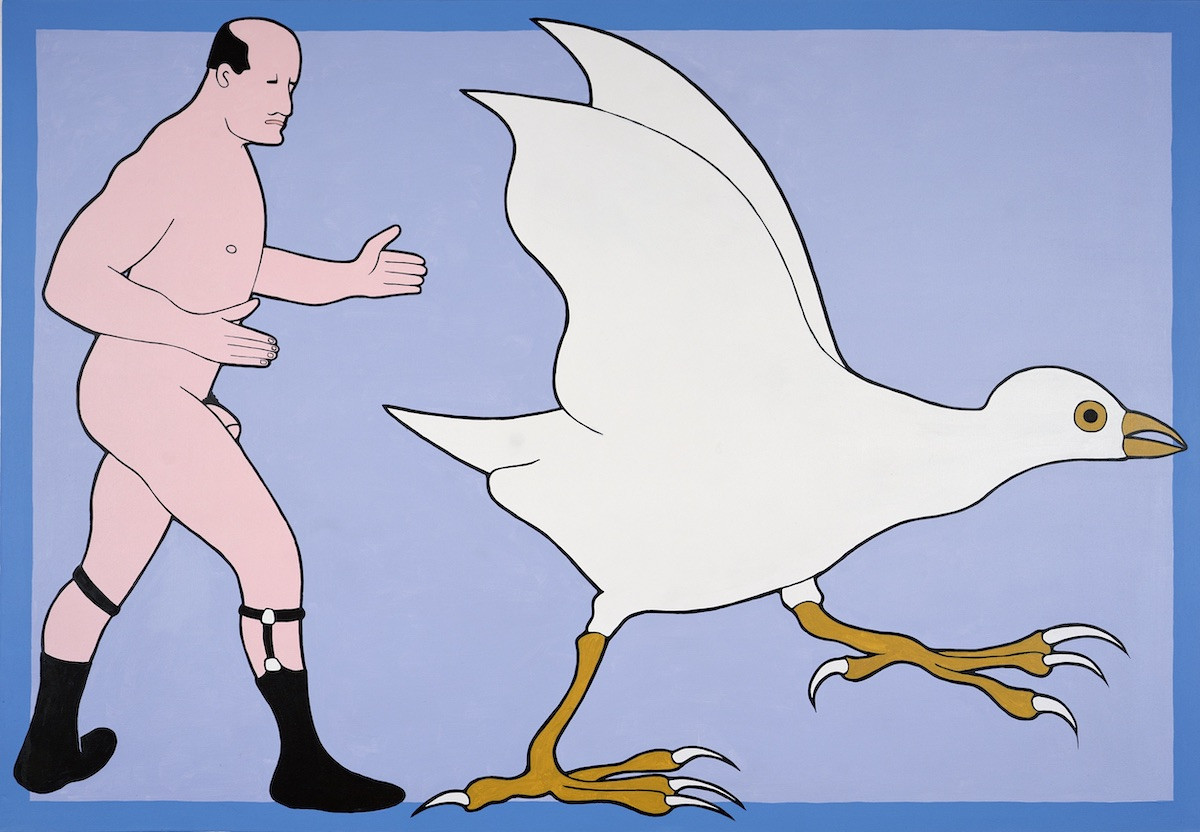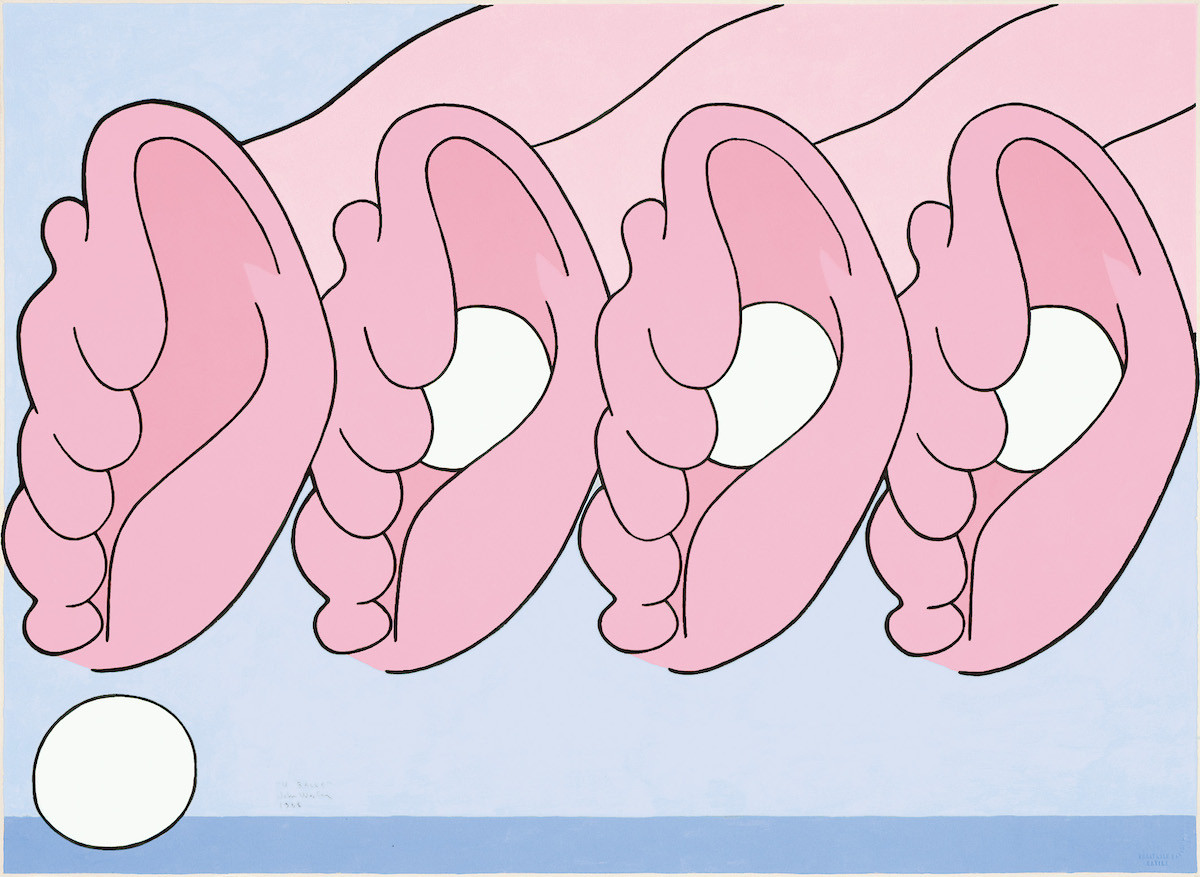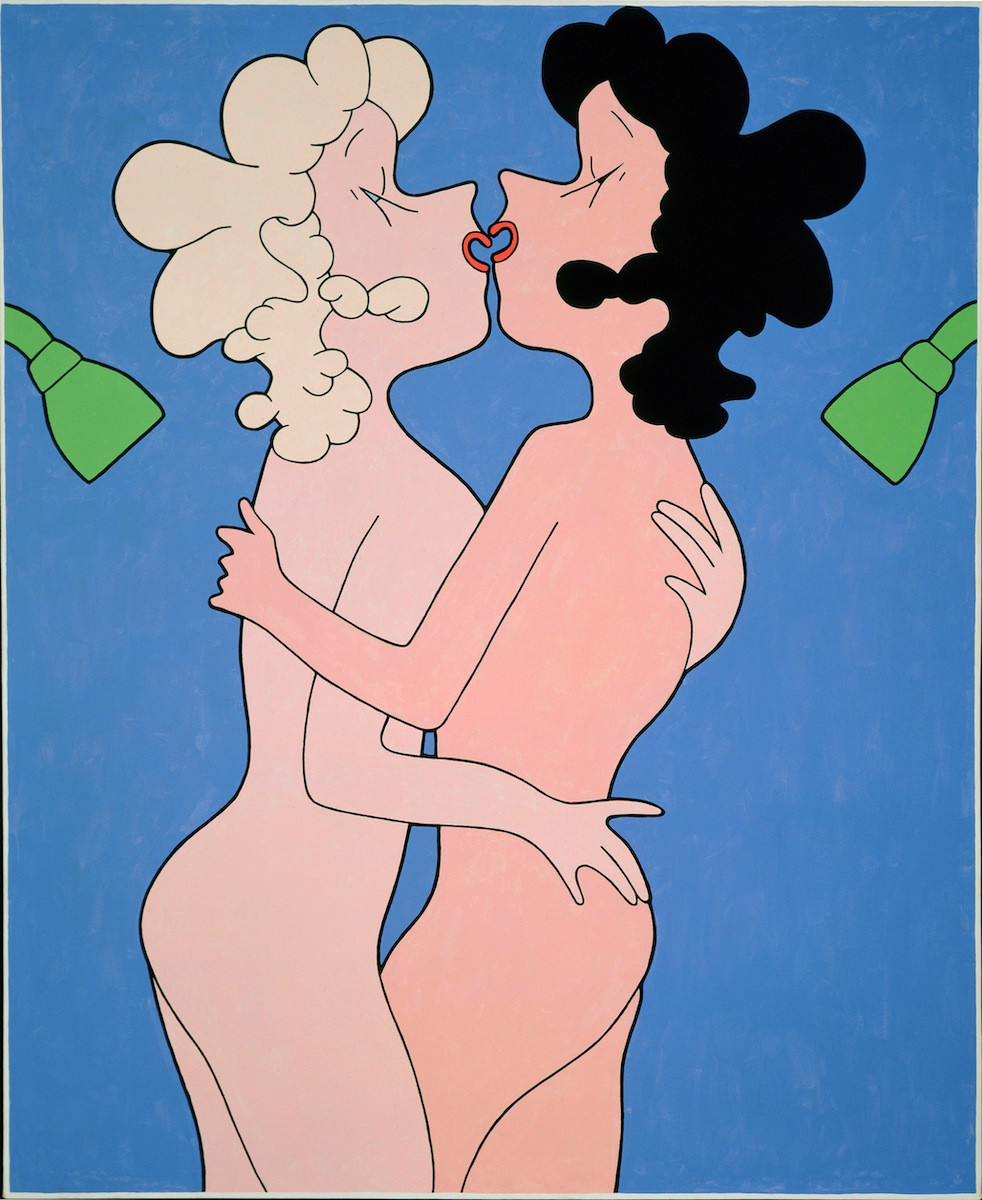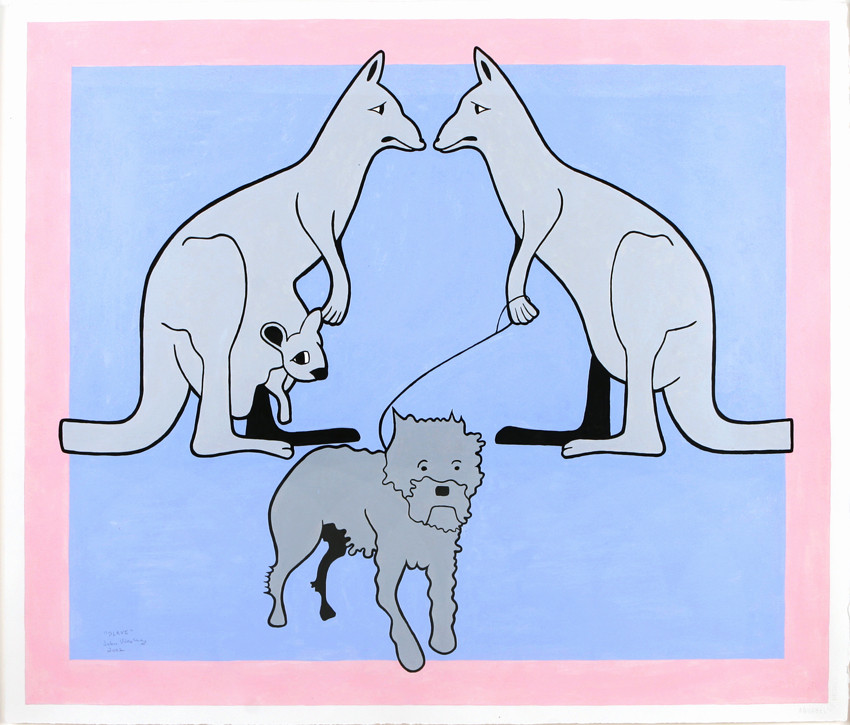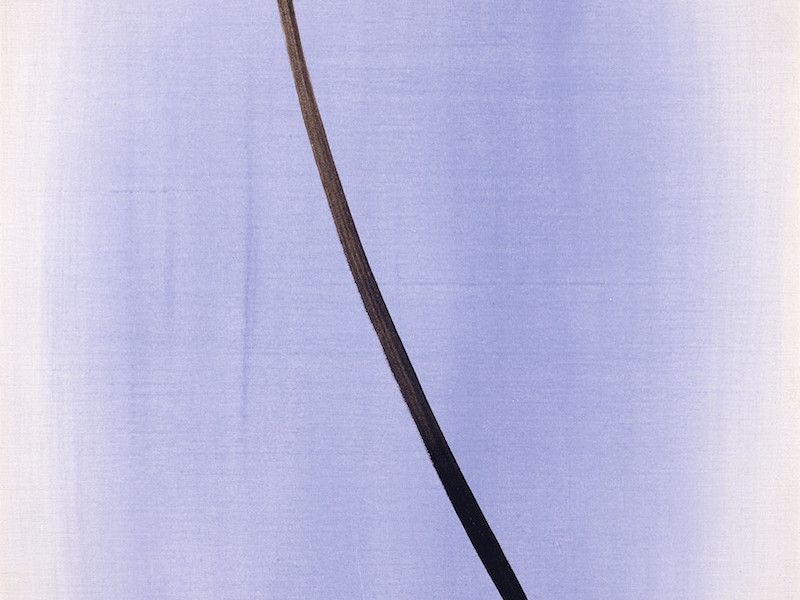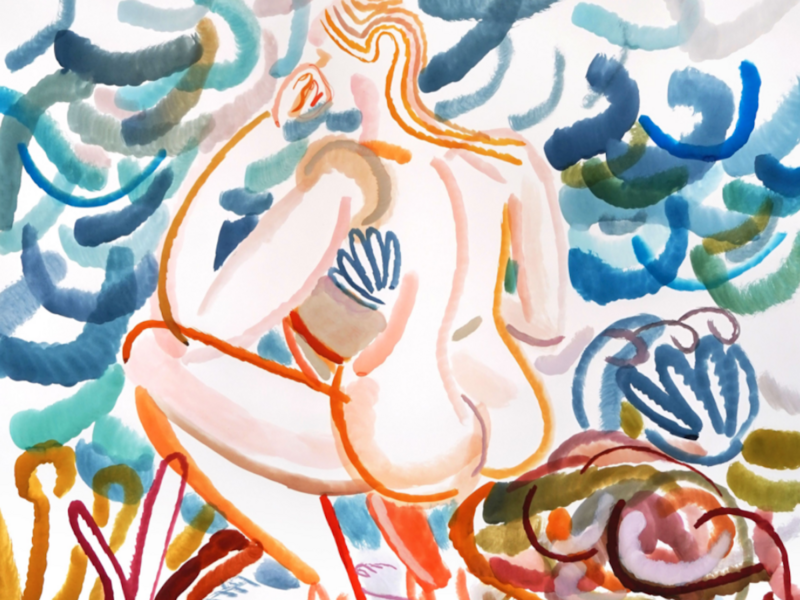


In preparing to write this text on the painter John Wesley—who died at age 93 on February 10th of this year— I read a number of earlier essays wherein critics and historians attempted positioning Wesley as either a Surrealist a Pop Artist or neither, faced off against each other, explained why he wasn’t one or the other, spoke about form versus content and innumerable academic subjects, and generally discussed how dancing works as opposed to what dancing is.
Immediately I thought of the following:
It’s Game Six of the 1992 NBA Finals. The Chicago Bulls are about to defeat the Portland Trailblazers. B.J. Armstrong has just passed the ball to Michael Jordan, who’s advancing quickly into Portland’s key. With the ball in his right hand, Jordan pushes off from his left foot and begins sailing over his defenders, the formidable Clyde Drexler, Jerome Kersey and Terry Porter. As Jordan moves closer to scoring, Drexler, Kersey and Porter begin talking amongst themselves about what exactly is happening:
“How does his leg do that, how does he keep his hand so out of reach, why are his muscles unlike ours, somehow superior, otherworldly?” they ask each other.
Lost in a wilderness of questions, they miss the very thing they’re paid to prevent; Jordan has just dunked on them, further securing the Bulls 97-93 win, and the championship title.
John Wesley dunked on the art world. I sensed in these essays writers focusing on the act instead of the magic, denying themselves that rarest of gifts: mesmerization.
This thought came next, some cautionary parable from an imaginary Greek or Polish Buddhist teacher:
“One day a chef began describing to me a soup he’d prepared for my dinner. He described the ingredients and their sources. He described the sources and their antecedents. He described the alchemical virtues of his soup, the effect of one ingredient on another, one component upon the next, and the point did come, after finding myself increasingly hungry and increasingly bored when I finally asked, ‘Dear chef, may I please taste the soup you’re describing?’ To which the chef replied, ‘The soup? Oh no, the soup is now far too cold to be eaten. You must taste it tomorrow, when it is fresh!’”
A lot, I sometimes think, is lost in the art historical drive to categorize and index, a drive that often seems born out of fear of perplexity, and a desire to feel safe in the face of ambiguity.
I’ve always been a fan of this paraphrased quote by photographer Sally Mann, “If it’s not ambiguous, don’t bother.”
Wesley’s deft elusion of categorizability defines his very category: genius, warlock, outlaw, American.
An early draft of this essay implored readers to discover “the greatest American painter you’ve perhaps never heard of”. After examining the catalog accompanying Wesley’s 2001 retrospective at P.S.1—a catalog filled with genial, affable, and entertaining conversations between Wesley and curator par excellence, Alanna Heiss—I changed the sentence to, “The greatest American painter, ever.”
Bold, sure. Not an uninformed opinion though, and, arrogant to state? Also, sure. Not just the greatest American painter, but the most American American painter.
Arrogant also the assumption regarding who people have and haven’t heard of, who’s familiar or unfamiliar with what. My slight, knee-jerk derision of art historical taxonification likely speaks to my own hang-ups as someone who makes paintings, as someone who privileges mystery and disdains ‘artist’s statements’, as someone with an almost dread-shaped awe for, and protective infatuation with, Wesley’s work, so that I can and should write the remainder of this essay simply as someone who loves paintings and painters, and particularly the paintings painter John Wesley left us, having produced close to a thousand over a half century.