
Her hair at the opening was remarkably artful, braids threaded with clear beads from mid-shaft to ends like a heavy Egyptian wig, though I must admit I was happy to admire it from afar. The impulse to touch someone else’s hair is strange and the artist’s use of it in her work fascinating, since it almost confirms and denies that she herself is a living artwork, one that is not to be touched even if the impulse is strong, but who is also by no means an object, and therefore calls out the impulse itself as a subconscious regarding of the black body as a mere object of wonder by a white audience. The neon message, then, is directed at this audience, while nodding to the black viewers that would immediately understand the sentiment.
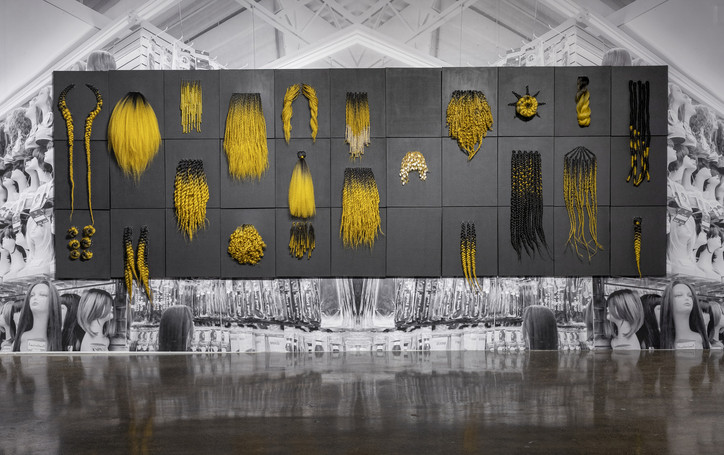
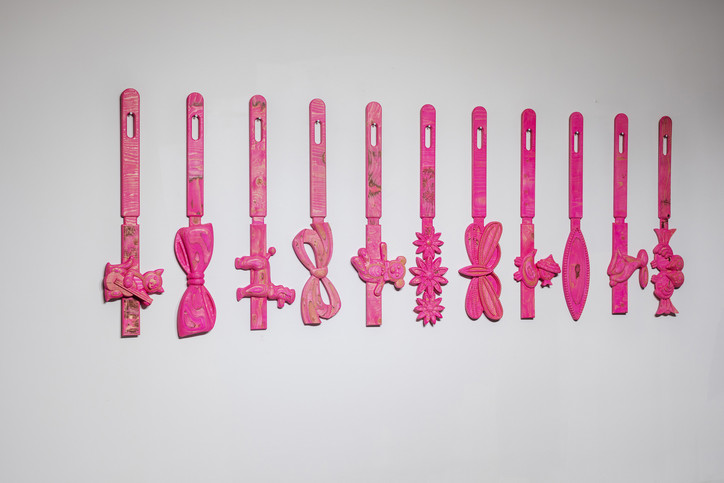
Her other works are about hair as well: one attempts to replicate, in its way, the overwhelming nature of a beauty supply: a wall mounted with false hair pieces, all ombréed from a dark, natural-colored root to a Crayola yellow hue—not blonde, but the cartoon version, a distant reference to Eurocentric standards of beauty (blonde only naturally occurs in the white population), but with an almost childlike interpretation. Apt, since the work across is a set of surrealistically-sized pink berets, exact replicas of those the artist wore in her own childhood—remnants of her first lesson in personal adornment. The neon sign’s brassy imperative can easily refer to the artworks themselves: “The security guards were saying, ‘This is the one to watch, the wall of hair,’ because they know how much black women pay for their hair,” Massey said with a laugh, though all the hair pieces were synthetic, a choice based both on cost and meaning. She confirmed my curiosity that one hair piece had begun on her own head, the others created specifically for this project with the help of her hairdresser.