Keith Haring and Jean-Michel Basquiat at the opening reception for Julian Schnabel at the Whitney Museum of American Art, New York, 1987 © George Hirose.
Stay informed on our latest news!


Buchhart points out that being part of the “Downtown” scene in the ‘70s and ‘80s meant working in a variety of performative disciplines—both Basquiat and Haring worked as DJs, videographers and photographers, and in a variety of mediums as artists, especially collage work. “The overcoming of traditional lines separating individual disciplines and cultural realms created a structural openness that led many of the artists of the Downtown scene, including Haring and Basquiat, to partake in artistic collaborations,” Buchhart says.
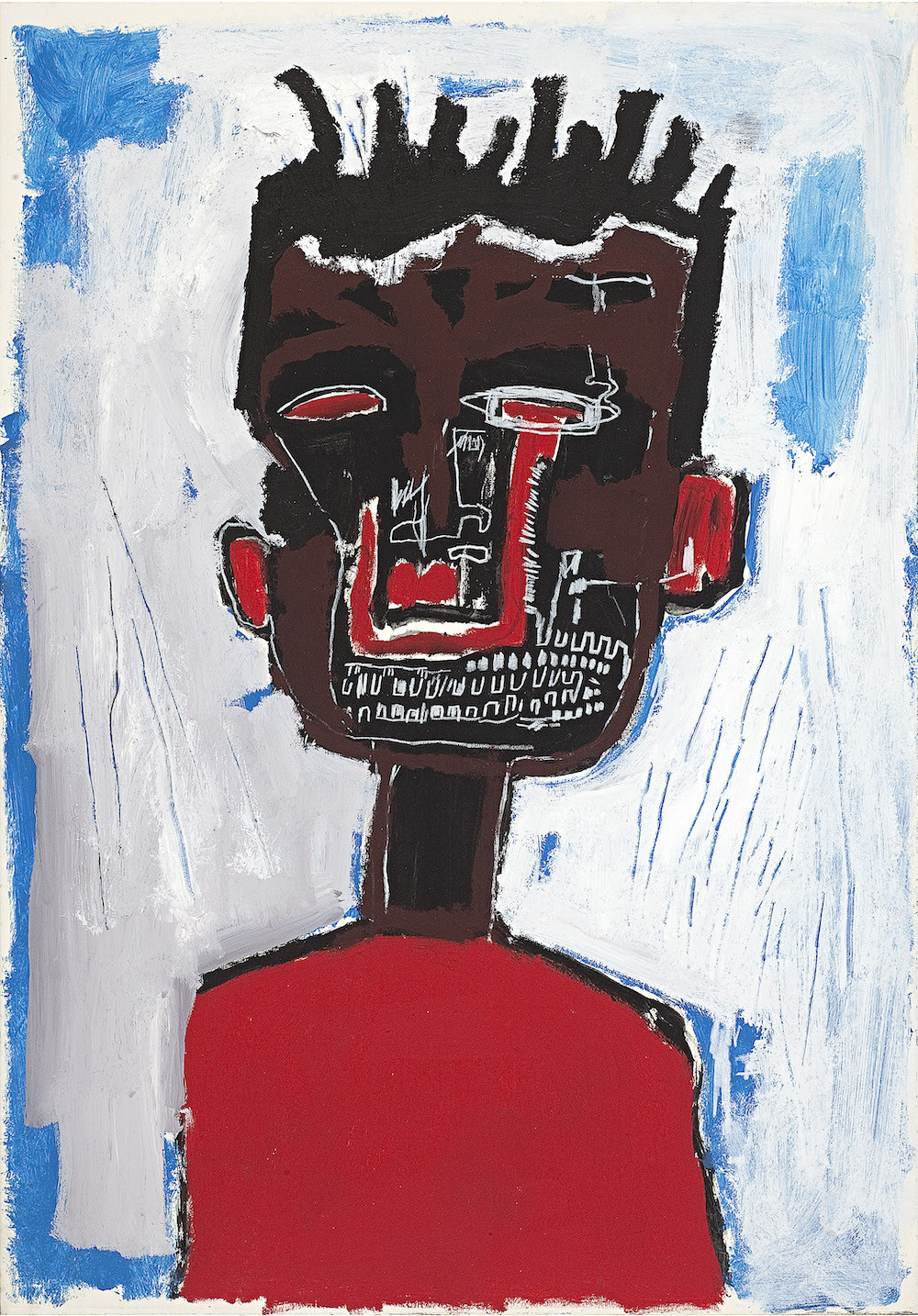
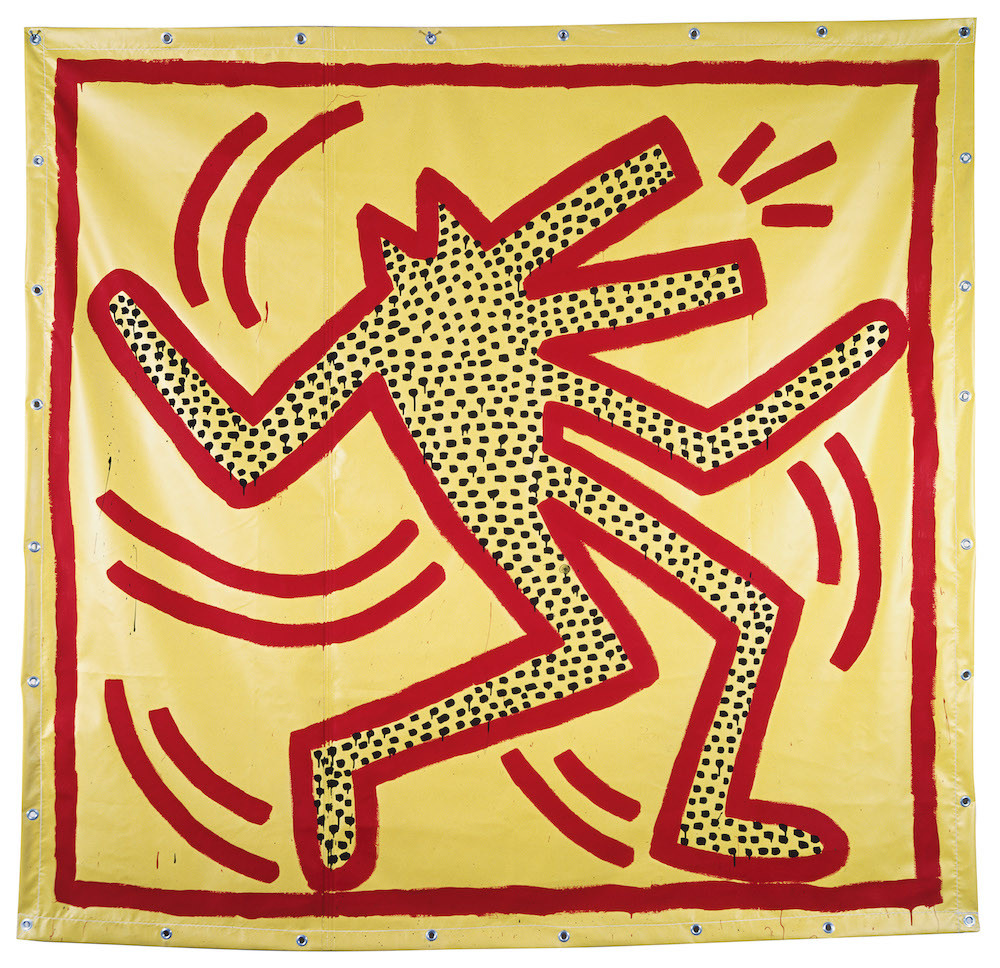
Left - Jean-Michel Basquiat. "Self portrait" (1984); Acrylic and oilstick on paper mounted on canvas, 98.7 x 71.1 cm. Private collection © Estate of Jean-Michel Basquiat. Licensed by Artestar, New York.
Right - Keith Haring. "Untitled" (1982); Synthetic polymer paint on vinyl tarpaulin with aluminium eyelets, 213.5 x 220.0 cm. J W Power Collection, University of Sydney, managed by Museum of Contemporary Art. Purchased 1982 © Keith Haring Foundation.
You’ve connected artists before that don’t usually hang side by side. But the Keith Haring and Basquiat pairing is more of a no-brainer; they had shown together in their own lifetimes. What’s new in the NGV exhibition?
As the exhibition title implies, we focused on the crossing paths of these two exceptional artists: the intersections in their lives, practices and ideas. Thanks to the generous support of The Keith Haring Foundation and The Estate of Jean-Michel Basquiat, we had access to an immense pool of archival materials that allowed us to document both their private and working relationship to an unprecedented extent. Interviews with their contemporaries—Patti Astor, George Condo, Diego Cortez, and Jenny Holzer—also gave us invaluable and previously unpublished insight.
Haring/Basquiat: Crossing Lines demonstrates how, despite having very distinct languages, the idiosyncratic imagery, radical ideas, and complex sociopolitical commentary of both artists created an indelible legacy that continues to influence contemporary visual and popular culture today. And while, as you say, it should be a "no-brainer" to explore this friendship (and rivalry!), Haring/Basquiat: Crossing Lines is a world premiere exhibition, the first large scale museum exhibition dedicated to these two outstanding figures of 20th century art.
What’s the value of these connections in a time where both the works of both Basquiat and Haring are achieving popular success among younger generations? Is there anything people overlook about these artists now?
Interesting question. Today, both are considered among the most influential artists of not only the 1980s but more broadly of our time. Both are relevant to global youth culture today; in fact, they have never been more relevant. While Basquiat anticipated today’s "always-on" culture of communication and contemporary knowledge spaces, Haring foreshadowed emojis with his image-word. This universal system of communication remains a positive, humanistic meme in the collective struggle against ignorance, fear, and silence.
An aspect that is perhaps overlooked is the importance and decisive nature of their artistic collaborations with other artists and performers from various backgrounds.
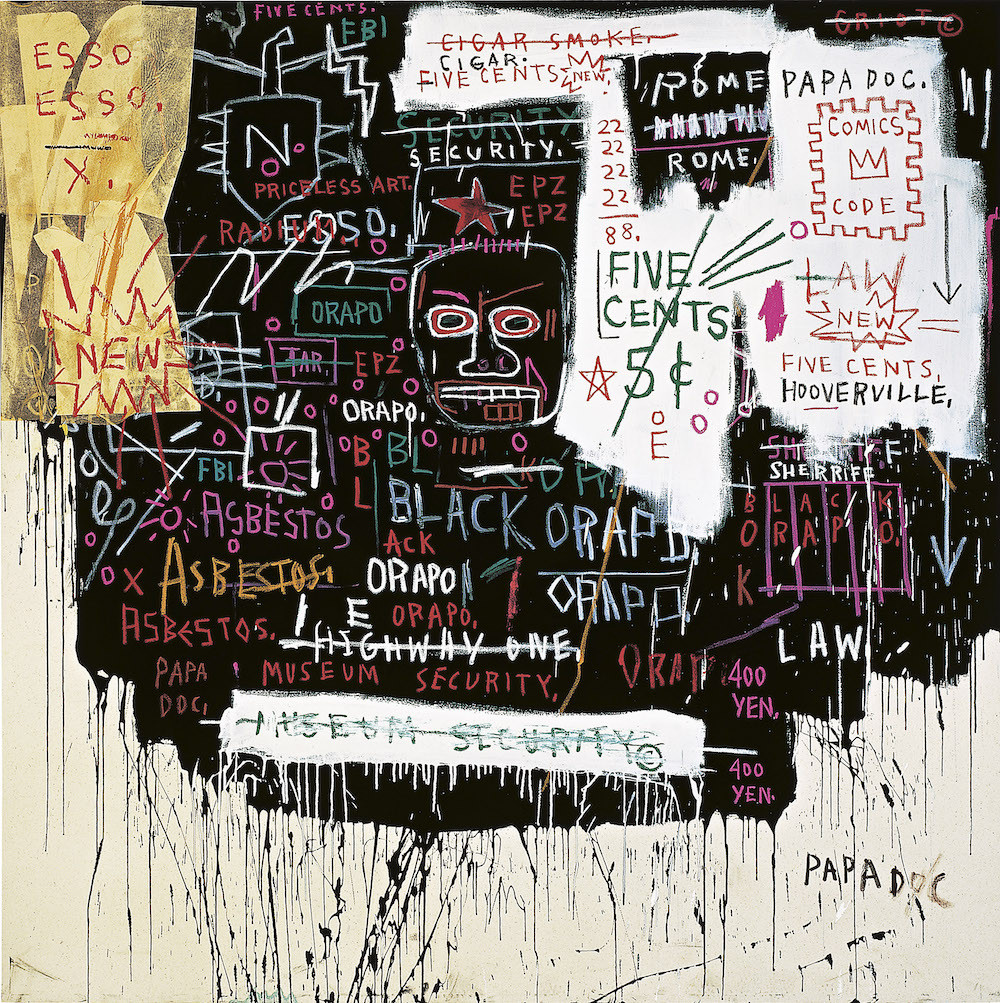
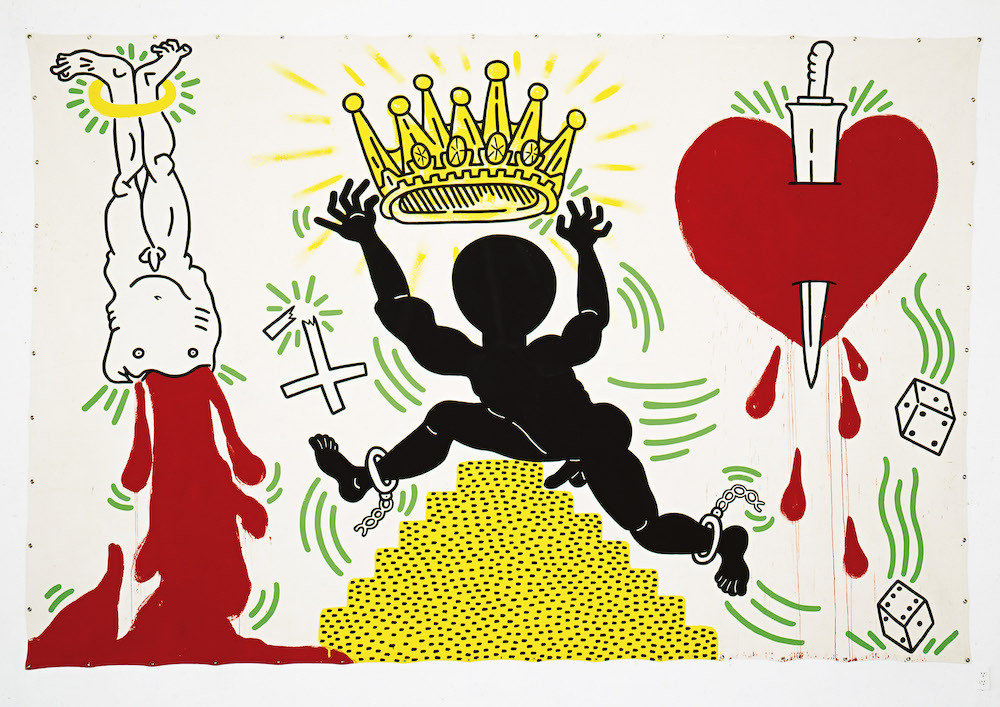
Right - Keith Haring. "Prophets of rage" (1988); Acrylic on canvas, 304.8 x 457.2 cm. The Keith Haring Foundation, New York © Keith Haring Foundation.
What legacy have these artists left in the NYC art world?
Their legacy is not limited to the art world of New York City, but an integral part of art history as a whole. They were both visionaries that not only inspired subsequent generations of artists, but also anticipated the present. Their works are like codes and keys to yesterday, today, and tomorrow.
Is there any significance of the show's location in Melbourne?
Keith Haring's visit to Melbourne in 1984 is well-documented, as is Basquiat's sampling from Aboriginal iconography. But these ties are not what speak so clearly for Melbourne as the ideal location for our ambitious presentation. We live in a global village, and Melbourne is an incredibly dynamic city and cultural hub.
What made both these artists so successful, even within their own lifetimes, and what draws you personally to their work?
I was first drawn to the works of Basquiat, because I saw the same energy in his works from the 1980s that I saw in the works of Edvard Munch from the 1880s. Munch was radical. He would scrape off all the paint from his canvases. He was like no other artist before him. I saw this same energy in Basquiat and started researching his work. Very soon, it was clear to me that he was not a neo-expressionist or expressionist at all. He was a very intellectual, conceptual artist. And that's what got me really interested. I became aware of Haring’s oeuvre through my work on Basquiat and my research into the art of the 1980s. What especially caught my attention in Haring’s work was his unique political line.
I believe that the key to the continued interest in Haring and Basquiat’s art is the relevance of it. Their work is of our time.
Basquiat was one of the first Black American artists to gain a sort of superstar status. Haring’s existence and production, on the other hand, was in some ways backed by the establishment. How does the exhibition engage with these themes?
Both Haring and Basquiat were most definitely considered superstars. While it is true that Basquiat, unlike Haring, did not have any formal art training, it is important to note that he was equally backed by the art world "establishment." The genius of both was noticed very quickly by the establishment, something that is reflected, for example, in the astounding number of international group and solo exhibitions that both participated in during their lifetimes.
Both artists received critical attention early on in their careers, although some projects they worked on were perhaps not fully appreciated by all of their contemporaries—Haring's progressive Pop Shop, for example, or Basquiat's collaborations with Andy Warhol and Francesco Clemente. The show includes many works which were first shown in some of the artist's most decisive early shows, works from the New York/New Wave exhibition, for example, or from their seminal presentations at the Fun Gallery.
You can see Crossing Lines at the National Gallery until April 13.

Perhaps best known for her book of poetry How To Cure A Ghost, Róisín is currently preparing to publish her novel titled Like A Bird. Making the clear transition from writer to multidisciplinary artist, she intends to release a variety of medium-defying work in the near future. office sat down to talk with the artist on everything from writing and healing to Kendall Jenner.
Tell me a bit about yourself.
I think for a very long time, I would have described myself as a writer. But recently, I started describing myself as a multidisciplinary artist. This year I’m merging and making more visual art, and I decided to make performance art. I’m working on two shows that I just have this vision for, and I’m doing it. I’d also call myself someone who is really invested in healing.
What is the transition from written work to physical?
Writing is a very interesting tool, I’m sure you know. There are many dimensions to writing, and I feel like I was exploring all of them. I’m screenwriting right now, and I’m releasing a novel this year. I just wrote a book of poetry, and I work as a journalist. So clearly, I’m navigating all of these facets, but it didn't feel as if it was the totality of my experiences as a person and artist—and maybe I kind of resent wanting to be distilled down to one thing.
Frankly, I’m so out of the microcosm of the writing world, although I exist in it. I don’t feel community there, and so I think the lack of community has really made me question where I do want to find community. All of the artists that I look up to are multidisciplinary to some degree, and that’s something that really excites me. So the transition has been cool, because I feel like I get to have this visual and more abstract component to this body of work that I’m writing. It’s really fun to be like, “Oh, this is the other facet to my being!” I’m not one thing, I’m many.


Left - Dress by NANUSHKA, jacket by NOMIA NYC, necklaces by PAMELA LOVE + LADY GREY, all other jewelry by LADY GREY
Right - Dress by GANNI, hat by CLYDE, jewelry by LADY GREY, belt stylist's own
You touch on lack of community, and in my opinion, you are a community leader in the writing world. Do you recognize yourself as one of the leaders of a community that might just be growing, because you are speaking out?
I see that question in two parts. I absolutely feel and think it’s necessary to be apart of the community in a way where there is no division, because we are all in this together. I’m genuinely such a corny person. Yesterday I was talking to my landlord, and I was like, “We’re in the midst of a revolution.” We are evolving as a species, and the world is falling apart. It’s burning, and everything is happening, but I am so invested in our future.
We need to start shifting, and we need to keep changing. That means that ego needs to be worked on, and we need to start creating spaces where we are invested in care. There’s not a lot of care in general, so I think I see myself as a beacon for that. I don’t want to just talk my politics on Instagram—I’m actually going to become what I’m saying. I want people to look at me and be like, “Oh shit, that’s what it looks like to have integrity.” I’m opposed to the idea of leadership, but at the same time I know I’m a leader. I really do. Every tarrot reading, every workshop, I fucking get, “You are a leader; you are a healer.” It’s a push and pull.
For anyone in that position I imagine it comes with a lot of rewards, but also frustration. What do you think the connection is between intention and reception?
I think it’s tiresome to see so much dishonesty, and frankly there’s not a lot of dedication beyond an aesthetic or beyond being like, “I’m going to say this on Instagram and be a healer. Love and crystals.” I know I say that in a mocking tone, and I do believe that. But we can’t be doing that anymore. We are really facing an apocalypse. We need to ask how we can shift. There’s a difference between what people think and what they’re willing to do.
The best way that I’ve seen people act is through conflict. How to build a community is through conflict. That’s when you really see if they will stand up for you and say what they think. As a queer brown person, are they going to protect my body? That’s a really moving and interesting way to see how artists in particular really stand by their art. I think that art is a tool to create revolution. So for the people who aren’t doing the work... we can’t be doing that anymore. That’s where the tension lies for me. Why are we all fronting so much? We have to evolve. I think this will be the thing I keep beating over people’s heads.


Dress by NANUSHKA, jacket by NOMIA NYC, necklaces by PAMELA LOVE + LADY GREY, all other jewelry by LADY GREY
I completely understand where you’re coming from, and I feel like a lot of people can’t get to this point of themselves, because they don’t actively heal. You’ve been very open about confronting your past and healing. What’s one childhood memory that has always stood out to you as a defining moment of this awareness?
A lot of my childhood was like that. I have a very domineering mother. She’s extremely abusive. From a very young age, I realized that no one was looking out for me. And it’s not like I didn’t yearn for that—I really wanted that, and I’m still really emotional. But there’s also the Capricorn side that’s very focused and committed, and that was my whole life, I was really committed to survival.
Last year, I remembered my mother molesting me. So that was a huge shift in my life—beginning to work through that trauma. I started seeing a trauma therapist last summer, and I’m a deep practitioner now of Ayahuasca, and doing the work of "facing yourself" in that sense is so difficult. Both these practices prompt to you go to your inner child and go to this place—kind of what you’re saying—this memory and giving that memory love. That is a great way to begin healing and self-parenting. For me, I have this distinct memory of playing blocks, and I'm maybe about three. I’ve got my back to the adult me, and I’ve just been going up to her and saying, “I love you, and it’s going to be okay.” That, to me, is time travel. What is time travel? Maybe it’s this ability to know you're going to be okay, and that’s amazing. Time travelling is really interesting particularly in the spectrum of trauma, because I think surviving is believing in your future.
If you can go back, can you also go forward and manifest?
Absolutely. [Laughs]


Left - Dress by NOMIA NYC, shirt by NANUSHKA, jewelry by LADY GREY, hat by CLYDE
Right - Dress by GANNI, jewelry by LADY GREY, hat by CLYDE, belt stylist's own
What have you manifested for yourself in 2020?
I mean [Laughs], oh my god, this year? Well, my book that comes out September 18, 2020 is called Like A Bird. It’s a novel that I started writing when I was 12 years old; I’ve been writing it for 18 years. I am really really hyper honest, because it’s a way of showing people that you can do that, and you can be yourself. There’s no distinction between who I am online and who I am in real life. It’s something that I’ve been very particular about, because I think that there’s a lot of dishonesty. But at the same time, all of us are just seeking truth. With my novel, I always had dreams of it being a bestseller and all of that corny shit. When I sold it, it was such a sad day. My agent was like, “It’s not a lot of money, but it’s such a good offer.” I was just like, “Okay, sure.” And it was, like, no money. I had dinner with my friend Kimberly Drew that night, and I was just crying to her. I felt like such a disappointment, and I was so embarrassed at the fact that I had made no money. And she was just like, “But you wrote a book, and you know it’s going to be good.” I looked at it again and was like, “Holy shit.” I wrote it for 18 years, but also I am really proud of it beyond the years. It’s about a girl who gets gang raped and survives. I have a lot of admiration for myself. Besides all of the things I’ve been through in my life and all of the intense barriers to my own survival, I just knew it would eventually pay off. The manifestation that I have is that it resonates beyond what I thought was possible. I really want my book to move people, and I think it has the potential to do that.
Also, just to make the art I want to make without the fear of money. I grew up poor, you know, and now I have a great apartment, but there’s always a fear of it all being taken away from me. So I’m doing my spiritual work to ensure and accept that I’m good, but then also to work and make foundations of where I am and building something greater and beyond me. So I’m thinking, what does a cultural institute look like? How can healing and educational tools come together for those who are inspired by the work that I do? Because this is not about me—this is about the work.
It’s amazing to have that vision, not only for yourself, but for others as well and knowing that the message only works if it has a ripple effect. I want to go back to you saying that you’re just as real online as you are in person, because I had a feeling. So I went through your Twitter, and I want to go through a topic you brought up, because it’s too fucking real. Kendall Jenner Instagrammed your book, and you retweeted it saying, “If the means of production is clout, working artists and writers do not own it, and they can rarely obtain it without help from the powerful. The myth that clout is available to anyone is the new American dream.” Can you explain?
That’s such a tricky bind. Do I care that Kendall Jenner is reading my book? No. Do I benefit off if it? Yes. And do I like that I benefit off of it? Yes. I’m not going to sit here and be like, “Fuck capitalism!” and pretend like I don’t benefit off of capitalism. I don’t have a safety net, so I need benefactors like Kendall Jenner to make Instagram stories.
The other difficult side of it is if she’s reading it and not understanding it. I remember when I first read Barth’s Death of the Author. I was like, “If I put my stuff out there, I can’t control how it’s taken?” I’ve seen that time and time again, because people read something and are like, “Fuck you.” It’s unnecessary, some of the hate that people have thrown, but at the same time, it’s their prerogative. I don’t know how to handle it.
I can’t pretend that I don’t want money, and I definitely struggled with that as a kid of a Marxist who was really insane about his beliefs, my father. I’ve seesawed between having a good life and what that looks like. I think that when you are an artist and making work during the time of capitalism, you need to ask yourself: How much money is too much money? At what point do you start giving the money back? A lot of really rich artists may justify their money, but I hope that’s where I can start paying it forward. I’m super invested in other artists. I buy their stuff all the time and make sure I support them. Those things are important to make sure that you’re creating this community. Knowing that the bigger you get, the more you give back is vital. I haven’t yet been able to give back immensely, but I look forward to the time when I can.


Left - Dress by GANNI, jewelry by LADY GREY, hat by CLYDE, belt stylist's own
Right - Dress by NANUSHKA, jacket by NOMIA NYC, necklaces by PAMELA LOVE + LADY GREY, all other jewelry by LADY GREY
How does it feel to have people who have lived vastly different lives than you connect with your work? Is it strange or upsetting?
No, I think it’s beautiful. When you bring it back to human connection, you can remove all of the ego. All of us have hurt. I just came out of a seven-day trauma retreat in the jungles of Mexico using Aya, and it was fucking insane. Maybe Kendall Jenner does fucking understand, I don’t know her life like that. I don’t think I have the right to say I’m better than anyone else. We’re all figuring it out. We don’t need hierarchy. I don’t need to feel better than anyone else. That’s not my jam.
You lead in a way that gives life advice, whether you’re aware of it or not. What’s one piece of advice that you’ve chosen to actively take?
I used to work at a magazine many years ago, and I wasn’t getting paid. Keep in mind, I’m really sensitive, and I’m genuinely shocked when someone hurts me. And my really good friend told me, “You have to remember that they don’t care about you.” I didn’t understand that people were like that. And still when people are bad and mean, I don’t get it. I really used to resent my innocence and naivety surrounding other people. I’ve gotten confirmation from my ex who's still a really good friend, and he told me, “I never really believed you were this innocent.” I think people are shocked when someone has truth, and that’s another thing I want to show.
I don’t want to be the person who doesn’t care about anybody. I want to be the person who cares about everybody. For so long, we’ve prioritized being mean, especially in the writing world. People would be mean to me, and then I would get insecure and be mean to them. It’s this cycle of people’s insecurities. My friend’s advice was helpful, because it made me see what other people were working with, but it also made me see that I never want to be this femme who is mean and industrious. That’s not impressive to me. I want to be kind and caring and full of life. That can be annoying and corny to people, and I know it’s triggering. People will try to belittle you and make fun of you. I just work on my ego and try not to take it personally, because not everyone can meet you there.

After deciding that school wasn’t for her, Sina Lesnik started her photography journey shooting events at a small club in Berlin. When the club owner approached her, he had a pretty good pitch. “You come here anyway,” he said, “might as well get paid for it.” What she soon realized was that she wasn’t taking event photographs, but editorial photos which later propelled her to get published in selects magazines like i-D Germany and Indie Mag. Despite her rising popularity, Lesnik was still not fulfilled. Stepping back from the wheel, she gained a refreshingly uninterested attitude about the whole popularity-publishing culture that most photographers associate with their work’s success. “At that time, I just needed to be by myself to reflect on where I wanted to go. I haven’t published anything, or done any shows because I just wanted to do something for myself. I didn’t want to give my work to anyone else, because when it’s published somewhere, they don’t properly pay you, and then what? I was wasting my work.”
Now finding her stride in her very first solo show, Lesnik focuses on movement and the body as a shape, creating ethereal creatives from her subjects. In addition to the photography work, the show also premieres Lesnik’s first short film of the same name. Scored by YAffra, the film investigates the “in-between” small moments that one might miss taking still images. Overall, Let’s Stop Running is the culmination of Lesnik’s journey to this work and a testament to what happens when we stop doubting our artistic process and let it unfold naturally. In Lesnik’s words, “We all have something that holds us back, that small doubt about you or your work. It’s about facing my fears, looking at what I want from life, and then putting that into my work.” While it might not have been easy to get here, we're glad that she did, and that she has this to “show” for it. Pun intended!
Let’s Stop Running: A Visual Tale of Self Exploration is open until January 24th at Pair O'Dice Los Angeles.