
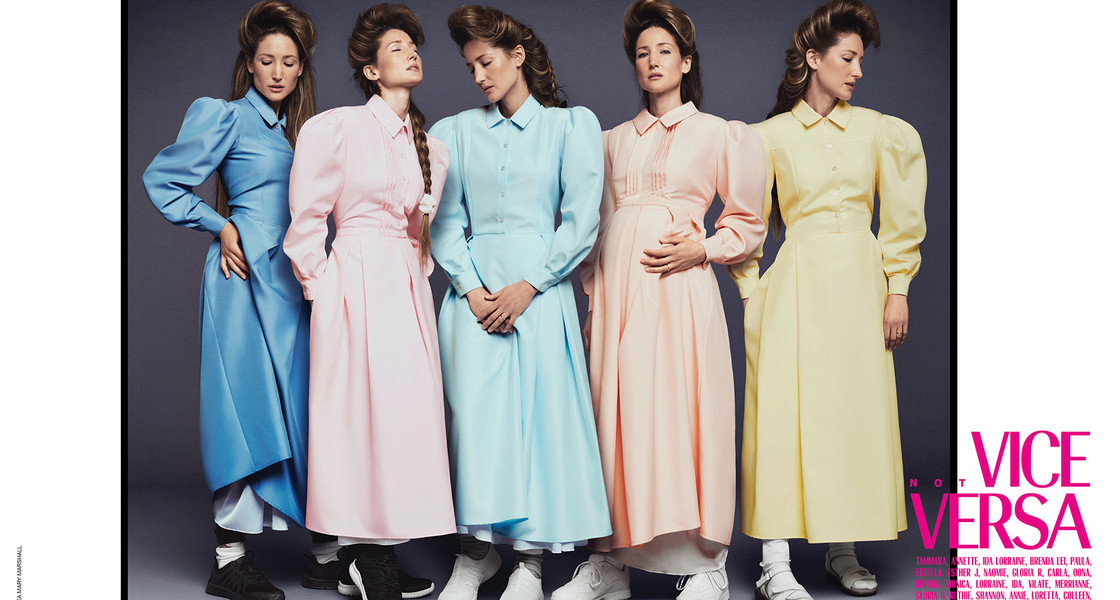
That image, in a weird way, then reminded Marshall of Versace’s iconic Fall/Winter campaign from 1994, in which supermodels including Cindy Crawford, Claudia Schiffer, Stephanie Seymour and Christy Turlington, posed in their own long-sleeve pastels. While the similarities between the two images may be tenuous, their contrast is stark: in the Versace photo, the women are powerful, sexy, unguarded—the queens of their own reality— and their clothes are just one manifestation of their unencumbered force. In Warren’s, the women look small, their smiles either disguising their fear or serving as proof of their blind faith, their garments a reminder of their mandated modesty and utter lack of free will.
That dichotomy, and the empathy she felt for the women in the FLDS community, became the inspiration for Marshall’s latest series, Not Vice/Versa. In it, the artist wears traditional FLDS dresses and temple garments while mimicking the models in the Versace ad, her goal being to raise awareness about the widespread abuses within the community. As part of her research, she met former FLDS member Sarah Allred, and Tonia Tewell, the founder of Holding Out HELP, a non-profit in Utah that helps those trying to leave polygamist communities. Allred, who was married to a polygamist at 18 and had her seven children taken away from her before being excommunicated nearly seven years ago, became one of the many voices Marshall hoped to amplify through her project, the title of which emphasizes “individuality of expression over conformity,” she says. “I am not just another face in the crowd, I am not easily replaced with another wife, I am not interchangeable as a woman. I am a woman with rights, and not vice versa.”
Andrea Mary Marshall—What was your life like in the FLDS?
Sarah Allred—Women were there to serve their husbands and to have children—I had known that since I was young. But when Warren Jeffs came into power, that’s when they really started telling us the details of what we should wear, when we should wake up, what we should pray for, what we should eat— basically controlling our whole lives.in the wrong way. I think that’s why a lot of women just don’t speak. With me, it felt like my kids were how they controlled me, because if you don’t conform to everything that’s required of you, then your children will get taken away.
AM—Which is what they did to you, right?
SA—Yes, they did before I finally left. They had been taken away from me six times, and each time they were taken away, it was anywhere from six months to two years. But it was for no reason, except for that they felt like they couldn’t control me anymore.
Tonia Tewell—Or they said you were not fit to be a mother, which is what they told a lot of my other clients, as well.
SA—Yeah, that’s ultimately what they told me. That, and that my children were meant for greatness and that I wasn’t worthy to raise them.
AM—Were there certain things you did that made them start to take your kids away, or did they do it just to exert their control?
SA—To exert their control. I remember most of the time, I was so baffled—I didn’t understand what I had done or if I had even done anything. Sometimes you were given a reason, sometimes you weren’t. Most of the time, though, I was told, “You have to suffer because somebody has to atone for the disunity in the family,” and I was the one that was always chosen for that. One day you were in good standing and happily doing everything you were told, and then the next minute, you’re in a vehicle in the night getting hauled somewhere and left without a phone, or vehicle, or any way to contact anyone. There was usually a man that was supposedly there to make sure you had the food you needed—they were called ‘caregivers,’ but they were really just there to make sure that you were doing what you’re supposed to, and to report back to Warren or my husband. I didn’t know how much abuse it was until now, really.
AM—With so much psychological, physical and sexual abuse in the community, why do you think so many women have stayed?
SA—Because they don’t realize how strong they are, because their whole lives they were told that they were weak, that they didn’t matter, that they had to have a man control them to survive and take them to heaven, and that you couldn’t get to God without going through a man. You have everything taken away from you—not only physically, but mentally. Call me a feminist or whatever, but I believe the reason why men work so hard to control women, is because women are so powerful. We would rule the world if all of us knew it. And men can’t afford for that to happen.
AM—What changed for you? What was the moment you realized how strong you are? What created that power in you, and your decision to leave?
SA—I was actually kicked out, and told I wasn’t worthy to be a mom and that I wasn’t worthy to be in the community, so they no longer had any use for me. I’m glad now, because my greatest trial became my greatest blessing. But at the time, it wasn’t my choice and it took me a couple of years of hell to actually get over it.
AM—After you left?
SA—Yes. I was still so brainwashed. It wasn’t until I was gone for two years that I took off my underwear, unplugged the recorded readings and Warren Jeffs’ teachings and just stopped. It was like an addiction or something—it was like he was plugged into your head at all times, so you didn’t know what your heart was telling you, and even if you did, you didn’t dare listen to it. For me, it was like an ‘aha’ moment, where I wasn’t going to take this crap anymore. I could either die of a broken heart, or loneliness, and let them win, or I could stand up. I saw around the world that women were being powerful and it was very inspiring for me. office—Why did they kick you out?
SA—My oldest daughter was being groomed for Warren Jeffs, and I realized that when he went to prison. Going back to when she was a young girl, his whole family—everyone—just knew that she belonged to him. But when she was six years old, Warren got taken to prison, and I just happened to be in a place that I wasn’t supposed to, where I saw something I wasn’t supposed to see, and I realized that Warren Jeffs’ wives had been taking young girls from different families and grooming them for him. That night, I had a nightmare and woke up, and wrote a letter to Warren. I told him I would never condone that. Ultimately, I believe that the rebellion I showed is why they wanted me to leave. So, they accused me of child murder. We were always told the only way we could lose our place in heaven is if we murdered someone. So, they started telling women who had miscarriages, or even used birth control, that they were murdering their children, even though I hadn’t even had a miscarriage. Part of why I started writing my book was because I wanted to leave a legacy for my children about each fight I went through to have each of them here today, including that accusation. After they kicked me out, they told my kids that I had tried to abort them, and when that didn’t work, I tried to kill them. That was probably the hardest thing I had to deal with—because my children were turned against me.
AM—Let’s talk about the clothes. I know there are four to five layers of undergarments underneath the dresses, and I can imagine that would be very uncomfortable, especially in Utah, with the heat and everything. How did you feel about it?
SA—It was just the only thing I knew how to wear. But it did get stricter and stricter, to the point where they would choose even the fabric that we could use and styles we could have. I mean, I wore underwear that was one piece that covered up my entire body except for my hands and feet, all the way up to my neck. That was originally called a temple garment, but they put it into effect so that women had to wear them all the time. We also had to wear a slip that did not fit the form, and panties that were full-figured, meaning they had to fully cover up your body so you couldn’t see any skin, even if you didn’t have a dress on. And of course we had to wear a bra, but it got to the point where the bras had to be specially made—they couldn’t be made by the church. We had to wear like, four layers of clothing every day.