


...Is your head actually shaved?
I do it to a one.
My wife Cheryl used to shave her head. Well, not really. She did it for a video. Her hair was very short. Women look really beautiful with shaved heads... When a man does it it’s because he’s going bald. Usually I mean.
Okay, should we talk about the exhibition?
Is this the interview? We should start it with talks about baldness because Walter Benjamin had a great head of hair and he moved like a tortoise. He was this big lugubrious fellow who lurched through life very slowly, analysing everything very carefully.
Weird. How did you get into Benjamin?
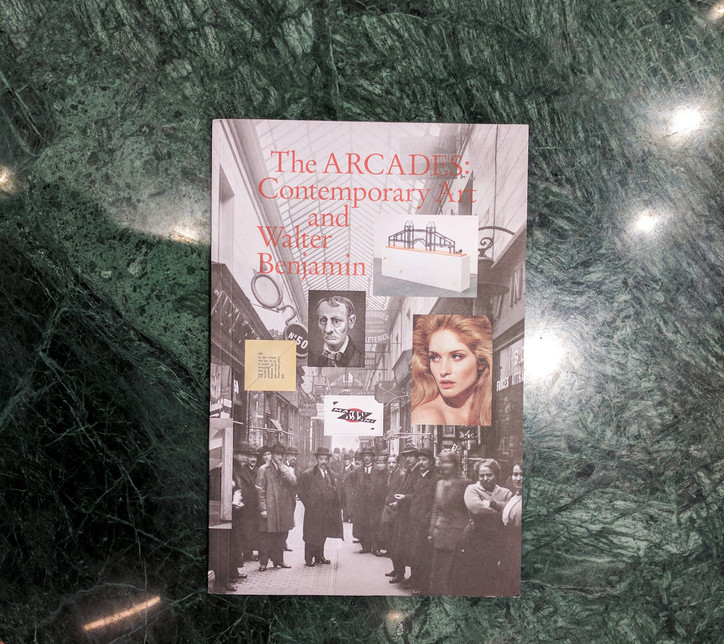
I knew about his work as an art student. You know, you learn about Walter Benjamin’s Art in the Age of Mechanical Reproduction. That’s kind of the only essay you read. But also, when I was a student there was a series of books that were really great and these would be in bookstores just begging for you to pull them off the shelf. They were all the exact same and they’re kind of ugly but you know, back in the day when books weren’t designed well, these were really cool. Because somebody was doing a series, and look at the great names, Reflections, Illuminations.
And Hannah Arendt wrote the introduction. That’s incredible.
Oh, so then they had the imprimatur of counter-culture on them. And you know, they look serious and they look sober with a cool old black and white photo of an intellectual. But when you start to read him he predicts everything. He’s the media theorist. He’s the first guy that wakes up in the electronic age and says, “hey, we’ve got to think about it.” Even back in the television age, he seemed to have a lot to say about that... He’s the first guy to deal with electronic media, so he seemed really contemporary even though he’s long dead.
I was wondering, could you tell me more about the book that you did in homage to Benjamin’s flaneur walks in Paris, the posthumously published one.
Did you ever read it? The Arcades Project... He sat in libraries for ten or fifteen years and pulled books off a shelf and sort of opened them randomly. When something would catch his eye, he started copying the passages out. He said, “The act of reading is the act of flying over landscape at 10,000 feet, but the act of copying is the act of walking on a road.” Nobody ever really knew whether it was supposed to be a study for a great theoretical work that was never written, or if this notion of fragments and accumulation in and of itself was a book... But actually, there’s proof both ways. One saying yes it was going to be a study for a great book about Paris in the 19th Century, and the other hand say as it was is a great study about Paris in the 19th Century, as a bunch of fragments. So, I did the same thing, but for New York in the 20th Century.
What’s so specific about New York? I mean, they’re both cities that have their reputation precede them, in a way. You go to New York with the ideal of the city in mind that’s been fed to you through films.
Well, that’s exactly right. New York is the capital of the 20th Century... Our image of New York is shaped through film, and our image of Paris is shaped through photography and lithography. So, you have a black and white city, and you have a black and white and color city... I think it’s kind of a great analogy for Benjamin’s book and my book. His book is all about depth, it’s all about the barricades and Marx and Housmann and social revolution. Mine is all about pop art, jazz, skyscrapers, and advertising. There’s some crossover.