Buck went to the Disney Concert Hall in downtown LA to a performance by Ma where they planned to meet. “Yo-Yo gave me the biggest hug,” he remembers, “ and he says, ‘I want to try something,’ so we went out to the hallway and he started playing ‘The Swan,’ and I started dancing. It was magic.” They eventually coordinated a performance at a meeting between different creative celebrities to incorporate the arts in education that ended up in the viral video recorded by Spike Jonze.
What I originally loved so much about the video was the shocking departure from what I was used to seeing with the sort of classical music like “The Swan.” I expect careful, reserved expressions that find confidence in their surviving antiquation. I don’t expect what Lil Buck does. In a way, I felt embarrassed by my reaction to Lil Buck’s dancing. Why is it that we find discomfort in the pairing of art forms? What would be possible if we found ways to destroy the barriers of relation?
For an artist like Lil Buck, it’s not that his art asks these questions. Rather, his art is a rare moment of explanation. An answer, unexpected. When I ask him how it felt to jook with Yo-Yo Ma, he admits, “I can't even describe the feeling,” and continues, “it felt natural and it felt real for me because that was who I am.” To Buck, dancing with Yo-Yo Ma was a product of a lifetime of finding his voice. “I didn't grow up with much of a voice,” he says, “I didn't grow up thinking there was anything special about me. I knew that this was something I could speak to. This was something that people can understand.”
It was an unexpected moment for Buck, an accomplishment he didn’t expect to achieve, blending the conservative, elite, and aged world of classical music with Memphis jookin’, merging a world felt unattainable to someone like Buck with a form that, to him, was once unattainable. To destroy boundaries like this is deserving of a master that has himself has done the impossible already in his life. “To present street dancing like Memphis jookin’ to the classical world and have them see for themselves that street dancing an art form as any other dance, any other art,” he slows, “it’s beautiful. Like growing a rose out of concrete.”
Buck continued to grow and spread the message of Memphis jookin’ to all those who would look. Over the next ten years, he would dance with Madonna at the Super Bowl, model for fashion catalogs, perform with the New York City Ballet, organize more collaborations with Yo-Yo Ma, and appear in more Spike Jonze movies. And yet, even with all of these collaborations, it took time for Buck to create the sort of project that was by and for himself. Not “the jooker,” not, “the street dancer that performed with Yo-Yo Ma,” not, “Madonna backup dancer,” but just as Charles “Lil Buck” Riley.
“I’ve always wanted to touch on who I am as a person,” he explains, “I speak my truth in my dance but I never got a chance to tell my own story. I never got to express the traumas I went through.” Although he was appearing with some of the biggest names in all corners of the art world, he didn’t feel as though anyone knew who he was beyond the dancing.
Recently, Buck was teaching a dance class with Red Bull, who regularly sponsors dancers, and started speaking to different people at the company about creating a video. He got in touch with director David Javier to start on something, a video, that would just be about Buck.
Buck grew up close to the church with his parents being dedicated Christians. “I think choir is a big reason I got so passionate about dance,” he says. “I always thought the choir was where the holy ghost was. When they started singing, I couldn’t control myself. I would jump up and start moving. And my mom would scream and say, ‘My son got the holy ghost!’ These are the moments I never get to talk about.”
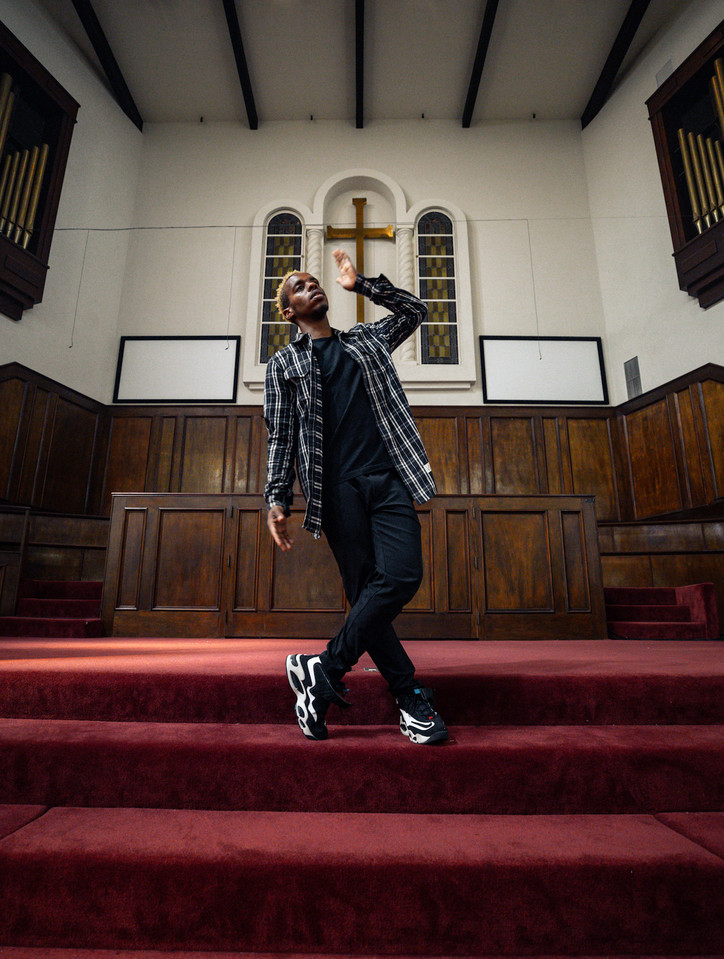
Buck told David about his past, everything he went through as a child, and how the recent Black Lives Matter protests were bringing out memories of his life in Memphis, dealing with police brutality and gun violence within his community. So they made a video, released one week ago, titled, “Nobody Knows,” a dance collaboration with Pastor T.L. Barrett and The Youth for Christ Choir. It’s a short video, a little less than five minutes, that tells a lifetime. A boy from Memphis, reaching outside of what is human, touching hands with God. A manifestation not only of personal history but also community memory. It encompasses pain and the love and hope found in common strength. And it’s a dance.
“I couldn't hold myself back,” Buck remembers. “I started to cry in some instances because it was something so personal to me and something that. I feel like I got to get off my chest and I got to speak through in the best way I knew. I'm actually speaking to your soul through dance, my truth. This was me out there naked.”
I half expect when I watch “Nobody Knows” for a singer to appear at some point in the video and begin to perform along with the themes, and yet it would feel out of place. “Nobody Knows” is a landmark for Buck as the central subject. It’s a departure from an empty sort of emotion that Superbowl dancers may know far better than Memphis street dancers: feeling like your work isn’t being seen. “Growing up jookin’,” Buck starts, “we take pride in the time and effort we have to do to cultivate this art that we've been growing. And we've been training ourselves. We're craftsmen, man. We're artists. We’re not just background dancers for other artists.”
While Buck reached heights in his career that he never expected growing up in Memphis, he found a surprising distance from the appreciation of his form the bigger he got, and it’s a problem all dancers in the industry face. “I'm working really hard to try to inspire the dance community,” he says. “Hone in on who you are as an artist and invest in that.” Buck feels especially passionate about making sure that those within the Black community, who are historically exploited within the dance sphere, are not undervaluing the power they have through movement. “This is a mission for me,” he states, “to show the Black kids in my community that they have a voice with their dance. You have power with your dance. As long as you focus and hone in on what you do, and work really hard at what you love. Don’t take no for an answer. You can make this happen for yourself.”
I can’t tell if Buck’s dancing is what it looks like to be touched by God, or if it’s the sort of thing that makes others believe they are witnessing an act of God. I imagine witnessing Lil Buck perform may feel similar to how it felt to witness the Chicago Bulls win their first NBA championship against the Magic Johnson LA Lakers led by a young man named Michael Jordan. Perhaps it is how those sitting in the Vivian Beaumont Theater felt when they saw a young woman named Whitney Houston perform “Home” on The Merv Griffin Show in 1983. It must have been what Lil Buck felt when he first saw Michael Jackson dancing on TV when he was a kid growing up in Memphis.
But, one of the most inspiring things I found in my conversation with Lil Buck was realizing that he doesn’t see himself the way that I or any of his admirers see him. After a lifetime of beating impossible odds, he reflects on his career with humility and compassion for young artists like the kid he was watching Michael Jackson on VHS.