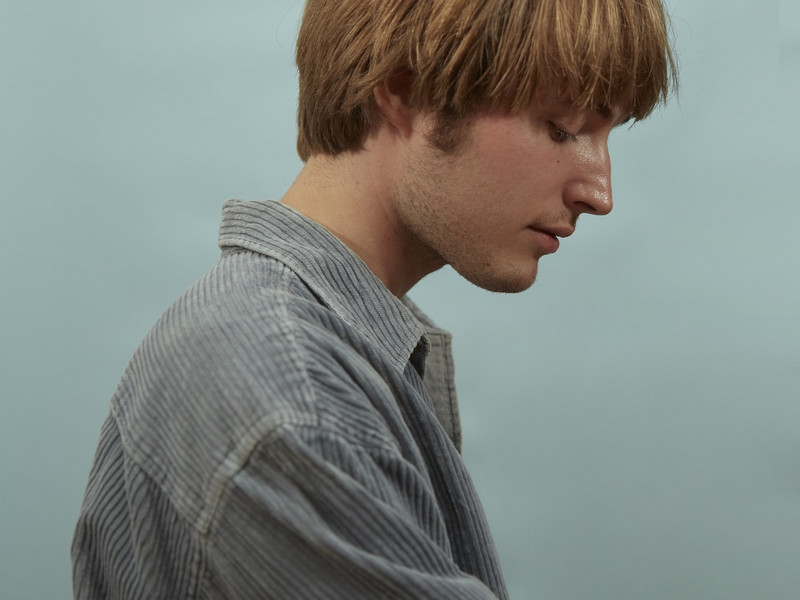
MIRRORS

office sat down with the artist while he was in town for a show, to talk about the LA punk scene, the current musical climate and which coast is best. (Spoiler alert: East. Duh.)
Can you tell me a bit about how you got into music?
I met all of my bandmates [Daniel Fox, Aaron Jassenoff and Jackson Katz] when I started out playing punk shows in Los Angeles. Especially venues like The Smell and Downtown. We just all kind of played in each other’s bands and it was just a big family thing, which is cool—that doesn’t happen a lot.
Did you all have a similar vision going into this process? I feel like, exactly what you just said—you don’t often meet people that you can just click and create with.
Yeah, I think we’ve all shared a really similar vision going forward with music, in general—we all take it really seriously. The music scene that we were brought up in was full of people, so it was difficult finding that core group of people who you can trust—I mean, not to say there aren’t good people in the scene or anything like that, but we got really lucky.
You’ve done a lot yourself as well, especially in the realm of collaboration, which isn’t always the easiest thing to accomplish.
Thank you. But I wasn’t always open to collaboration. Some of the earlier stuff I’ve done was because I liked the music, but a lot of the time, I’d just do it myself. But as time goes on and you make more things, you realize that you need help from other people and that most artists are just better than you. My viewpoint has shifted a lot and now, I think it’s completely necessary for growth, because your career probably won’t last very long otherwise.
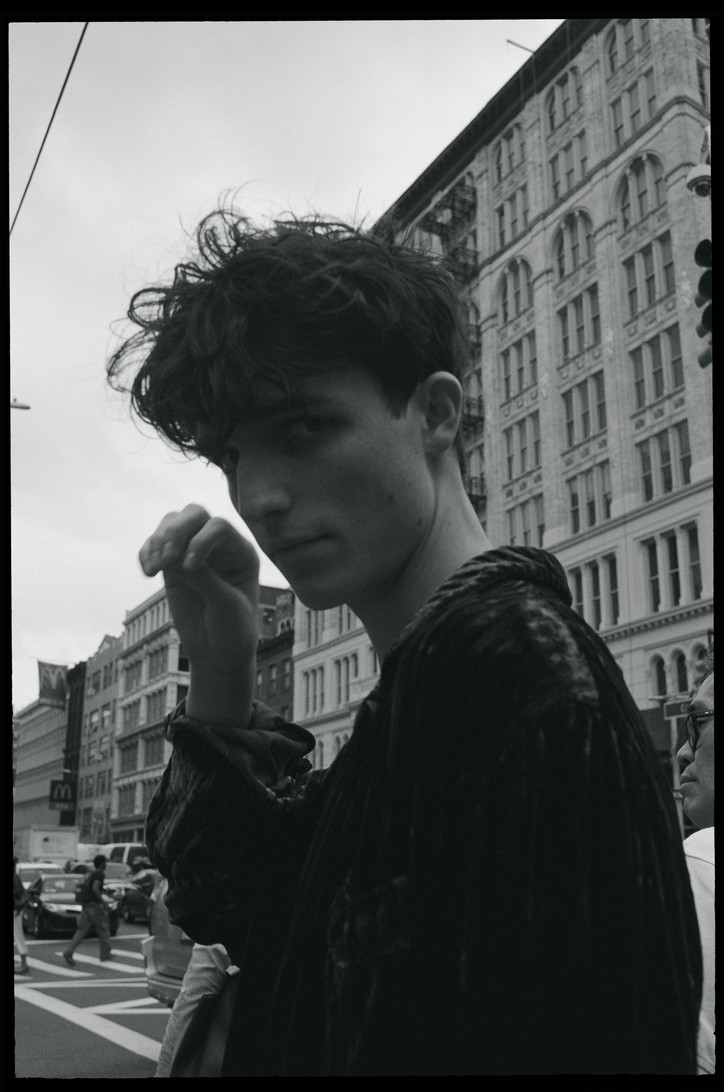
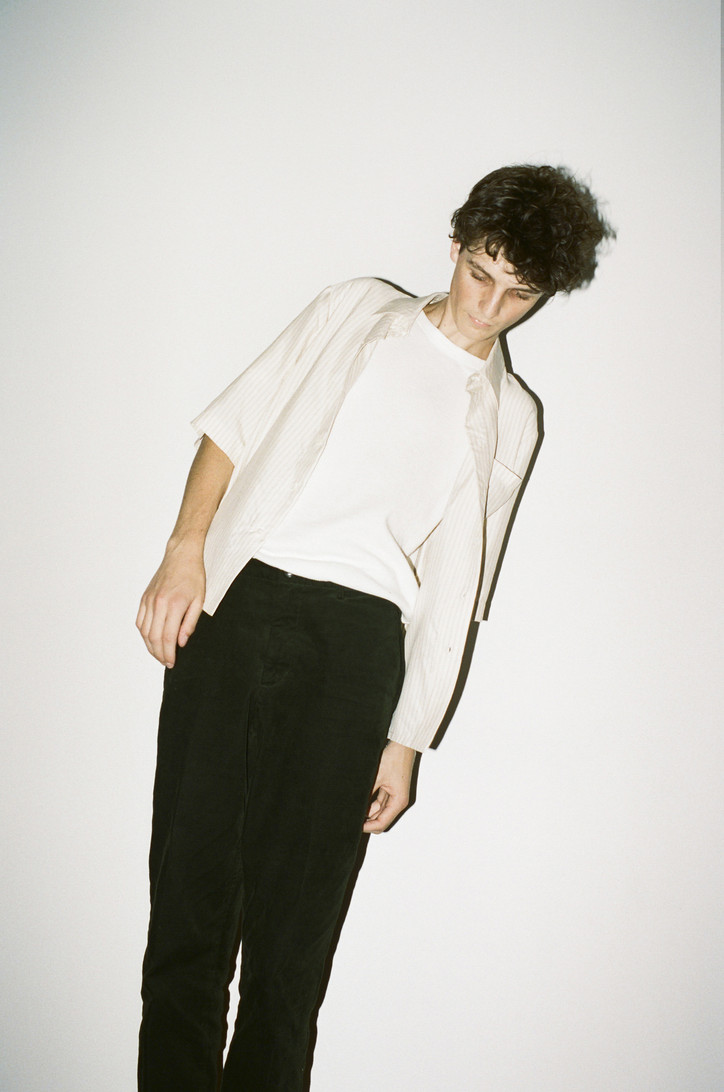
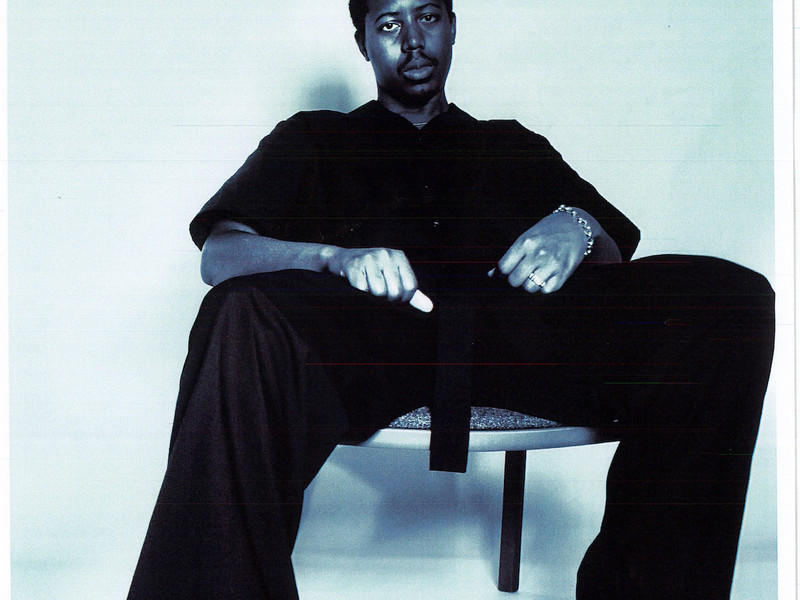
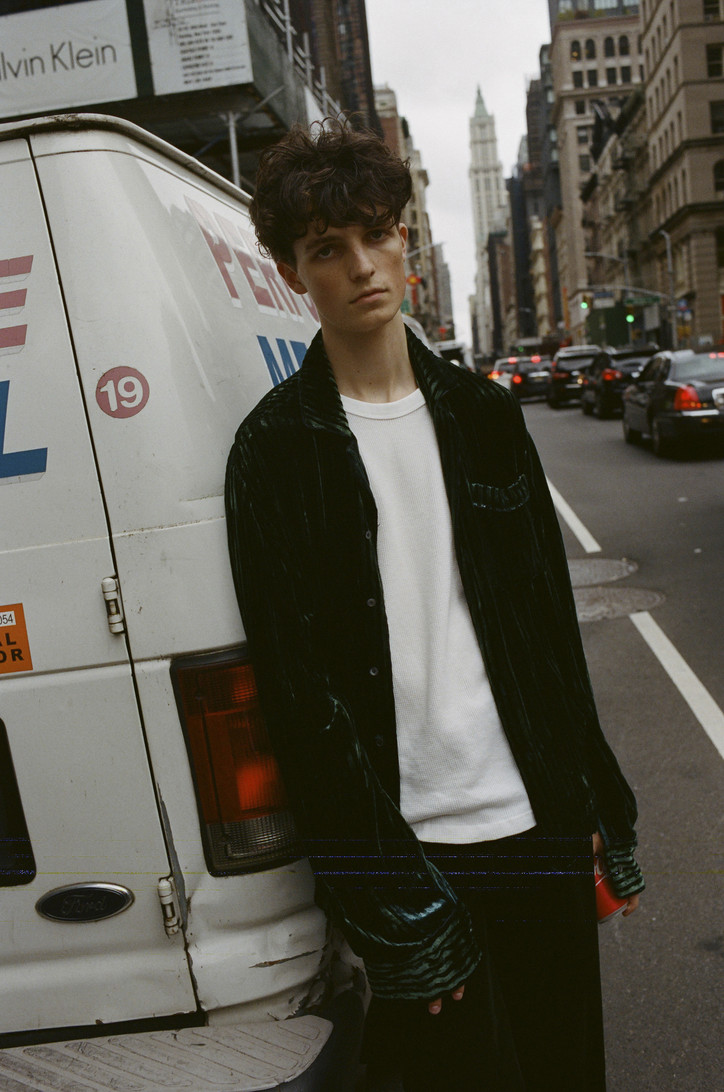
Right: Faith Connexion shirt; Left: Faith Connexion shirt, Austin's own pants & shirt.
I really love your “Lessons for Later” video by Kevin Abstract. The vibe is kind of peculiar—really dark, but also kind of dreamy. Do you think that’s sort of representative of your aesthetic?
Hopefully. Since it was our first official music video that we made, I wanted the visual to be a marker for everything we’ve done up to that point, which was relatively mellow, but had an interesting undertone to it. That’s why I don’t move the entire video and I’m just standing there. It felt necessary—otherwise, it would have been too much acting. We just wanted to make something that wasn’t too overstated or full of itself, while at the same time, just making something that was sort of pretty and had some thought to it.
Opting to take a subtler approach to music, how do you feel about the current musical climate?
It’s definitely oversaturated, but it’s not necessarily a bad thing. Just the output and opportunities and the value of everything is pretty insane right now. It’s not anything new, but it’s kind of refreshing to be able to find something entirely new anywhere you look. It keeps you on your toes and encourages you to make forward-thinking music because if you’re not paying attention you could miss a beat.
But do you ever feel like there’s too much to discover?
I think there can be. I never really felt like that personally, just because I keep my scope pretty narrow, otherwise things can get blurry, and it’s easy to get lost in other people’s output and start making stuff based on visions of people around you.
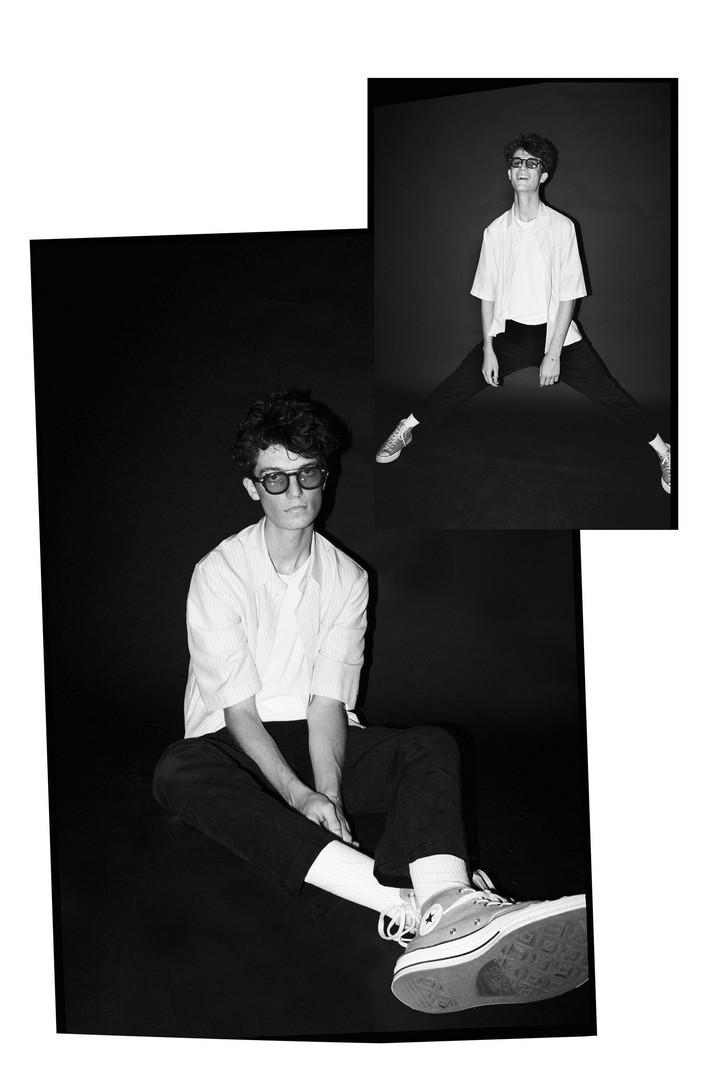
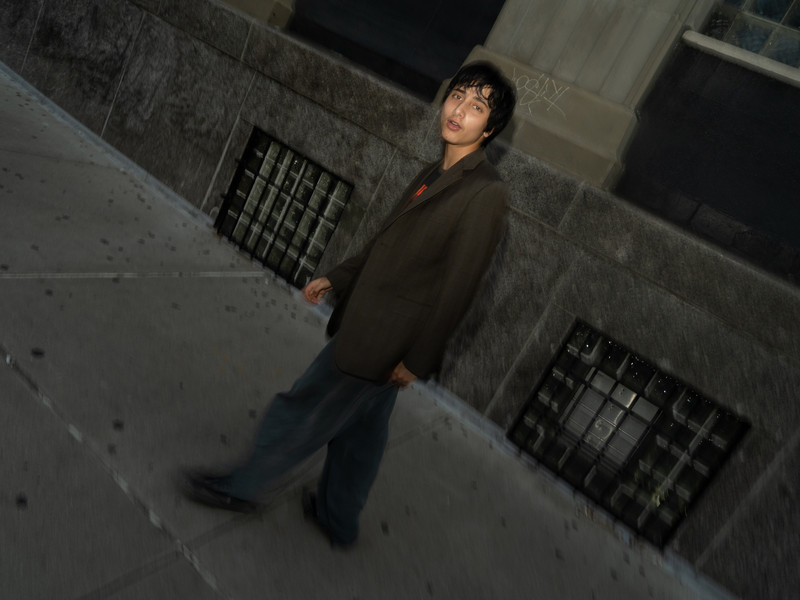
Right: Faith Connexion shirt, Austin's own pants & t-shirt; Left: Faith Connexion shirt, Moscot glasses, Austin's own pants & t-shirt.
Why did you choose the guitar as your main instrument?
It’s always the default instrument for young people. It’s heavily marketed to make people look cool. You can get starter packs for guitars really cheap and you can get whatever model your favorite rockstar has for really cheap, too. Not that that was the reason I started, but it felt like the most realistic and something you could write songs on, whereas other instruments have a standard of where they belong, which never really interested me—I always wanted to have options. But also, the guitar just looked really cool, which is something I was definitely thinking about when I was seven.
You’ve worked with some of the great musical innovators of our generation, like Tyler and Frank. In my mind, they’re such ever-evolving artists and it’s interesting you also mentioned the endless features that the guitar has provided you when it comes to your craft.
I think as soon as you think you’ve learned everything, that’s when you stop. I guess if we’re talking about Frank or Tyler, they’re great examples of the balance between knowing they’re opinion matters, but also not pretending they know everything. They’re taste is always evolving. At least, I know Tyler, for example, is always pushing forward—even if it feels too ahead of right now, it will come back around and prove that he’s right. We’re already seeing that with Cherry Bomb. I think people are currently rediscovering that album because it was so ahead of its time.
Maybe that ties back into the saturation of the music industry.
It’s based on where the mass celebrity goes, basically. And if the mass celebrity is being fucking insane, which clearly is happening right now with artists like Kanye, for example, then that’s what people will listen to. It takes a lot of people to listen for a real, forward-thinking artist to be actually appreciated. So, it’s nice that people who really want to push boundaries are being recognized.
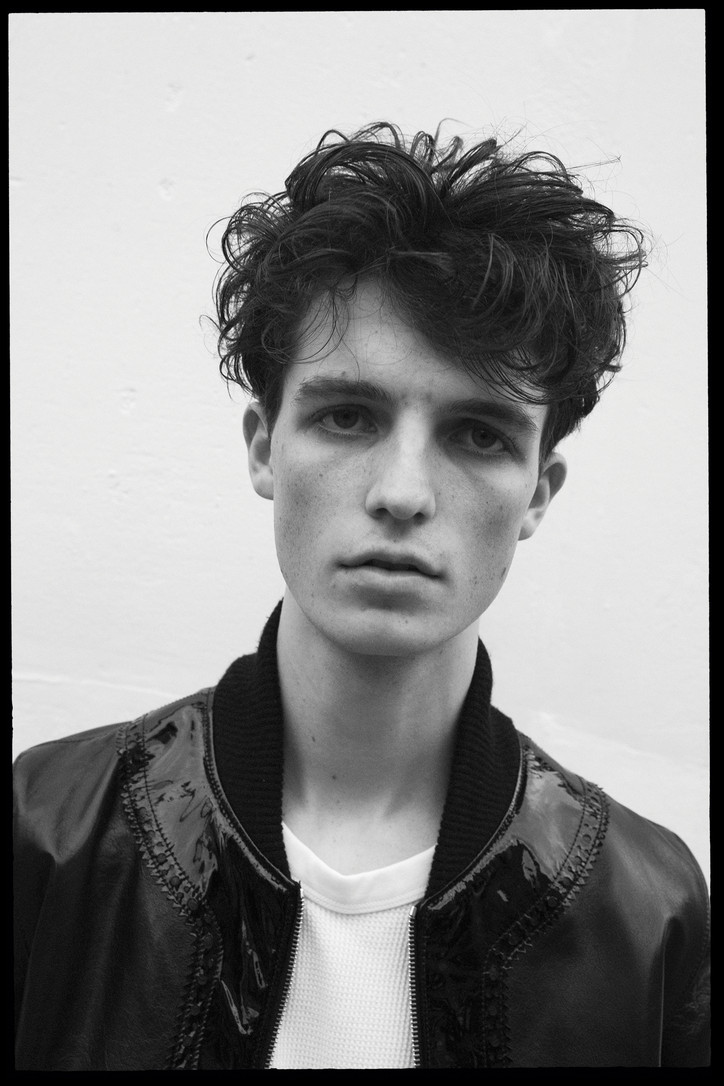
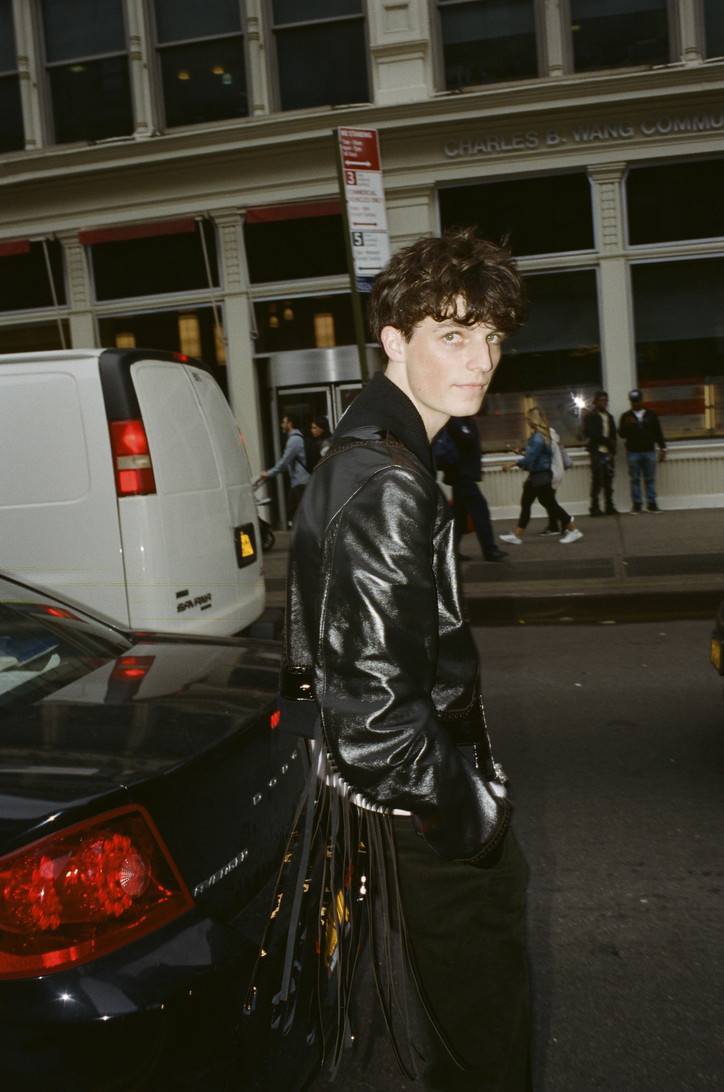
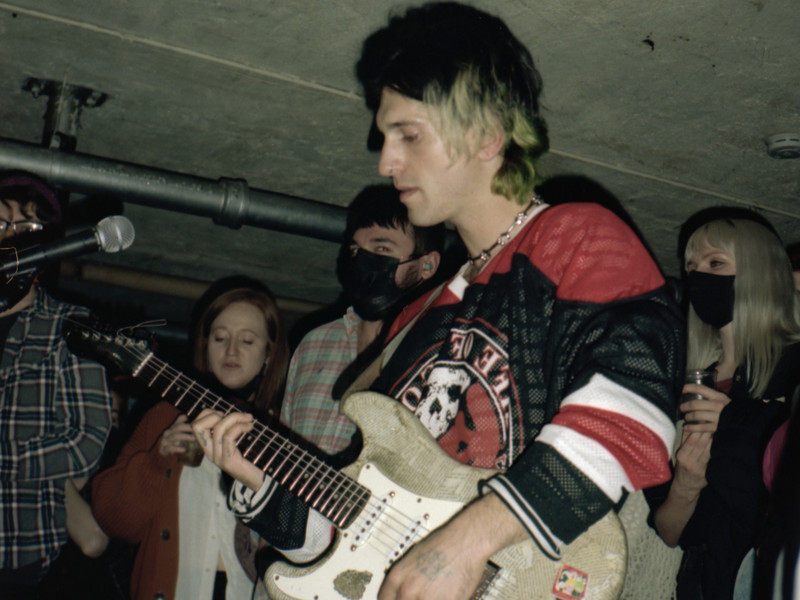
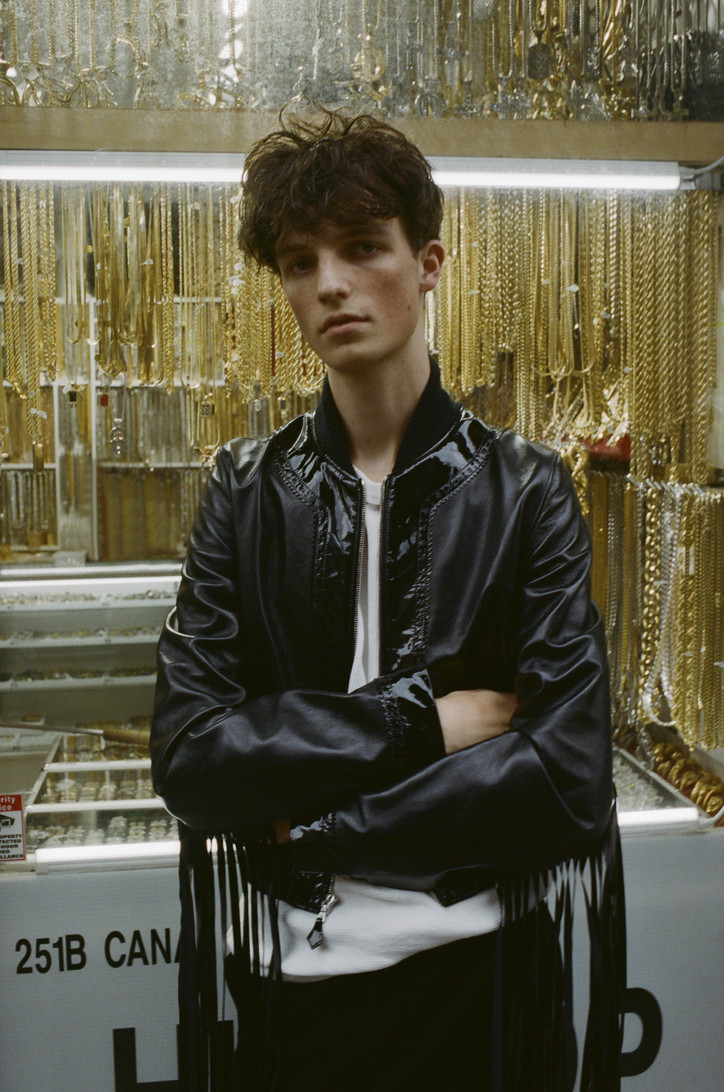
Above: Linder jacket, Austin's own pants.
You just got back to LA after touring throughout the U.S. Which do you prefer: East Coast or West?
I just don’t really get much inspiration out of Los Angeles, but I don’t necessarily want to leave. I think what LA has to offer is just more space and the ability to breathe. But the East Coast has more energy—the buildings, visuals, opportunities and the representation of people is just different in a way that makes me just feel energetic when I’m there. I think things fly under a radar—not in a way that they go unnoticed—but there’s more normalization of interesting things. Still, LA is interesting in its own way.
How so?
In LA, you can find places where things go on, but it’s not too community-based, which I kind of like, because I like doing it on my own. I’m drawn to a more domesticated lifestyle. In New York, you always have to be on your toes. So, in that sense, I like the stability that Los Angeles has to offer.
What are you working on next?
We have an album that’s being finished right now—I don’t think that’s much of a secret. There’s no release date yet, just because it’s still being finished, but I think we’re trying to go back to why we started writing music and capture that feeling again, which resulted in not simpler songs, but songs that were really sticky, and really had a purpose, and didn’t overstay their welcome—maybe that made the songs a little poppier or faster. We’re always just trying to not bore ourselves.
Listen to Slow Hollows' most recent single, "Selling Flowers," and watch "Lessons for Later" here.

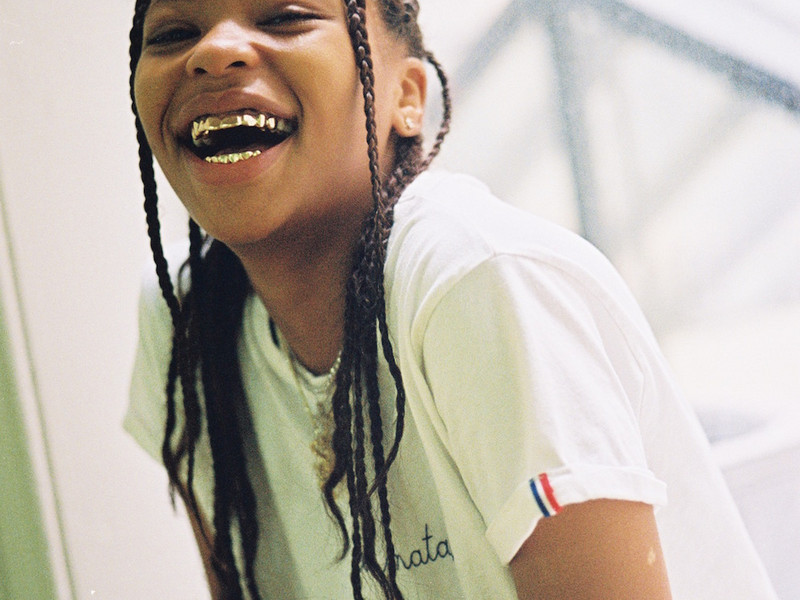
office sat down with Jordan when she was in New York to chat with her about her debut album, her current success and growing up.
So, you’re from Baltimore. What’s different about it from all of the other cities you’ve been visiting on tour?
It’s really cheap, and it’s a good breeding ground for intrinsically-motivated artists. No one really goes there to ‘make it.’ There’s not a lot of foundation to be successful. In the past, there was a lot of DIY infrastructure and a lot of places for shows—this whole crazy scene—but now there’s not as much going into it. It’s ever-changing, but I think there are a lot of really incredible musicians there and a lot of people have followed in their footsteps; a lot of legacy, and the art is flowing. It’s cool.
You’re lyrics are beautiful. Tell me, what’s your writing process like?
It’s pretty slow-going. I’ll usually write the entire guitar part and arrange the entire song, write the vocal melody—basically I’ll finish the entire song before I even start writing lyrics. It takes me almost a year to finish one song—it takes me so long.
We respect a process, and yours evident—you speak with intention. What stories are you trying to tell with your songs?
I don’t consider myself to be much of a storyteller. I find myself to be very expressive and emotional—I just try to channel that and it becomes and outlet for me. To just be sad, feel whatever I’m feeling in the most raw way I possibly can, and attempt to give myself context to those feelings by just putting it into a timeline or sequence on a record. It’s like giving myself closure.
Maybe it’s because I’m also queer, but I definitely hear the yearning for clarity.
Yes. Totally.
There’s not enough queer girls in the game, to be honest—or at least they’re not enough getting the credit and recognition they deserve.
Agreed. I don’t find myself being around queer women often, but it’s not intentional. Honestly, I think it’s kind of necessary to have that aspect of your life—a lack of queer presence—and it’s such a unique experience. It’s hard to relate to other people who haven’t experienced it.


It’s an interesting perspective. How has this past year been for you? Did you expect people to have such a positive response to your music?
Yes and no. People had a very personal reaction to the EP that I definitely didn’t expect, and it gave a lot of leverage from not having any help at all in that process. We just put it out on my friend’s label and—I don’t know, Lush felt really big and important and whole, but I didn’t necessarily go into it expecting other people to feel the same way. So, with this one, I’m glad they do. We’ve been able to do a lot of traveling and got to do and see some cool stuff. But it gets hectic.
Of course, because it’s still business.
Exactly. There’s a lot to consider, learn, understand—for me, at least.
What do you do to pass time on tour?
I really like wine, I read a lot, I like to do stuff myself. I’ll buy four drinks or a really large drink at Starbucks in one night just so I can sit there for hours and avoid the green room.
When did you realize you wanted to get involved in music?
Right before I was going to go to college and was trying to decide if I was going sign to a label and make a record—I didn’t want to half-ass anything, so I just picked one.
Are you a goal-oriented person?
I’m secretly a goal-oriented person.
Have you accomplished any of your goals?
Well, I always wanted to go to Asia, so that’s cool that I was able to finally do that. When I was really little, I wanted to play Madison Square Garden, and we’re opening for Interpol there this February.
'Lush' is out now.

But of course, attainment of this caliber by no means happens over night, as the musician humbly notes. From classical training to playing in various bands, including LA scuzz rockers, Cherry Glazerr, and teaching music scoring for films and commercials, you name a musically-involved vocation and SASAMI has been there, done that—and did not forget the lessons that each phase of life taught her along the way.
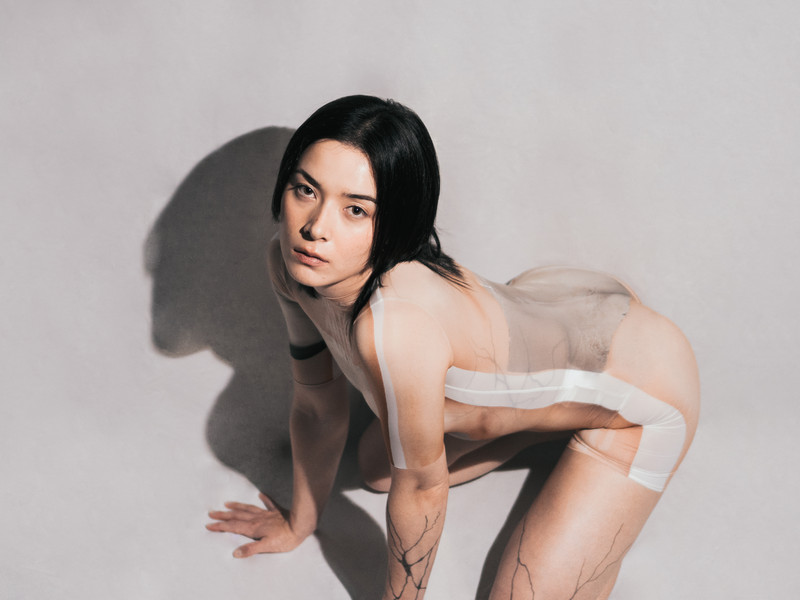
With the recent release of two new singles, SASAMI is dead-focused on the making of her debut album, set to drop sometime early next year. office had to pleasure of catching up with the musician and picked her brain about her journey, micro pigs and learning to compromise.
I know you just released “Not the Time” and “Callous,” and that was your first solo venture since Cherry Glazerr. So, can you tell me a little about the creative thought that went into these pieces, and the ideas you wanted to communicate to your audience?
Well, “Not the Time” and “Callous” are two pieces that I’ve been working on for the last two years. Since I’ve been off tour, I’ve been working on songs, so they’re not necessarily two of the most recent songs—more like two pieces within an entire record. They were just the two that I was most excited to put out.
You’ve said that “Not the Time” was about those unsent messages—those drafts that you write but never send to the intended person.
It’s funny because I’ve been making music for such a long time—I studied classical music and I’ve been playing in bands for years and years and years—but this the first time that I really had an urgency to write songs with lyrics. So, this record came from a place of needing to do it. I wasn’t like, ‘I’m gonna make a record!’—I was just in Leeds or some random place at the time and just had to write. That’s where it came from.
How has your experience and interdisciplinary musical education informed your creative process or the cultivation of your sound?
I think it’s just inevitable that your education in any area affects you all the time, just because it becomes part of you. In a lot of ways, my musicianship is informed by my rejection of my schooling, my classical training. Being obsessed with My Bloody Valentine and Gang of Four, and angular guitar music, and super noisy guitar music is a rejection of really clean classical music. But I’m sure my arrangements and songs are informed by my knowledge of music theory and voice leading and shit like that.
How do you determine when a song is finished, or when an album is complete?
Songs, when you record them, are really not super different from the demos, and demos are pretty much made in a day or two. This whole record was definitely made on impulse. There are some decisions that were changed in the studio on a couple songs, but I would say for 80 percent of the songs, the demos are really similar to the finished product. I tried really hard to keep everything as stream-of-consciousness as much as possible. And then with a record, after a certain point, I’m ten minutes over how long you can even put on vinyl, so I tell myself I should probably stop.
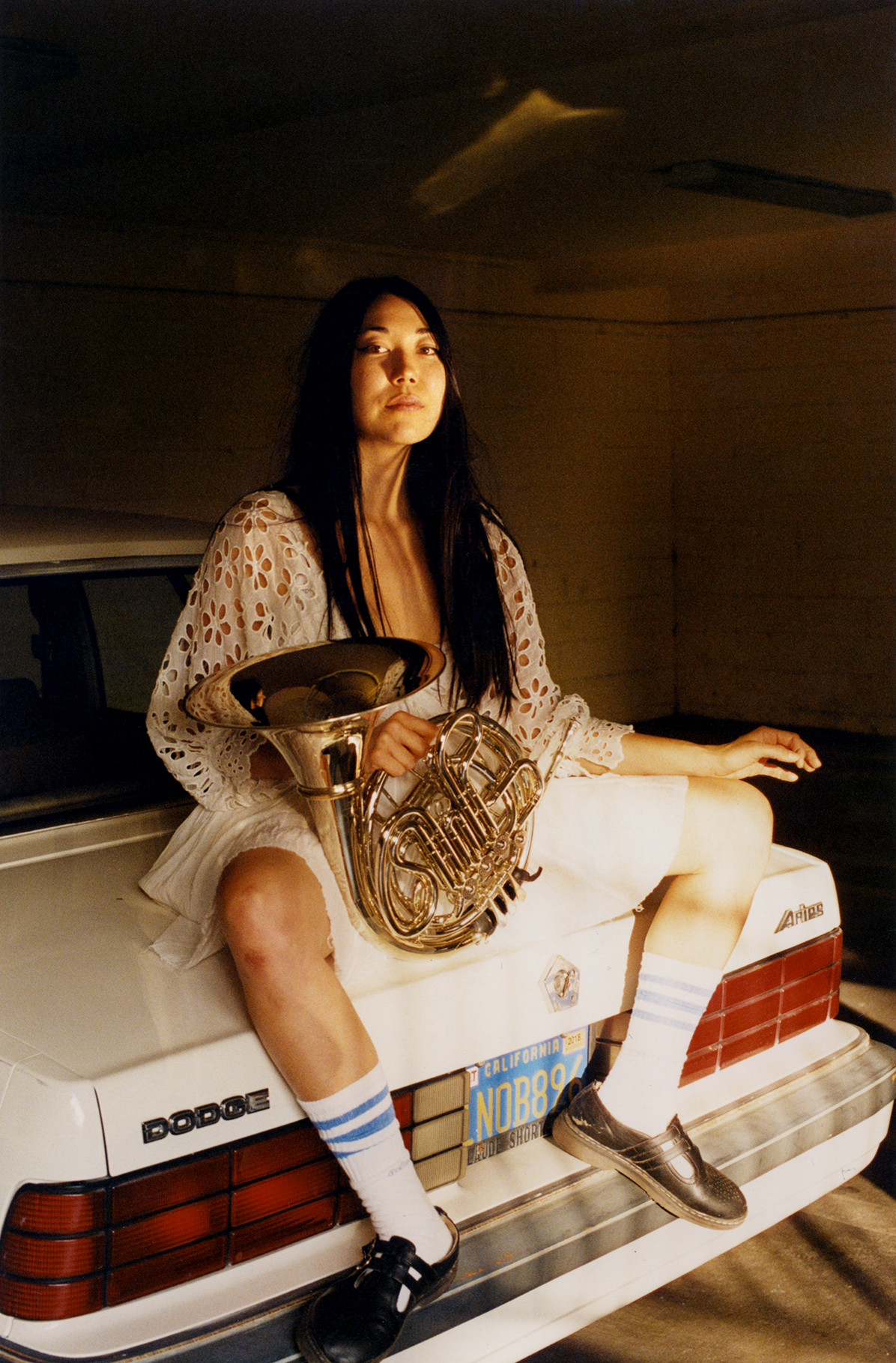

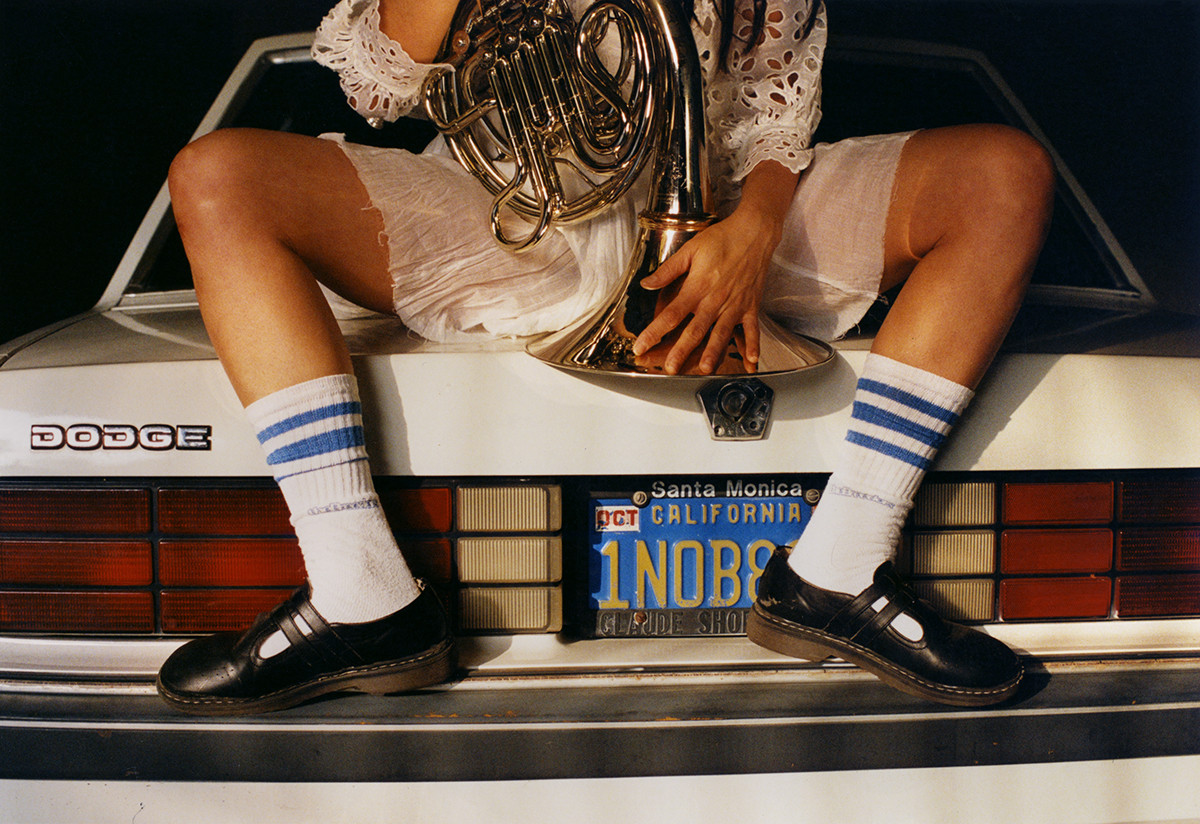
So, the decision is pretty much made for you! What’s your favorite food to eat on the road?
Oh my gosh—favorite food to eat on the road? I love eating Tom Yum—it’s a really spicy Thai lemongrass soup. It’s really good, especially if you have a cold because it makes your fucking sinuses start running—you’ll be all stuffed up and then all of a sudden you’ll be fine. It’s a magical soup—magical.
That’s great, especially because traveling is really good at making people super sick.
I know! Your immune system is low and you probably didn’t sleep the day before because you had anxiety about traveling, and all the germs, and you don’t have your regular routine. So, yeah it happens.
Blossom, Bubbles or Buttercup?
Which is the one that has the raspy voice?
Buttercup, the green one. I thought you were going to say that.
Yeah, probably Buttercup. With my raspy voice, I guess I kind of already relate.
If someone wrote a biography about you, what do you think the title would be?
Sasami Salami!
I like that! You could have gone really serious, really intense with it, but you took the light, fun way out.
Yeah, I feel like I get a lot of my sadness, my anxiety—the more emotionally-wrought kind of stuff—out in my songs. Generally, the rest of the time, I’m a fucking weirdo. When you go to my shows, it’s kind of funny because when I’m playing, I’m serious, but when I’m talking in between songs, I pretty much just rip at how much of a loser I am. There’s definitely a dichotomy between the serious content of my music and the generally light content of my demeanor.
You need a healthy balance. You don’t want to be too much of either, or it’s no fun.
Exactly.
So, I mentioned Cherry Glazerr, and I know you’ve done a bunch of other collaborative work, but it seems like for most of your professional career, you’ve worked in groups, or musical settings that include more than one person. Now that you’re working on your own, what have been the difficulties in distinguishing yourself as a solo artist?
I mean, my issues with it are much less artistic and creative, and more of just realizing that you have to be the boss of your own work—show up and be the boss of my instrument. I have to hire a band, hire a manager, pick a label, pick which tours I want to do and make sure that I’m playing shows with people that I’m aligned with. Just so much non-musical stuff to deal with when, before, I would just roll out of bed and smack some keys, drink some kombucha and then do it all over again. So, it’s kind of different now, but its cool. It’s gratifying, and it’s fun to connect with the audience in a little bit more of a direct way.
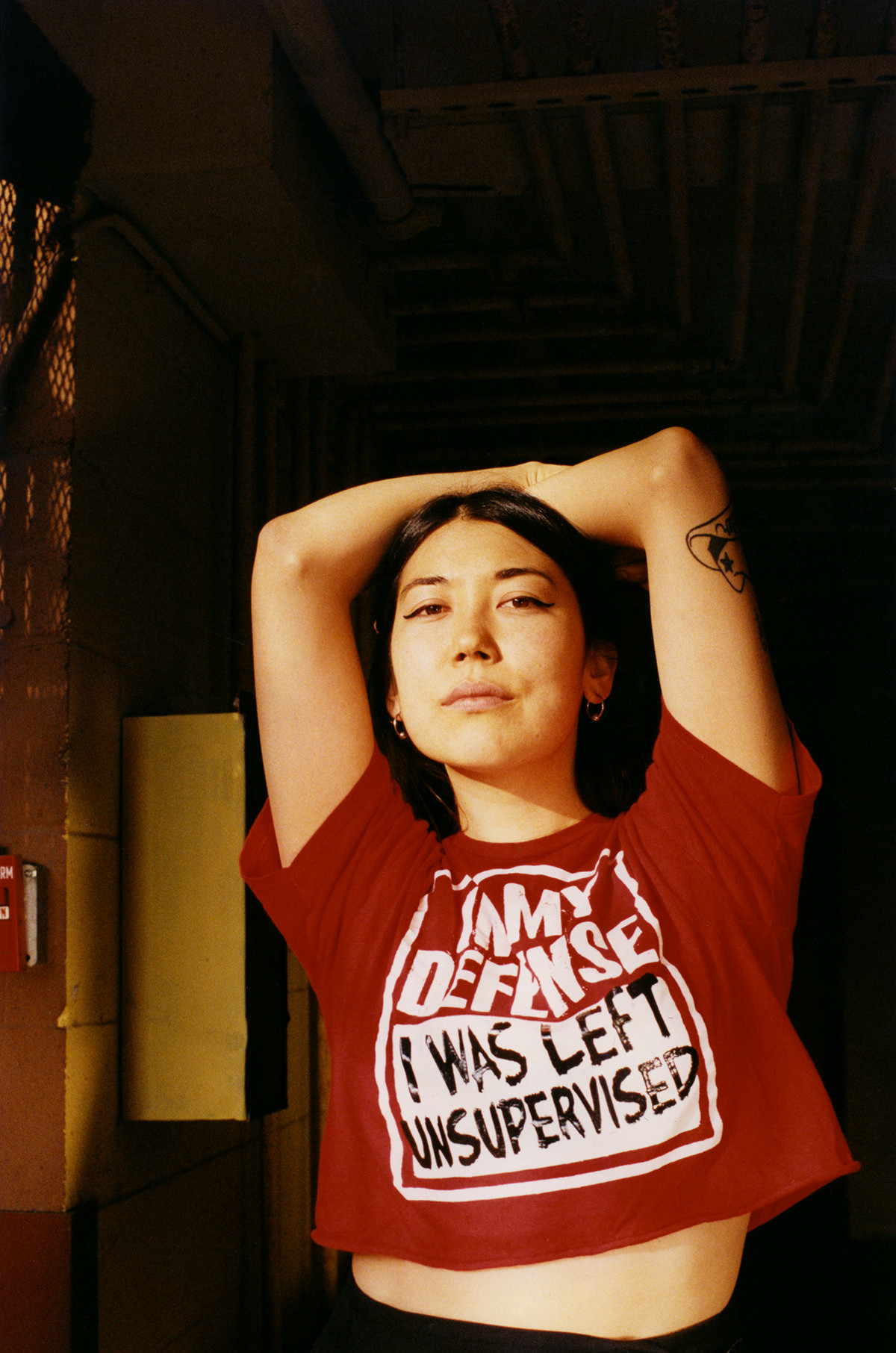
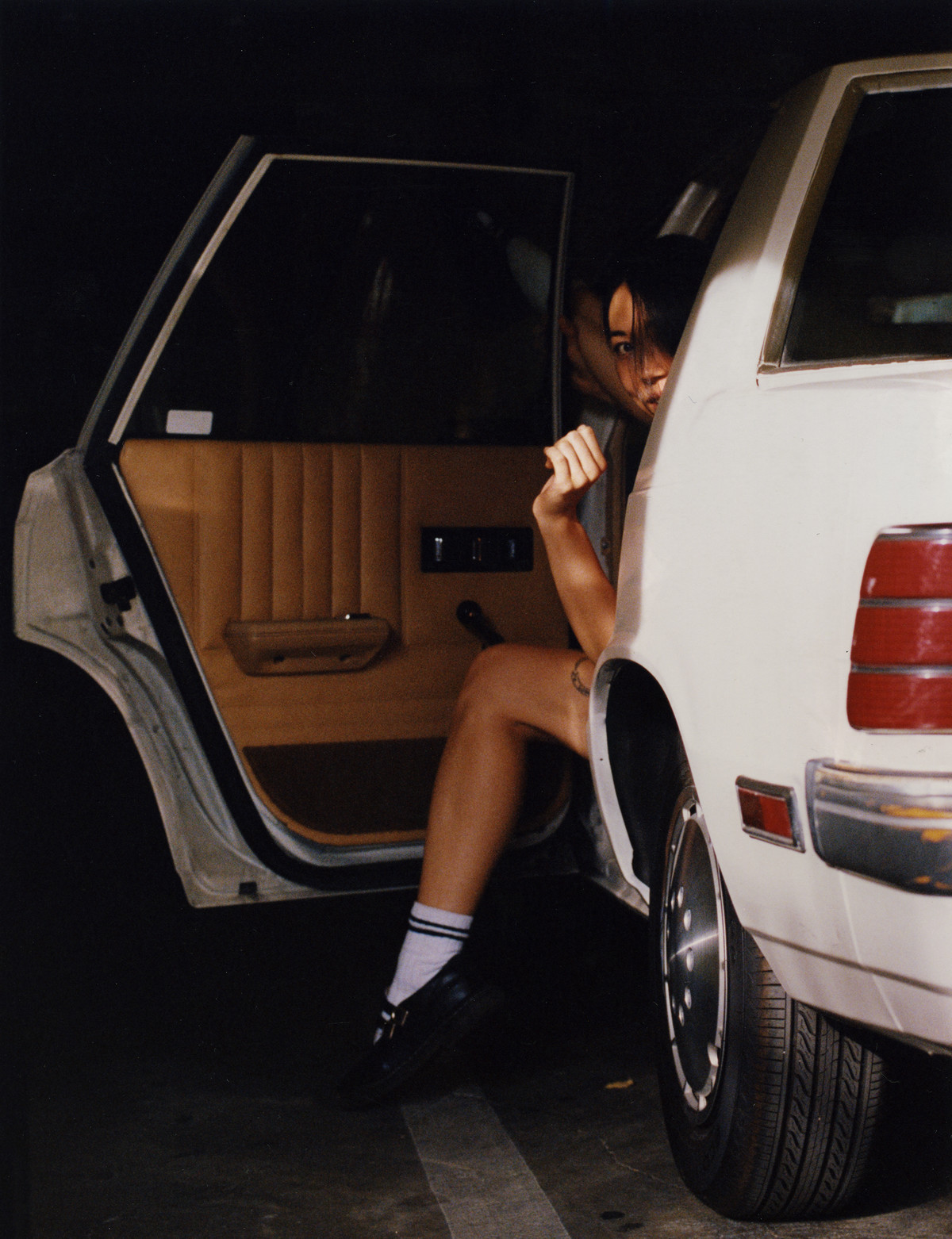
I’ve always felt like I need to be my own boss because I don’t like to listen to people, and I’m a big picture type of girl, so the nitty gritty details always elude me—I don’t think about them, but they’re so important and I often forget that.
Totally, it’s hard. I mean, you’re a writer, so you’re an artist, and I feel like artists are a little more loosey goosey—I know I am. My sister is an occupational therapist and she’s so black and white, she just tells it like it is, you know, like ‘You said you were gonna be here at 11 ‘o'clock, yada yada yada,’ and I’m just like ‘I really just had to do this thing.’ Meanwhile, I’m probably like popping a pimple or something—I’m so floaty, even though I’m Korean. My Korean side is definitely the one that’s like, ‘Finish it, right now!’
What would be your advice for aspiring musicians, or any artists who wants to get started? It’s so scary because if you want your main vocation to be in the creative realm, you either make it or you don’t. So, just any general advice for someone who wants to take that leap?
Yeah, I mean—I’m trying to phrase this in a way that’s not super demystifying of the art world—but I feel like you get to a certain point where your like, ‘I have a job and music is my hobby, and it’s very pure and it’s unaffected by anything other than my creative outlet,’ or you get to the point where you’re like, ‘I don’t want to have another job, I want music to be my whole life,’ but when you hit that point, you kind of have to accept some of the realities of compromise. Not necessarily creative compromises, but you just have to start making decisions in your life that open you up to opportunities that allow you to play music all the time—to put a record out with the right amount of resources. It’s so important to be honest with yourself about what your intentions are in being a musician—if your intentions are just to make pure art. This is also very dependent on your socio-economic situation. Some people are just rich kids, and can just be musicians and don’t have to worry about money, but I’m not like that. I’m the person that paid a hundred grand to go to music school, and am still paying it off, and working through school, was a music teacher, and played in other peoples bands. I had to work. I just started making songs when I was 28, but music has always been a job for me, and I’ve always felt super lucky because I loved my job so much.
Some people have a different relationship to music, but for me and my friends, and colleagues who are successful musicians, I’ve realized that there was just this very clear understanding that this is my job, and I am privileged to have this as my job. There is a lot of work involved, there are a lot of decisions, and a lot of hard realities to be faced, so I think for people who are starting, I would say don’t make it your job right away. Go to school, have some other jobs, let the music proliferate out of a place that is pure, and not money-based. Because at a certain point, when money gets involved, it does affect your musicianship, your plan for what your album is going to sound like, what your music videos are going to look like—it adds this kind of pressure when music becomes your main source of income. So, honestly, if you’re just starting out, don’t be like, ‘I’m gonna do music and my job is to be on tour non-stop and not have another job, and music is my career’—that might burn you really fast. You want to enjoy the process.
I don’t think people talk about that, and it’s such a reality. People get all butthurt like, ‘Why is their music doing well and why isn’t mine?’ and it’s not because your music isn’t good—it’s because probably I’m working harder; or because I saved up a bunch of money from my shitty pizza shop job so that I could take a tour where I wasn’t going to make money, so that I could play to more people, and book another tour. So, I would just say that if your question is about being a musician as your life, don’t start making music when you have career pressure on it—start making music when you have this pure urgency to do it. And practice. In a lot of ways, art comes from urgency, but there is also a skill and a practice to it that you could hone in on. I mean, I was making music for years before I ever wrote a song. I was playing in bands and in an orchestra before I ever felt like I had to make a song.
That’s really beautiful, and something that I also feel is completely overlooked. A lot of things, when you look at them are black and white, but between those two extremes there is so much compromise and grey area.
Totally. In a capitalist society where, in many ways, art only exists when it coalesces with capitalism, it’s a dark reality about art. I just think it’s important to keep that in mind, especially when you’re judging yourself. Don’t judge yourself so hard, like ‘I’m not doing well because my music isn’t good, or my art isn’t good, or my writing isn’t good’—there are so many other factors. I don’t think it means you have to compromise who you are, but there are a lot of small compromises you have to make. I don’t feel like I’m not myself, but I do feel different now that I am a boss of my industry, as opposed to a french horn player who just shows up and toots—it’s a different story.
If you had to liken your music to any animal, what would it be?
A micro pig—smarter than you think, and kind of funny and squealy, but still sly as hell.
'Not The Time / Callous' is out now.