The Modern Muse


Stay informed on our latest news!


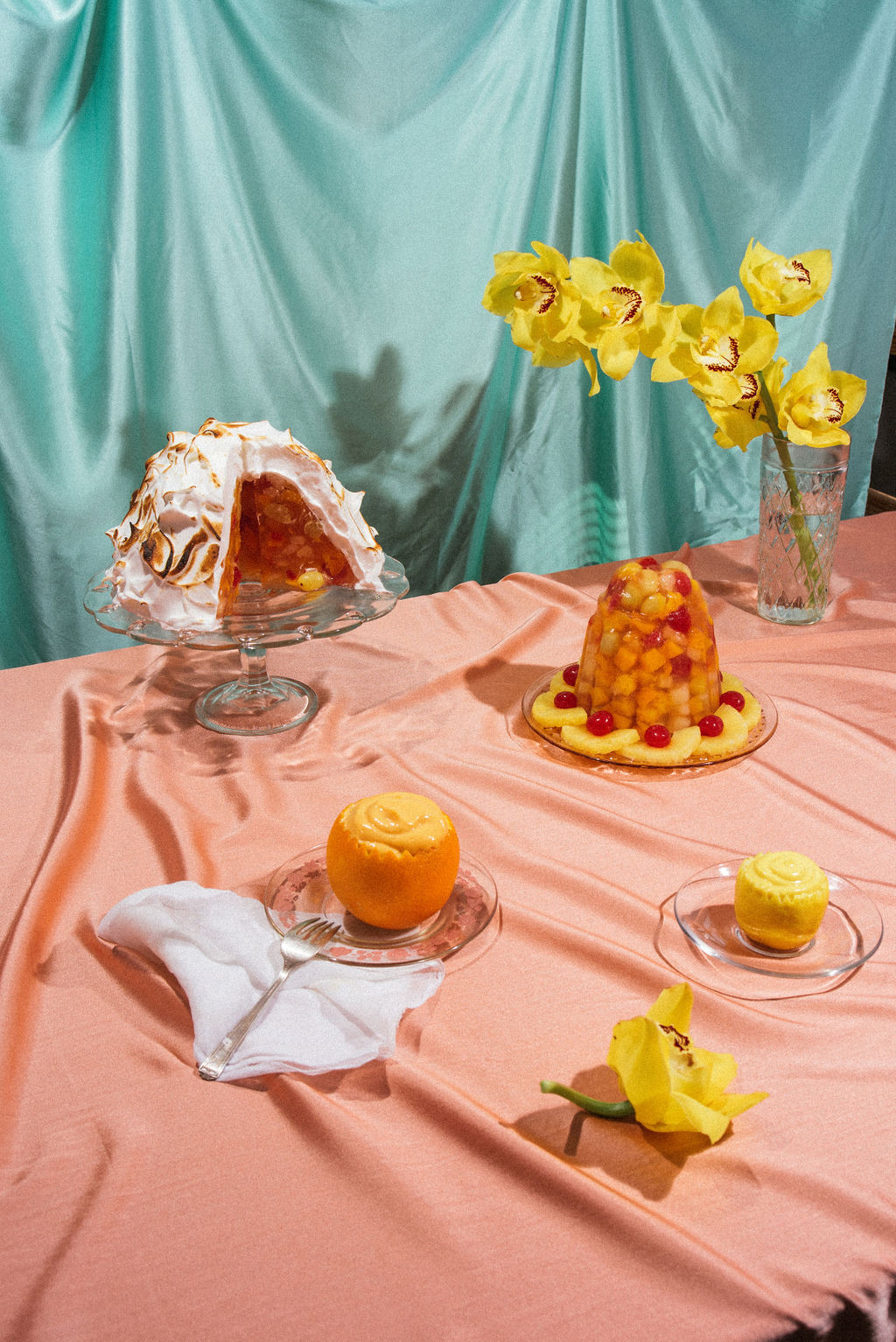
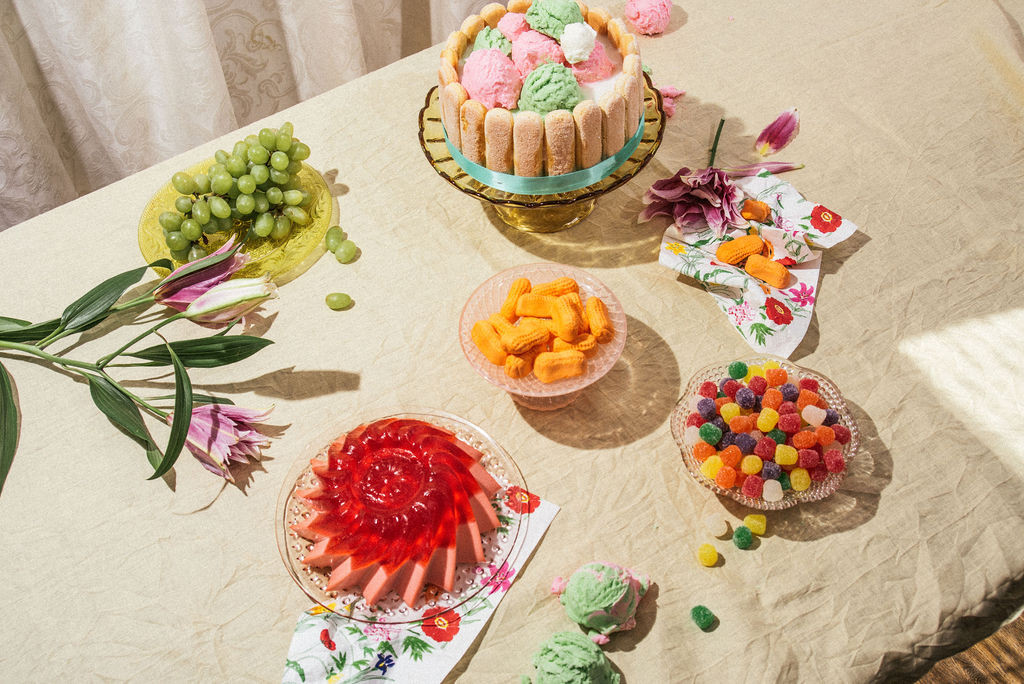
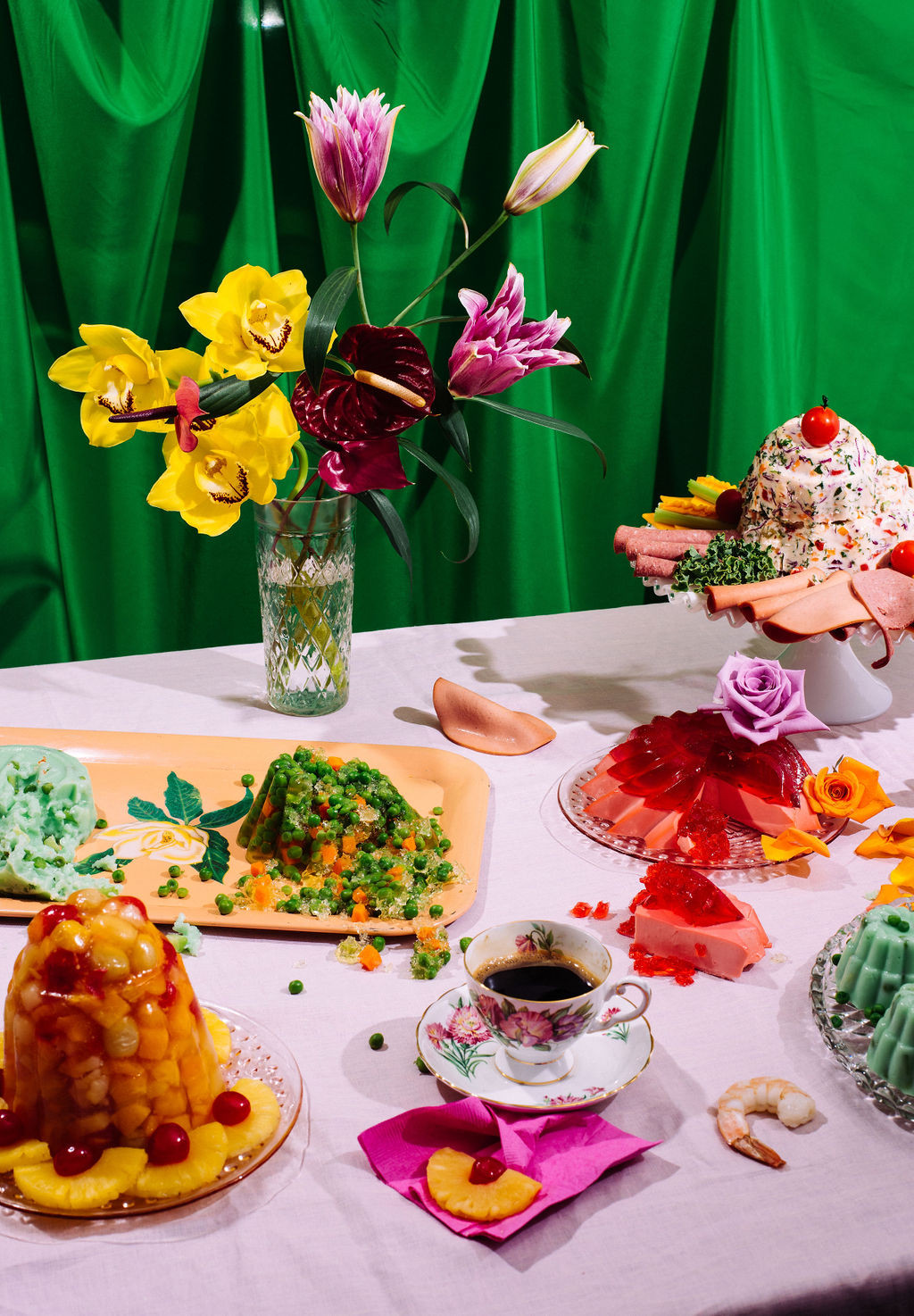
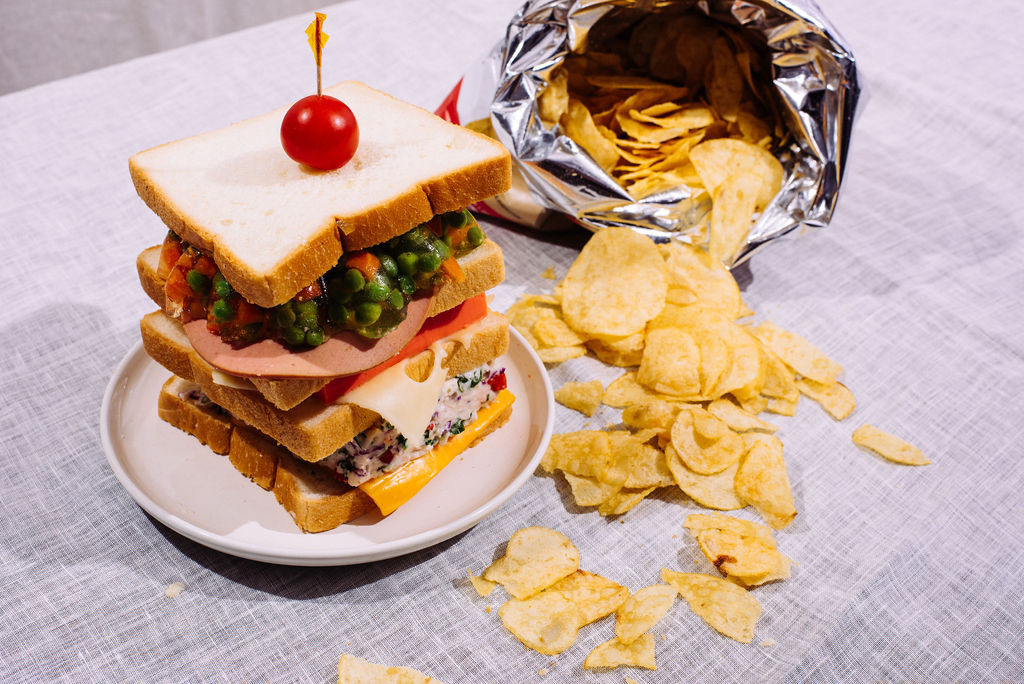
Truly, these decadent Jell-O molds would surely drive Marie Antoinette to envy. America’s culinary history was bookmarked by industrialisation, and the mass production of non-perishables. The food industry’s push for novelty resulted in humour, strangeness, and charm. Here, Marshall-Garrett masterfully allows us to look through the time glass—and the largely unassumed art of fashioning foods for filmic releases is a pure visual feast, but no easy feat—as the chef herself knows perhaps all too well.
We picked the chef's mind on everything from her shopping cart at the grocery store to a delightfully specific breakdown on Jell-O, so check out the interview below.
How long did it take you to prepare all the food for this series?
About three days, about a half day of shopping, and 2.5 solid days of cooking. The plating occurs on shoot day, so I guess actually four days.


What was on your grocery list when you went shopping for the materials to make the spread?
Haha! SO MUCH CANNED FOOD. I won’t bore you with a complete list, but the highlights include:
Cheez Whiz
Fruit cocktail
Maraschino cherries
Lil smokies
Jell-O Instant Vanilla Pudding
Frozen peas and carrots
Curly kale
Canned mandarins
Evaporated milk
Bologna
Canned pineapple
Various flavors of Jell-O
And of course: mayonnaise


If we were to eat the lobster jello, what would it taste like?
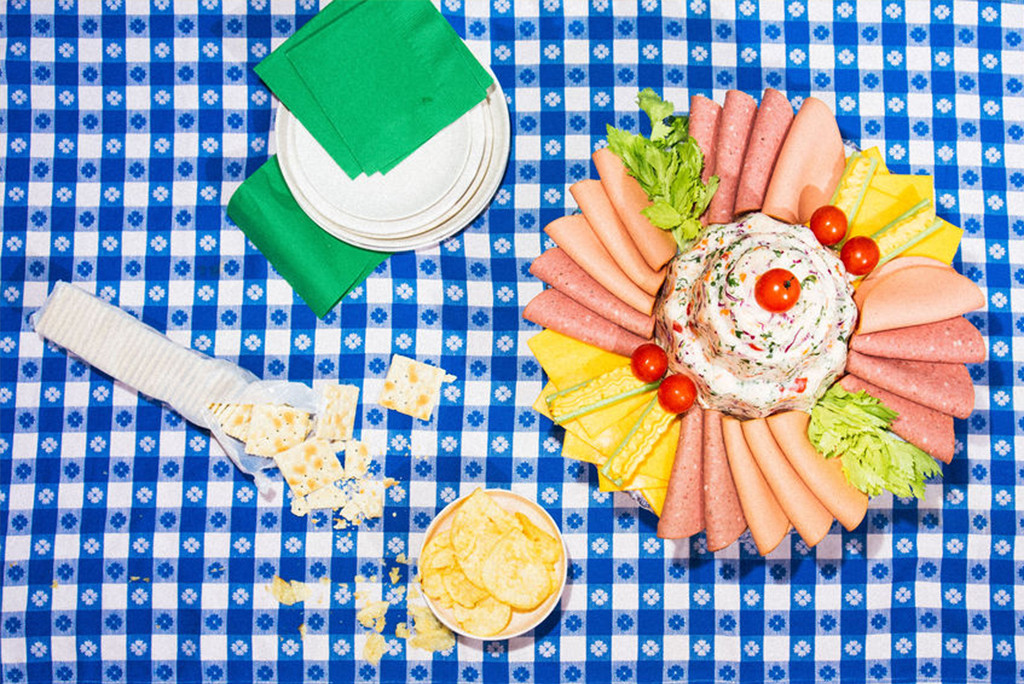
Champagne Wishes and Caviar Dreams, of course. Obviously, I kid. In reality, any seafood mousse mold will taste like a blend of whipped dairy, the seafood you choose, and whatever herbs you include—in the case of seafood, it is usually flavored delicately. The real question is what does is feel like? And the answer is: cool, fluffy, kind of melt-in-your-mouth, and depending on how emulsified, clarified, or strained the recipe demands, there may or may not be some texture. You can tell by the smooth versus rough appearance if there is a texture. Compare the lobster (smooth) to the Patio Platter mayo mold (rough), and you can see what I mean. Bet you didn’t expect a dissertation on Jell-O molds, but as it turns out, this is my weird mission in life.


How did you decide to pursue culinary artistry?
A feature film prop master and a dear friend, Jonathan R. Hodges, trained me. He is probably best known for his work in the movie Pulp Fiction—the most epic prop film of all time, and he has a storied career. He saw something in me, and he gave me my break. We worked on some hilarious and epic jobs together, including a McDonald’s commercial called “Ronald Has a Bad Hair Day,” which you can totally find on YouTube and Jay Z’s "Hard Knock Life" video.
I first got into the media business working with my high school BFF photographer and general badass boss lady, Danielle Levitt, who pushed me to style her early work in NYC in the '90s. Eventually I moved home to LA and met Jonathan. I also worked very closely with Stephen Stickler, a now deceased music photographer who was a dominant force in the '90s. Jonathan pulled me back to the film industry in 2014 when I food styled The Astronaut Wives Club. This is when the ham and gelatin Kraken was really released. I’d always been fascinated by period food, and I was given the opportunity to just go crazy. I made every single weird thing I could think of in those six months—except maybe a Patio Platter, as it turns out. This is really the job I cut my teeth on and is directly responsible for why I was able to pull off the Justin Bieber "Yummy" video recently. A truly epic quantity of gelatin and other fantastically weird foods were made for that video—hat tip to Maya Bookbinder and our assistants who I couldn’t have done it without.
What’s it like seeing your work featured on such high-profile projects and knowing millions of people are seeing it as well?
I’m going to be real here and say: I LOVE IT. Seriously, the love of gelatin molds, foods made into towers, and Sputnik-shaped appetizer presentations are so close to my heart, and it gives me GREAT JOY to represent this odd slice of American history to other people. Plus it’s really, strangely, what I am best at, and there is a pleasure to playing with all the cards in your deck.


What’s a challenge people might not necessarily expect when it comes to preparing food for filming and photography purposes?
That is has to last! This is especially true in film and television. In a food styling environment such as a print shoot where the food is the main event, often the whole day is built around the food, and it’s normal for the rest of the production to orbit around it. In the motion picture industry, surprisingly even in food advertising, where the whole reason we’re there is to sell food, the food is only one aspect of a very expensive production. Generally speaking, the order of operations is prioritized around the talent and the location. So, no matter the circumstances, whatever you are bringing to set, you have to be able to get it ready in the blink of an eye, and then it may wait hours until it’s filmed. Or it may be filmed over the course of several hours and under hot lights. So, the food really has to be sturdy.
Also, the work environment is more often than not anything from decidedly unglamorous to utterly insane. Like doing all this in rough camping type environs. And there is almost never plumbing or a water source.
Do you or others eat your work afterwards?
Generally, no. Food safety is a major issue, and the food sits out. If it is being eaten for the scene or job, then you are cooking and preparing it fresh over and over. I always give away the properly stored unused food though, and depending on what it is, sometimes I take it home and eat it myself. Cookbook food stylists often eat their work! They’re known to schedule the shoot around meal times—like we’ll shoot this gallette or whatever close to lunch and then eat it after. I think overall, print allows this more easily than motion picture, and food storage determines a lot.


If you could imagine any person in the world, real or fictional, sitting down and eating the food in the photos, who would it be and why?
I love the idea of people from other nations and/or times consuming these prototypical industrial food complex foods of the mid-20th century with the kind of nose-wrinkling disdain we historically applied to anything non eurocentric. It’s hard to believe now that we as a nation disdained things like garlic, but we did—we associated it with immigrants and crime. So, I think it’s only fair that this kind of "EW GROSS" thinking is applied to these super establishment foods now. This kind of food is the ultimate expression of leaning into the middle and exerting great effort to assimilate into the mainstream from the time in which it ruled.
It’s such an evocative food group. I think the only possible person it could look natural with is a fictionalized space alien or a 1960s idealized housewife, and both of these are tropes from the same era that produced this food, of course.
For me, that’s why it’s so powerful. It has such a theatrical quality to it. And of course, it’s very pretty and, for all its clean architecture, has real maximalist potential—which is why you see it cropping up in the media today. There’s this high-low culture aesthetic built into it. You see this in the Bieber "Yummy" video, and the Gucci Resort collection film directed by Harmony Korine that came out last year. I mean, obviously I am here for it, this is my favorite topic and one I think quite deeply about. So I guess really, I can see anyone and everyone getting into a gelatin mold.

Now, with their film and video library being archived by Cultural Traffic on YouTube, office highlights some key works.
EXILE
An early entry, and perhaps the most outwardly odd, of the films listed here, Exile (1984) is a short, riddled with paradoxical images and sounds. In a haunting and somewhat maddening satire of the British elite, the GO is throwing a tea party. In proper GO fashion however, this particular party is special, because it’s set against the brutalist backdrop of the Beckton Gasworks and includes a soundtrack of queasy pulsating drums, jumpin’ Jackflash saxophones and a chorus of reverbed men’s voices yipping, hollering, meowing like cats and quite literally yelling at you to, “Take it easy on the beach.”
"ATTACK ON CORK STREET"
As mentioned, the GO was known for great displays of protest through performance art, and an arguable apex of their early anti-establishment period is captured in the short film “Attack on Cork Street” (1985), which documents when, in 1985, the GO “livened up” some of London’s most famous art galleries by dousing their facades in massive splatters of grey paint. The short is a crystallization of everything the GO was achieving at the time; combining film, image, voice and music as a vessel for razor sharp displays of rebellion and anarchy.
SHOWREEL
On the flip side of the coin, and at the opposite end of their career, is the catalogue of the GO’s commercial music video and album design work. The GO, whose name was made by mastering the art of telling the establishment to fuck off, was tapped to work on videos in the late 80s for high-profile clients like De La Soul (the GO shot and designed the iconic 6 Feet High and Risin’ cover), Grace Jones, and even 80s Jagger—all of which is on display in their showreel (1988-1991).
CORRIDOR
While the GO gained popularity for collaborating with massive names in the music world, the collective did not become totally consumed by those more commercial opportunities. Corridor (1989) proves that the GO was still creating compelling, simply constructed, yet challenging films well into the late 80s. Corridor is one such example. Taking place in a (you guessed it!), members of the GO meander, lean against walls and are seen “endlessly waiting.” Perhaps a comment on the increasing speed of consumerism and media consumption, perhaps a joke at the viewer’s expense or perhaps simply a way to use some leftover film, whatever it may be, it is unsettling and effective in its agonizing simplicity.
So, dive in. The entire archive is worth viewing and each piece further proves how far ahead of their time the GO was. Through a combination of combining video art and anti-establishment sentiment into a cultural machine, slyly winking from within the lines of said establishment, the GO proved the enduring power of film and video as both a marketing tool and an instrument for artistic expression.

Read the interview below to see where Downey's head is at.
So you just moved from Brooklyn back to Florida, and you’ve lived just about everywhere in the country it seems. Why did you decide to move back?
Yeah I’ve lived all over: east coast, west coast, midwest, up north and down south. I got lucky as a teen with the opportunity through skateboarding and the support and guidance of countless people to travel and live in many different places and to do what I love at a young age. I’ll forever be truly grateful for those that helped me throughout my life. I originally grew up in Florida and life has taken me full circle something like 17 years later. I met my girlfriend in New Orleans about six years ago who also grew up in south Florida, but we never had met there. We ended up both moving to NYC and living together for the past like four or five years. We moved back together so she could start working in her family’s jewelry business. It’s been a really great thing for us so far. Leaving New York put some life things back in perspective. We’re able to get ahead a little bit, slow down and enjoy life a little more. We’re actually buying our first house, something we probably could never have done living in NYC. I’m still going up to New York for work each month, so it’s actually been a great ratio of fast-paced craziness mixed with an escape.
Why hats? And did you imagine you would garner this much traction for your art?
I’ve been making hats out of fabric and recycled clothing and other objects for about eight or nine years. As for the more conceptual art hats, I follow the idea that I only make one or two classic styles of hat. With these constraints, I can hit a few specific design elements like the crown, the bill and the back closure that make that hat distinct and recognizable. Then, the material possibilities become almost endless. So by taking this classic, iconic thing and making it out of other unrelated, classic iconic things, you end up with something that you've known our whole life, but also never seen before. I think that’s why people are able to connect with the hats in the way they have. It’s nostalgic, personal and instantly recognizable—but new and weird and a surprise.
What’s your process like for creating the hats on your Instagram? Do you conceptualize it or sketch it first?
I don’t sketch at all. I usually just have the idea and go for it. A lot of time I get really lucky with the end results, like things line up perfectly or something smart works out in the design without forethought. Maybe it works out better when I improvise than when I really dissect my approach. So, I trust my instincts and the process and try to create in a free way. Mistakes are welcome.


I kind of envision you having a room for all the hats you create. What do you usually do with them after you make them? Do you sell your work on Instagram?
I’m in-between studio spaces from recently moving, but in my old space, I had all the hats up on hooks on a wall in a big grid. Now a lot of them are in storage. Some are being displayed in a gallery on Palm Beach, Florida called JL Modern. They have the hats for sale through their artsy account. It’s a crazy thing to see my hats in a proper gallery setting. I’m like shit, I guess they really are art. Making them has been a lot of fun, and I’m really happy everyone is enjoying them. My best sellers are the Pantone hats and the Ziploc hats, and I’ve been selling those through the gallery and through DMs on Instagram. I would love to do a book with all the photos of the hats with all the behind-the-scenes photos. One day.
How do you choose what materials you’re going to use for the hats?
I think it works best if it’s a nostalgic or iconic item, something people can personally connect with. When it comes to sewing these materials that aren’t necessarily sewable, I have a lot of weird little things I do to make them workable. For the collard greens hat, the leaves were too rubbery and sticky. I had to spray them with WD-40 to stitch them into the hat. Each hat has a little trick. My girlfriend and I have fun thinking of new materials. Most of the time an idea will hit you instantly. You’ll be walking through a store and suddenly think, “Banana split hat!” I’ll probably do that one soon.
You used physical issues of office for some of your hats. (We’re very honored.) And now we’re interviewing you, so full circle. How did you first find out about office?
The honor is all mine! I have been a fan of office for a while. It’s a really impressive book. I have a friend Caitlin who works there with y’all as a fashion editor. Whenever I was around the Canal Street Market, I would grab a coffee from the office coffee shop too.
To date, what’s your favorite hat that you’ve made?
I have a couple favorites, but a funny one just happened. For a while, I’ve turned peoples old favorite t-shirts into hats. Six years ago, I had a Kickstarter project based on it. Recently, this guy DMs me and says he has a shirt for me to turn into a hat. I say great let’s do it, then don’t hear back. A couple weeks later he contacts me and is like, “Man I don’t know how, but I lost the shirt I was going to send you. Bummer, nevermind.” So I said sorry, let me know if it shows up or you have another one you want to do.
Then a couple weeks later, a woman DMs me and says she stole a shirt from her husband that she wants to get made into a hat and give to him as a surprise. A couple months later, this guy probably got his T-shirt hat and was so hyped. I was so happy to be a part of that.
Do you make the hats on your own? Is your girlfriend Emma a part of your creative process?
For the art hats, aside from actually sewing them, she’s pretty involved. We brainstorm new materials, or she’ll help me piece together a design. She’s in the jewelry world, so she has a really good eye for small details. She’s into fashion and art and has great taste. Some of the arts-and-crafty ones we’ll do together.
On the Falcon Bowse site as of today, there’s only hats in stock. What are your plans with Falcon Bowse in 2020?
Yeah, only hats. I’ve had full collections of clothes before, but my hats always do the best. I’m honestly just much better at making hats than other garments. I have a really cool short film coming out soon. It’s our second one we’ve made with Collin Read. He’s a genius. It’s going to be hilarious. I also just came out with an iPhone sticker pack app, where you can put my hats on photos or memojis in text messages. It’s available now on the App Store, called Falconbowse hats. Next I want to try to make AR filters with all my hats. I’ll probably get that going soon. I’m having fun figuring out different ways for people to interact and enjoy my hats and art.
Between skating and designing, you’re a man who “wears many hats.” What other projects are you currently working on?
I’m currently back in NYC working on some reupholstering some furniture for the Tibi store in SoHo. You can see some of my upholstery stuff on my other insta @bowsehaus. I want to do some version of a live workshop or art show where people bring in their old favorite shirt, and I make them into a hat on the spot. I’m talking with some people to get that going. I think it would be a really fun event. I’m also working on another fun project, doing the illustrations for a children’s book my mom wrote. I’m about halfway done. It’s definitely my goal to finish it this year, no matter what.
Hats have become so political in today’s day and age. Any stance or feelings towards that?
Um, I’m staying out of it.
What’s the most you would pay for a hat?
Well, I just make whatever hat I want. I would probably pay $20 or less like if it were a cool or funny vintage one at a thrift shop.
How many hats do you own?
I have like 60 of the art hats just in my storage. For personal hats, I only have like three or four that I actually wear day to day. They are ones from special, small batches I make of vintage fabrics that I’ll never find again. And I have two thick wool beanies I’ve had for years, one my girlfriend knit for me.