PRESENTE CONTINUO: the intimate ties between then&now

Starting May 30, PRESENTE CONTINUO will be available to purchase on presentecontinuo.com, cpcompany.com, and at the C.P. Company flagship store in Milan, Corso Matteotti 7.
Stay informed on our latest news!

Starting May 30, PRESENTE CONTINUO will be available to purchase on presentecontinuo.com, cpcompany.com, and at the C.P. Company flagship store in Milan, Corso Matteotti 7.

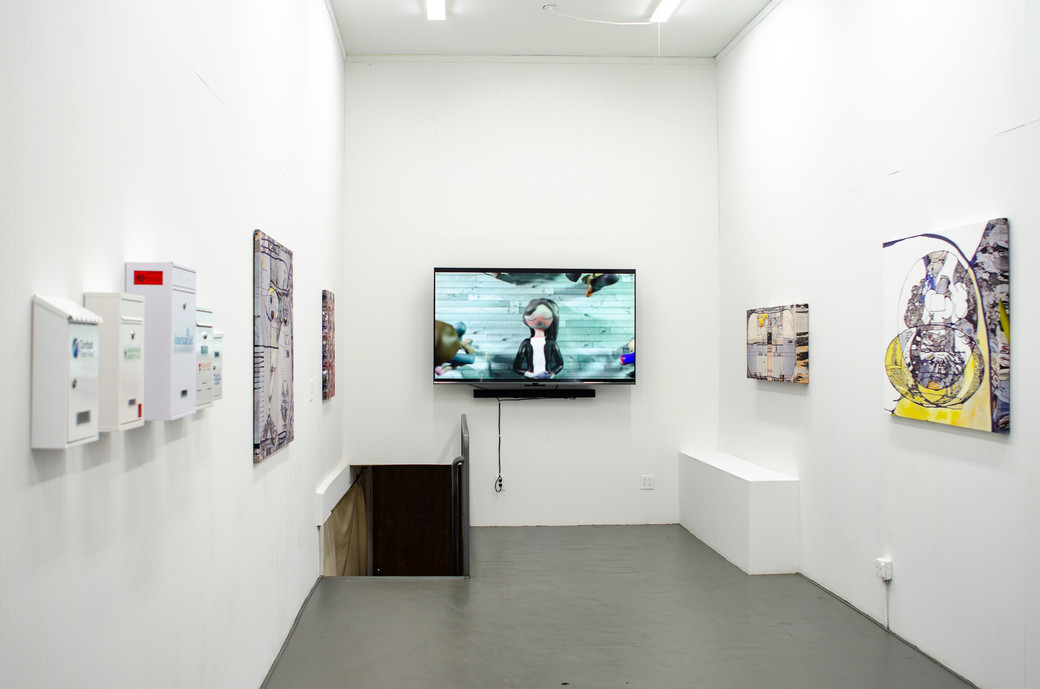
The question of avoiding the overintelluctualization of art has always plagued me as someone who doesn’t actually have any artistic abilities. I contemplated this with Bonfils and Balfus in the midst of the running of their show to see if they agree with the notion to lean into over-contextualization at all costs. Is the Wildean idea ‘to define is to limit’ always relevant? We discussed their work, from influences to interpretations, Jeremy Strong to the O.C. And we agreed that analyzation is the whole point.
Let's start off with: what was the process of coming up with the name, American Girl Diagnostics?
JB- I feel like it was sort of just natural and sweet.
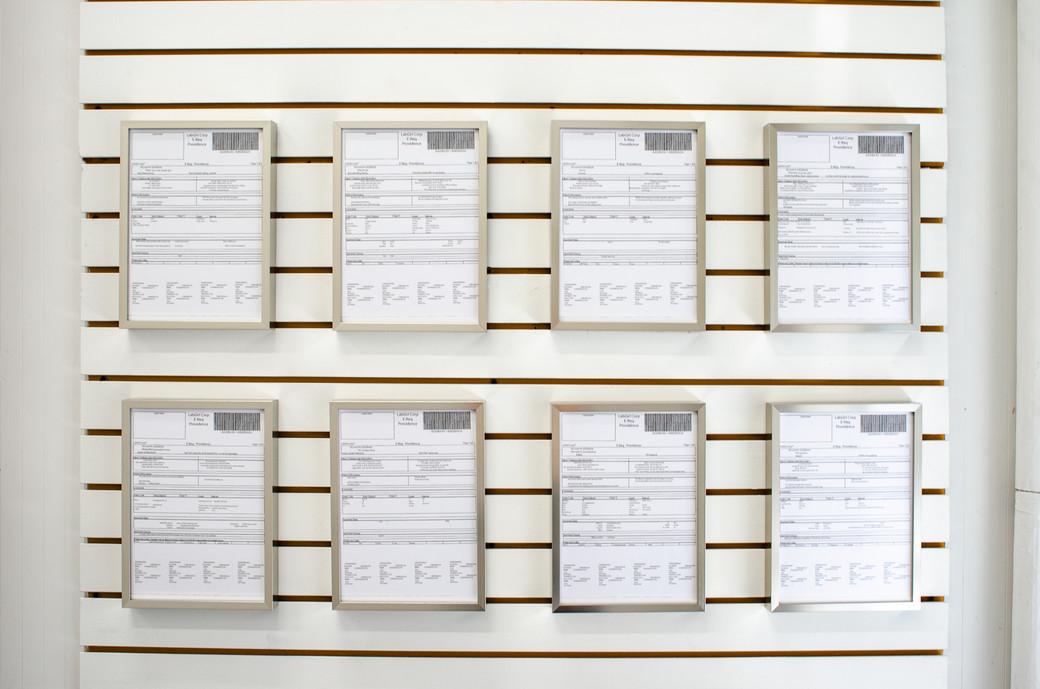
AB- Well it started off as the name of [Jane's] piece, one of Jane’s medical boxes. It was the name that you came up with for a fake diagnostics company.
JB- I mean it was definitely the catchiest out of all of those fake parody companies. And we had a running document with a lot of random sentences and mood boards and context stuff like that. A lot of screenshots from movies we were referencing and diagrams from the medical books that Ali was looking at, and I feel like we just kept circling back to that one and were like, ‘wow this kind of is perfect’ because it’s like, A) we’re making all these plays on western medicine and these bureaucratic systems that are specific to American healthcare, and [the work] is also like a total toy to be accessible and specific to our generation.
AB- It's definitely nostalgic in a way that's really specific to our age. Girls, too.
JB- And theories on dolls and… so on.
So when you guys decided to do the show, was there already a clear vision set out for what you wanted to create or was it mostly curated from works already in process?
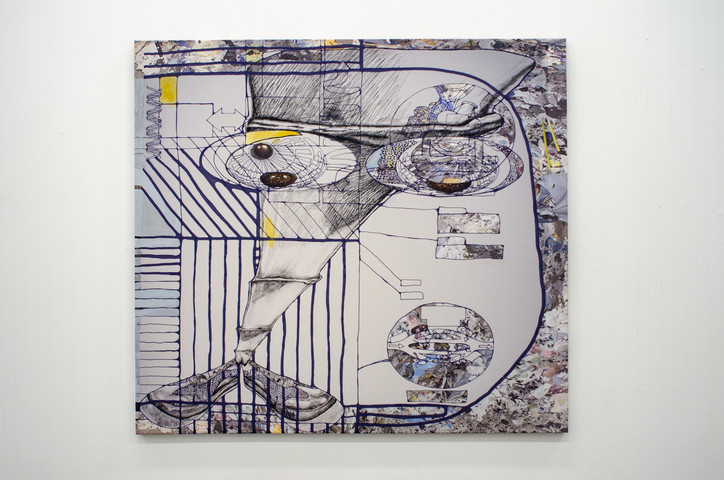
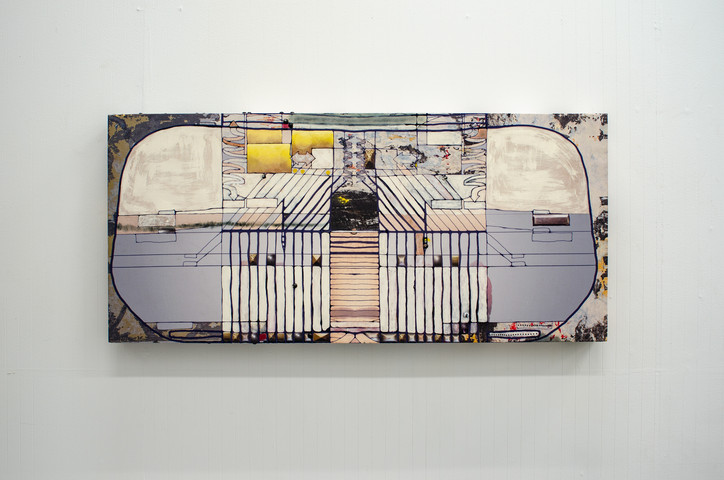
AB- We both had projects that were happening but in really early, early stages. I had a lot of paintings or digital drawings that I had started, and after talking with Jane about doing a show, they just kind of progressed as we figured out what the show was about. I had a process that was really fine tuned. But then the process started to encapsulate the ideas that we were talking about for the show, which was: the body, and representations of the body. In my case, through diagrams. I used diagrams from nutrition books from the early 2000’s. The early 2000s seem to have a trend of nutrition and prescriptive diets that was like a one-size-fits-all. So it was this moment in American nutrition that I found really strange. I used the diagrams from that book as starting points for these digital collages that then turned into the paintings. But yeah, that process was kind of in place before we discussed having the show. But then it was emphasized and really shaped by what we wanted to talk about.
JB- I feel like we had both admired each other's work for a long time, and have always wanted to collaborate and do something together. In a lot of ways, our content was synchronous, and referencing similar points of context, and a lot of it also was really different. And we were like, ‘Hmm, I really like your work, and what could we possibly do to make something coherent and unified,’ and then it was kind of a serendipitous thing, because we ended up both being kind of on a wave of these ideas of girlhood, in medical spaces and diagrams, and recontextualizing more oppressive structures and making them femme and silly, or exploring how they’re erotic or naive, which is the crux of the show. We ended up making the works, slowly, with constant visits with each other.
So it was kind of a little bit of both, a discovery through the process. But then also, Ali already had the medical diagrams, and Jane already had the original medical waste box.
JB - Yeah, I had the box idea. And then I was also working on the video for a long time. I feel like my last few works were sort of like portraits of my own illness and disability and wanting to expand on that.


Ali Bonfils' paintings
I was going to ask about the personal or external influences that came to mind when creating these works/ideas.
AB- I was really wanting to have this really systematic process, and experiment with what that would look like in creating an art object…we also need to talk about the O.C.
JB- That was a huge jumping off point actually.
AB- I was also looking a lot at Sarah Sze’s work that I really love. I just love how intense her use of materials is where it's just so all encompassing. Her ripped paper was something that I was really looking at a lot and trying to play with on the surfaces of the paintings. She uses a lot of tape, I got really into using tape and nails and things that might be used to create an object, and use that as the decor of the painting almost.
Was that something you've never worked with before?
AB- This is the first time I've done paintings, or something that could be considered a painting, and really started thinking about the material. I used to just use colored pencil and graphite on paper, and I never really let myself play around with material much past that. So I think this was a lot about just experimenting with different materials and playing with the surface, all of the works are inkjet printed on canvas. But the surface, I was really interested in bringing it out just a little bit, not a lot, nothing too sculptural, but being able to vary the surface just slightly. And I think nails and tape, and there's some taped pieces of paper on one of the paintings, that seemed like a good way to add texture to the surface without making it overly sculptural, just enough to emphasize the surface.
JB- I feel like the end result of using all those materials, with your process based flow of making your works ended up having a kind of a magical result in the sense that, a lot of the materials are sort of aggressive, but they bleed into each other. And it's sort of indiscernible what's coming from where. There are a lot of obvious bursts of the materials really shining through but it was an equally magic experience to see people come in and ask, ‘Oh, what is this? Is it an object? Is it a painting?’
AB- Not being able to discern what was what I think was a cool thing that I didn't really expect to happen and ended up happening. And that's nice to see people interact with it that way.
JB- And also using things that are more aggressive and having the result be just as delicate or beautiful or painterly as paint, that was exciting. Thinking back to the external references we were definitely watching like a lot of the O.C.
AB- Jane put me onto the O.C.
Never seen a single frame.
JB- Okay, homework for tonight.
JB- I'm really obsessed with the formulas of all these like young adult teen High School dramas because they're like, really bizarre. And they also have identical structures to each other and everyone is hot and the style’s cool.
Is that one ‘reality’ or acting?
JB- It’s acting.
It’s theater.
JB- It is theater! While we were working on pieces for the show, we were watching these giant production movies like the original ‘A Chorus Line,’ and ‘Singing in the Rain’ , more examples of media with varying formulas. And I'm also really obsessed with, and have seen every single episode of, Friday Night Lights, Gilmore Girls and Dawson's Creek, and protagonists from each show appear in the video. All of those shows and those structures were really important to this idea of a ‘proto-girl’, this like, ‘perfect’ girl who is more doll than human. All of these characters have these wild experiences of trauma, but they look really fab. And they're constantly in weird, vulnerable states near death. There are all these paradoxes around their lives and their crazy love stories.
AB- I love the idea of a show that has a formula that is repeated over and over again.
And formulaic matters as such almost ties back to the prescriptive elements of the show as well.
AB- Yeah, in terms of the diagrams, I was also thinking a lot about plugging in my own information or subverting what it was trying to diagram and confuse. And I feel like in the shows, one of the projects we were talking about doing together, which we ended up not doing just because of time, was diagramming out the episodes of the O.C., and then plugging in our own information to those diagrams.
Also, I feel like the patterns in your works Ali, it's interesting to know that it was a diagram in a medical book, because sometimes some of them look almost like a motherboard or something, you know what I'm saying? Like almost technological. Do you experiment a lot with that in your work?
AB- All the works are printed and then worked on top of, that's what I've been doing lately, yeah. Having those things right up against each other. All of these works have been in my studio, and this is the first time I've shown this kind of process that I've been thinking about. And I thought it was much more obvious what was the hand and what was the digital, or I thought it was going to be a lot more to the viewer. There was some intent to make the digital aspects of it look handmade and have that weird tension between the two. But I think it was a lot more unclear than I ever could have thought once it was in the real world, and produced in a physical realm.
Jane, I wanted to go back to the video, the backing track that you had that plays throughout. It's like an omnipresent kind of mixture of sounds. Did you make it yourself?
JB- The composition is mine with like a few samples, one of them, the sort of breathy grunge vocals is my friend Elusin, and then the ending Latin hymn is a version of ‘Pie Jesu’ but sung by a choir comprised of young boys in England who sing in these female ranges, they have just these really beautiful pure, femme voices that are kind of trippy and magical and imperfect and delicate. I was trained as a classical vocalist as a young kid and sang it, so it was familiar and special to me, and then a lot of sound bits I kind of messed around with, even ones that are five seconds of songs or mixes that were really abrasive I had just been saving and pocketing for months.
What programs did you use to create the video?
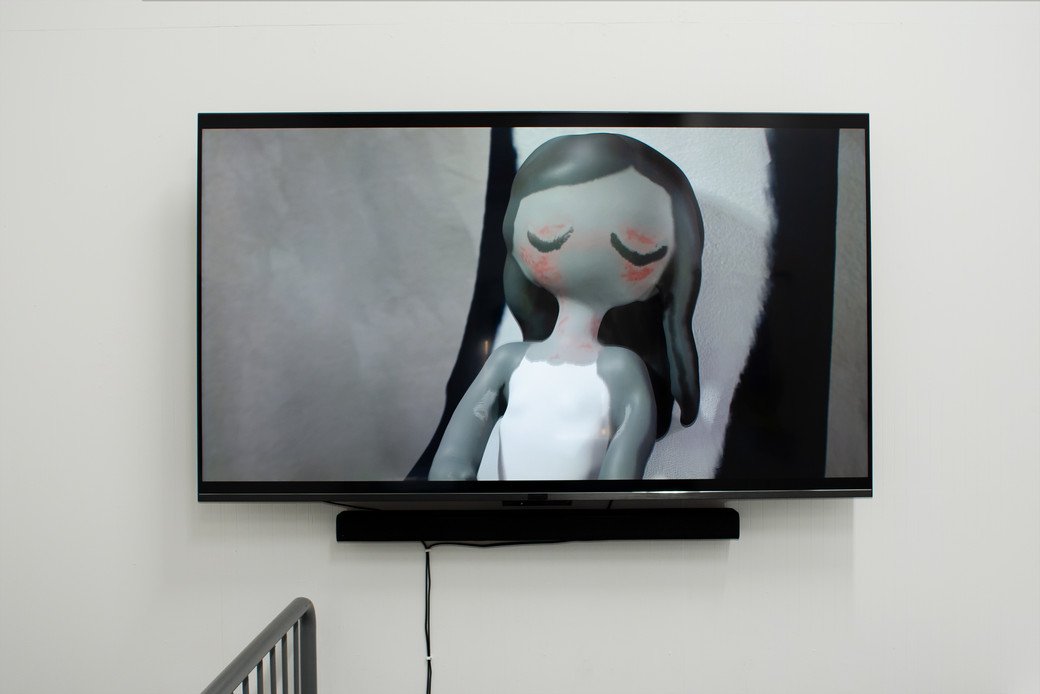
JB- Eventually all the clips are stitched together and edited in Premiere. And my 3D process is completely co-opted from my brother, who helped me with the environments and lighting of this film, and taught me everything I know about 3D. I make my models and environments in an Oculus headset. So I start with the headset on and I'm sculpting things in a sort of ‘digital clay’, which I find to be more boundless and fun rather than if I were to start in a 3-D software like Blender or Maya, where I’d start with a square and extrude it and move it around, which i find to be more complicated and boring, especially with the visuals I’m trying to make. Whereas you can make whatever you want, right from the start, and then export it and then render it in the 3D software from there. But, yes, the video’s content is, obviously, or not obviously, kind of a self portrait. There is the sick figure, and there are these four vignettes of all of these characters from the shows I mentioned. There's a feminized version of a football player from Friday Night Lights, and there's Misha Barton, you know, with her bloodied head post car accident, basically in her death scene from the O.C. There's Lane Kim from Gilmore Girls, Katie Holmes’ character from Dawson's Creek, the sick character is loosely based off of myself. She's in a flare state, which is essentially where, if you have a rheumatological illness, your body will have flared out moments where you have extreme symptoms, due to your immune system constantly attacking itself. On a really bad day my body will start to shut down and I can’t operate normally. With Lupus specifically you can develop a bunch of skin ailments, which the character has in the video. She loses circulation in her hands and develops a rash all across her face and down her neck and down her body and she's bloody and chapped, and balding! I feel like all my characters are sort of studies in moments that are really aggressive and violent, and finding ways to make them cute or delicate, which I definitely tried to do with the flaring character too.
AB- We were talking about how both of our work, when we were thinking about ways we could overlap, are like moments in systems where women, or people, kind of leak out of these systems or can't fit into the systems where modes of beauty happen. I like the word leak. My work is a lot less overtly feminine. But the choice of a nutrition book as a starting point for all of the paintings feels really relevant to me, and my experience as a woman, where it's like, one really prescriptive diet leaves no room for you to find what works for you. I don't see my work as being so direct about food or women, for example, but it definitely was taking those ideas and taking the imagery that might be associated with them in a pseudoscientific way, and then totally changing it into something that was really intuitive. The end product might not be super overtly feminine, but it's kind of in there in the programming and formula of the work.
Yeah, I think that makes it more fun anyways, for not to be super topical all the time.
AB- Yeah, and I also really liked the way that it exists with Jane’s work, there are things that crossover. And I do think I see femininity in my paintings, and I think Jane's work brings that out even more when they're right next to each other.
Yeah, there are certain things about both of your work that wouldn't necessarily be visible unless they were shown together.
AB- Even my paintings in a show under the title ‘American Girl Diagnostics,’ I think they would not have any of that aura if it wasn't alongside Jane's work and under this title.
JB- We started from these super intense topical places and these really strong ideas of girlhood and femininity, medicine and bodies. We ended up scrapping a lot of ideas, because they were so on the nose. But in the end, you can really only see the references if you're looking for them, or if you ask. Again, a lot of ways these ideas of these proto-girls, which is the word pairing I keep coming back to, come through if you're observing really patiently or if you're curious. There's this note that I found from when we were writing about the show, and these characters, which I think is applicable too. “Each of these figures, our proto-girls, are like bizarre prescriptions. They're all existing in states that are wholly fake, with these formulas and scripts in these TV shows within planes of these fictionalized towns, but they're all experiencing real traumas, like poverty, addiction, death, religious oppression.” Also to harken back to the diagrams, it's a second iteration of a series of poems that I've done in these administrative, oppressive, sterile structures. More context for those, too, is being trained as a computer programmer, and working for a while as a software engineer. I was working with data structures and algorithms, which I found to be oppressive and dry. A lot of the ways in which I would remember them is by plugging in my comfort with the content of these silly shows, or embedding them with poems, for example, ‘mapping an array of objects that's composed of like, ribbons, or wishes, or tears,’ you know what I mean?
AB- I really love that visual. I really gravitate towards the idea of plugging in your own information into like pre laid out structures. I feel like a lot of both of our work keeps coming back to plugging things in intuitively instead of systematically.
JB- Another detail we had written, which is a general crux of all the pieces in the show, is their “general intention is to ridicule the entire structure by filling it with content that is lacking in real, concrete data, and instead putting in these dizzying accounts of being a girl, ideas on crushes or delirium, or feeling out of control.”
AB- Moments where the things kind of, like I said before, leak, or come out of structures, places where the structures can't hold them.
What you said about poking fun of the structure, I think that's something that's really interesting. I actually wrote down this quote that I wanted to include, I wanted to see what you guys thought about it. It's from Deborah Levy, and she talks about how “it is so hard to claim our desires and so much more relaxing to mock them.” I feel like that is something that's deeply feminine, an urge to reject the things that are used to define your gender.
AB- It is easier. I definitely agree that that's a feminine quality. Even engaging ourselves in the mocking of female speech patterns. I don't know exactly why that occurs, but I see it happen all the time.
JB- Even watching Succession, not to keep mentioning how we're so inspired by TV, but we are. And Jeremy Strong’s interviews, that was on one of the posters for the show. His GQ interview, a ‘What’s in my Bag’ or something, there's something so ridiculous about him, he just romanticizes everything to the nth degree and uses the most verbose language.
And that’s kind of like what I said at the beginning, not wanting to limit by defining the shit out of it. I feel like he’ll intellectualize a pen in his bag. Which I'm obsessed with. He's so feminine in that way.
JB- It's really interesting, it's hysterical to me.
Genuinely really funny.
AB- He has such a strange, but unapologetic presence thatI really admire. I think it's so cool, in interviews he seems like he's playing a character, but that’s him.
Did you hear about him method acting to ask where the bathroom was? One of his lines was just to ask where the bathroom was, and in real life on set he went to the next set or whatever, and fully went to an assistant to practice asking for the bathroom?
AB- He’s so forthcoming about it. He doesn't hide that which makes it so much less cringe in a way.
JB- I’m back to our document notes: pseudoscience, spirituality, imbuing medical spaces, slash offices with fantasy, sacredness, patternmaking formulas, etc, etc, etc.
Patternmaking? Deeply feminine.
AB- I was definitely trying to reference craft in a way to the tape, the upholstery nails. I used some nails that were really crafty, woodworking nails for tiny little woodworking projects.
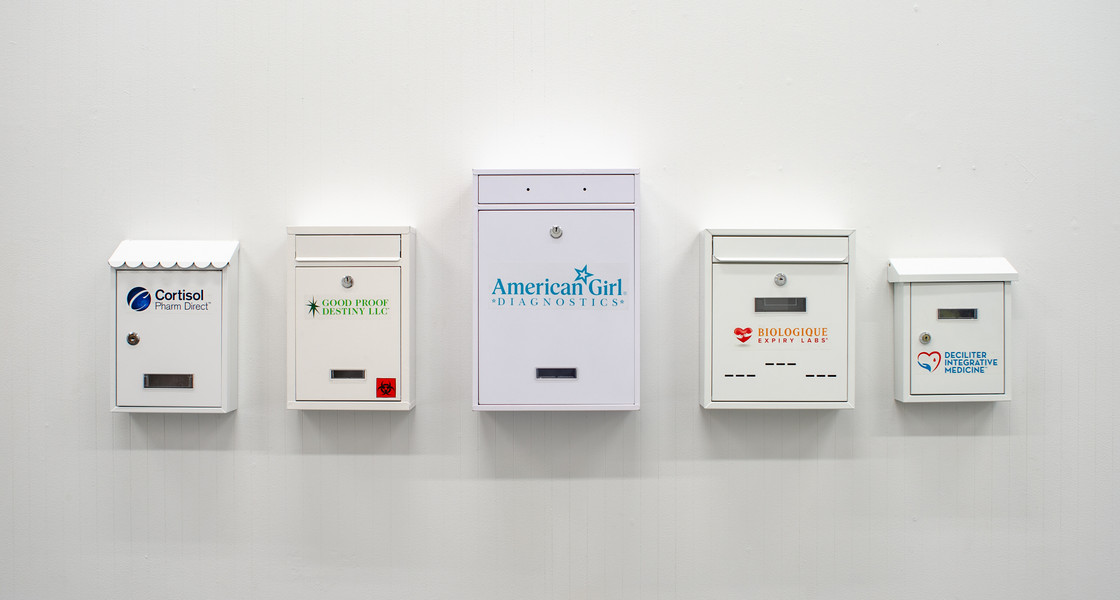
JB- Also with the medical boxes, I was trying to figure out the best way I could steal them. Empty ones…
Where did you end up sourcing them from?
JB- I ended up just ordering from some American standard mailbox companies. They’re mailboxes, they're not even medical boxes, which also kind of adds a layer of domesticity and Americana and suburbia to them. A medical box would never have a scalloped edge, which one of them has, and they're frilly? The boxes themselves are objects I interact with every two weeks, as a base minimum. Whether or not I'm on a healthy one or not. These deposit boxes only contain blood and urine in real life. So that was another fun thing to explore: how do I beautify, or make something more subtle or delicate that contains two really aggressive bodily fluids, being measured for their toxicity?
AB- Also that Semiotext(e) book we both read, Theory of the Young-Girl.
What's that about?
AB- It's about the patterns of being a young girl in society. And I read it as mostly being kind of directed towards patterns in capitalism and patterns in marketing that that coerce, kind of using sexuality into making consumers.But it doesn't always have to apply to young girls, it could apply to anyone, but it's like tactics of marketing and capital, making pretty little customers.
JB- Yeah, and that's a perfect read on it. Yeah. It was written in the 2010s, so it definitely has a more contemporary speculative approach. It's certainly one of the more modern texts on ‘girlhood theory’ that exists. Dakotah Murphree, our dear friend who wrote our press text, is a really brilliant artist and writer. She suggested that I read this a few years back…The works are definitely explorations on these themes of being a young woman and girlhood, but it's definitely not ‘feminist art’, or it's not art that’s overtly female, even if it has elements that are really ‘feminine’.
AB- I think it's more of a consideration. All works are considerations more so than statements.
AB- Just a thought, but I do feel like a lot of really trendy work right now is making a statement or taking a position. I think sometimes the value of considering something, or the value of not having a really clear point or stance is forgotten sometimes. The middle ground is kind of where we both feel comfortable and like to explore.
JB- We really want to make work that's in a subtle plane, even if that means that I have a video and really loud speakers and a subwoofer that shakes a building. I'm like, that's still subtle.
AB- Even if that aspect of it is physically noticeable, the work as a whole, I think, has a really subtle presence. And it also sneaks up on you.
JB- Yeah, we were both trying to make people come back to explore.
AB- No quick hitters. I like the idea of people spending time with the work. Consideration is prevalent
JB- Facts.
AB- Dramaturgically speaking.
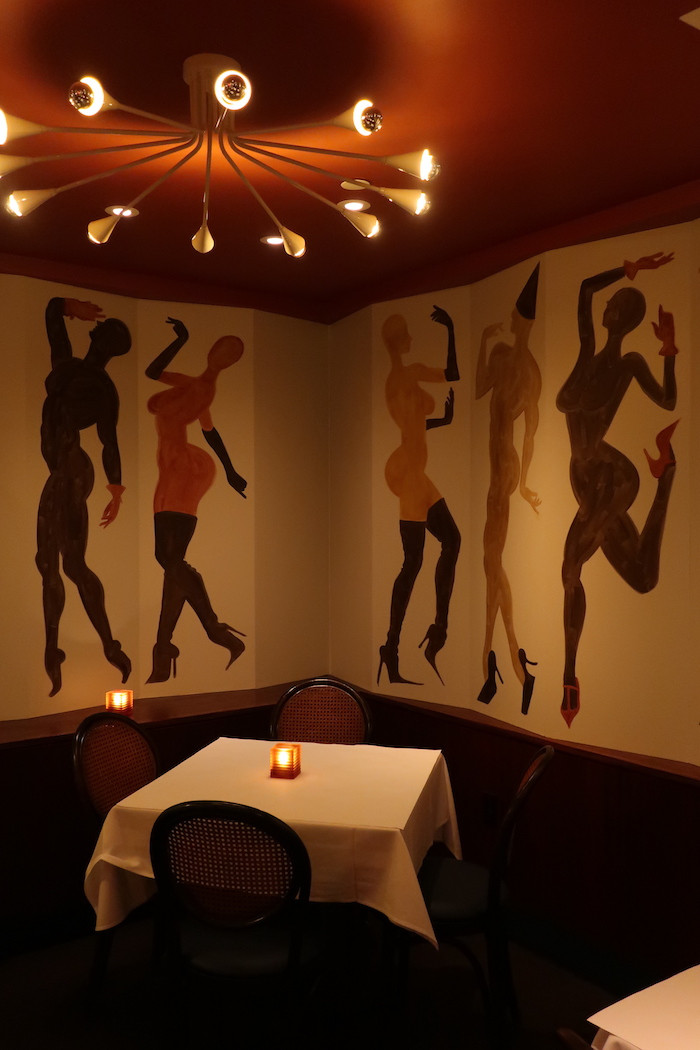
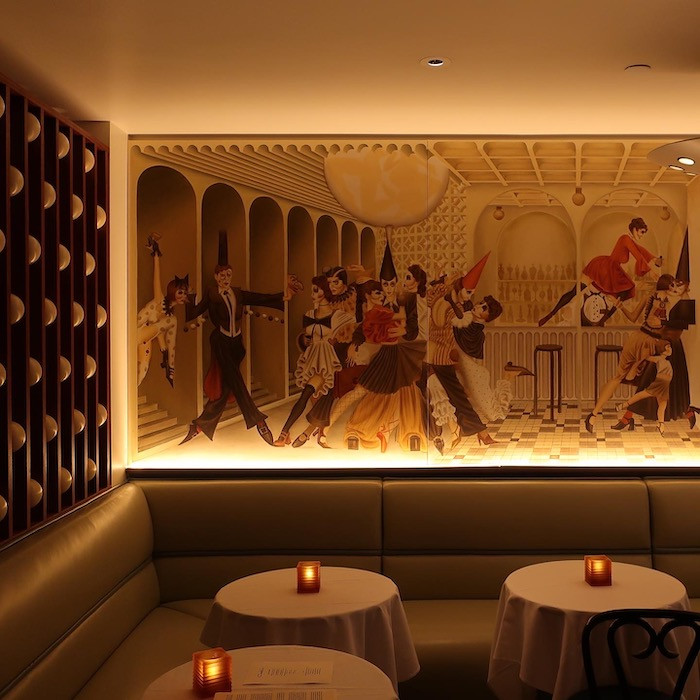
In his latest body of work, a series of murals situated in Cecchi’s restaurant in the West Village titled “Into the Night,” Villafañe further explores both the intersection between architecture and painting, as well as the divide between private and public spheres. Read more about the multi-medium artist below.
Your creative endeavors originated within the realm of architecture. Why did you set out to learn about architecture initially and how does it now impact your visual creations?
While growing up in Puerto Rico, I had the opportunity to create numerous murals, each dedicated to celebrating the unique visual identity of different neighborhoods. Engaging in these artistic endeavors within the public space ignited a fascination with architecture, as I came to realize the captivating interplay between how people move through spaces and the art of spatial design. I've intertwined painting with my architectural training, deploying classical representational instruments used to conceive and communicate spaces to rather distort them and elevate them to fantasy. Through painting, I began to question the scalar and annotative aspects of the drafted line, using it to recompose reality and question the consequences of visual communication and representation.
My work seeks to traverse the intersection between figurative painting and architecture, drawing from the idiosyncratic associations I encounter in my dialectic relationship with the city. I use the viewer's gaze to transform moments in the urban environment into a stage setting, taming and domesticating them in my paintings and sculptural dioramas. By presenting private spaces in section-cut-type depictions of interiors, I seek to give the spectator a glimpse into the daily performance of life — both deliberate and subliminal — revealing sealed scenes of self-realization and re-establishing the city as an intimate spectacle of desires fulfilled and celebrated.
You have studied in New York City, Hong Kong, and Brazil, and your work has been exhibited all around the world. How has this multicultural viewpoint informed your work?
The compositions I create offer a captivating lens through which I analyze the profound journey of connecting with a city from an outsider's perspective — viewing it as a tapestry of experiences and artifice-crafted culture. During my year in Hong Kong, I delved deeply into the art of calligraphy. In Brazil, I had the opportunity to visit many projects designed by the architect Roberto Burle Marx. The spaces offered a harmonious fusion of artistic disciplines, including painting, architecture, urban planning, and embroidery. This eclectic amalgamation had always held me spellbound, leaving an indelible mark on my artistic sensibilities. Now, in the bustling embrace of New York City, my gaze finds itself entranced by the city's density and the mesmerizing microcosms that unfurl in every corner of Manhattan. Each block seems to encapsulate a distinct universe within itself, and I find myself drawn to reverently exalt the chaotic urban fabric and diverse architectural fantasies that play out in this vibrant metropolis.
Though you often paint with oil, many of your pieces include multiple mediums — from graphite to screen print to pastels. Why do you choose to work across multifaceted mediums? How does it strengthen the message behind your works?
The root of my work lies in the integration of multiple layers of meaning, each uniquely portraying distinct nuances and depictions from a myriad of characters I have encountered. These ideas become materialized through delicate strokes of pastels, amplifying the allure of make-up, to the versatile use of graphite, where lines and shadows conjure memories of my architectural background, and further employing screenprint to infuse a photo-realistic dimension into my compositions. The trajectory has been one of continuous experimentation. Recently, I ventured into the realm of architectural dioramas, akin to peepshows, an immersive experience where viewers peer through a peephole only to encounter a world of mirrors, with their own reflections gazing back at them. This dynamic course of dimensional and material experimentation has provided me with the means to delve into an entertaining play of unleashed excess and whimsical intimacy.
You have expressed before that your reliance on multiple mediums and techniques manifests as “acts of deviation.” And many of your paintings explore the rambunctious parts of life as well. Do you think there is enlightenment or a release in deviating from what is expected from time to time?
The concept of escapism is a subject that profoundly fascinates me. Through my compositions, the boundaries of the tangible and intangible blur, allowing me to weave narratives in a vivid and satirical portrayal of society. I showcase various aspects of human nature. The paintings play with humor, observations on human relationships, and societal norms with the aim to seek respite and solace from disconcerting realities, particularly through the pursuit of diversion and enchantment. This inclination manifests through the search for entertainment and the engagement in realms of fantasy, wherein the mind can briefly detach itself from the burdens of life's harsher aspects.
Through the gestural strokes, I weave and fragment intricate microcosms within the embrace of artificial surroundings, offering a portal into alternative realms where the whimsical, dark, grotesque, and comical all coexist. As beholders of my work, we are transported to a universe of perpetual metamorphosis — a wild gathering we only dare to imagine. Enigmatic scenes unfold before our eyes, adorned with carnivalesque figures that sway in and out of the foreground, immersed in a captivating dance amidst a backdrop of endless debauchery. These artful depictions evoke memories of Prohibition-era festivities and lavish soirees, filling us with an exuberant sense of joy, playfulness, and spontaneity.


I first met you when I visited your studio in Chinatown. In what ways does your current location in NYC, especially your specific neighborhood, influence your work and subjects?
Nestled on a distinct corner, my studio gazes upon the final section of Sarah D. Roosevelt Park, where a medley of activities unfolds throughout the day. From gamblers, to gracefully choreographed dancers, to sports enthusiasts. Adjacent to it all, a bus stop serves as a portal, whisking people away to various random corners of America. The neighborhood truly epitomizes a melting pot within the already diverse city, acting as a gateway connecting the Lower East Side with the enigmatic heart of Chinatown. These captivating characters I observe often appear in my paintings, their contrasting identities seamlessly finding their way into the menageries of my artistic compositions.
Your figures all take on a whimsical and animated form. Why do you choose to present all of the characters you paint in this fantastical way — what does this convey about the people and “characters” you come across in real life?
Through the use of striking rhythms and improvisational techniques, which I consider both artistic and conceptual acts of deviation, I transform the human body into a stage. My brushstrokes become sensuous, lyrical lines, and dense figures of luminous color serve as linguistic elements, impacting the bodily subjects both physically and emotionally. By embracing these carnivalesque properties, I seek to reimagine identities, breaking down roles and reshaping the inner worlds of the characters. In my artwork, everyday life in New York becomes a theatrical spectacle, striking a delicate balance between playfulness and gloom, the grotesque intertwined with humor. It delves into fantastical realms featuring puppets and dolls that symbolize our ever-fluctuating, ever-changing identities to reconfigure the way bodies intertwine and move through spaces.
What was the inception point that intrigued you and led you to want to explore the taboo, the unseen, or the unspoken in your renderings?
In the streets of cities like NYC, a fabric of many different personalities unfolds, where people tirelessly toil, yearning for respite from the unrelenting demands of their lives. This quest for escape often leads to concealed acts of debauchery and vice, where indulgence in activities like drinking or the use of drugs becomes a way to cope with the pressures of reality. Having been raised with a Catholic upbringing, I've always found amusement in the absurdity of blind subservience to norms and the establishment. Instead, I seek to carouse in the unconventional and discover the satirical pleasures that lie deep within the confines of traditional systems, such as religion, politics, and societal conventions.
Many of the figures and spaces you create are incredibly detailed — down to the accessories or outfits that are portrayed. How does fashion play a role in your artwork? Do the things some of your figures wear convey certain messages about the work itself?
The fashion portrayed in my art becomes a vivid representation of the allure and extravagance the characters yearn to escape into, transcending their world of excess and exuberance. Draping fabrics take on architectural forms, while stiletto heels engage in animated, lifelike interactions. These garments serve as a medium for bodies to intertwine, blending architectural visions with the poetic essence of chance encounters. At times, a single suit may house multiple bodies, and culottes give rise to multiple figures, all amidst patterns and graphics that distort perceptions of articulation and movement. Concurrently, hats bestow the characters with stature, glamour, and allure, evoking notions of specific professions. The intention is to create a scene within a scene, captivating the viewer's gaze as they gradually unravel the intricacies held within the artwork, unveiling the hidden complexities that further exemplify the concept of escapism.
Tell me a bit more about your recent project with the new restaurant, Cecchi’s, in the West Village, titled “Into the Night.” Why did you choose to use the Seven Deadly Sins as inspiration?
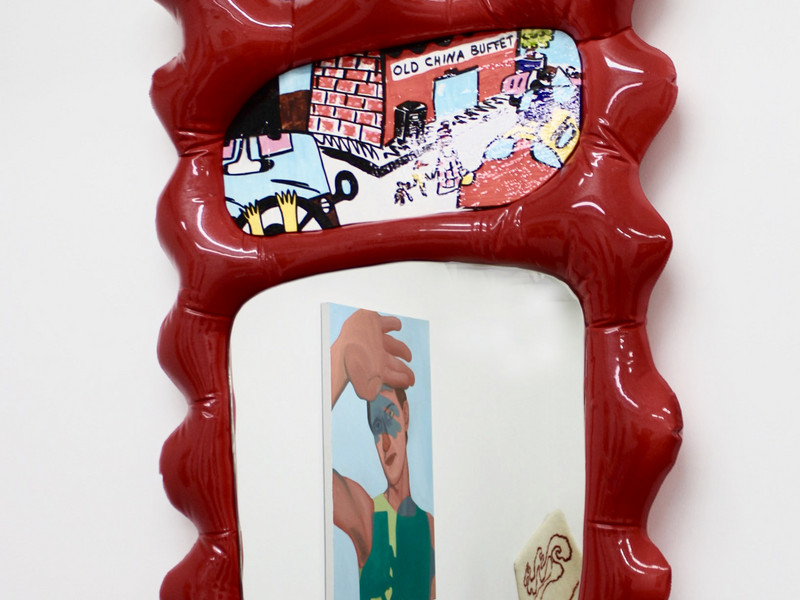
For this particular project, I found it compelling to explore the notion of catholic guilt, drawing inspiration from the Christian concept of the Seven Deadly Sins. The idea for Cecchi's murals revolved around the 16th-century interpretation of these sins, initially painted by Hieronymus Bosch, and reimagined within the setting of a restaurant. Bosch's circular arrangement depicted these sins in everyday scenes, serving as a reminder that they could be concealed within the seemingly mundane aspects of our lives. Embracing this representation, the murals transformed into a garden of earthly delights under the chef's artful touch. Lust, gluttony, greed, envy, pride, sloth, and wrath came to life, each personified and navigating through individual scenes of both debauchery and intimacy. The frames of the murals invite viewers into a voyeuristic experience as if peering into a painted mirror that unveils indulgence in sinful pleasures.
How do you hope your murals make customers feel when they are dining in the new spot?
The murals exude a sense of irreverence and exuberance, acting as captivating mirrors that beckon us to question the illicit and fetishizing gaze that might arise when we behold their canvases. As we peer at these artworks, we are met with the reflection of the restaurant itself, prompting contemplation on the interplay between distance and intimacy. It becomes evident how the presence or absence of a spectator shapes the content, revealing our roles as both willing participants and trespassers in this intriguing world.
By employing the voyeur's gaze, viewers are offered an opportunity to transform the enigmatic restaurant into a mesmerizing theatrical stage. In this process, they can tame and domesticate the space within the canvas, and as a result, become witnesses to the daily performances of life. Within my scenes, the allure of sinning comes alive, inviting us to immerse ourselves in the eccentric drama of this vivid realm.