PRESENTE CONTINUO: the intimate ties between then&now

Starting May 30, PRESENTE CONTINUO will be available to purchase on presentecontinuo.com, cpcompany.com, and at the C.P. Company flagship store in Milan, Corso Matteotti 7.
Stay informed on our latest news!

Starting May 30, PRESENTE CONTINUO will be available to purchase on presentecontinuo.com, cpcompany.com, and at the C.P. Company flagship store in Milan, Corso Matteotti 7.

From navigating the waters of being so young stacked up against people who are twice her age, Arbel shows that natural talent can get you to anywhere you want to be. Through a gracious humility, she brings us into her world of tattooing and gives us insight as to how she got to where she is today.
Continue reading for an exclusive interview below.
What have you been up to lately? How are you doing today?
I'm good. Yeah, just working a lot. I just got a place, I bought a house. So I'm working extra every day to manage everything until I move in.
Oh, that's awesome. Congrats. I know one of my friends just got a house, and she put in so much work. But how did you get started tattooing?
I was homeschooled from my sophomore year of high school because I was just super into art and I was not really taking school as seriously at that point. So I just thought it would be more practical to spend less time in school and just focus on drawing and stuff. Back then I was intending to go to art school, hoping for RISD. I obviously wasn't working or anything or making any money, I was just drawing and stuff. And my mom was just like, "You know, you should try tattooing. Just make some money on the side while you're making this art shit happen, you know." So she kind of helped me find some apprenticeship to kind of get that going. And then it ended up just completely taking over and I didn't even go to art school. Wasn't really the plan initially.
I feel like the best things you can't really plan. But since you started so young, and you are obviously apprenticing in other shops, what were the other artists' respect levels like?
Well, the shop that I did my apprenticeship at, they were always taking apprentices. There were probably like 10 other apprentices at the shop at that time. They were all older than me. I was like 15, or 16, and they were all like in their 30s or something. But yeah, there were so many I don't even think they really looked twice at my stuff or anything like that. They didn't really even once I got my license to actually tattoo because I was also underage. So I had to have an extra-long apprenticeship because you can't tattoo till you're 18. So I was working and cleaning the shop and shit, but the second I got my license, I was trying to do pieces and my friends were trying to come to me for stuff. But once you just start out you have to start with really small stuff, you know, and they wouldn't let me experiment or even push my boundaries. So I ended up getting a job in a different shop on Melrose. But they didn't really focus on me at all because I was like 18, or 19, I had no tattoos, and I was a little girl. And they're all big ass dudes, you know what I mean? It's like the OG ass tattoo artists and stuff like that. So they would always just clown me and stuff.


But then they would see your work and then you would just be like, "Okay, my work speaks for itself."
I wasn't really that good at the time, but I mean I had good drawings, I was really good at drawing. But they never saw my drawings and I'm not the type that's trying to show people you know what I mean? The reason I got the job there is because I showed the guy that knew the owner my drawings. My whole first or second year I was only doing like fine-line stuff, you know that trendy type of stuff like that. So they kind of were just like, this stuff isn't even real tattoos. You know what I mean? Like, yeah, that's kind of how they thought of it. I don't even know if they know how I'm doing now. I'd be surprised if they did.
What would you do if one of them came knocking on your door right here?
I'd be stoked. I'd be like "That's sick that you actually care." But, I doubt it. Like, especially ones that I worked with at the shops, the OG ones. I feel like it's a newer thing in tattooing when everyone's super supportive of each other. On Instagram, everyone's backing each other up, but usually, it's really competitive. In the old scene of tattooing, you don't try to take your other artists' clients in the shop, but nowadays it's different. Everyone goes to every artist, you know what I mean? Back in the day, you go to the same guy, like you don't cheat on your artists. So it's like, you don't really pay as much respect.
For my tattoos, all of them, except for I think, like one, or two are done by the same girl. It was just something in me where I felt like if I got something from somewhere else, and I walked in, she would be like, "Oh, where'd you get that one?"
Yeah, which is fair, but all my tattoos are from different artists. I think it's nice. It's like a collection.
When you see a tattoo of yours, you go, "Oh shit, that's an Arbel tattoo." You can distinguish your pieces right off the bat. Talk to us about your design process and how you started to do your design work now that everyone sees.
I feel like I definitely try to keep it all kind of looking more old school. That's like the main thing that I fuck with. Especially if there's clothing involved, or even as far as the way the shadows work, I try to make it almost look like film photos, because there's more contrast in them. I feel like most of the time I really am open to different shit. Like my chrome looks nothing like my vintage. I have different little things that I experiment with and I just try to keep it basic with rules of realism in mind when I do my designs.


Is there a first standout tattoo where it was kind of similar to what you're doing now?
There's this artist that works in the skateboarding industry that does super cool pointillism, but he does a lot of vintage photography, goofy stuff, and just sick artwork, to where he doesn't take it so seriously, but it looks really cool. The designs aren't so serious, but they're just cool art and I feel like I really liked the stuff that he was making. And I tried to incorporate that to where it's not something like roses and stopwatches and stuff like that, but just sick photos.
Would you say your more playful stuff, like the headless guy, stuff like that, is coming straight coming from you? Or would you say it's a kind of a collaboration between you and who you're tattooing?
I do a lot of custom stuff, for sure. Obviously, I'm more drawn to cooler photography, like stuff that's just wicked and different, you know what I mean? Rather than some basic stuff, which is why I started out with a lot of those headless people. I was always just open to experimenting, just getting better, and realism. So I was doing a lot of custom pieces on the side, regardless of what I was posting. I always post maybe 20%. Sometimes it would take me by surprise, a lot of my stuff on my Instagram are custom pieces, then I'm like, "Damn, this actually came out really sick." Honestly, I don't put that much thought behind it. As much as I would like to say I would. I think it just kind of flows and comes out.
People nowadays are getting way more tattoos frequently, versus older people back then. Every time I come home with a little tattoo, my parents would roll their eyes. What are your thoughts on tattoos normalizing?
I think it's tight. I think it's cool there are so many people trying to get tattoos. Because it opens the market for a bunch of different styles. There are so many different styles of tattooing now, rather than there were like 30 years ago, which is super sick to see.


What does a day off look like for you when you're not tattooing? Do you have any days off?
I don't really take days off. I'm kind of like that though. Even before I tattoed I would draw very obsessively. I'm just very into whatever I'm doing and I try to just push myself all the time.
Say tattooing wasn't an option, could you see yourself doing anything else?
I mean, before I was tattooing I was taking commissioned artwork, and stuff like that. I had done murals on people's walls, which I hated. I was doing that for a second, they really underpaid me, and it was pretty shitty. I was assisting painters also. There are a lot of painters that once they get kind of a bigger name they make their design of a painting they want to do, and then they hire younger artists to like actually paint it for them. Because they don't have time or don't want to spend their time doing it. So like, they would make an outline of a horse and I would actually paint it for them, and then they would sell it on their name and just pay me for that. You know? I liked art, but it never really clicked. I didn't enjoy it to how I enjoy tattooing, but I would probably just go back to figuring something out in art.
So would you say assisting different artists was sort of a driving force as to why you have your own studio?
I wanted my own studio because I hate being bossed by anyone. I like to do my own thing and I don't like to be around many people, so I kinda just needed my privacy. I think a big thing tattooing for me that I don't like, as of lately is that everyone and their fucking aunties literally tattoo now and it's just like, such a huge community. And I think what I liked about being a tattoo artist is that it was a different route than what everyone went on. And now, it's a very common thing. So I kind of don't like feeling like one out of a million in a shop of like 40 other people tattooing. I kind of like being in my own space.
What's a day in your shop sort of look like for you?
I come in early always like an hour early and I just draw all the designs that I have to do that day. Sometimes I do it the night before and I'll kind of just relax. I usually go in and turn the lights on, or you know, just chill for like 30 minutes, and set up.
What does your perfect world look like?
There's nothing much I would want to change. I kind of like how everything is right now. I like that everyone has an option to really put in the work and get to where they want to be if they want to. Some people don't and that's just up to them.


In preparing to write this text on the painter John Wesley—who died at age 93 on February 10th of this year— I read a number of earlier essays wherein critics and historians attempted positioning Wesley as either a Surrealist a Pop Artist or neither, faced off against each other, explained why he wasn’t one or the other, spoke about form versus content and innumerable academic subjects, and generally discussed how dancing works as opposed to what dancing is.
Immediately I thought of the following:
It’s Game Six of the 1992 NBA Finals. The Chicago Bulls are about to defeat the Portland Trailblazers. B.J. Armstrong has just passed the ball to Michael Jordan, who’s advancing quickly into Portland’s key. With the ball in his right hand, Jordan pushes off from his left foot and begins sailing over his defenders, the formidable Clyde Drexler, Jerome Kersey and Terry Porter. As Jordan moves closer to scoring, Drexler, Kersey and Porter begin talking amongst themselves about what exactly is happening:
“How does his leg do that, how does he keep his hand so out of reach, why are his muscles unlike ours, somehow superior, otherworldly?” they ask each other.
Lost in a wilderness of questions, they miss the very thing they’re paid to prevent; Jordan has just dunked on them, further securing the Bulls 97-93 win, and the championship title.
John Wesley dunked on the art world. I sensed in these essays writers focusing on the act instead of the magic, denying themselves that rarest of gifts: mesmerization.
This thought came next, some cautionary parable from an imaginary Greek or Polish Buddhist teacher:
“One day a chef began describing to me a soup he’d prepared for my dinner. He described the ingredients and their sources. He described the sources and their antecedents. He described the alchemical virtues of his soup, the effect of one ingredient on another, one component upon the next, and the point did come, after finding myself increasingly hungry and increasingly bored when I finally asked, ‘Dear chef, may I please taste the soup you’re describing?’ To which the chef replied, ‘The soup? Oh no, the soup is now far too cold to be eaten. You must taste it tomorrow, when it is fresh!’”
A lot, I sometimes think, is lost in the art historical drive to categorize and index, a drive that often seems born out of fear of perplexity, and a desire to feel safe in the face of ambiguity.
I’ve always been a fan of this paraphrased quote by photographer Sally Mann, “If it’s not ambiguous, don’t bother.”
Wesley’s deft elusion of categorizability defines his very category: genius, warlock, outlaw, American.
An early draft of this essay implored readers to discover “the greatest American painter you’ve perhaps never heard of”. After examining the catalog accompanying Wesley’s 2001 retrospective at P.S.1—a catalog filled with genial, affable, and entertaining conversations between Wesley and curator par excellence, Alanna Heiss—I changed the sentence to, “The greatest American painter, ever.”
Bold, sure. Not an uninformed opinion though, and, arrogant to state? Also, sure. Not just the greatest American painter, but the most American American painter.
Arrogant also the assumption regarding who people have and haven’t heard of, who’s familiar or unfamiliar with what. My slight, knee-jerk derision of art historical taxonification likely speaks to my own hang-ups as someone who makes paintings, as someone who privileges mystery and disdains ‘artist’s statements’, as someone with an almost dread-shaped awe for, and protective infatuation with, Wesley’s work, so that I can and should write the remainder of this essay simply as someone who loves paintings and painters, and particularly the paintings painter John Wesley left us, having produced close to a thousand over a half century.


Admission: I have no idea what Wesley’s paintings are about. Here’s what they’re about.
John Wesley was first and foremost a pervert, and an exceedingly anxious pervert at that.
In 2013, New York’s Fredericks & Freiser Gallery—who represented Wesley from 1996 until his death—published a catalog accompanying his 2013 exhibition “The Bumsteads”, a show comprised of works spanning thirty-nine years which depicted the original American cartoon nuclear family as disrobed, abject, kinky, suicidal and existentially stultified.
For those too young to be familiar with the Blondie comic strip (centered around the Dagwood family, particularly Blondie and her seemingly hapless, nitwit husband Dagwood Bumstead), imagine Marge and Homer Simpson. The painting on the catalog’s cover, titled simply The Bumsteads (1974), shows Blondie, face down on her bed, nude save a blouse, burying her face in a tissue. On the other side of the bed, hands on the mattress with his face obscured between her spread legs and high heeled shoes, Bumstead stoops fully dressed, about to attempt sexually pleasing his distraught wife, or else recoiling from a rejected attempt at rear-approach cunnilingus.
This is a painting of marriage as real as they come, depicted in just five colors, flatter than flat but as juicy with despair as any painting by Walter Sickert.
Other works in this series:
Off His Feed (1990) shows Bumstead hugging his pillow while Blondie appears to be both tickling his feet and giving him a blowjob. The couple are both fully naked, looking disturbingly both cartoonish and porcine.
Bumstead in Bedlam (1991) is a tall painting showing Bumstead in a straightjacket, his mouth agape in terror.
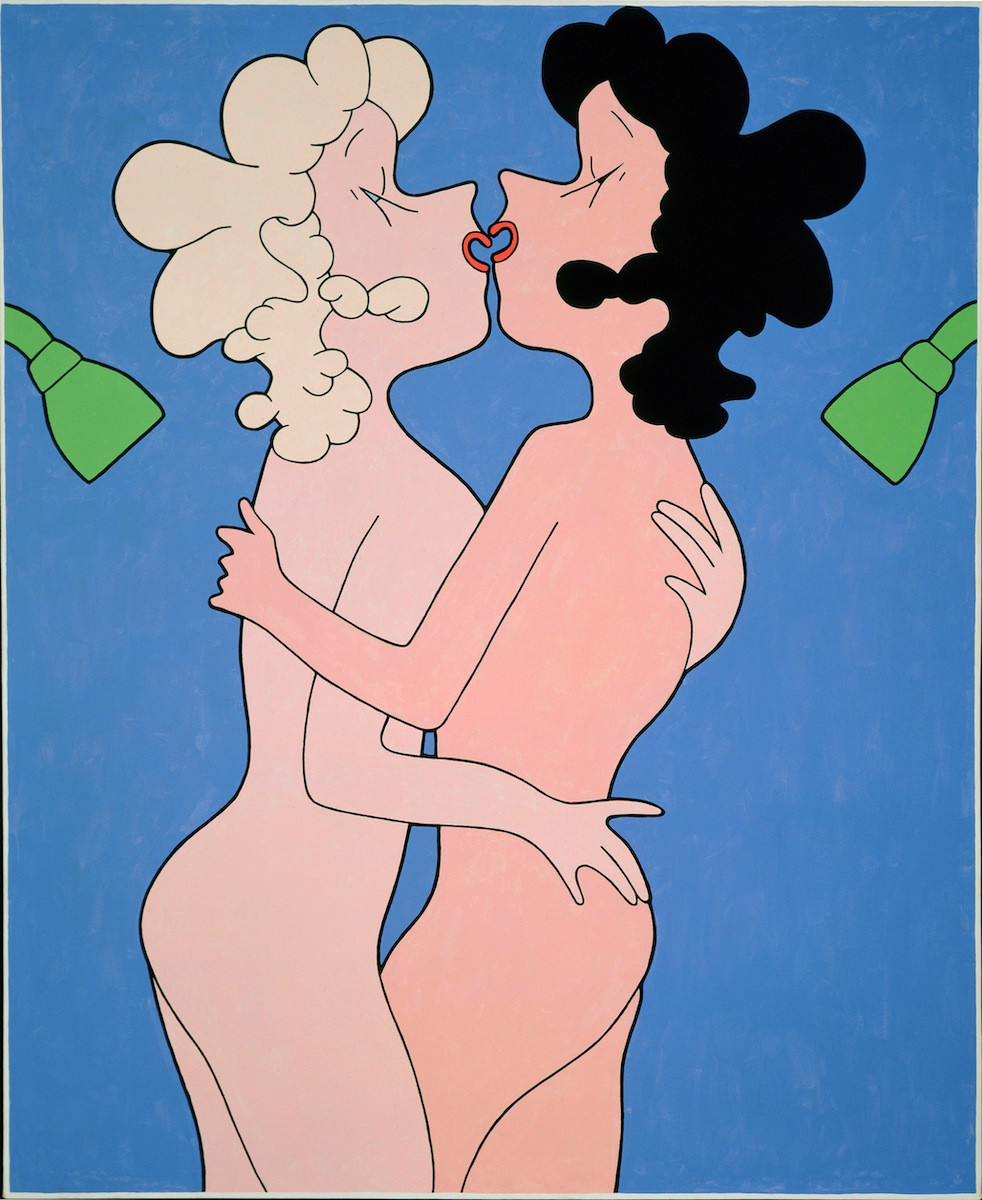
First Kiss: Blondie Bumstead and Ynes Sanchez (1991) depicts Blondie and her fictional neighbor Ynez, nude, embracing in the shower, about to lock lips.
Bumstead Out the Window (2000) is a painting of the tortured husband apparently leaping to his death, a smile on his face, a twisted update on Yves Klein’s Leap into the Void.
Bumstead and Dead Geisha (2006) depicts Bumstead looking blankly over the shoulder of his apparent sexual companion, a paper-white, dead Geisha.
These images find their origin in what were called “Tijuana Bibles”, dirty comic books produced between the end of the 1920’s and the beginning of the 1940’s. Comic books made in small patches, eight pages long, wherein innocent characters from popular cartoons were thrust into prurient, pornographic scenarios. But the sex in these paintings of the Dagwood family is never tittilating, only troubling, and mostly always frustrated. This is the genius of Wesley’s appropriation of the family; the Dagwoods become proxies for the average American couple. Sex plays a small part in the work, and only in service of the overarching theme; psychological unease. In this way, Wesley turned fan-fiction into high art. The true perversity lies not in the sexual element but in the perverting of the sexual element.
He draws us in with the appearance of some naughty transfiguration only to show us ourselves, rendered flatly, dumbly, in Easter colors, our entertainment media accusing rather than amusing us. At first the familiarity evokes laughter, but soon the uncanniness evokes tears.
No art is more successful than that which can make you both laugh and cry, either at once or in alternation.
Wesley has a connection to Karen Kilimnik, another outlier who resists categorization, and who co-opts figures from culture and history to further her own personal world-making. Leonardo DiCaprio becomes a prince while some supermodel, a suffering Russian princess. Wesley in some ways painted science-fiction, or at the least, speculative fiction. What if, instead of the Dagwood family freezing when we close the newspaper, they continued on with their lives, argued over affection or housework, the reciprocation of orgasms, who was pulling their weight in disciplining the kids?
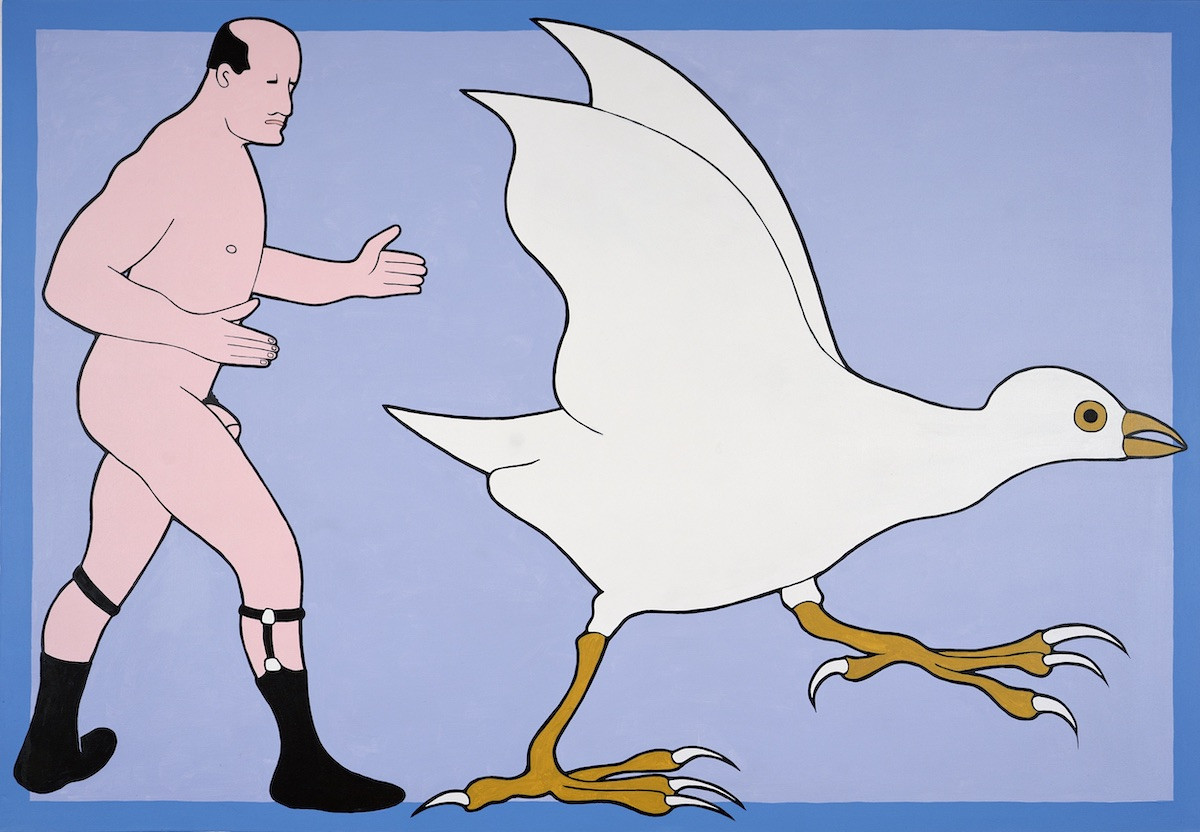
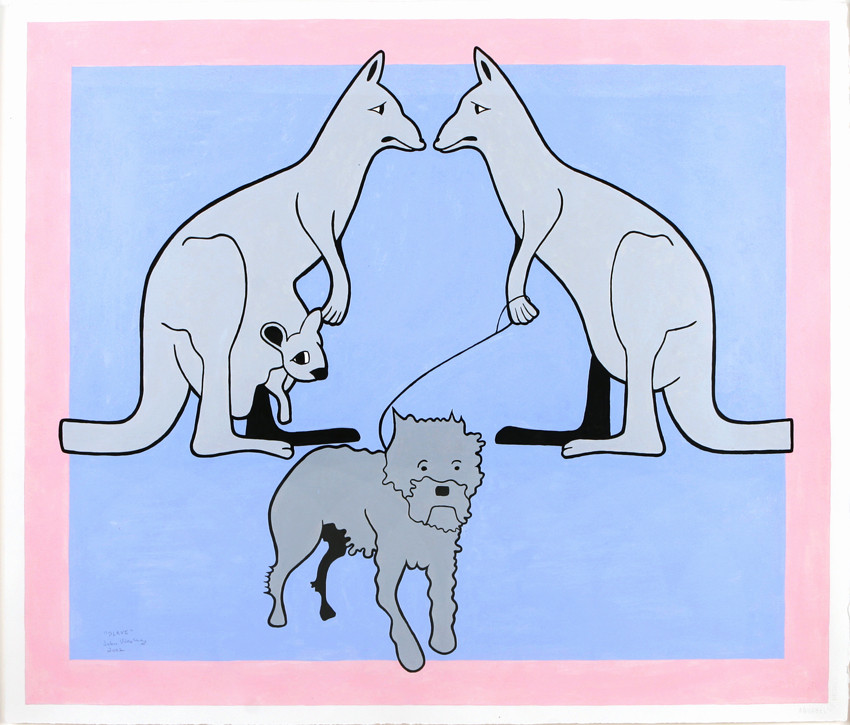
This is but a fraction of Wesley’s output, and in no way the most discomfiting. Common throughout his paintings are depictions of nude women, nude men and nude children in comminglement, alone, or as often was the case, with animals. In one painting (Rabbits, 1968) a woman lays on her back, giving birth to a rabbit, the seventh in a litter of which six have already assumed a patterned formation. In another painting (Birthday, 1990) a Disney type duck is giving birth to what appears to be a fully formed human leg. In Leda & The Man (1972) a man, naked save braces, chases after the mythological swan. Certainly there are nude women, but there are also nude men, nude bears, nude elephants. Beyond the social order, the very order of nature is shattered. Camels are accosted by horse-human hybrids (Camel, 1966) and kangaroo’s keep dogs as pets (Slave, 1971). Wesley’s work is not about shock however, this would be a mistaken reading. Instead his work is about taboo, and particularly about fetish. He was mistakenly considered a Pop Artist, but really wasn’t, and was mistakenly considered a Minimalist, but really wasn’t that either. John Wesley was uncategorizable, uncharted and unapologetic, and therefore unmistakably American, in the greatest of ways.
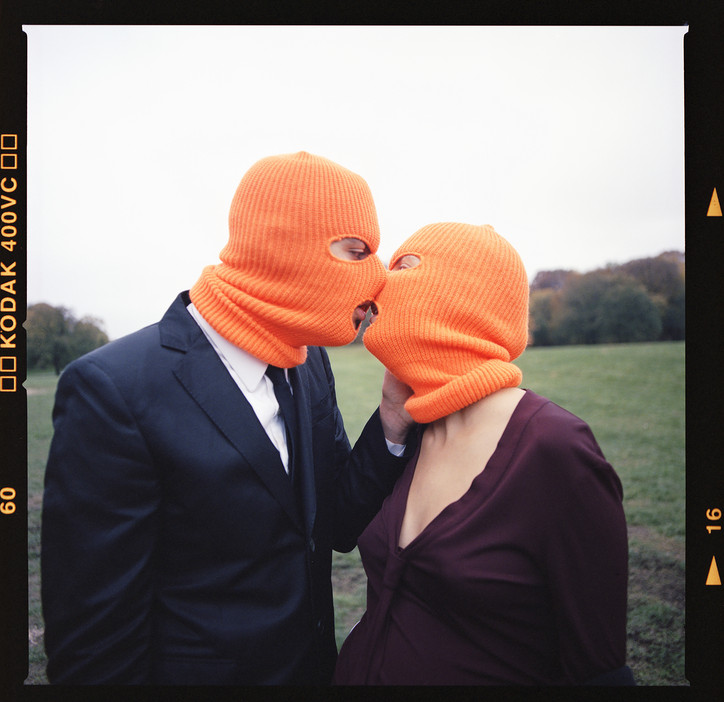
I admit to being an artist more interested in content than form. Amongst Wesley’s greatest supporters were the seminal Minimalists Donald Judd and Dan Flavin. Certainly they were correct in admiring his work, with it’s super limited palette, its obsession with flatness and an almost claustrophobic perspective, so that when looking at one of Wesley’s paintings one gets the sense of drowning within it. Such is his work that I’m too enamored of the subject to also praise his technique, which is clearly praisable, but also outside my area of expertise.
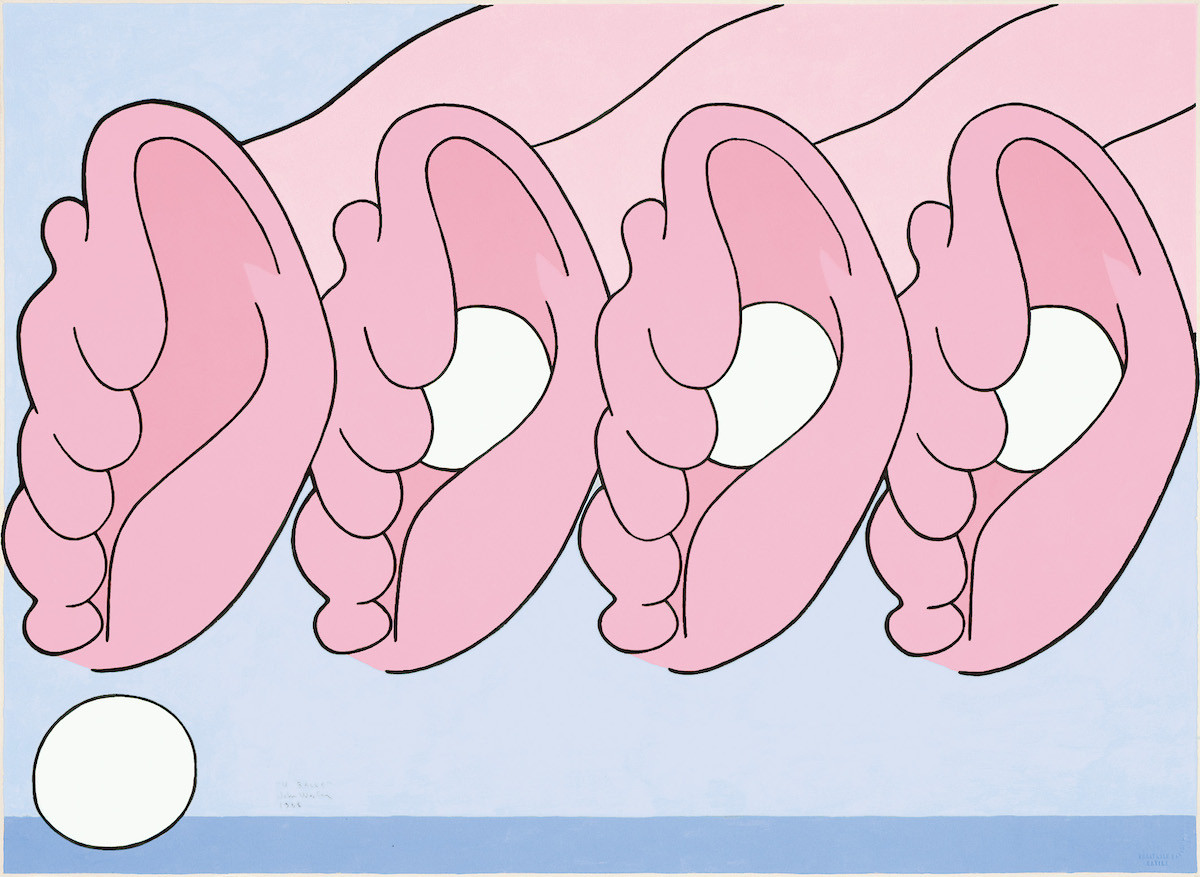
In Wesley’s paintings you see figures morph into shapes, or the limbs of figures at least, that sometimes evoke Robert Gober’s ultra-spooky disembodied limbs, trapped in and calling out from the most abject of locales. In his obsession with pattern and gift for turning anthropomorphism into abstraction, one single painting predicts the entire body of work of painter Inka Essenhigh (Four Balls, 1989).
I’ve never seen paintings as creepy as Wesley’s.
I’ve never seen paintings as funny as Wesley’s.
I’ve never seen paintings that look like Wesley’s, and the sign of a rare, singular talent, is that nobody even bothers attempting to mimic it.
While writing this, I did make a connection to someone whose paintings feel obliquely like Wesley’s, whose paintings also on occasion turn human limbs into animal shapes, turn animal shapes into abstractions, then turn abstractions back into shattered, horrified human limbs: Francis Bacon. Bacon and Wesley, both with the post-Hiroshima/post-Auschwitz vibe, depict creatures bursting with the awful awareness that we as a species can inflict the uninflictable on our own kind. Bacon did it with screaming popes. Wesley did it with the wide, flat face of Donald Duck, his mouth stuffed to capacity with svelte female legs (Gluttony, 1969).
John Wesley was also punk rock, The Ramones to Bacon’s Sex Pistols. He possessed the quintessential American frontiersman attitude, was a world-maker and shaper. He consumed the media of his youth, digested it, dreamt it, then spit it back into the culture, a body of work as chimeric American unease. All of it cut with a certain punk rock ‘fuck you’, a smiling ‘the fuck if I care what you think’, which ultimately is necessary for the creation of any art of lasting value.
John Wesley is gone. Long live John Wesley.

Exploring their Latin American heritage and the relationships and moments that have shaped each artist, “Aqux” provides relief, acknowledging one’s multilayered identity. Informed by the newly adopted inclusive term, Latinx, which has held much debate, “Aqux” is a visual meditation on histories that are not merely rooted in a specific place. Emphasizing the power of divergence, César García-Alvarez offers insight into the dynamics of home.
The artists include; Marcel Alcalá, Tiffany Alfonseca, Susan Aparicio, Felipe Baeza, Chris Cortez, Gloria Galvez, James F. Garcia, Jay Lynn Gomez, M.A. Guevara, Elizabeth Ibarra, Anabel Juárez, Mark McKnight, Star Montana, Jaime Muñoz, Esteban Ramón Pérez, Edgar Ramirez, Lily Ramirez, Fay Ray, José Guadalupe Sánchez III, Eduardo Sarabia, Claudia V. Solórzano, Ken Taylor, and Raelis Vasquez.