PRESENTE CONTINUO: the intimate ties between then&now

Starting May 30, PRESENTE CONTINUO will be available to purchase on presentecontinuo.com, cpcompany.com, and at the C.P. Company flagship store in Milan, Corso Matteotti 7.
Stay informed on our latest news!

Starting May 30, PRESENTE CONTINUO will be available to purchase on presentecontinuo.com, cpcompany.com, and at the C.P. Company flagship store in Milan, Corso Matteotti 7.

These feel driven by narrative, almost like illustrations to a children’s story. What kind of story are they narrating?
The story of the little boy who got lost in the forest and ate the wrong mushroom. I don't know really what story is being told. In my sketchbooks I make random images without really thinking much about them, then later I go back and find if there's anything worth developing further. I don't have any kind of agenda or goal. I just try to stay spontaneous trusting my intuitions. I noticed very early as an artist that I was attracted to images in my own work that suggested a before and after and I thought it was good that the person viewing the image would figure out for themselves the before and after.
What is your experience with the occult?
Occult practices themselves seem to me, from the outside, to be kind of sad and prosaic. But in the old days, it was just another kind of religious practice, or really thousands of little religions. I am more attracted to the Christian view of the occult, which is so romantic and exotic. It's kind of like in those old paintings of heaven and hell — hell is always the great part of the painting. The heaven scene is pale and boring. You can tell the artist is having so much fun depicting the fire and torture and screaming, all the hallucinatory animals with their tongues hanging out. Some evangelical Christians in the 1980s displayed their own romantic imaginations during what was later called ‘the Satanic Panic.’ I'm fascinated by the ‘Satanic Panic.’ Pizzagate is the latest version of this phenomenon.
Is art modernity’s religion?
I remember the essay by Tom Wolfe on that subject. Religion seems to be necessary for us humans to create meaning out of our chaotic existence. But that meaning tends to become rigid, and I think art can challenge those rigid structures so we can adapt as time goes on. Mike Kelley said, "The purpose of art is to fuck things up,” and I like this idea.


Above: 'All of Me (Version 2)' and 'Buddies'
When you sit down to work on a piece, what do you turn to? What informs you?
For me, the mood is the main thing. I find that music sometimes helps to maintain a particular mood. There was one painting recently I was working on, "All of me – version two”, where I had to listen to Rimsky-Korsakov in order to paint the painting. After I was done, I never had the desire to listen to his music again.
There’s a sense of horror to these pictures, which I love. Why do we love horror so much, do you think?
I guess I don't think of my paintings having a horror element, but I see what you mean. I am interested in Gothic horror. There's something scary about the past, a fear of old things.
Would you rather live in a sci-fi world or a fantasy world?
I might prefer to live in a pre-1960s sci-fi world. I love the old science fiction pulp magazine covers which usually were graced by scantily clad space girls who occupied that universe. I don't think I'd want to live in a fantasy world. I already live in one, where all women find me attractive and fame and fortune are just around the corner.


Above: 'Kiss of Kalli' and 'Adam Eve'
Women have a special power in your pictures — where does this power come from? How does it manifest?
I am attracted to women, and desire is one of my main motivations for making art. Desire is an interesting territory: full of tension and dynamic contrasts. I am not interested in painting images of happy endings.
Are the men in your work schmucks? If so, why?
I like to think of them more as comic figures — like the old burlesque comic in baggy pants doing a routine with a beautiful showgirl. His buffoonery only enhances her loveliness. I always identified with those old comedians, Like Lou Costello, Charlie Chaplin, they weren't only pathetic, they were also likable, so the audience could identify with them, see themselves and laugh at their own situation.
If you could illustrate a classic piece of literature, which would it be?
The Grimm brothers’ fairytales. My artwork is informed by folktales, anyway, especially those of the brothers Grimm. When I was very young, I read "The Uses Of Enchantment" by Bruno Bethlehem. He describes how children and adults respond to these simple and dramatic stories as metaphors for their own experiences. After reading that book I read every collection of folktales I could find. It had a big influence on me and the way I think about storytelling.
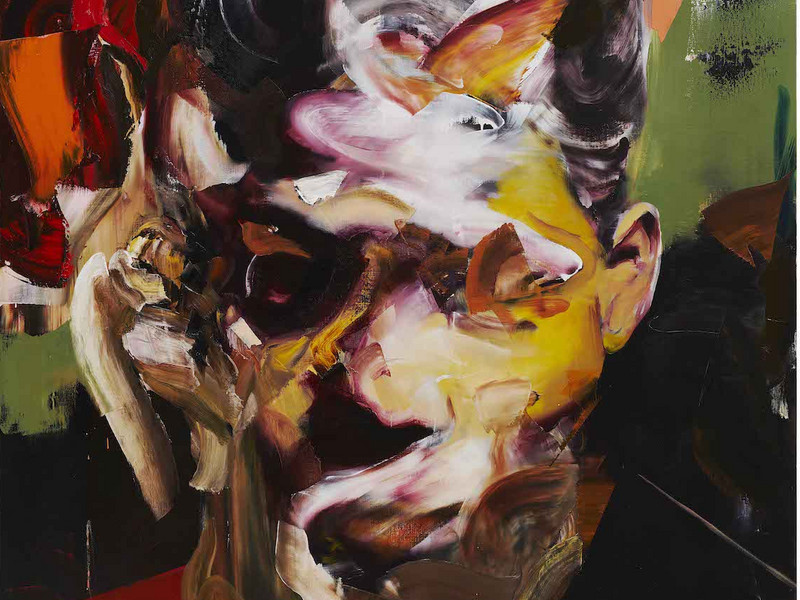
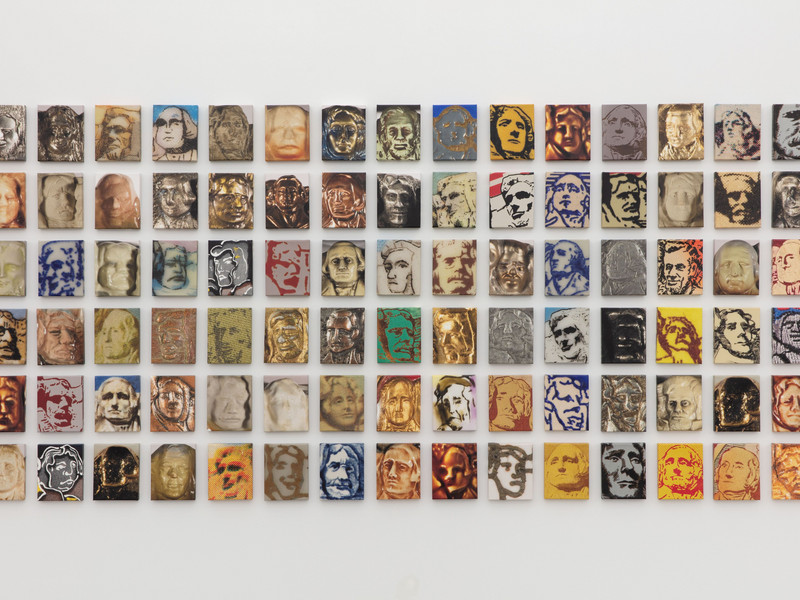
'The Witching Hour' is on view at Fortnight Institute through April 26, 2019. All images courtesy the gallery. Lead image: 'Manson's Head'

Alannah attended Cooper Union but not for painting, for photography--it was her teenage modeling years that sparked an interest in digital art, a creative realm that teaches the importance of lighting and technique. With this formalist approach to craft, young Alannah evolved into a modern Old Master.
The primordial piece of “Worlds Without Rooms” at The Painting Center hangs to the right of the still-lifes, depicting Jared Oppenheim. Her subject lies half nude, with shirt unbuttoned, on their shared bed. Banana, a tuxedo feline, accompanies Alannah’s partner. Jared’s feet and socks are noticeably greyscaled. In fact, many of these paintings possess this tonal quality. “I start all of my paintings in grisaille... and then, I add color over it.” This technique allows Alannah to play with mood, inviting us into her “invented rooms.”
Alannah’s preference for painting portraits in landscape format is informed by her lineage. Both of her parents were artists: her mom is a Hudson School acolyte. These portraits of Alannah’s friends — fellow East Village natives — tell tales of melancholia and contemplation. A signature piece titled, “Sanctuary (Magdalena)” features a young Polish girl lounging in her bedroom. What actually caught my eye, though, was not the quiet strength on the woman’s face, but the unfinished hand on the thigh. Wide ethereal strokes fade into light. “She actually wore long, silver acrylics” speckled with glitter. Alannah’s initial draft featured realistic fingers, but the nails drew too much attention away from her face. The final product is intimate and soft.


Above: 'Avenue B (Marie)' and 'J&B.'
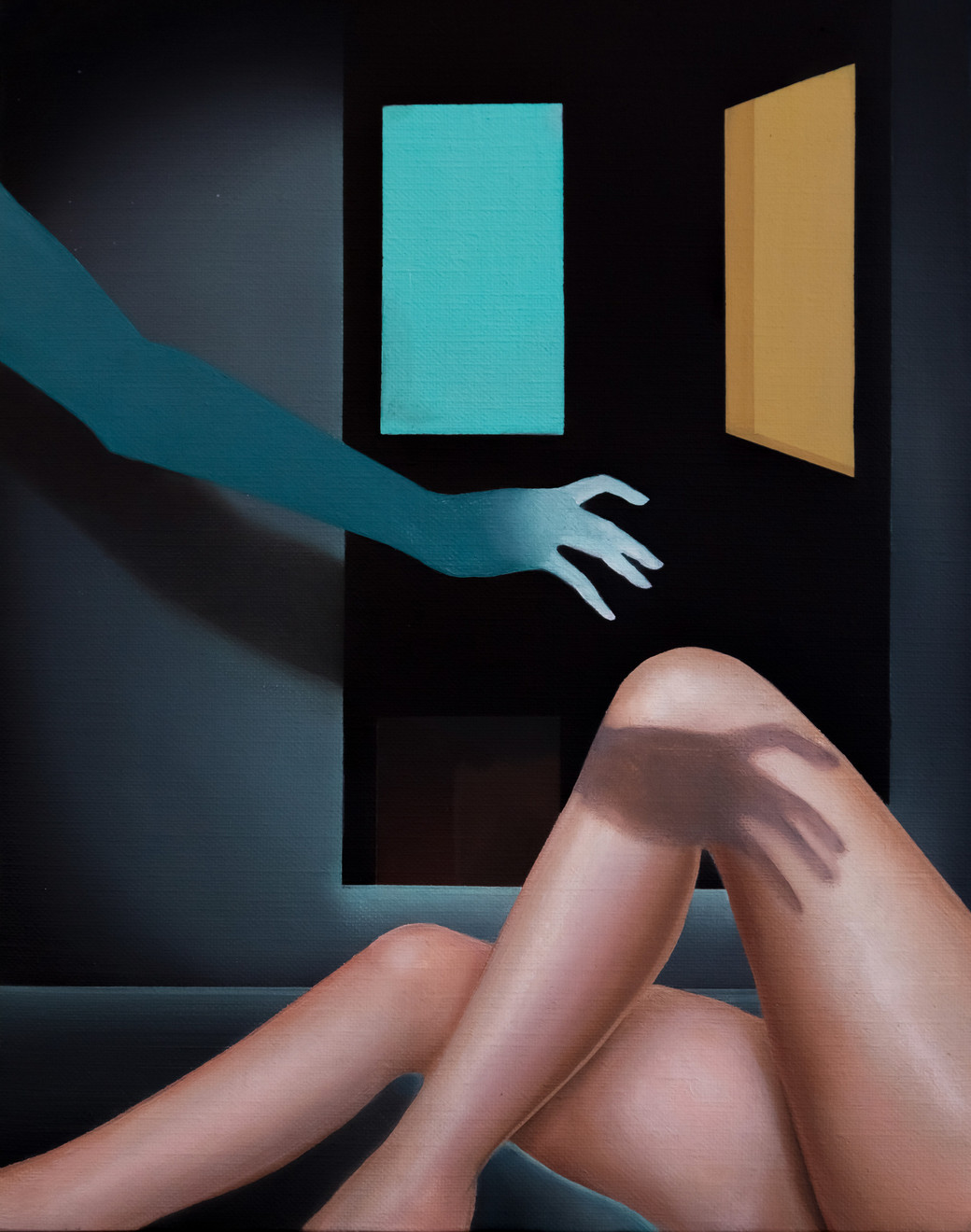
Another highlight of the show illustrates Alannah’s history with sleep paralysis. Surveyors get an intimate view as a shadowed arm reaches for Alannah’s legs, which recoil. With green walls, the supernatural element adds humour — something she, and I, both recognized, whereas others only know fear. I wondered if she was a spiritual person: she is not, but Alannah does compare her artistry to alchemy. From there, we touch upon mental illness. “Sometimes it feels like I might have a mild form of schizophrenia.” (It runs in the family). Positioned next to “Sleep Paralysis” is a green portrait of a woman in green glasses, dress, backdrop. The verdant schema can only be contextualized if you know Alannah’s familial history. It is an homage to her uncle’s portrait that looms in her childhood home.
But Alannah doesn’t want to tell you how to interpret the work — her work ...or any work. I asked her why there was no wall text; and what she wanted the audience to extract from this show. “Art is a visual medium — and you shouldn’t have to be literate to enjoy it.” She notes how classist write-ups (and the art world, at large) can be. Opened from March 28 through April 20, 2019, hers is an egalitarian solo show. Alannah Farrell is more than just a visual artist — she is a vanguard for human emotion. And as for painting... it never died: only evolved.
Worlds Without Rooms: Works by Alannah Farrell will be on view at The Painting Center through April 20, 2019. All images courtesy the gallery. Lead image: '2 Gold Steet.'

Tell me about the show and your work.
The exhibition is called ‘Stay Fly’ and it is the second iteration of this idea. I had a solo show at the Kravets Wehby Gallery last April, which was called ‘Fly Girl Fly.’ Basically, this series of exhibitions is about me examining — they are autobiographical so they talk a little about me but mainly about the women in my family through the analysis of fashion. So for this exhibition, it opened with a series of photographs that I borrowed from my mother’s photo album which featured her in her life here in the ‘60s and ‘70s. And I had those pieces, not juxtaposed, but included with images of me when I was in high school as a teenager living in Detroit. So it was this installation on the wall of a generational dialogue about me mirroring my mother. There’s one photograph of my mother in her fur coat, and there’s another photograph of me playing dress up in that coat and one of her wigs. So you walk through the exhibition, there’s an installation where I utilize clothing from my personal collection, but also from a local entrepreneur, activist, and boutique owner. She had this amazing collection of vintage 90s-era, logo-heavy clothing, so I borrowed pieces that were very reminiscent of the 90s and pieces that my mother would have worn.
So were you a teenager in the 90s?
Yes. I graduated in 2000, so I am the first millennial I guess. I’m from Detroit, born and raised. It was probably a blend of low and middle-class families. The area I lived in was low in the economic level, but when you looked around, people were dressed to the nines. When I was in high school, and I went to one of the bad high schools, it was also known as the ‘runway show.’ So it’s a very interesting phenomenon, of us having this low economic status but we still prided ourselves in how we dressed. My mother had a very interesting life full of strife, but she used fashion as a mechanism to cope. Essentially, this exhibition is about how fashion has become political, and when you examine black culture within the historical context of America, we know that this is a very tumultuous history. All the way from the earliest photo, people were dressed really well.
I’m in this class right now called ‘The Baroque and Neo-Baroque,’ and the argument is that the Neo-Baroque is sort of the black culture borrowing from old European ideas of aristocratic flashiness. It’s very interesting, and the teacher mentioned in class exactly what you’re talking about, this runway aspect of everyday life. Do you feel you are playing into that, or does that speak to you at all?
I do, but I want to take it a step further because I think there is this notion where, in looking at American history, that we relegated to Europeans. And of course, when we look at these photos, there’s clearly this appropriation of European style.
Which is inevitable.
Right, thank you colonization! But what I want to argue is that even pre-colonization, that was always a part of who we were. I am part indigenous American — my family is Muscogee and Choctaw with a little bit of Cherokee, and that’s part of who we are.


It’s also a thing in black culture, and it almost feels innate in a way.
I think it is definitely innate. I’ve been really closely examining fashion the past couple of years, and I have friends who grew up really poverty stricken. Like my family was very poor, but my shoes — I would have some Jordans that would take care of them like they were the second coming of Christ. And you have these arguments around respectability when it comes to black indigenous bodies, and talking about “Oh you shouldn’t waste your money on that” or “You should invest in something more meaningful” and Bill Cosby was really notorious for this. From my recollection, he went on this ‘respectability’ tour around America. So there’s this conversation of “You shouldn’t own these type of things because you’re too poor,” and my thing is why not? Now we have politicians like Alexandria Ocasio-Cortez, and these conversations emerge again because she has very socialist ideas. You have these politicians and you’re like “Oh, she has a pretty expensive suit on, what’s that all about?”
It reminds me of an old idea that all your wealth is on your person, so you can be mobile in a way. Like, yeah, your shoes are valuable, but you could sell them at any minute. So in a way, you are wearing your bank account. Like in Indian society, investing in gold jewelry is a big cultural trend.
I need to sit on that for a minute. Because even if I am not being able to invest in an education fund because I am making $8 an hour, these shoes are more attainable.
They are tangible.
They are very tangible. So I’ve been really examining that and I’ve been creating work around these ideas with colorful collages. I don’t know if you’re familiar with the Midwest, but Chicago, Detroit and Harlem are firstly known for their gaudy style, like you got your lime green suit with your lime green car. It’s a real thing - matching your clothes with your car! It’s one of those things as a person of color when you have this sort of upward mobility. I moved away from Detroit and now I’m now in a different socioeconomic class, and you kind of forget about your past or sweep it under the rug. Like, “I remember those days and those people,” but that is a part of the culture and the Americana history. I want to really embrace that, and my works are really gaudy. They are really hyper-layered and that’s really an ode to that culture that I grew up in.
It’s very interesting that you used the word ‘gaudy’ to describe your own work, because it’s the last thing you want to be in a way. But also you do want to be gaudy - from within the culture it’s almost like gaudiness is a good thing.
I think it depends on where you are. For example, Washington D.C. is very conservative, but then you go to Harlem or Detroit and you have the big hairstyles and long nails. I hate to use the term - you know what, actually I’m okay with using the word ‘ghetto’ because I think we need to subvert that term.
Like ghetto fabulous.
Yes, it’s very ghetto fabulous. And I think that it’s very avant-garde and part of who we are culturally. We tend to not be as ‘ghetto fabulous’ when we are occupying certain workspaces, but that part is always there and I want to celebrate that!
Right, it’s like you’re going back to your origins.
That’s exactly what’s happening! I’m going to spend the next couple of years on this topic I think.
How do you dress now?
Oh, I am so conservative now, it’s so disgusting. I’ve been a teacher for the past 13 years and I just left education to do art full-time. So what’s fascinating about that is the second I left the classroom, I felt like I could finally be me again. Deep down inside, I’m a pretty ratchet girl.
Yeah, I always wonder, what is your job? Like where do you work walking around like that?
Exactly! That’s a very good question!
I mean you have to be working, you can’t live in NYC and not work.
You know what, it’s so funny but you see these women who are working maybe desk jobs or blue collar jobs, but their hair and nails are done to the nines even when they are wearing their uniforms. Even teachers. And the nails! I have always wanted to wear nails, and in my drawings, my girls’ can have on these cat claws. But because I’m an artist and I’m always washing my hands, I sadly can’t do it, I need my hands. But, it is such a mood! I love it!


It’s so interesting, I actually work as a hairdresser and I just started this job where I primarily work with black girls and they all have their nails done, and I wonder how are you running your hands through so much hair without losing a nail? I just don’t know how you live your life in those things!
Definitely, and I would say that is a very Black-Americana thing.
It’s an art form.
It is an art form in itself. I’ve had many family members or just people I see who may not have as much, but it’s nice to see them still priding themselves in how they look. And they should. I can invest in this, and again I think you have that respectability aspect of it too. But at the end of the day, it’s just like “Do you sis!”
I wonder how much of it is connected to self-esteem and joy, or the aesthetics of yourself? You could be poor, but at the end of the day at least you could look good and feel good about yourself.
I also think that it is about having freedom and agency within your body. Luxury to me is about agency. If you look at an urban area, like Detroit, it is the complete opposite of whiteness. Of course certain things are appropriated into mainstream culture, however that is very important because it insinuates a sense of protest. There is something very radical about being able to occupy certain spaces, for example with your hair or nails. It’s protest, and it’s about being unapologetic about your existence. Sure we assimilate, because that’s part of life, but I respect the people who just give zero fucks about it.
It’s a very weird, touchy area. I feel there is such a thing as white culture and black culture, and they exist next to each other, but are not necessarily working together and everyone is okay with it, in a way. It’s okay, but it also feels weirdly not okay to acknowledge it.
Exactly, I think so. I lived in the suburbs of Washington D.C., and at a lot of events that my children would attend, they would be the minority because it is predominantly white and Asian. My son had a concert, and a young man asked him if he had khaki dress pants but called them a different word, and I had to Google it. We were both baffled why we hadn’t heard the word before, but I told my son that it’s just language. Another example is that in black culture we say ‘triflin’’ like, “Oh, you’re triflin’!” And I was working with this guy and he was like, “What is triflin’, I’ve never heard that word before.” It was very funny. And I think this language difference translates back to the fashion component as an interesting line. Especially with black elders, they understand the importance of assimilation and respectability within a culture, for example with dreads. Even with the hairstyles my girls are wearing - those are very Black Americana hairstyles - it’s an ode to that culture of being who you are and being able to celebrate it with agency.
Something I’ve noticed living in NYC is that many high-fashion designers seem like they just walked around Harlem and just pulled from what they see on the streets. It’s so weird how these looks are characterized as “low culture,” yet these designers pull them into high culture and it becomes very confusing on where a style even originated from.
Well, you have Dapper Dan, who was this guy from Harlem in the ‘80s who would take Gucci patterns and would make them really ‘ghetto fabulous’ and hook it up. He would take luxury fashion and make it even more luxe. He had all these beautiful pieces he made for rappers and celebrities. But they cracked down on him and shut down his shop. However, two years ago, Gucci took one of his ideas and put it on the catwalk. Twitter went crazy, and Gucci hired him to work for them, and now he does.
That is so good!
Also, Google “ghetto prom dresses.” There’s this huge thing in the Midwest for customization, which was really big when black people migrated to big urban areas and received these jobs, and it was the first time we were really able to participate in the middle class. But we weren’t allowed to shop at those stores, so we would have to remake our own pieces. That’s how customization became such a big thing. I was a prom dress designer while I was in high school, so I was designing these ghetto prom dresses that were pretty much haute couture.
So you sew and know how to make clothes?
I do not, I would just design them and take them to a seamstress.
That sounds like a super intelligent life hack!
It is! But now we also have to talk about the bootlegger within the community. There are a couple types of bootleggers - I had friend who’s father would go to China, purchase a lot of knock-off designer handbags and then resell them. But then there are also those who would just have really bad knock-offs or steal them. But the role of the bootlegger within urban communities was a very major role. Still, look at “Sex in the City” - everyone is wearing bootlegged things. We’re not immune to it. But within the hood, it became really important to have access to this ‘luxury.’ It’s very fascinating and convoluted. Now that I left teaching, I’m really getting fresh, and when I go back to the hood, I love it because black people are like “I see you sis!” But I feel like when a white person notices, they’re just like “Okay, cool.”
'Stay Fly' is on view at CulturalDC through April 13th.