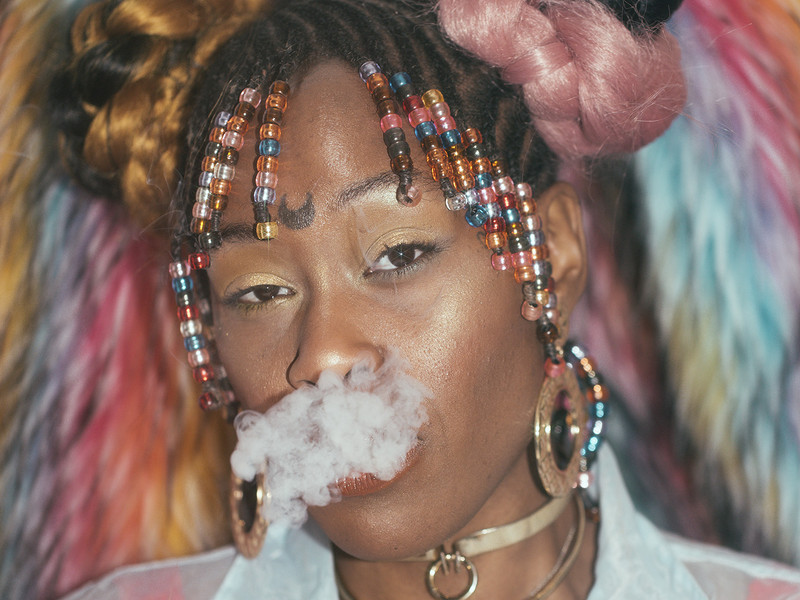
Hi! So Yndi, tell me where you’re from.
Right now, I’m in Paris, where I live and work, and where I was born. Right now it’s kind of weird with COVID and everything. I grew up here. My parents are Brazillian, so my house was a pretty typical Brazillian household. I grew up here and I never lived in Brazillian. I’ve been a lot of times but I’ve always studied here and worked here.
You have an LP coming out soon, Noir Brésil, the first under your new moniker. Why the name switch?
I used to work with the moniker Dream Koala. This album is pretty much the first thing I’m doing with my real name - Yndi. I felt like I put so much of myself into it and it was so intimate and I didn’t want to use another moniker because I felt like it wouldn’t feel natural.
I get that. What was the process of making Noir Brésil?
Honestly it was very personal. At first, I kind of always wanted to make an LP but I felt like everything I was making worked with three or five songs but not thirteen or on a longer project. The moment I found something I’d really like to explore for this long of a project was when I first started writing in French.
I used to write in English, my songs before. Since it’s not my first language, I felt like switching to French helped me to get deeper on what I felt and what I was writing. Also, I spent five years on this album. So it’s been a lot of work. Five years ago was a moment where I was talking a lot with my mother and grandmother and we had a lot of discussions about their upbringing and the differences between our generations and between Brazil and Europe. Talking about this made a lot of my memories come up with music and things linked to Brazil. It was a moment I realized even if I was born here, in Paris, I will never be considered as a French person by other French people. I wanted to put in my music everything I could that I got inspired from Brazillian music. I didn’t want to copy other Brazillian artists but translate that in my own way. It’s not traditional Brazillian music but it has a lot of percussion and rhythm, and some lyrics in Portuguese, too.
Right. This project really represents who you are. You’re speaking in both French and Portuguese. It’s a fusion of both your identities. What imaginary physical landscape is your music and your sound creating?
If my music was a landscape, it would be something like… My girlfriend showed me videos from Patagonia a few days ago. She told me it was a place with the most differentiated landscape. You have volcanoes, then fields, and rocks… I think it would be a really tiny place with a lot of different kinds of landscapes. Volcano, forrest… Not really a realistic landscape. It would be a collage.
Like a magical oasis.
Yes, like an island. With a volcano, because I love volcanoes.
I wish I could visit there. How would you describe your sound, and how has it changed over the years?
What changed a lot is that at first, I had seen myself as a producer. I was into the production. With time, I became more comfortable with working as a singer and songwriter and adding my producing skills to that. Rather than thinking of production before anything else. It took a long time. It wasn’t overnight. With experiences and working with other people… From my previous projects, I used to produce and do everything on my own. On this album I worked with other people, like this French producer Superpoze. We worked together and he co-produced this album. I also worked with some percussionists, Brazillian percussionists. And a pianist. My first time recording other people and collaborating this much with others. It has been really fulfilling. It’s like you can take the best parts of different people and put it in one project. It was really cool to work this way.
I also didn’t necessarily use a lot of Brazillian sounds in my work before. It’s the first time I’ve made a project where that’s at the forefront. You can’t listen to the album without realizing that. It has been really life changing. The language change, the sound change, the process change…
The sound changed, but also your creative process really changed. It morphed and it grew. You still use your knowledge and experience in your past work to inform your new work.
Yeah, it’s that. I feel like this album and how I’m working right now, if I didn’t spend five years of my life only being a producer before, I wouldn’t be able to do that. There is something in the industry about… a separation between who produces the music and who sings and who writes. When you hear someone who is there during the production process, I think you can hear it in the album. Bjork is a good example. I think Solange also.
Those albums, you can definitely hear that it’s one person. Both ways can make beautiful music, but I think there’s something more personal and unique to production when you are part of it yourself. I was lucky on this album to know how to produce, but I also had a co-producer, so I could step back when I wanted to. It was really fluid and cool. One time we were both working on the same track in different rooms on different computers at the same time. Then after, we joined together and compared and combined the two sessions.
I agree with you that you can tell when an artist is involved in all areas of the creation of their work because it creates a more cohesive or holistic concept and picture. What themes are you exploring in Noir Brésil?
My biggest fear with the album was to have like three singles and all the other songs are like other versions of those tracks. That is my worst fear to make an album like that. So I really wanted each track to have its own little world, it’s own little universe.
To stand on its own.
Exactly. "Noir Brésil" is really a track about people of Afro descent today and a poem to my ancestors. In Brazil, we really talk a lot and connect a lot with our ancestors. In a religious way, but also in a mundane way. In the way we talk and do things. You always have to not only respect, but pay homage to your ancestors. It’s really present in the culture, especially in music and all that. I feel a large duty to keep the history of our ancestors to protect it. Some other songs can be more about childhood memories, some are also about me questioning my faith, spiritual things. Some are more melancholy and about depression. Each song has its own little cell. It’s difficult to say what is common between the lyrics. The sounds have connections, but the lyrics, they’re all different.
When we were making the album, at first, I was scared the first track would cut you in the album. But now I feel like I like it. You can listen to it three tracks by three tracks. You don’t necessarily listen to all of it. You can be like, I’m only in the mood to listen to this part of the album, and then you only listen to that part and it’s okay.
I don’t consider that the album is a “fail” if you don’t listen to it all together. What really helped me to understand that was Frank Ocean’s Blonde. It’s one of my favorite albums ever. In that album, I never listen to it in its entirety. I only listen to the end, or the middle, or the beginning. It feels so good to know the part of the album you want to listen to. You’re in control as a listener. I wanted the same feel for my album.
Some parts have heavier rhythms and are more produced, some parts it’s only guitar and voice… really soft, and all of that kind of follows each other.