At The Circus

Oh and the peacock feathered suit was killer. See it, and our other favorite looks from backstage at the presentation, below.
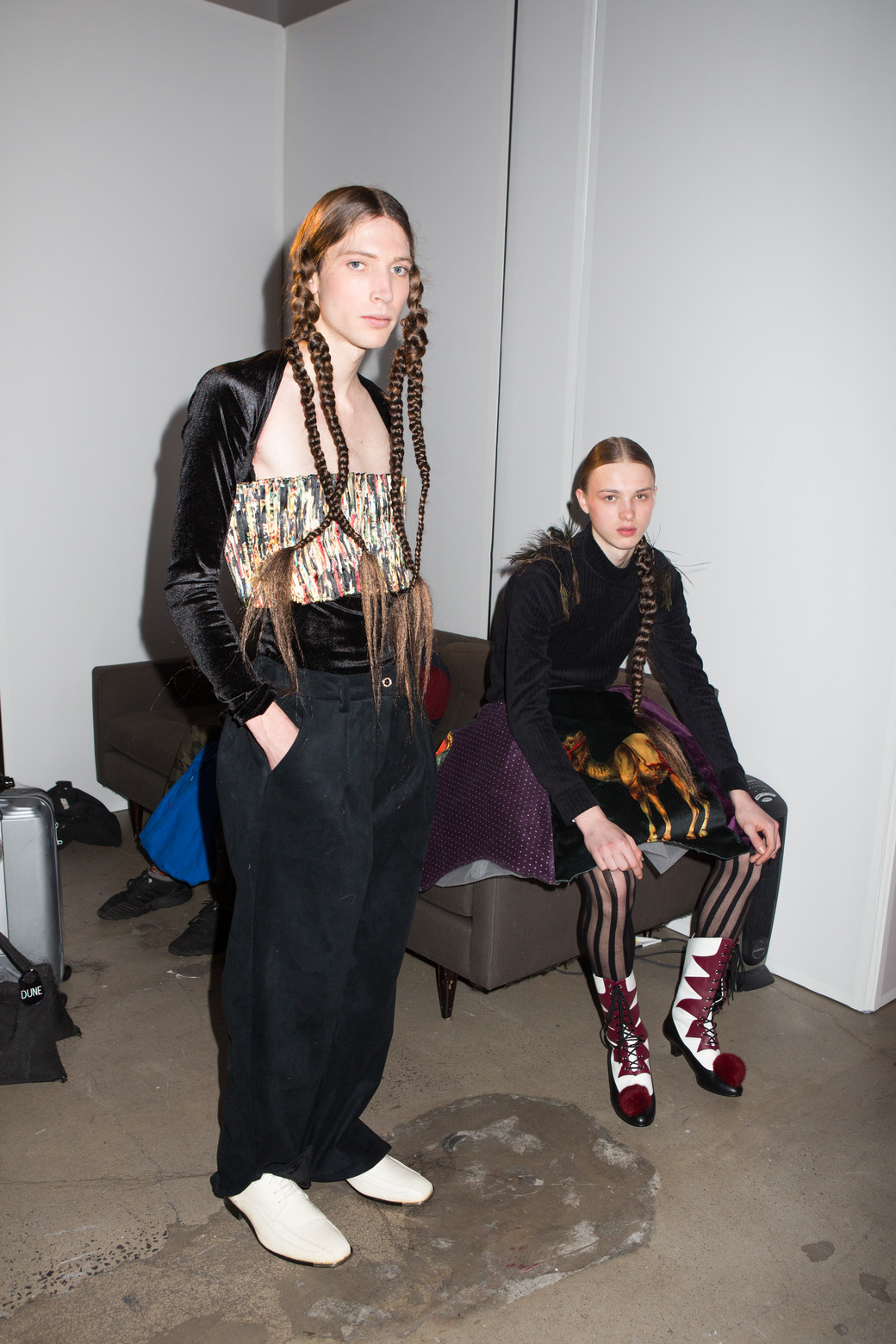
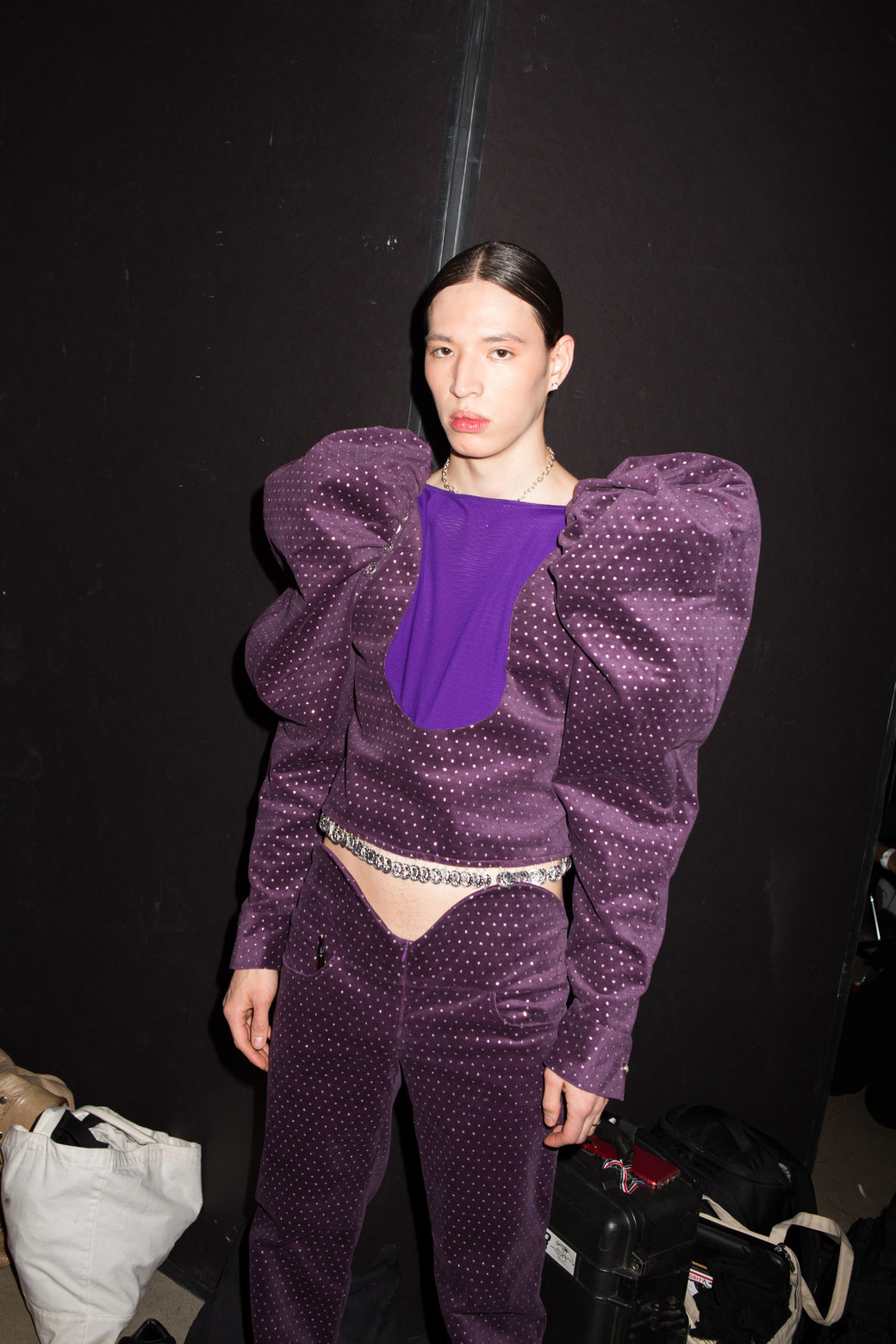


Oh and the peacock feathered suit was killer. See it, and our other favorite looks from backstage at the presentation, below.

We believe there were a few Milan designers that deserve an equally bright spotlight, and they have been mulling in my macchiato-fueled mind since I saw and spoke with them.
This is our roundup of Milan Fashion Week. We hope you dig a little deeper with us into the designers and creative directors shaping the next generation of garments, and get a little something you haven't gotten already from the Spring/Summer 2023 season.

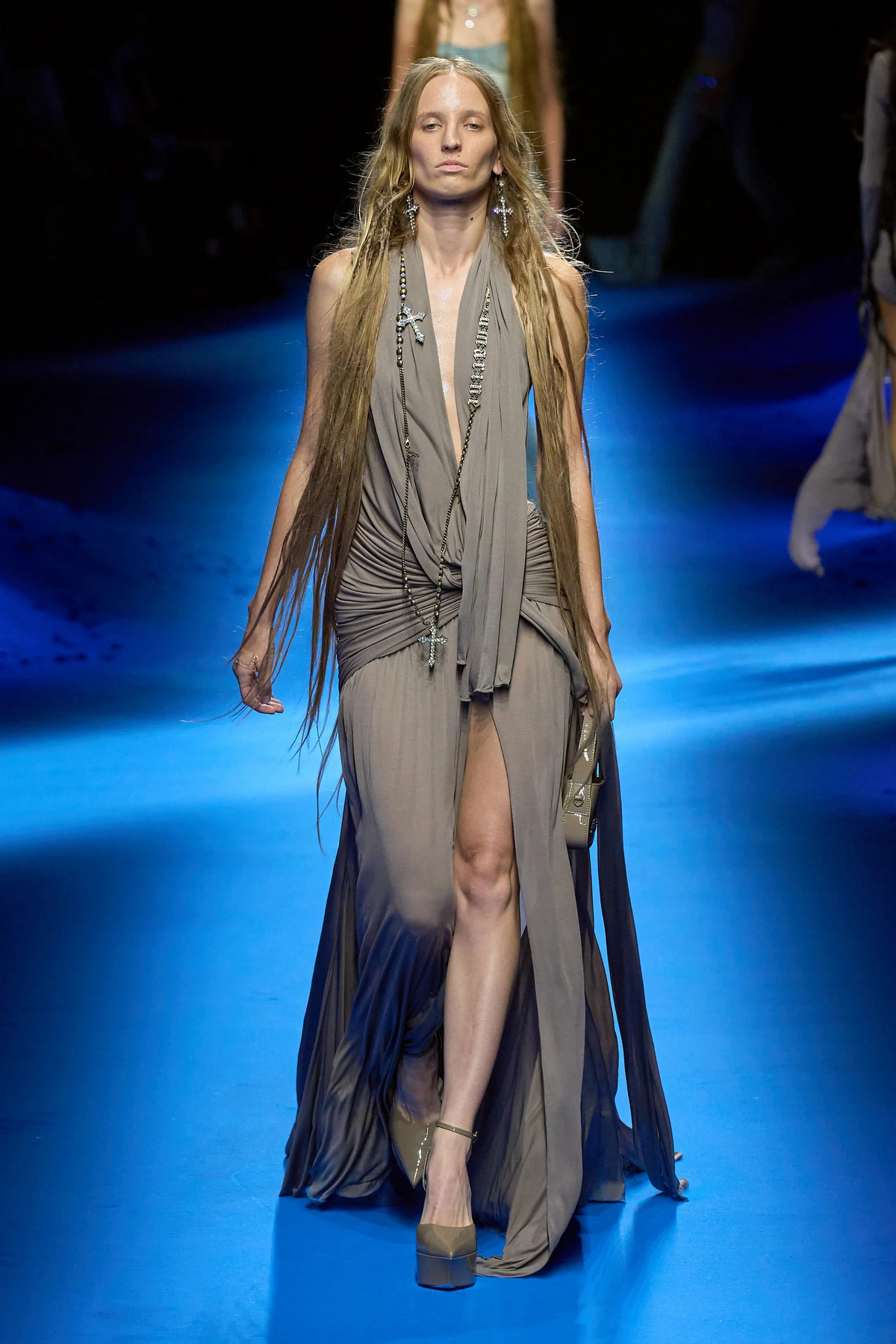
Blumarine
"How do you want people to feel when they wear Blumarine?" I asked the brand's creative director, Nicola Brognano, who had the answer on the tip of his tongue, "Exposed." To use an unavoidable cliche in this context, this season, Brognano understood the assignment.
As a designer, and as a creative director taking over the role at a longstanding fashion house, the most difficult thing to do is evolve the brand without losing what makes it the brand. Blumarine has always had an inherent romance and cuteness, which Brognano has freshened up with collaborations with Sanrio and a hefty infusion of late '90s and early 2000's aesthetics that have garnered a new and excited audience for the brand. But this season, we saw another shift in Blumarine's style, one Brognano articulated in telling me, "This is the first time we used this kind of style, the artist's style and dark style for Blumarine. This time I went to do something really strong, something really impactful, of course. I want to do sexy, feminine, and edge of course. There's something really hot there. We want to explore this kind of work. For me this is important, because when you do a collection for a brand, the important two things are to keep your identity each time, while every season keeping and following an evolution step-by-step, season by season."
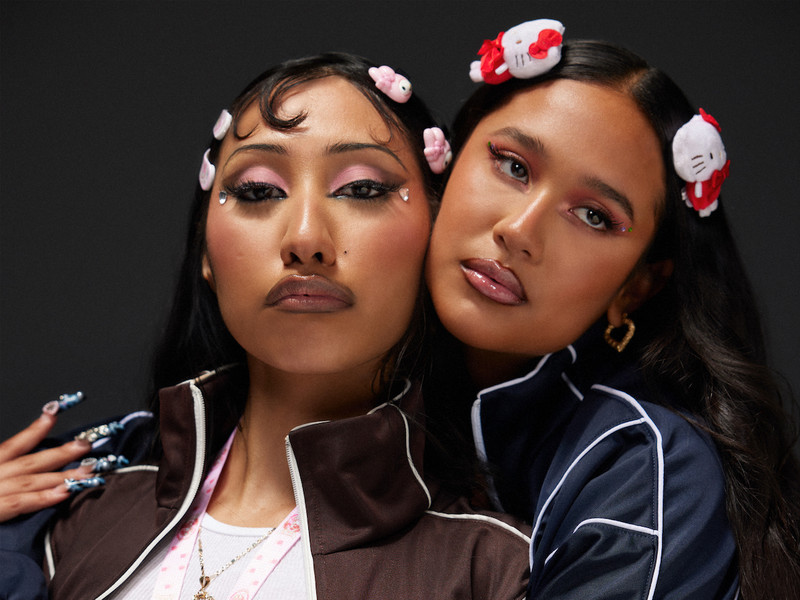
With models — and Petra Collins — floating down a blue-colored sandbank with mermaid hair hanging low and long, Brognano built a foundation on the idea of fantasy and fairytale, but inserted more subversive, sexy references than previous collections, ranging from gothic crosses to oversized hoodies and super low-rise distressed denim and matching micro purses with the rhinestone logo.
Andreadamo
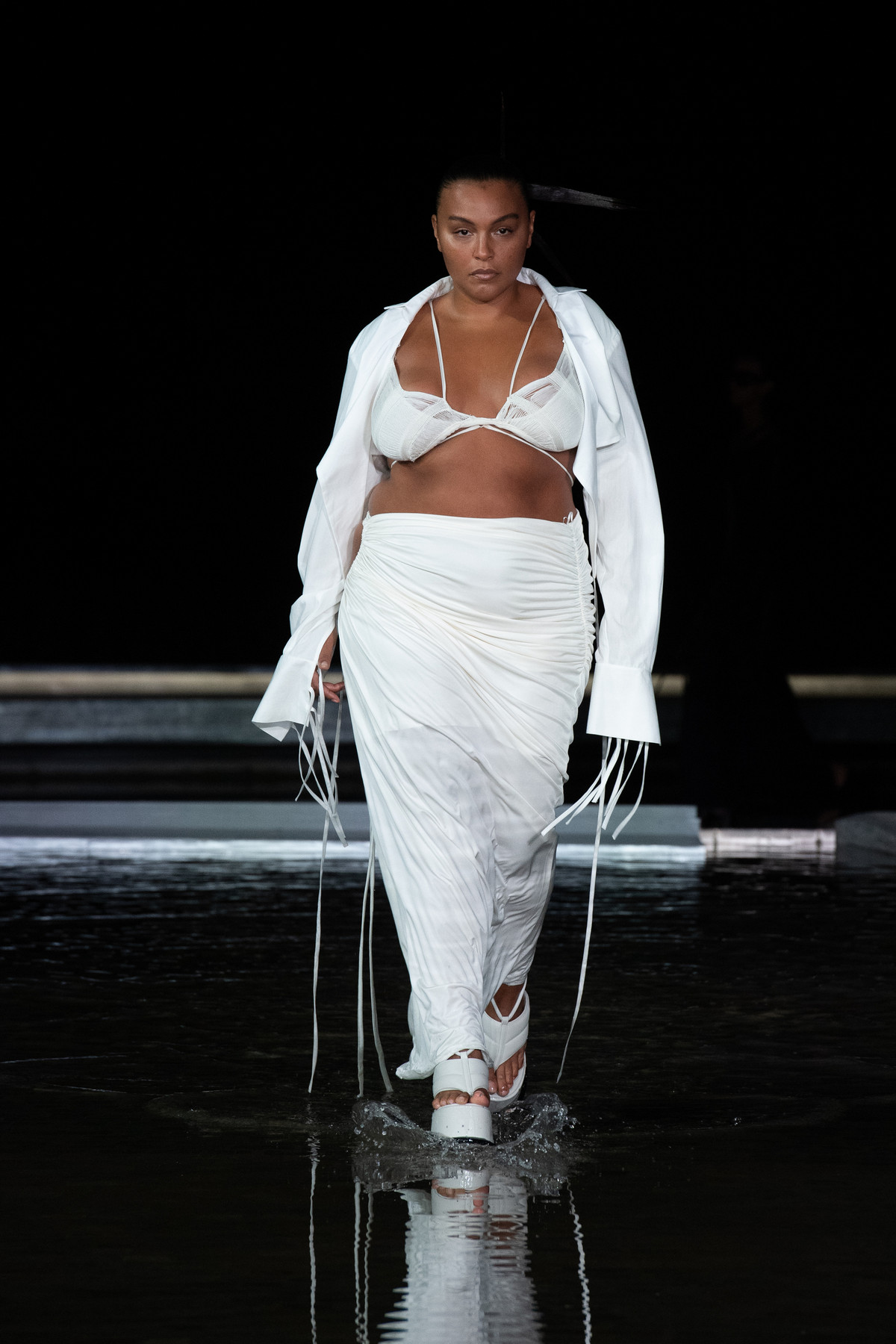
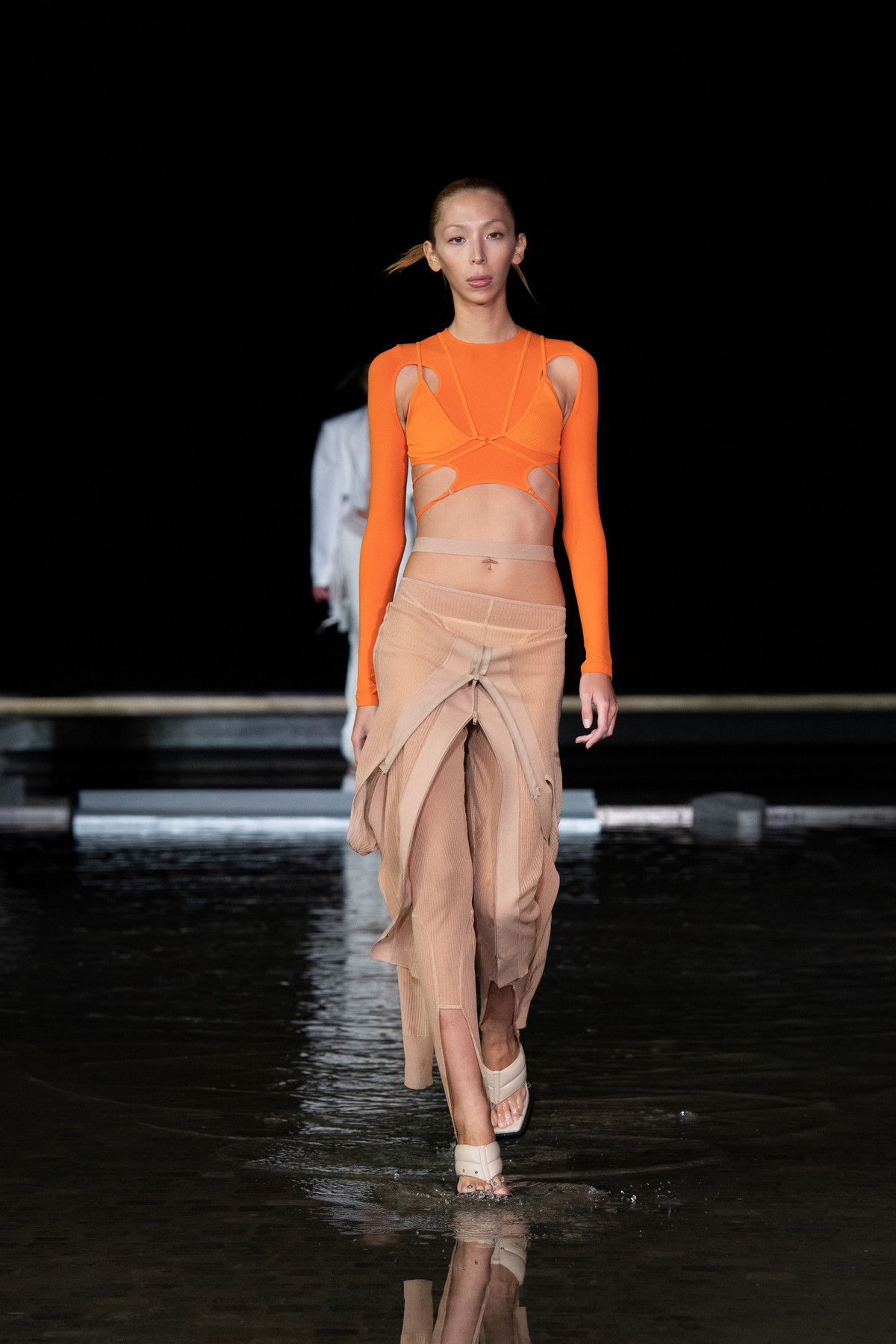
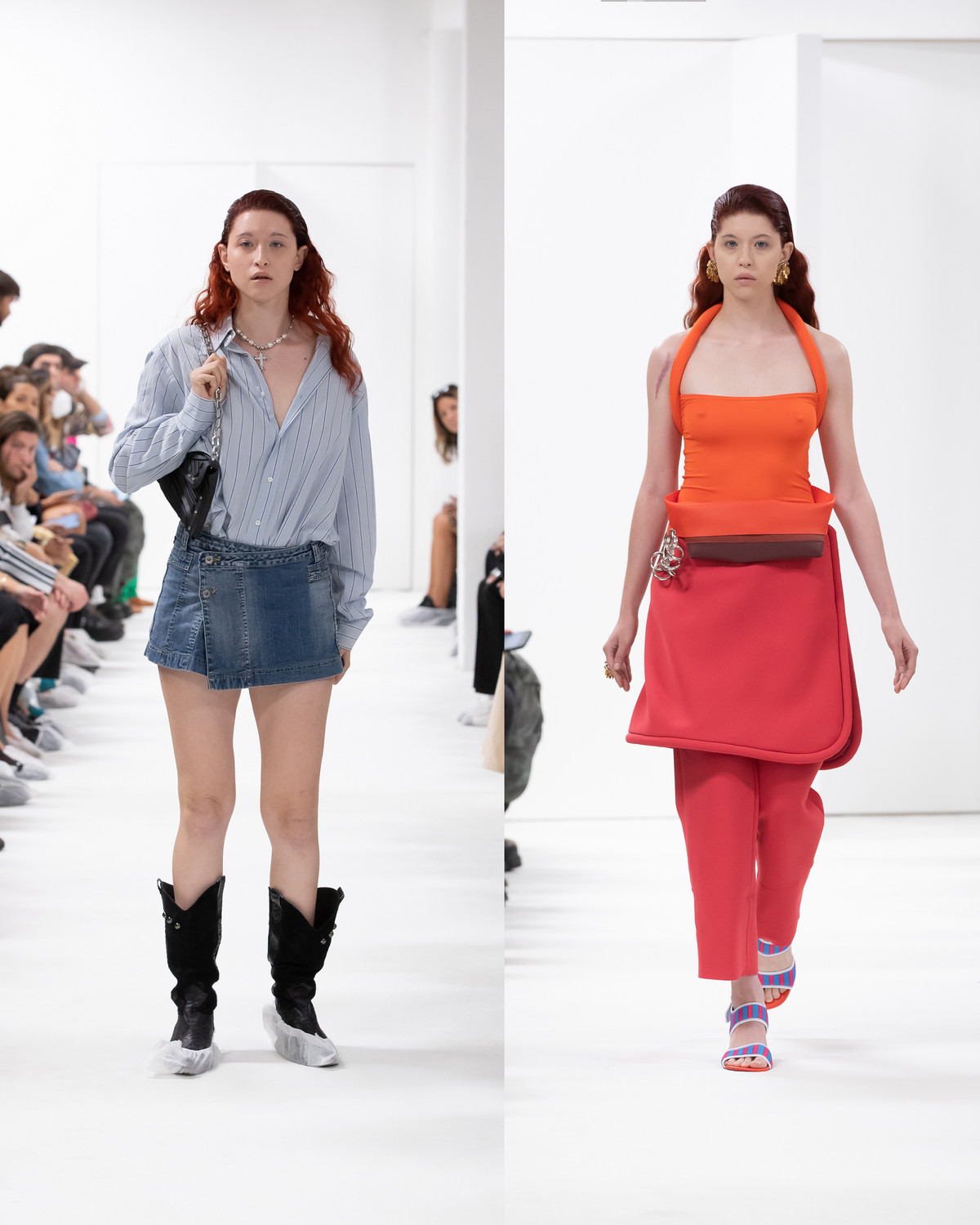
Andrea Adamo's show was a tactile, somatic experience. The designer, known for his beloved twists on bodycon knitwear, inspired by a recent trip to Famara in Lanzarote, a surf village in the Canary Islands, presented his Spring/Summer line with dramatic nighttime show, where models walked the catwalk in a shallow pool of water behind the Prada Foundation. The village of Famara, the designer told me, felt like a "ghost town" at night: think sand dunes, eerie silence and a dusky palate. But during the day, Adamo smilingly told me, "That's where the orange comes in. It was completely the opposite, bright and colorful."
As a designer known for pieces that exude sex appeal and embrace the body, Adamo is ademant that each collection also focus on inclusivity. From the palate he presents, which challenges the concept of color, telling me, "Nude is not just baby pink. Nude is a universal color, and it has many forms," as well as honing in on creating a collection that is both sexy and genderless. When I ask what he hopes those who wear his garments will feel, he tells me simply, "Be proud of you. Not just your body, but who you are."
AVAVAV
I love Beate Karlsson, and was beyond enthusiastic that her work would be in Milan as the new creative director for AVAVAV. It seems to defy much of what makes Milan the "Ad Week" of fashion season — her style is full of sarcasm, with a hyper-modern edge and eye, poking fun at the industry and making a statement without forgoing chic aesthetics or creating entirely unapproachable pieces.
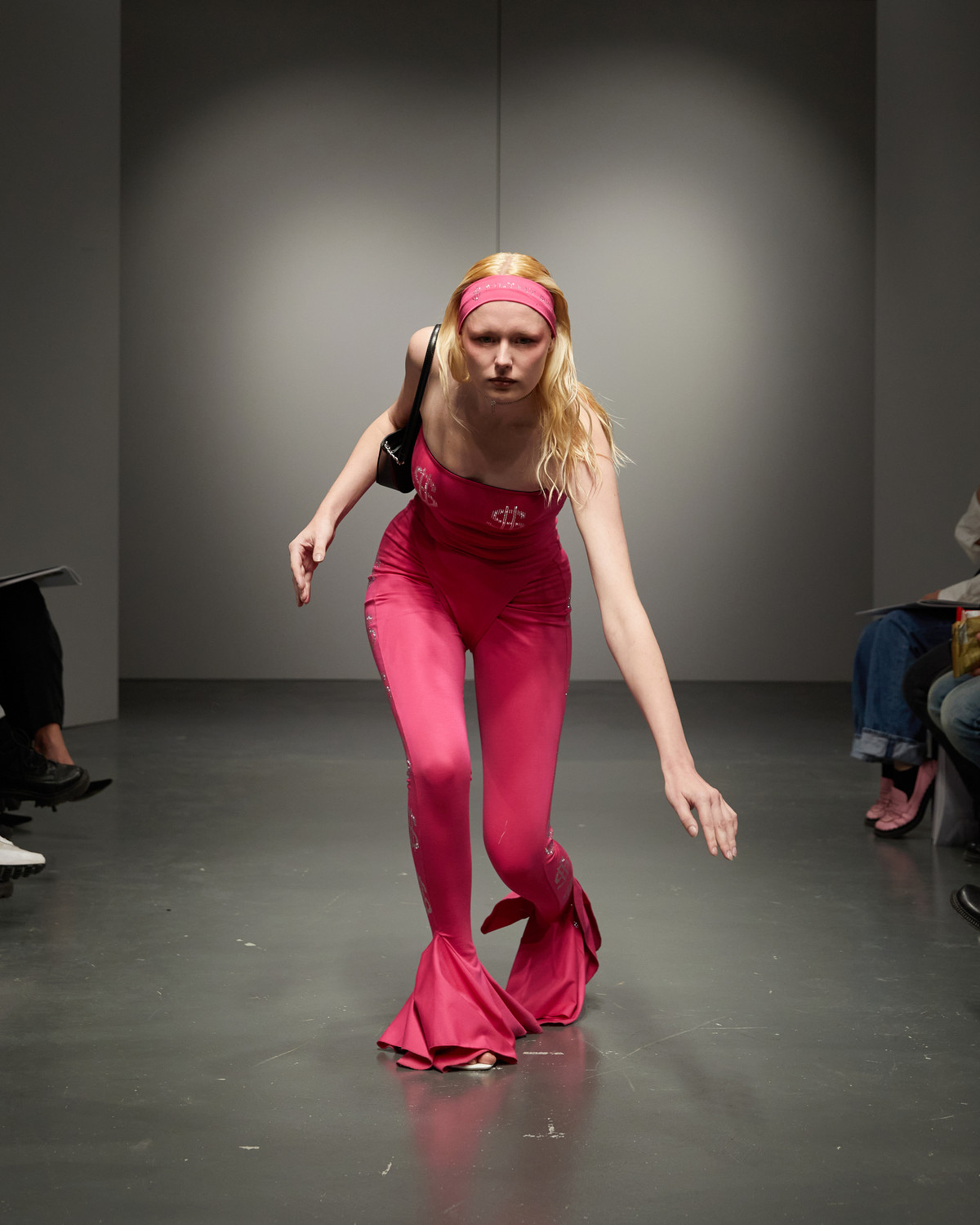
And I was right to be excited for what she would bring to the table in Milan, and it wasn't just the carefully constructed pieces, artful abstracted shapes mixed with 2000's elements from oversized furry boots to strapless micro-mini dresses. Karlsson awed the audience with surprising showmanship — each model flailed down the runway, with a dramatic and intentional fall at catwalk's climax moment. "I’d like to think it has a sense of humor, I always prioritize having fun in everything I do and hopefully that reflects in my work. I don’t actively try being a disruptor, but I strive to conceptually elevate what fashion can be, which sometimes ends up in bizarre ideas that disrupt. The references for the collection have been a compound of my internal associations to “richness”. Everything from wealthy people to flex symbols like Rolex and expensive material like leather and fur."
Of presenting her first show at fashion week, she told me, "In all honesty I’ve been skeptical about participating in the routines of the industry, mainly because of its dated nature. Doing my first runway show has however left me more hopeful that there are ways to make change from within. I’m shocked by the support and love we’ve received from the industry and it inspires me to join in more."
We truly hope she does.

SUNNEI
When we profiled SUNNEI for our Winter 2022 issue, we highlighted the dynamics of the Milanese brand. It operates outside of traditional fashion structure, upholds a mysterious guise, and rejects a system of hierarchy internally — "From the finance department to the youngest intern, SUNNEI operates in a relaxed unison to foster a family-like ambiance no matter how big the office gets."
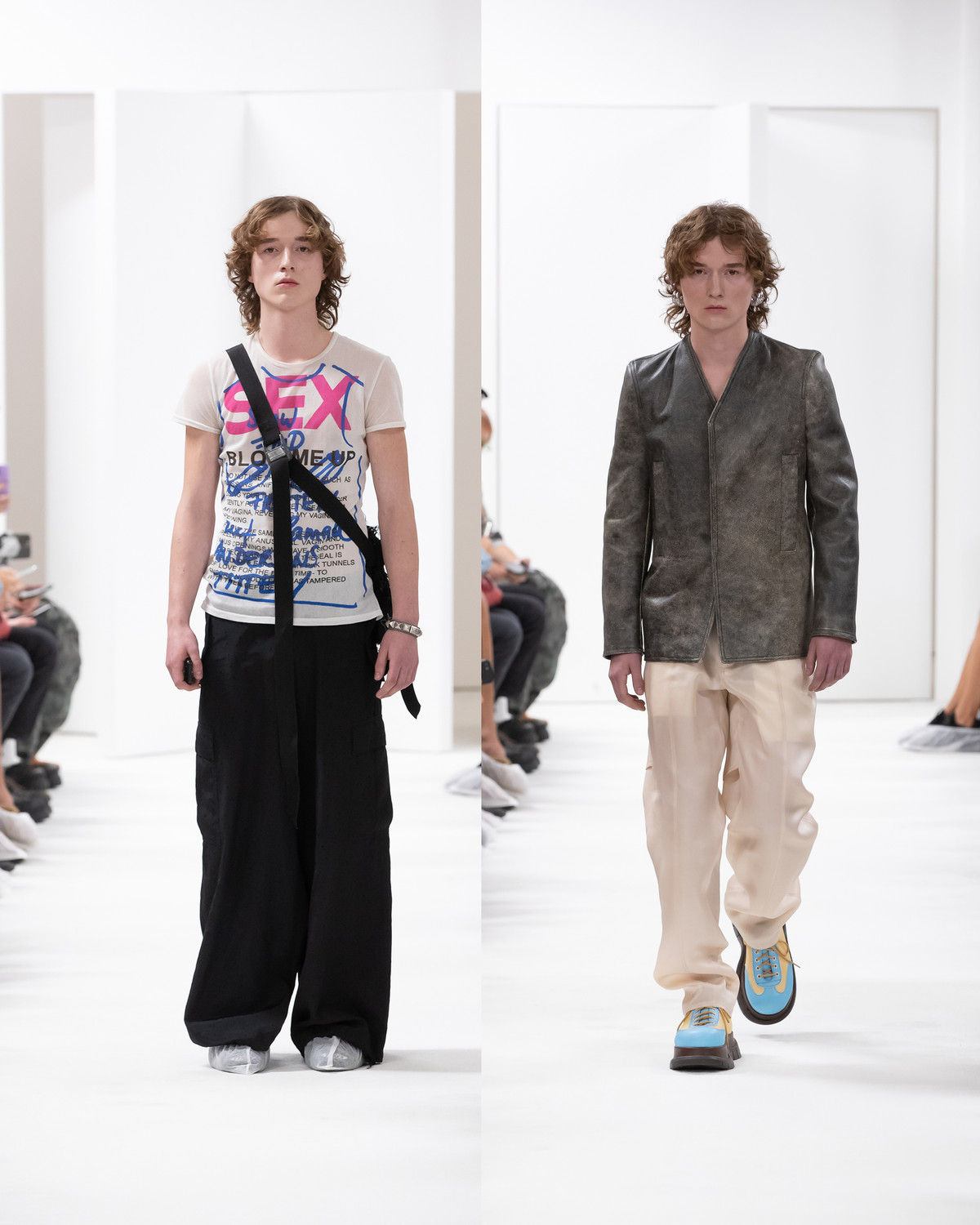
For the Spring/Summer 23 collection, family is the key word. Gucci, who showed just a couple hours before, was not the only brand to put twins down the runway this season. But we can attest that the experience of each show and collection was anything but similar. SUNNEI is a collective, spearheaded by deisgners Loris Messina and Simone Rizzo, and this season the group continued to offer their interpretation of humor, community, and connectivity with a completely non-traditional show.
From the audience — who were instructed to wear surgical booties stretched over their chunky Prada loafers and Balenciaga knife pumps — as the music built, someone stood up from their seat. It was a model, disguised in street clothing. From her seat, she walked down to the catwalk, and through an elusive revolving door, out of which she seemingly appeared again, in full SUNNEI. And again, the boy in front of me stood, walked down, through the door, and out again, in a colorful patterned pajama look, with bright, thick-soled SUNNEI Oxfords. It registered to the excited crowd after the third, these were twins — who at the end, lined up together in the small crowded space, a vision of unison in a patchy rainbow of their regular clothes and SUNNEI's unique line.
It was a performance piece as much as a presentation of well-executed and eclectic fashion. And though the twinning in use of twins may have been overshadowed by the Gucci production, SUNNEI stood out to us as a particularly special moment in Milan, and entirely dissimilar to the precise properness of the Gucci show and the Gucci pieces.

MSGM
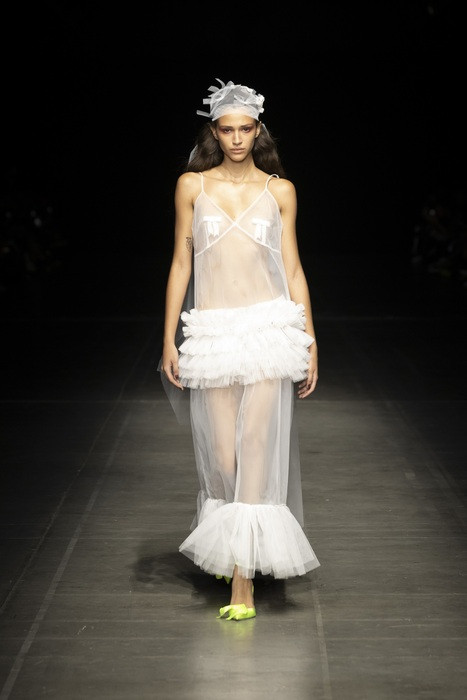
Massimo Giorgetti's invitations alluded to the theme pretty overtly: the thick, script embossed card had two wedding rings tied to it, with a neon bow. The seat placements were a satchel of white jordan almonds. It seemed, that Giorgetti had marriage on his mind. "I wanted to speak of an unconventional romanticism, one that is tender but also caustic." In a season where we saw a long list of wedding looks come down the runway — many of which seemed to stick to the more traditional romanticism — I was eager to see his fresh, "caustic" approach. And I can say that Giorgetti definitely delivered on the description.
Giorgetti, who was a DJ as well when he started the brand, told me backstage that he wants, "...fashion to be music for the eyes. I love vibrant colors, patterns and prints, and I see them as the visual interpretation of rhythms and beats!" The designer explained, "To me, music is like another element of design at MSGM. It's like we translate into clothing the energy and the attitude of the music that we're listening to in the design studio." This season, the designer told me, was heavily influenced by his listening to the Kill Bill soundtrack. Thus, the unusual wedding theme — and also even more reason to love the collection.


MM6 Maison Margiela
MM6 Maison Margiela is always a heady experience. The brand, from its beginnings through today, season after season, has brought us a super smart approach to simplicity that has yet to be superseded. Simplicity may be the wrong word, perhaps intention is more appropriate. The designs are stripped down iterations of what the pieces are meant to be, forever free of unnecessary frills but adapted and articulated with details so astute and so signature that despite changeover in the brand over the last decade, their dedicated high fashion fanbase has never waivered in hunger for another next season.
Nor have we, and in Milan for SS23 we were satiated. Sitting on the stage of Auditorium di Milano Fondazione Cariplo, from the vantage point of a dancer, facing an audience replete with classical musicians, we were enthralled by Igor Stravinsky’s avant-garde ballet The Rite of Spring, which were were soon made aware was yet another brilliantly intentional choice on behalf of the brand. The collection was a soft dance in itself, with pieces presented in a palate inspired by the art of ballet — which, we all know is not necessarily a new reference for brands over the last few years — but MM6 did things differently, as per usual. In flipping traditional garments such as cosies to warm the joints presented in lacy mohair, sleeves reverse engineered on frayed fabrics and attatched to scoop-neck tops and vests worn as minidresses, this was one of the freshest presentations of the dance form in fashion we've yet to see. Not to mention, what's not to love about mixing silky, chunky-toed ballet flats and Salomons, especially when the Salomon collab extends onto the body itself, with the new MM6 Salomon Adv Skin 5 running vest.

London has always been ahead of the curve with sustainability, diversity and inclusivity, likely due to the fact that the city is home to one of the best fashion schools and a fashion week that does an unparalleled job of inviting students and the next generation of creators to be a part of it. And O'Dwyer is a shining example of this.
To do the concept of "inclusivity" justice is a tricky one. Many brands appear to be paying mere lip service to the sentiment, casting a couple models who aren't sample size, adding a face that doesn't fall into the Eurocentric beauty standards to follow suit of the times while their garments that go to production remain in a certain size bracket and the efforts to enforce inclusion and fight the whiteness and ablism in the industry end after presentation day.
O'Dwyer is not a member of that group. Since the Dublin-born designer's debut, the garments she's produced and casting she's done for the shows have been some of the most forward-thinking, bold, and beautiful embodiments of modern style. With work that's as much about her personal experiences as the world around us, the world we see and the one we want to see, there's a level of emotion about O'Dwyer's label that is difficult to achieve as a designer in this industry.
I sat down with the designer after her London Fashion Week show to discuss the collection, the city, and how she's able to put all of herself out there.
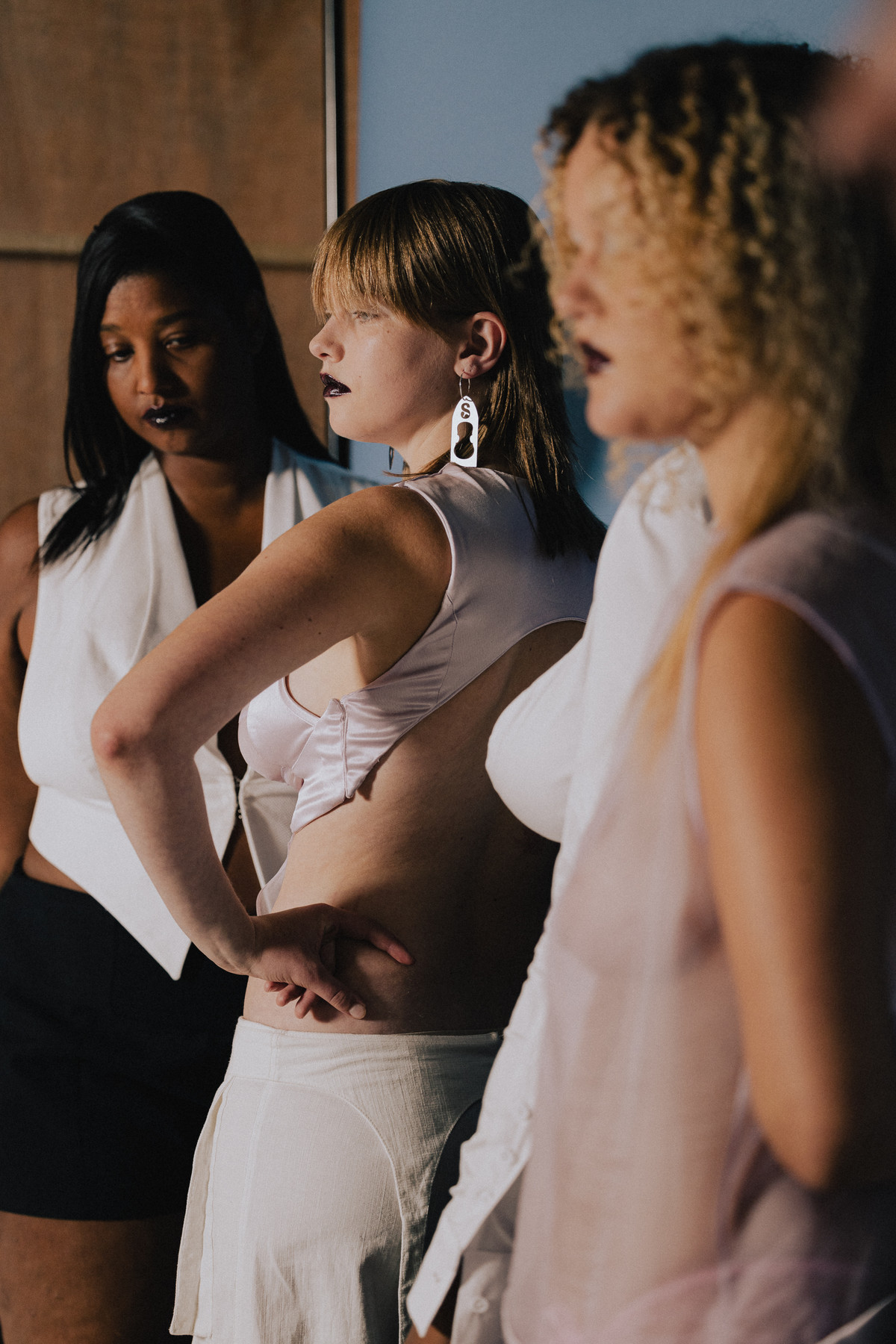
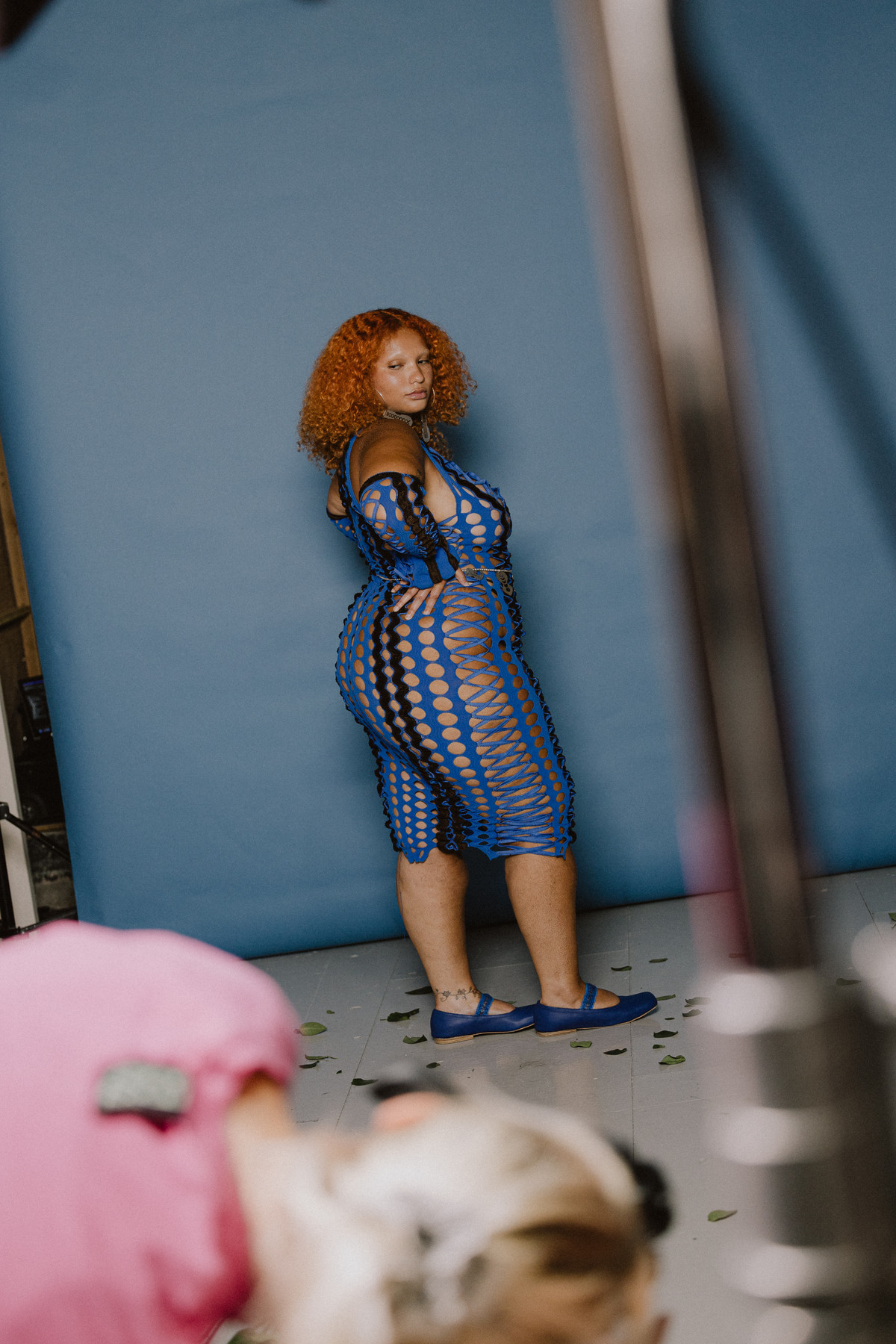
Do you think art can exist or be created without pain?
I think art can be created from many emotions; however, I think that every human experiences pain and art that reflects that tension is important for us to connect with sometimes, especially when life feels hard.
How does it feel putting out such a personal show?
I had actually not realised how personal it was until it hit me how public the show was! My work is very personal though. I’m not sure how I would do it otherwise, its what helps me keep the meaning in an industry that can sometimes feel superficial.
What do you hope those who might wear these pieces will feel?
Comfortable and empowered to express themselves.
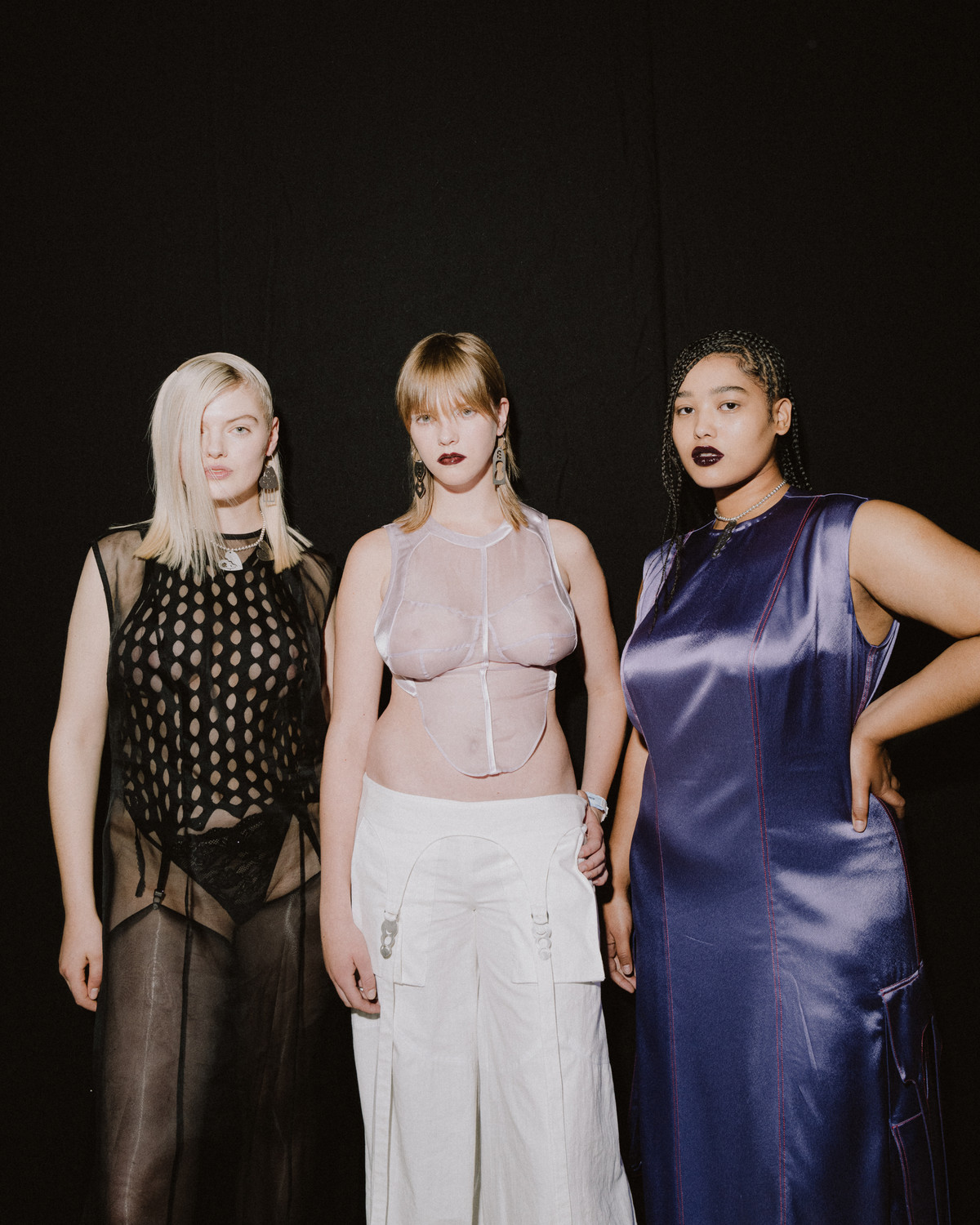
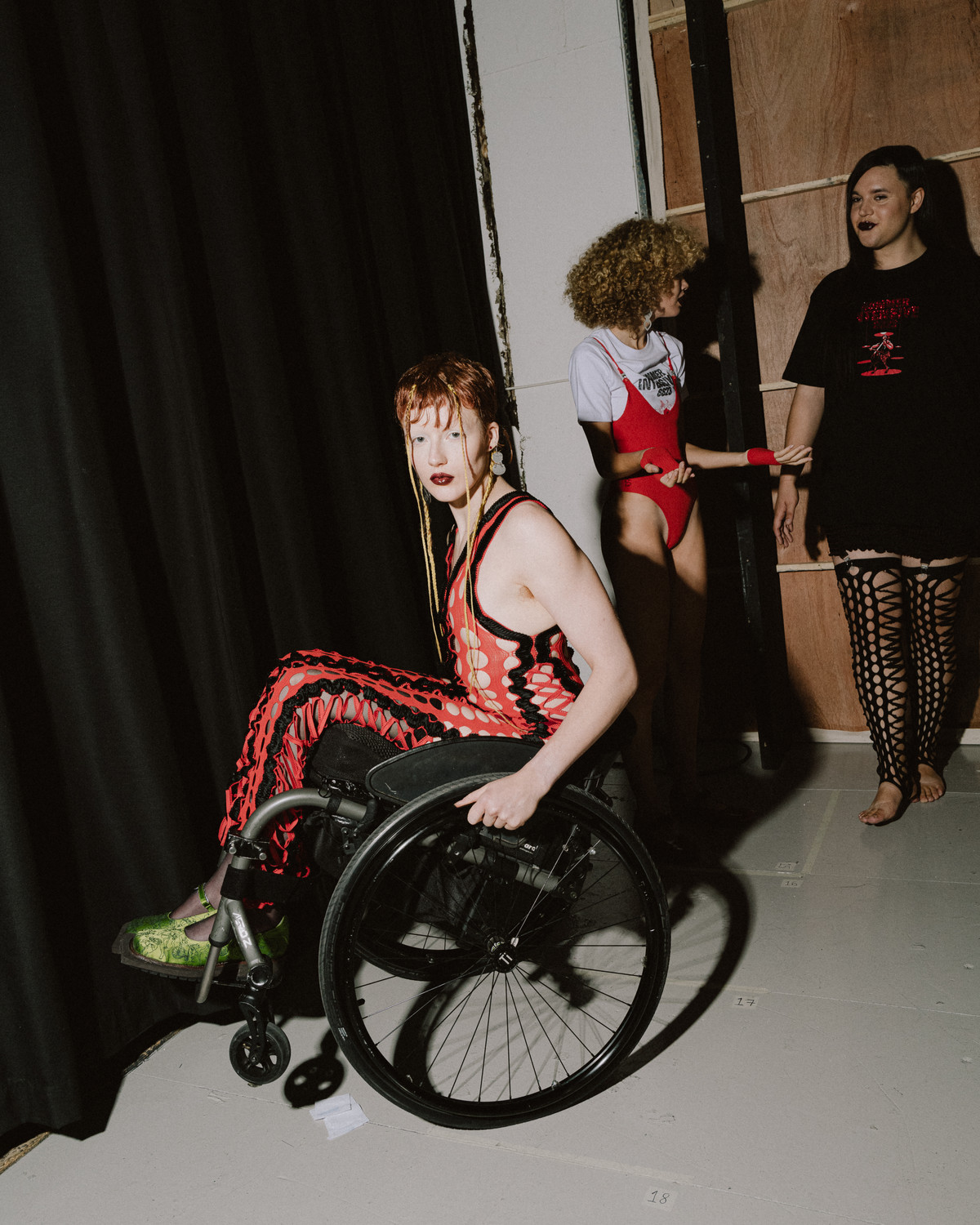
How do you balance expressing intimacy with your own experience and making a collection that’s approachable for others?
I think I usually approach my work with a very personal narrative but then it ultimately becomes more of a universal feeling. I think that most people can relate or empathise with emotions.
How do you feel your approach to inclusivity is different than other designers?
It is important to me to actually respond and be inspired by the body I am dressing. I have no desire to use the body as a hanger for my work, rather I see the body and clothes as having a relationship and they need to compliment eachother. I suppose the main difference is that most designers use 6-10 UK as their sample size and I take size 20 UK. I also sampled in UK 12 and UK 26 this season, so that I had a bigger range for when we did the casting for the show and also so that I am more prepared for sales. It is impossible to grade all sizes from one block, so having at least 3 sample sizes is important if you want to do a broad range of sizes for production.

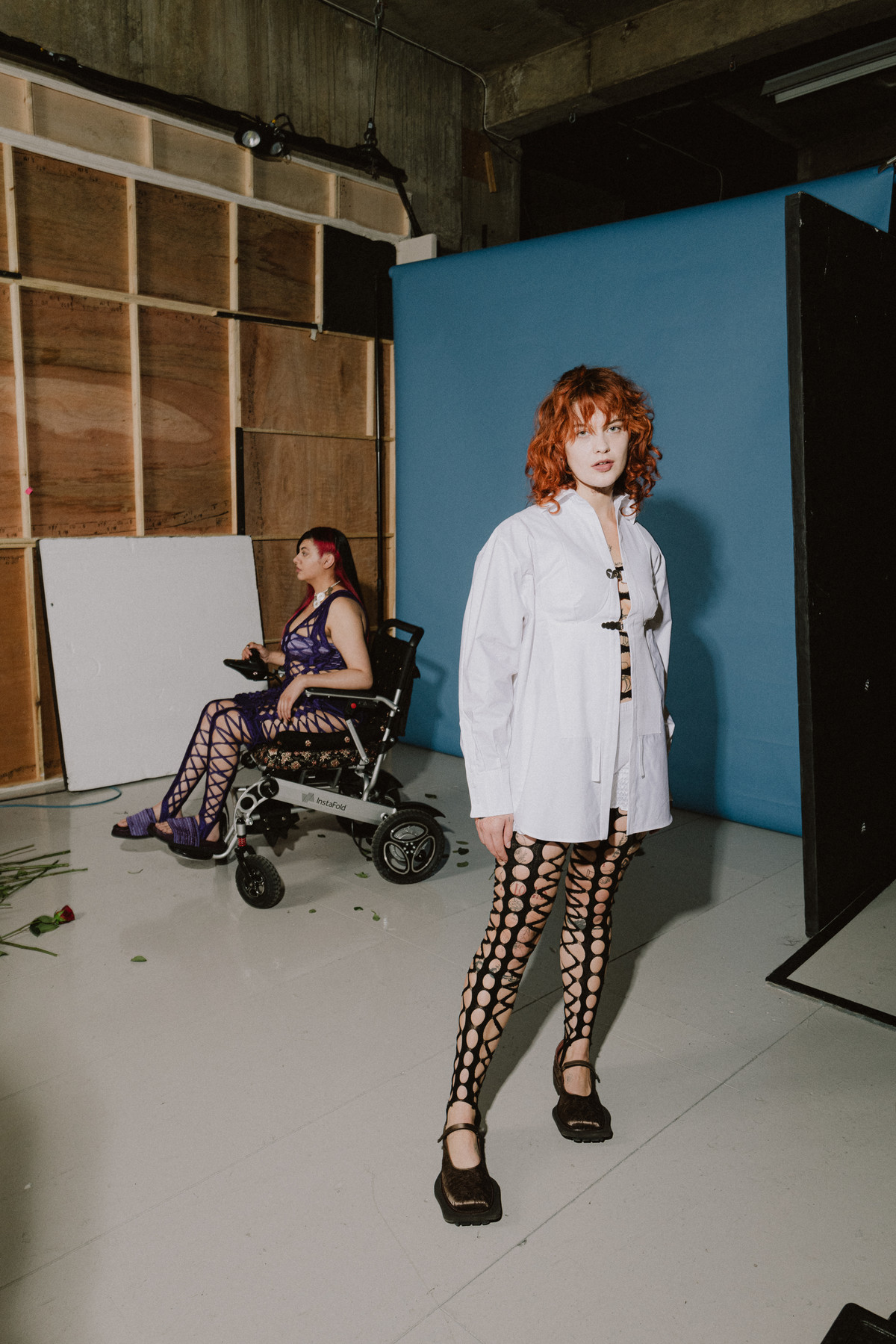
Your collection was heavily inspired by your playing and being around classical music as a child. Do you still play music? How do you think an understanding of music has influenced your practice in ways other than aesthetic references?
I don’t! Sometimes I play at Christmas with my mom and sister which is really fun and I would like to join an amateur orchestra one day (when I have the space to own a cello and time to practise it!). I think I actually learnt how to work consistently and be patient from playing music, having to practise every day is really playing a long game… it takes ages until you stop sounding terrible as a kid so you have to really stick it out until you can enjoy chamber music and the satisfaction of having some control over your sound!
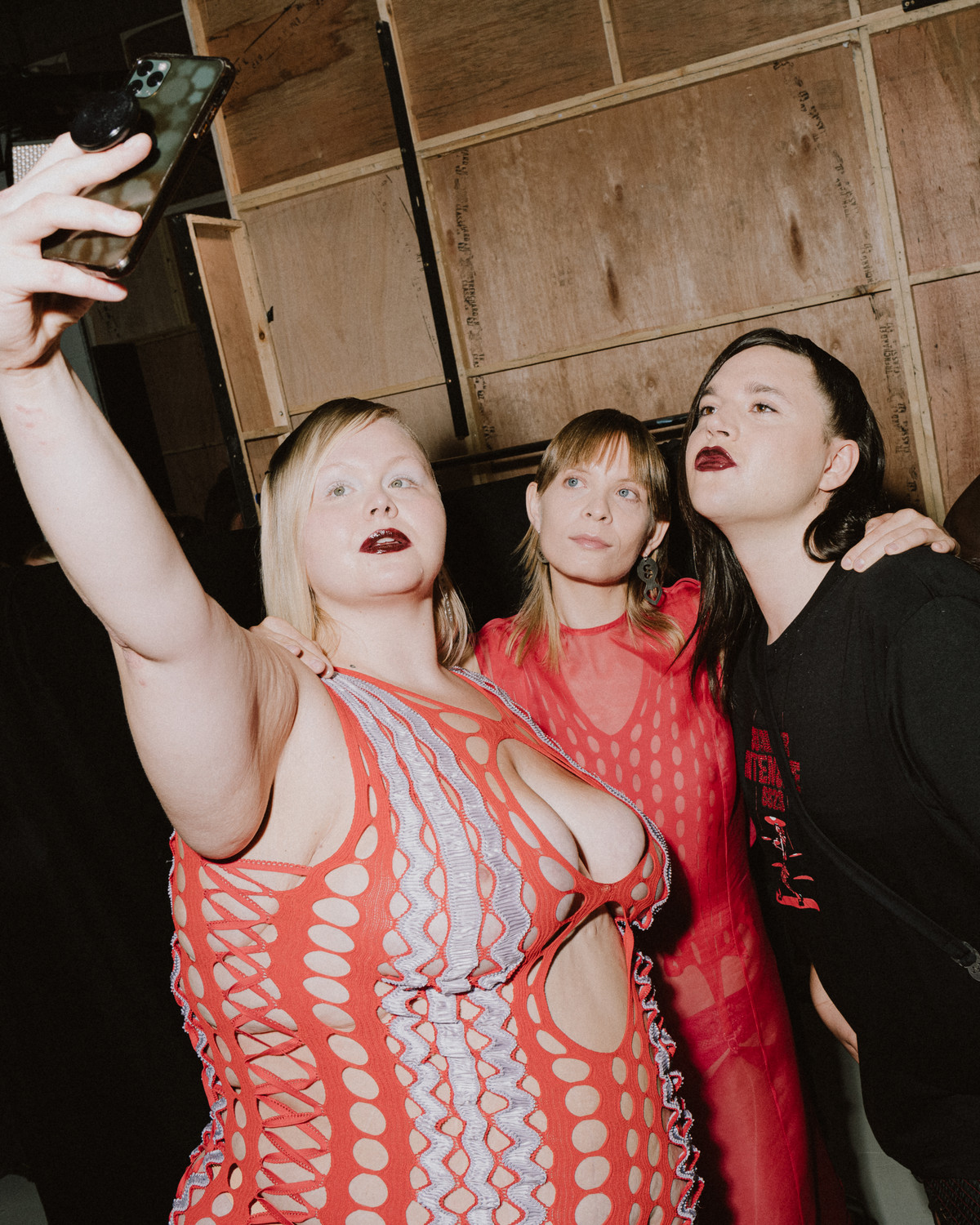
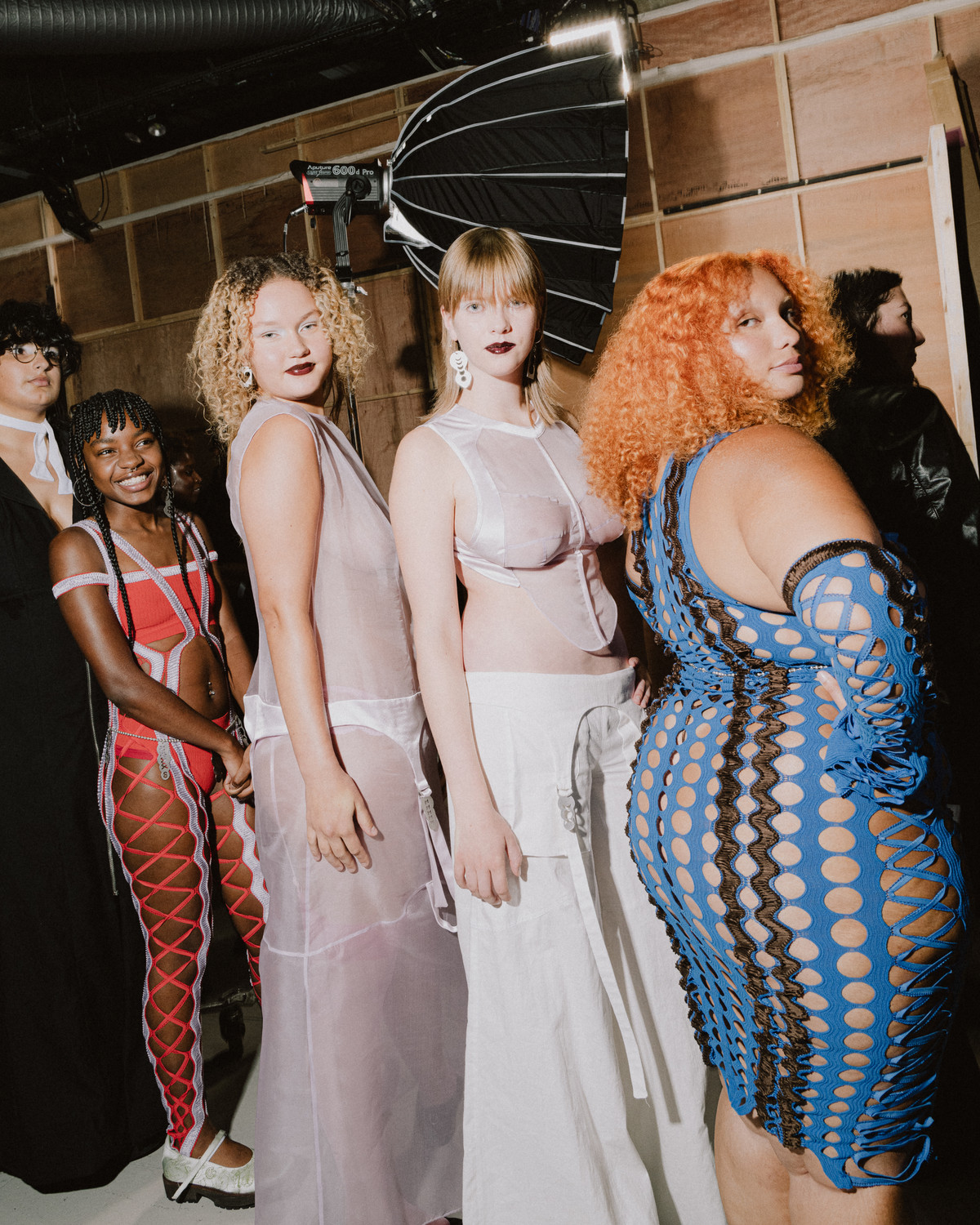
I feel like London is really a place that lets designers create without boundaries. Why do you think that is?
I think its because its such a diverse city with so many different sorts of people. I feel free here to be who I am and create what I want. Though I’m conscious that I exist in a very specific queer artistic city bubble, however this bubble does allow me creative freedom that I really love.
Would you show somewhere other than London?
It’s not something I have considered.

The collection features swimwear-Esque bodysuits, cut-out trench coats, extenuated fishnet maxi dresses, and exposing yet sophisticated onesies layered under short satin dresses and oversize blazers. Even if Burberry's menswear is heavily dominated by traditional tailoring, Tisci blends in genderfluid elements such as frilly tulle skirts with streetwear inspired, box shaped crew necks and suit jackets.