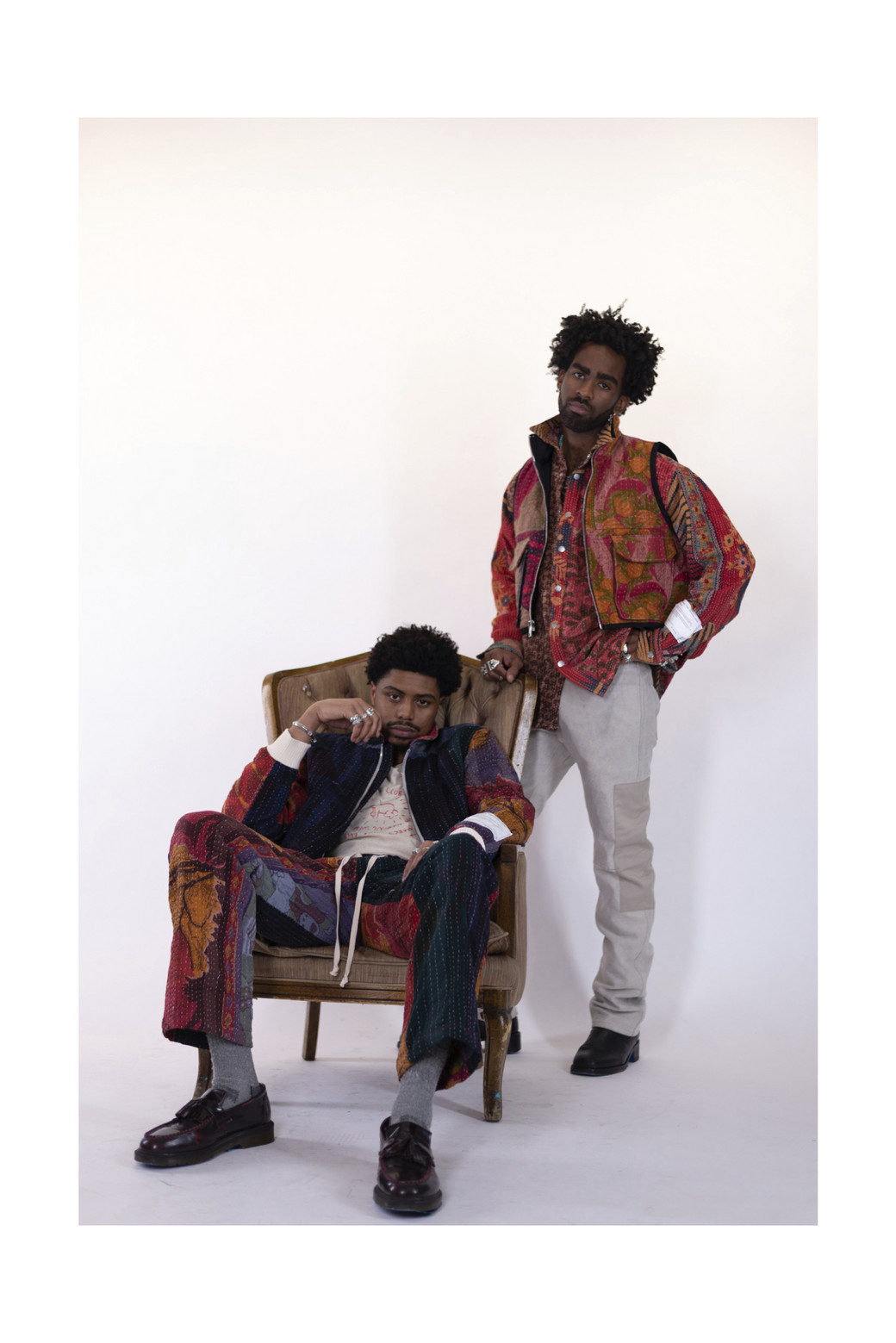
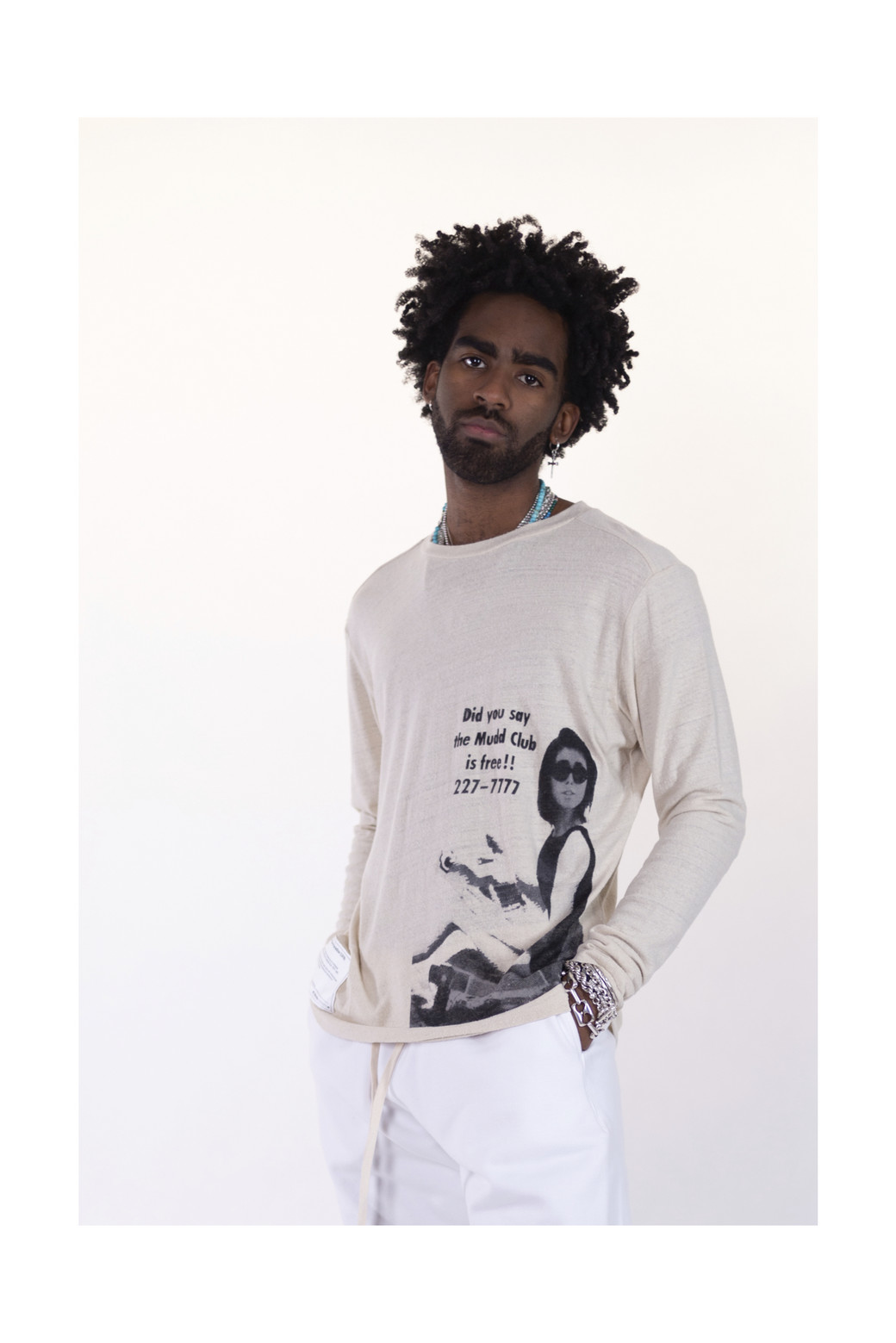
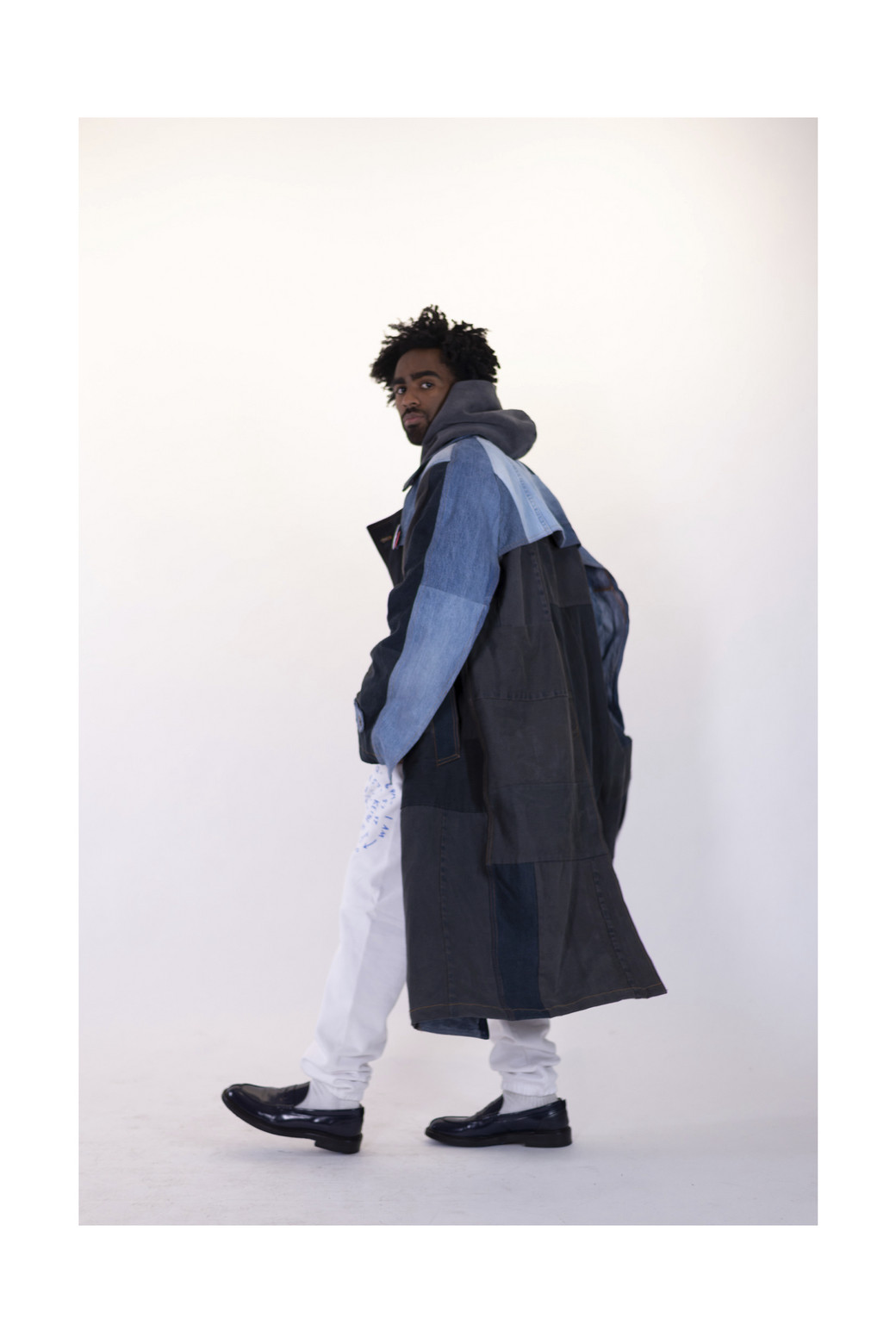
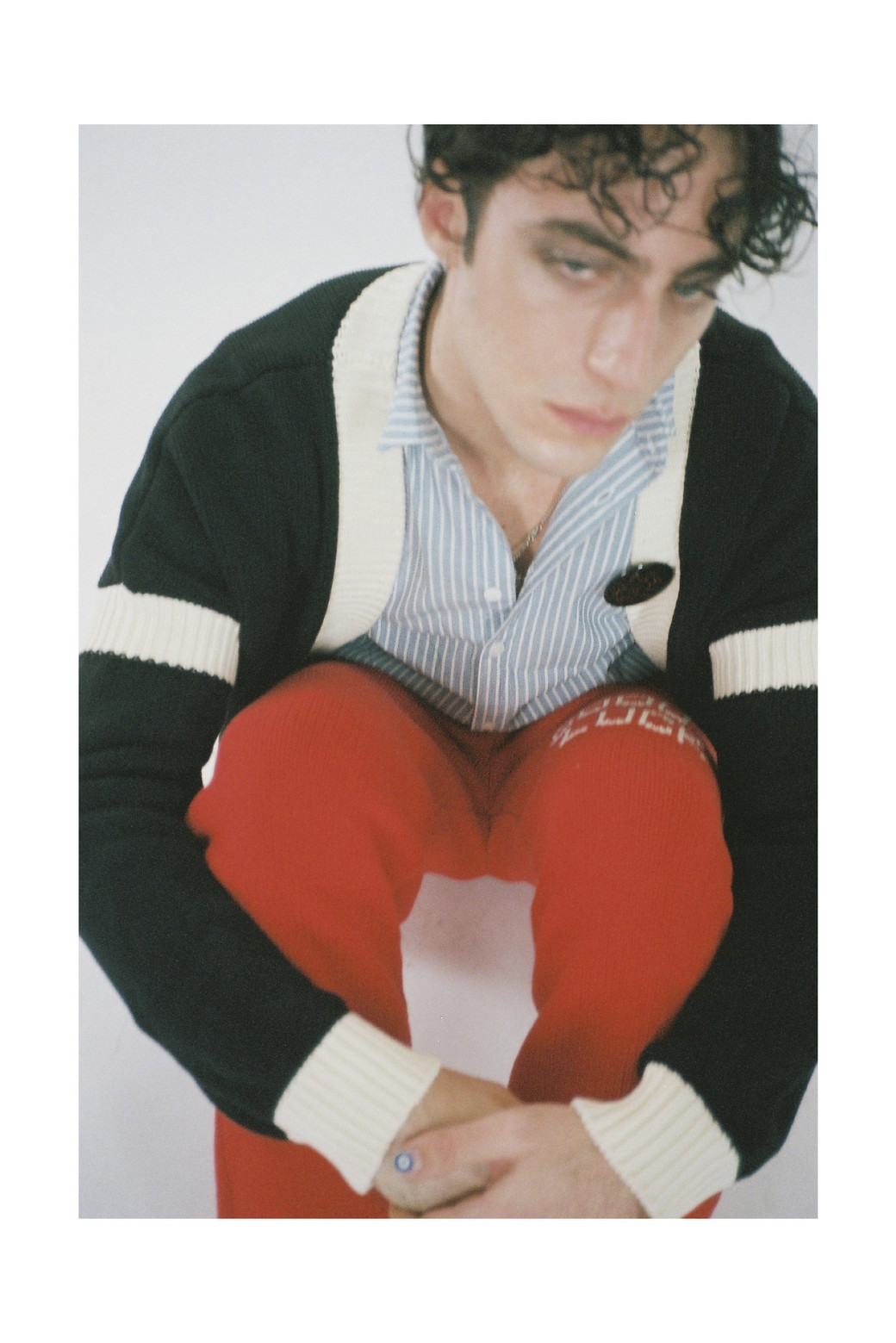
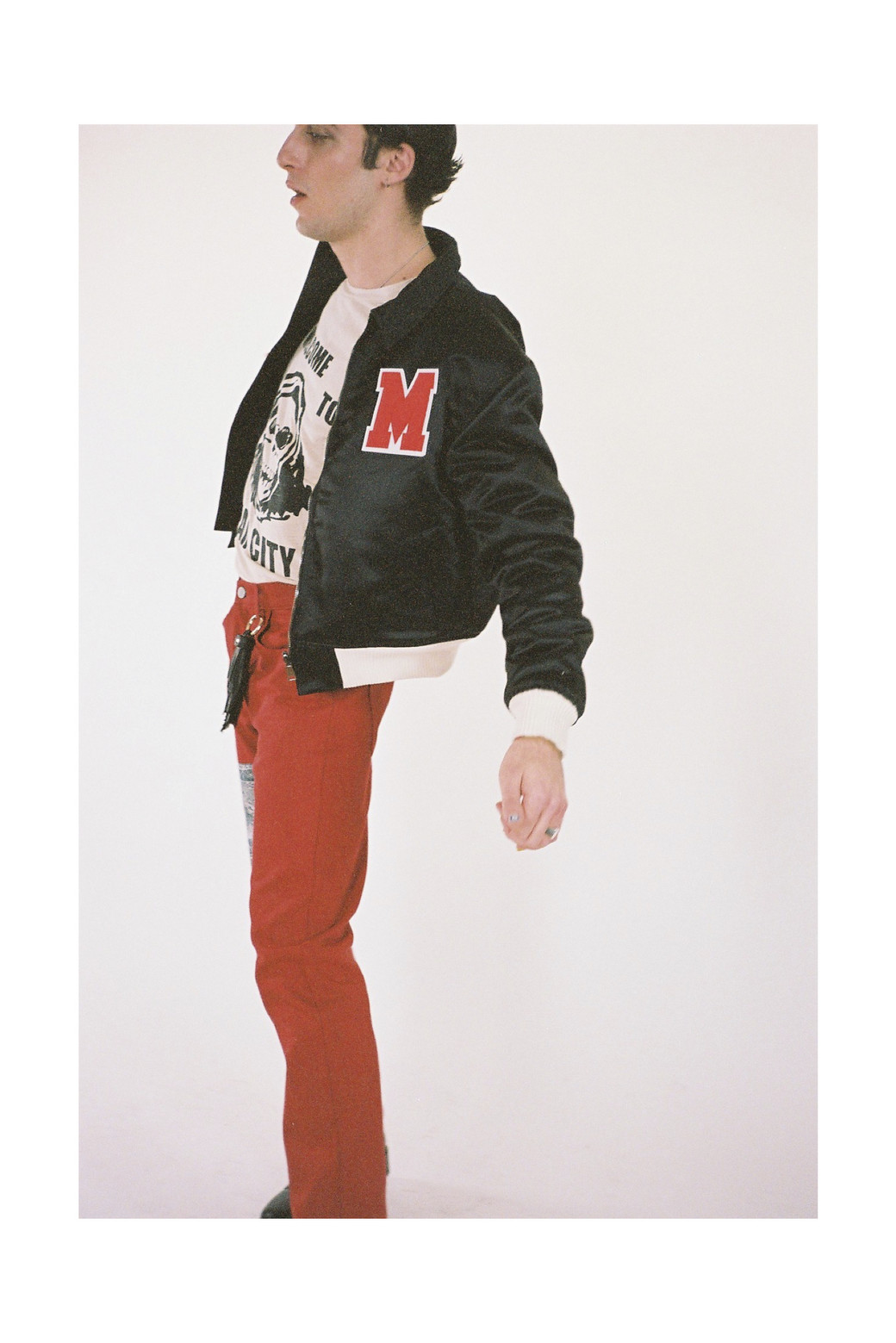
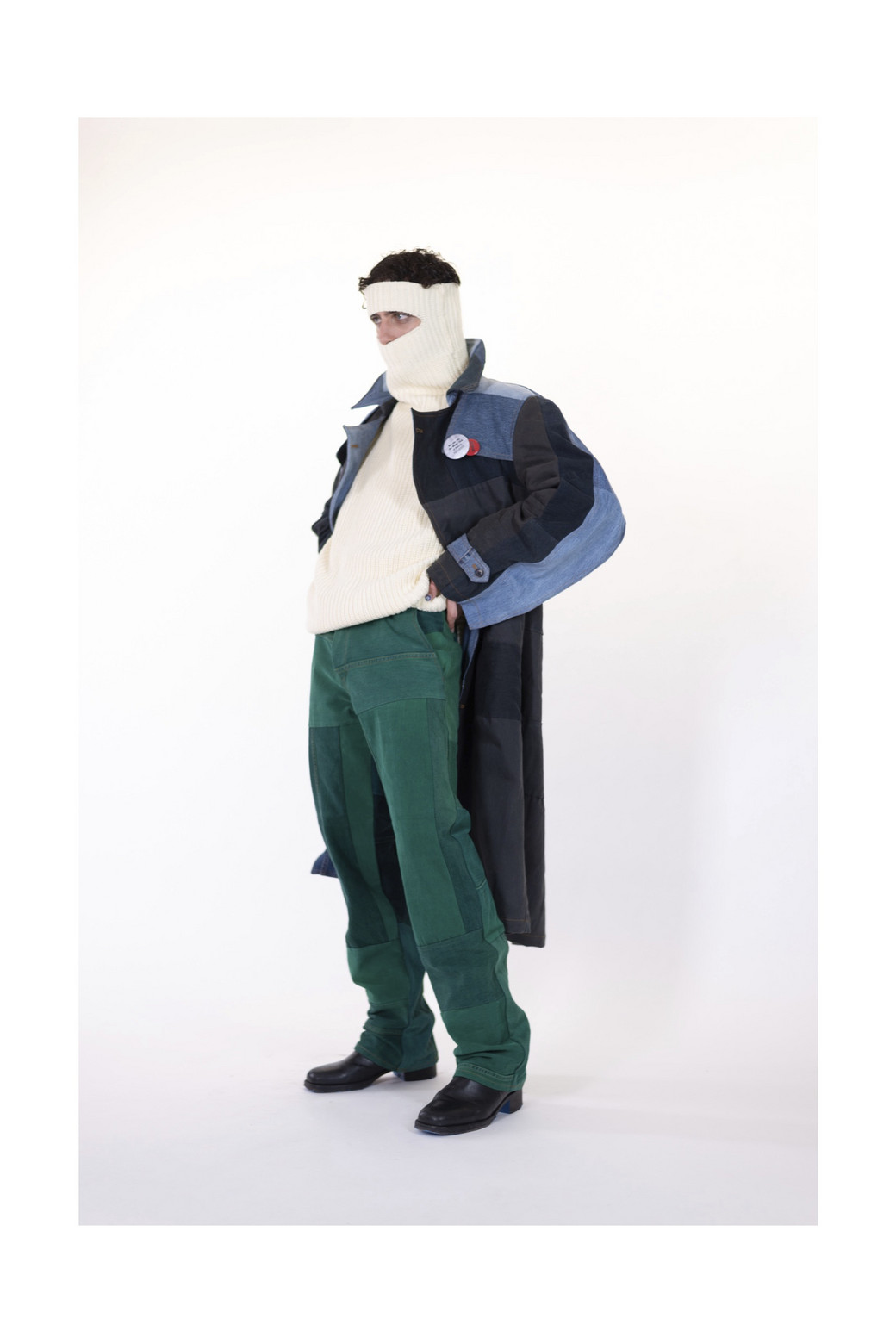
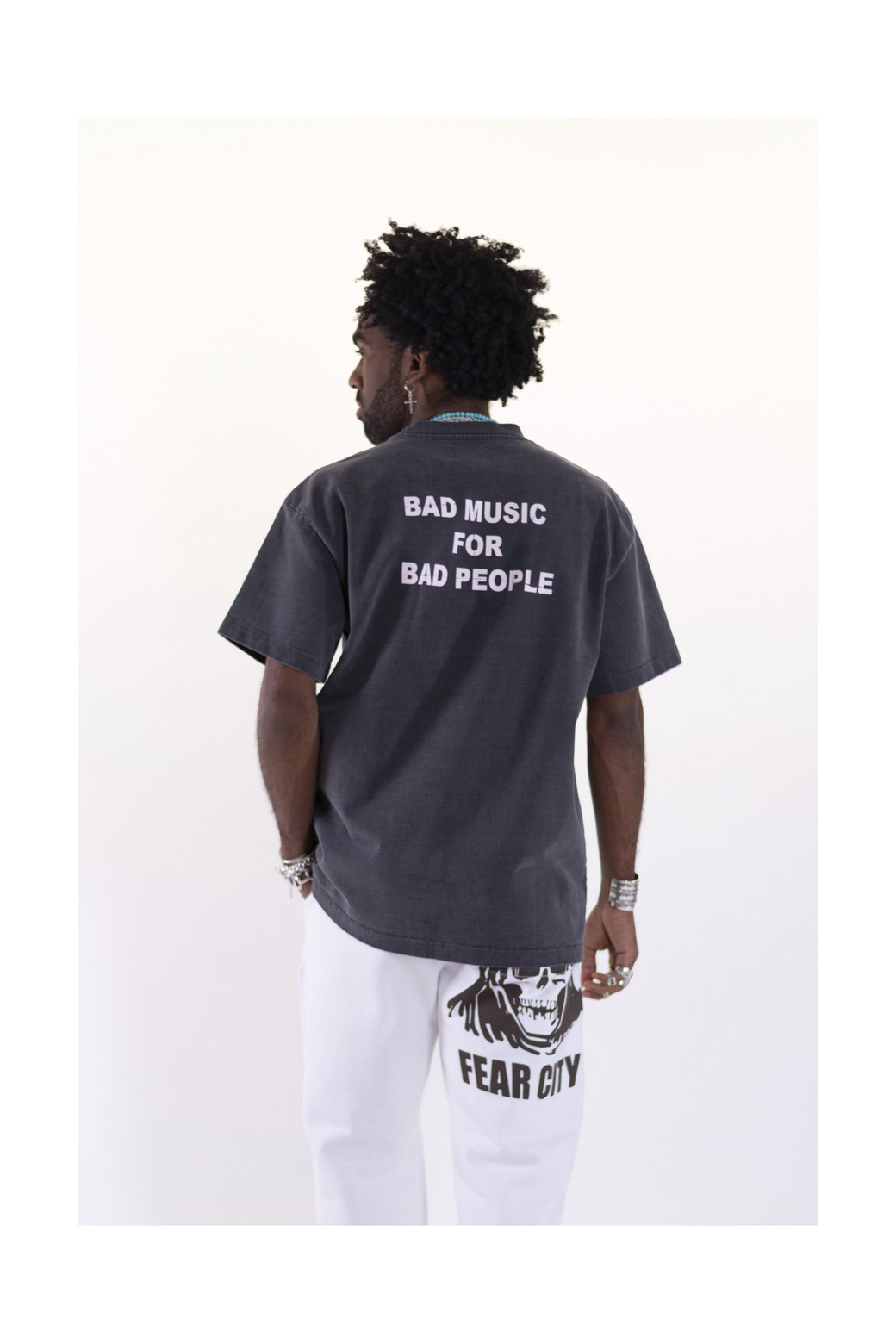
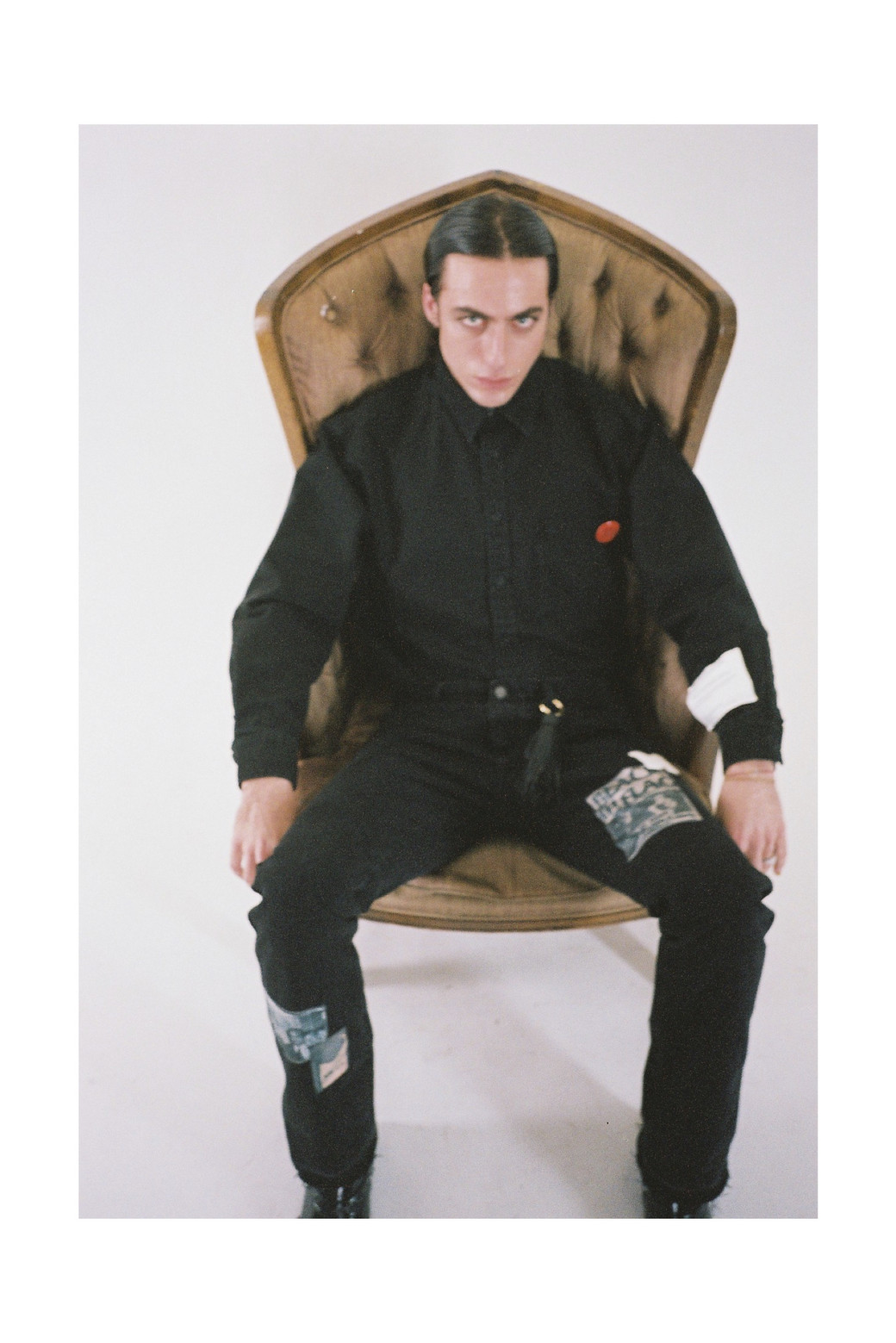
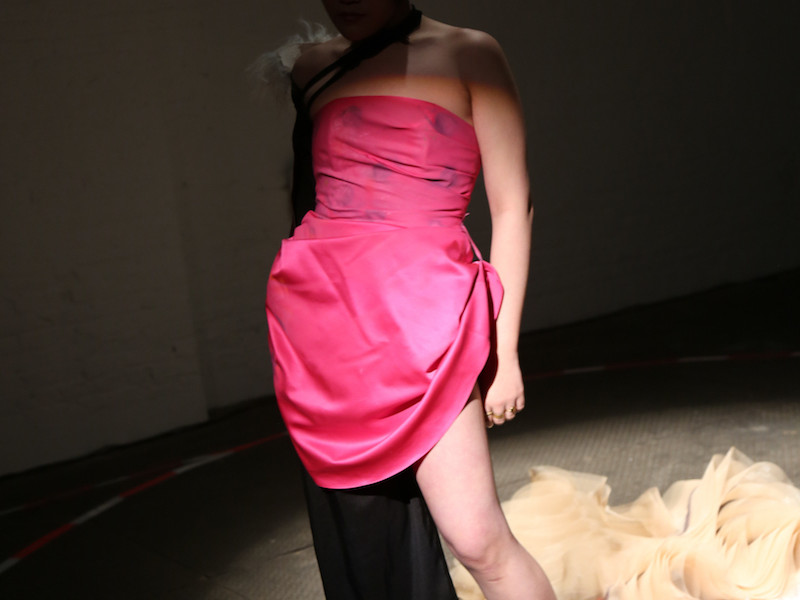
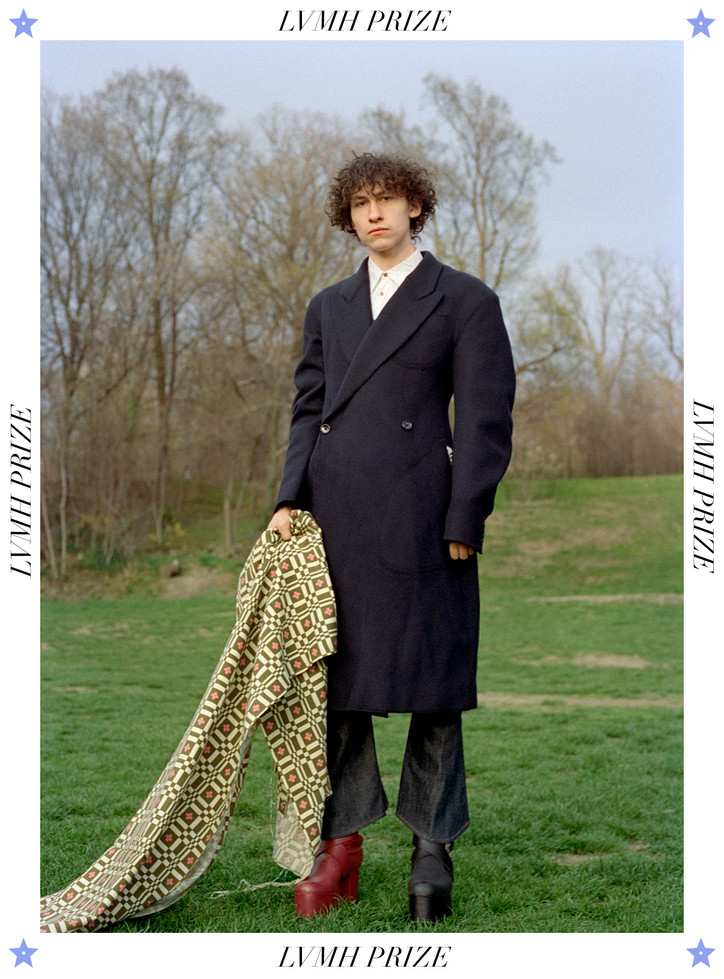
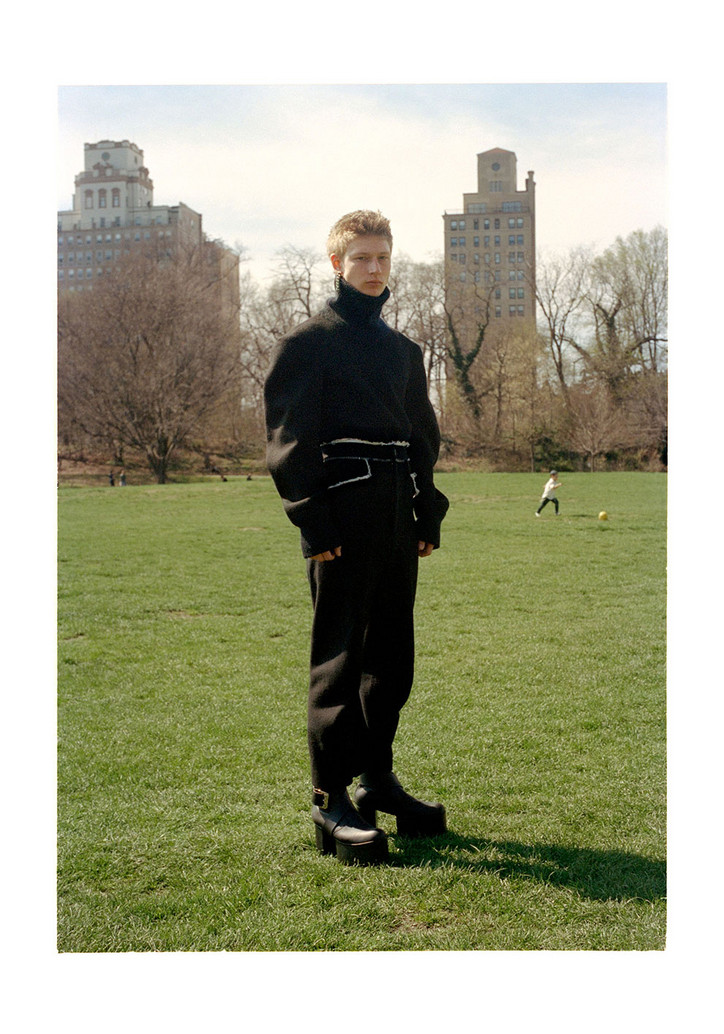
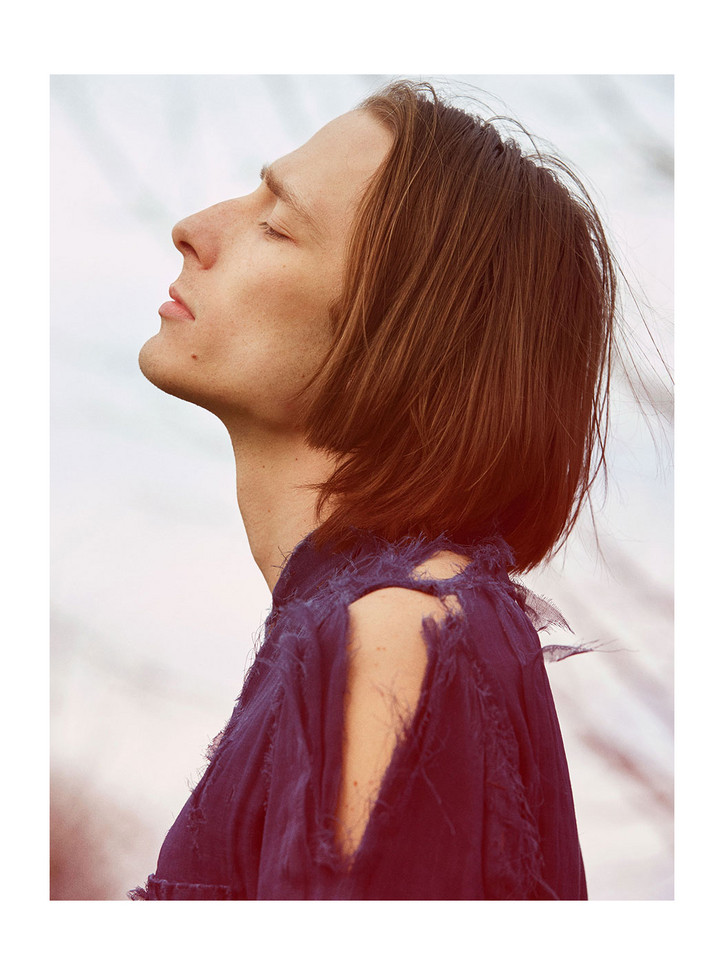
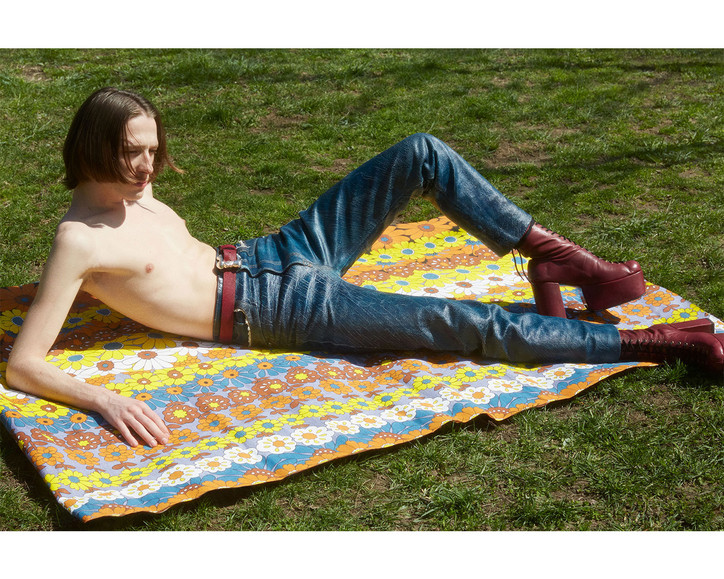
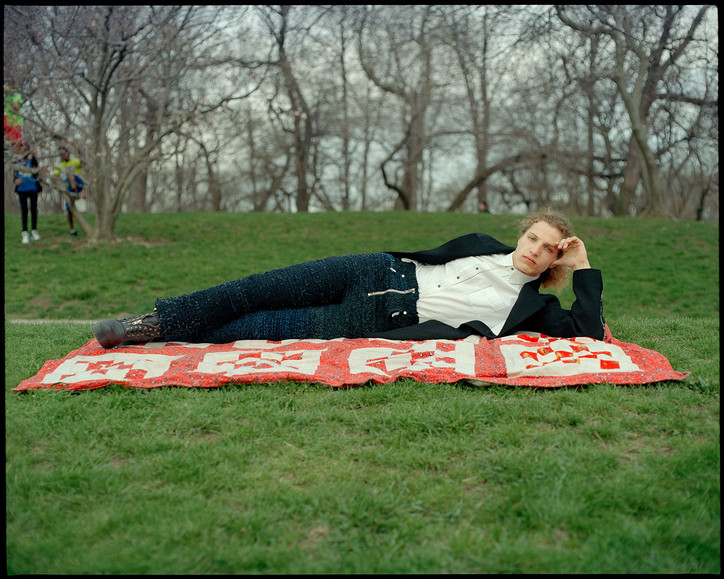
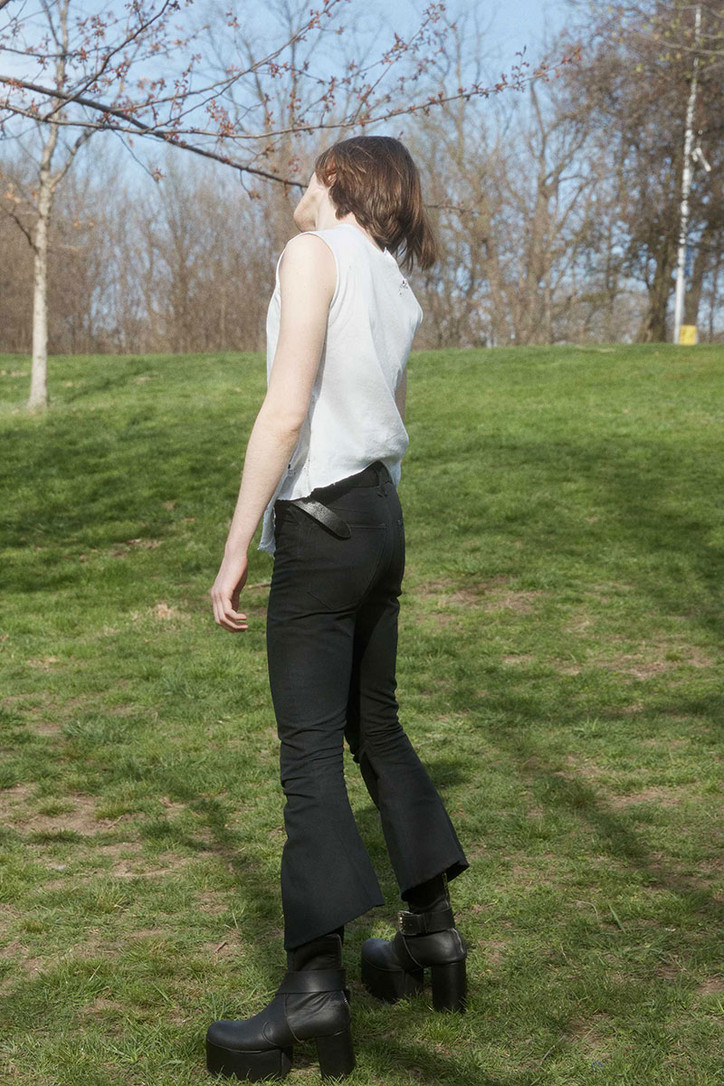
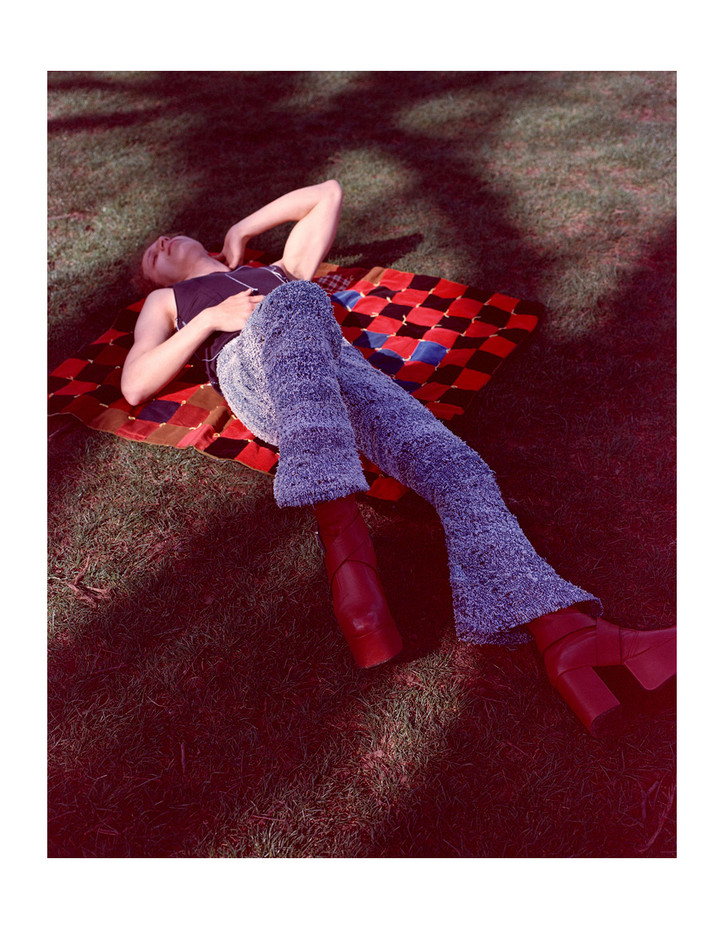
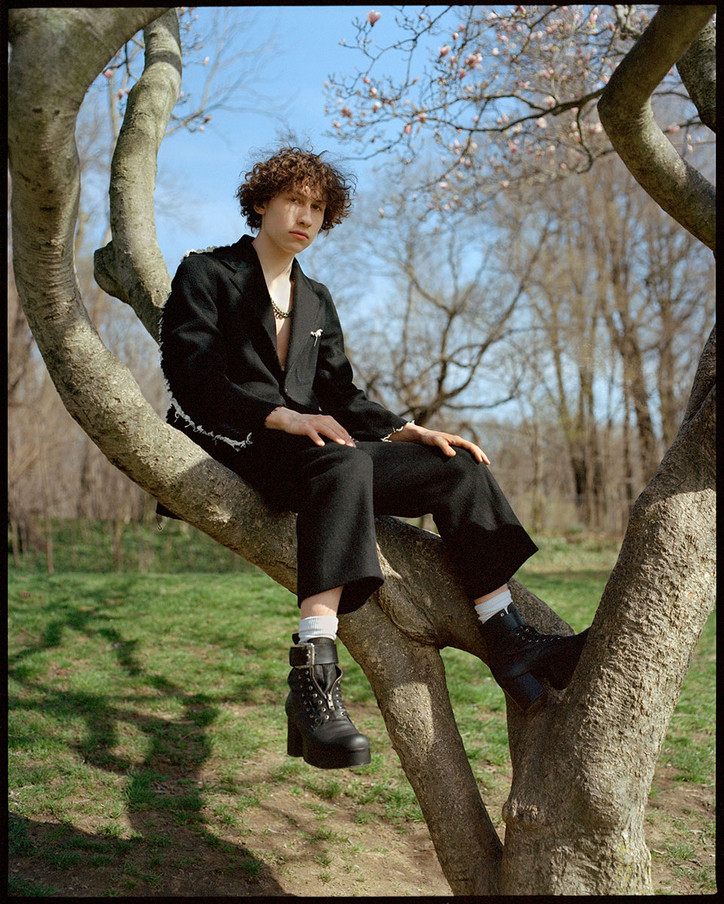
Check out more from the collection below.
Stay informed on our latest news!

Raised in ‘90s Tokyo and trained in London and New York, where he is currently based, Kozaburo Akasaka has gained fast and growing attention for his namesake line of men’s garments, which offset entropic cuts and inventive material treatments with intricate tailoring and a deceptively precise finish. Drawing heavily on the music and streetwear he discovered in adolescence, Kozaburo’s designs are a tangle of narratives, each piece a story composite, yet personal.
Focused even amidst the excitement of his nomination, Kozaburo spoke to us from back in Tokyo, where he was busy overseeing production of his new collection, to be premiered in Paris and New York later this year.


What were you doing when you heard you’d been selected as a finalist?
I was having brunch with my wife, actually. I was very happy when I got the call, of course, but I also was very moved. There’s a lot of difficulty that comes with being an emerging designer in a new country—not just building your brand, but simply living in the US as a foreigner. My wife and family have been very supportive throughout my career, so it’s a nice validation to have this happen after so much effort.
As part of the nomination process, you’ve had to explain your work to panels of experts. Was this an intimidating prospect, given the stakes?
It’s definitely good practice, as this is a commercial necessity for any designer—and of course, my techniques are often complicated, so it was an interesting challenge to explain things in only a sentence or two. It was also nice to see how these influential people responded to the work. But really, the reason I make garments is because I can’t express my vision in any other format. This is the medium I’ve chosen to tell my own story, so I feel that the visual presentation always comes first.
Your pieces are still generally made by hand, one at a time.
Yes. There are some helpers who assist me from time to time, but I typically work on my own, with my hands.
Is this your preferred approach, or has it been more of a practical necessity?
Both. I love the physical process of creating, it’s something I want to keep as central to my practice. But it also reflects my business, which—at least so far—is of a small structure and works with small orders. It’s made sense to do it all on my own. But as things progress and the workload increases, it’s something that will have to be addressed.
Given the intricacy of your techniques, I imagine it’d be as great a challenge teaching them to assistants as it’s been explaining them to panelists.
It wouldn’t be easy, but then, if I can do it, anybody can. [laughs] Because the methods are so hands-on, there would inevitably be slight differences in my results compared to others’—but I like that, because my work is really about celebrating the individual, embracing differences and recognizing the uniqueness of each character. So I think that process would be in keeping with my vision for the brand.


How has this emphasis on individuality translated into casting? Is there a prototypical Kozaburo model, or do your leanings change with each collection?
Generally, I like each model to be different—no specifics for skin color, hair length, or body type. I want to combine individual looks that together create a harmony. Seeing how they carry themselves, you just get a sense that some people fit, that they look great in the clothes and match the vibe of the brand. It’s really more about attitude.
Between Central Saint Martins and Parsons, you spent some time as an assistant at Thom Browne. What was that experience like? Have you retained any lessons from your time there?
For me, the biggest lesson was simple but crucial: You must be true to yourself. In that sense, Thom showed me by his example. As a designer, I really respect how he’s been able to extend his vision yet retain a signature style. Of course, we shared a certain dedication to technique, but more than anything, I was impressed by how he built his brand as an individual. By the time I became interested in his work, around 2007, he had been a guest designer for Milan Fashion Week, where he had a show of forty models wearing the same suit on the runway. To me, that was very punk. It wasn’t only about the clothing, it was about the statement being made. So that was the main impact he had on me—his attitude. I try to carry that same approach today in everything I do.
You’ve said elsewhere that “the timeless design of classic men’s apparel is at the core of [your] aesthetic.” I wonder which elements, material or otherwise, might lend themselves to “timelessness?” In your own designs, has this meant retaining specific cuts, proportions, palettes? Or is it something less tangible?
I think my vision is an honest one. I want my garments to be relevant over a timeline. I look at the past hundred years, imagine the next hundred, and then try to make clothes that I could see people wearing at any point along the way. Part of that is producing items that people have been wearing for a long time and will likely continue to wear: jackets, jeans, shirts. I’m not inventing any new garment categories, I’m just using classic formats and showing differences in the construction and detail. I want my clothes to feel somehow both vintage and current, and to take on new qualities over time as well.
What about your use of recycled materials? Given what you’ve said, one might read that practice as a literal means of extending a narrative—or then again, it could simply be a matter of aesthetic preference, even of finance.
When I’m creating a new collection, I might not know how much of a certain textile to buy, what to have fabricated. Oftentimes, recycled material has simply been more accessible and affordable. At the same time, I do like the notion of the material carrying a unique history, even before I use it. From the beginning, my clothes already have a little bit of age to them, a bit of character—and then, of course, as people wear them, they take on additional character as well. In Japanese, there’s a term called mottainai, which essentially means “waste nothing.” That’s part of how I was raised, “Finish your meal,” and so on. So the notion of “sustainability,” which is such a big word in fashion right now, is already quite natural to me. It’s about using what’s available, recognizing a “soul” in each item, and creating new narratives.

In creating your designs, are you generally inspired more by concept or craft? Do you sketch and then execute? Or do you discover new directions by manipulating materials?
I’ve never been one to make a hundred sketches of something—it’s more about letting the process happen. So let’s say I start with fabric manipulation, but then maybe I realize I’d like to use a certain seam, for which a more durable material may be better. So then I start thinking about what else I can do with that new material. How can I shape it? Is it better as outerwear? From there, the initial idea can change quickly and repeatedly. So really it’s a fluid process, where everything’s developing at once.
Your runway and lookbook presentations have been increasingly collaborative efforts, reflecting the input of stylists, photographers, set designers and musicians. How have these “outside” elements changed the way you saw your own garments?
It’s just a different perspective. Collaborating with outside talents has brought a new way of understanding the work, which I’ve quite enjoyed. Their worlds are quite different from mine—and, as a result, they often see something different in my work than I do. So it’s been quite interesting, incorporating their vision into my own. The result becomes something new, and I’m learning to enjoy that process.
Looking ahead to June, how are you preparing for the final jury presentation? Are you rehearsing your speech, going through practice runs with models?
To be honest, I’m not preparing any specific presentation or speech, because I feel like this whole process has been my preparation. As honored as I am by this opportunity, I still have to continue building my brand. I’m very busy now creating my new collection, doing samples, working on production, talking to the showroom and working on PR. In a way, I feel that doing this work is the best practice I can do.


If you win the Prize, how might you use the money? Are there specific goals it would help you achieve?
The first thing would be to organize a big supper and invite all of my friends and collaborators, almost like a “thank you.” After that, I’d simply invest in my brand. As more stores begin carrying your work, you start thinking ahead towards production and realize how much money is involved. This will always be true, of course, but the Prize would be extremely helpful in taking the next steps.
What kind of insight or guidance would you hope to gain from the mentorships?
I’m not sure yet! LVMH is such a big company with so many experienced people, and I’m sure all of their stories would be useful. I think I could learn a lot of valuable things about business and branding, allocation of budgets. The nice thing about this experience is that it forced me to really look at what I’m doing and how I can get to where I want to go. I’m pushing as much as I can, but I’m still trying to keep it all centered, keep my vision clear and find new opportunities. My priority is my vision, being true to myself while moving ahead. That’s my mindset at the moment.
Read our conversation with fellow LVMH Prize Finalist Molly Goddard.

Molly Goddard’s work often reclaims a traditional feminine aesthetic that has long symbolized, if subtly, the oppression and societal strictures of young womanhood. The British designer’s bright, embroidered smock dresses—baggy, ruched, something fit for a doll—are girly, and yet still leave room for you to breathe, and, if you fancy it, to not be girly at all. Goddard appreciates a youthful sort of anti-fashion sense, finding inspiration in the way kids appear “when they’ve obviously dressed themselves, and are looking a bit mad.” Molly’s artistry perhaps comes from this defiant, almost revolutionary notion that gender-assigned styles can be reinterpreted with the fluidity and freedom of identity that we enjoy uniquely when in the enigmatic state of childhood. “You're not defined yet as a person. That’s what interests me.”


You’ve worked under some really incredible people. What do you think is the most invaluable piece of advice you’ve learned from them?
I think Louise Wilson—I mean, it was often said in a way [that made it] hard to kind of realize what she meant, because it was often shouted out or something—but I think her knowledge was so vast. The thing I’ve noticed from everyone that I’ve worked with has been their amazing memory and knowledge of everything. I think that’s a really important thing to try and have. Also working with Louise, I realized in hindsight that what she was trying to say was, do what you’re really good at, rather than try and change the world or develop newer skills.
When you were working under her, were you making the same type of clothes that you’re making now?
No, I think that’s why I didn’t do very well, because I was trying to make things totally different to anything I’d do normally and that didn’t really work. Yeah, not really anything very me and I think that showed because it didn’t really have any conviction to it, I suppose. I think you need to have a reason why you’re doing it, even if it’s just because you like it.
Do you ever sort of get pushback or any criticism from using the term “girly”?
I don’t know, I think I use it very lightly if at all. I don’t want to be too closely associated to that because I think it has the kind of connotations that aren’t completely positive. But I think it’s a useful, descriptive word. I don’t think it’s a bad word. I don’t know, I guess I’m always keen to not be put into that bracket of pretty, girly clothes. My clothes are a bit more than that. I’d like to think so anyway. [laughs] And I’m not very girly.
I read you’re inspired by kids’ clothes—what were you wearing as a kid?
I wore a real mix of things, like a really pretty white cotton smock dress, and then another day I’d be wearing a tracksuit and a T-shirt and a hat. I was mainly mistaken for a boy. So I think the kind of combination of the two is where it all comes from, I suppose. It’s two kind of extremes brought together. But I was never dressed up to be on display, it was always me having as much fun as I wanted with what I was wearing. And you could see my mom had some fun dressing me up.


You’ve said how much you like the fashion scene in London. Do you feel that it’s better than New York or Paris? How do you think they compare?
I think they’ve all got their own pros and cons. I think Paris is amazing because it’s so over-the-top and grand—it’s kind of the finale, I suppose. But for me, I grew up in London so it’s very much home, and I don’t know, at the moment I wouldn’t want to be anywhere else. It’s exciting doing something professionally in the city that you grew up in. And being able to show at the places that you could never even dream of a few years ago. You know, we did a show at Tate Britain and that was amazing because I’ve always loved that as a gallery space, and I never imagined I would do anything there. It was amazing to have my own stuff in there, even if it was only for a night. It was so exciting. So for me that’s what I love so much.
What’s the most interesting or inspiring way you’ve seen someone style your clothes?
There was a Beauty Papers thing someone did and I thought that was really lovely because it was about skin, and skin through the tulle which was really amazing. I think Tim Walker and Jacob K did a Vogue issue that I loved. They used my stuff in a few things and it was really transformed. There were two shoots—one with Kate Moss which was really romantic and another one which was a bit weirder and darker. And it was nice to see the two in the same issue. Then also my sister Alice Goddard, she’s a stylist and she always uses my things. I always like seeing what she picks because often what I don’t imagine she’d like is what she ends up picking. So I think that’s interesting to see. And we work closely together on the collection.
Is there something you’ve always dreamed of doing with your clothes that you haven’t been able to do yet, whether it’s designing costumes for the ballet, or for a movie, or something like that?
I would love to do a ballet, because I think you do have to think about things so differently, I’d imagine. I would hope to do something very unexpected. I’d probably do something as far removed from ballet clothes as I could. I’ve only been to the ballet once but it was so amazing. Apart from that, I’d love to do more leather accessories, bags—I think that would be fun. We are going to do it but it’s just quite hard.
Is there a material that you would never want to work with?
Fur. I don’t think I’d want to work with fur. There’s such good faux fur nowadays that I don’t think it’s necessary.


Where do you source your fabrics?
All over, really. I do research online and we go to fabric sales. It’s really hard sourcing fabrics actually—I find it’s one of the hardest things. And always the minute you find the fabric you like you can’t get it or it’s discontinued or you need to buy 3,000 meters and you don’t need that much. So I find it very hard, but I try and find core fabrics that we use again and again in different ways. But mainly Italy, and the UK, and Portugal.
What is something—whether it’s a book, movie, or album—that you can consistently turn to for a jolt of inspiration?
I always go to the library at Saint Martins for inspiration. I suppose Vogue—well, Italian Vogue. My sister has loads of Italian Vogue. I never sift through it and don’t find something. Or photography books, like kind of documentary, reportage photographs of people. Tina Barney and Henri Cartier-Bresson and things like that. I always like looking at those books.
What do you wish there was more of in the fashion industry today?
Maybe more money? [laughs] I don’t know, I’d say money because it was really fun when everyone had loads of money to do really frivolous shows. There aren’t many things that are meant to be quite so frivolous as fashion, so I think it’s kind of a good thing to celebrate in that way. But then I also find I’m most creative when I don’t have the money to do something. And we definitely always work on a really tight budget. I suppose I wish there were more of the theatrical shows that there used to be.
Who is the most fun person you’ve worked with?
[I once] did a shoot with Tim Walker for i-D. He took a photo of me and my mom and my sister and then seven of the models we had in the show in dresses and warm coats. That was pretty amazing because I’ve always really admired him and it was nice to see the way he worked. It was a very warm environment to do something in.

An extended version of this interview originally appeared in office magazine issue 06.