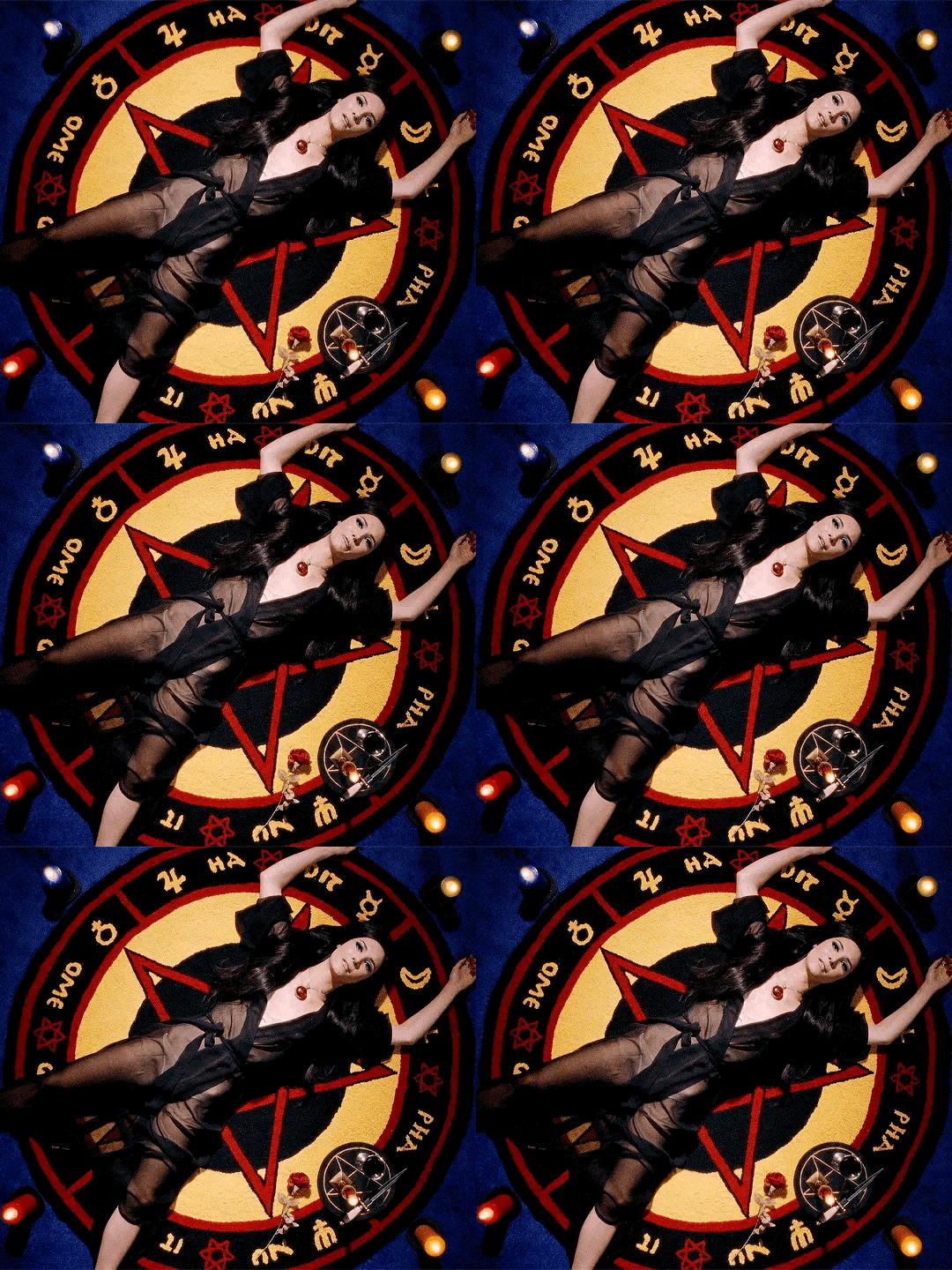
The Erotic Thriller Is Back and Better Than Ever


How did the idea for Night Nurse come to fruition, and what inspirations drew you to write the story?
The idea for Night Nurse came from a scam my grandmother nearly fell for called the "Grandparent Scam." Someone called her pretending to be my brother and told her he'd been in a terrible car accident and needed money. She went all the way to the bank to wire the money, but fortunately the bank tellers recognized it as a scam and stopped her. After that, I became fascinated by these scammers. I was struck by how theatrical their performances were, pretending to be someone else and inventing these dramatic situations. I kept thinking about whether I could turn that idea into a thriller.
At the same time, I've always loved erotic thrillers, especially David Cronenberg's Crash. One thing I admire about that film is how it eroticizes something that's not typically considered erotic. Through a similar lens, I wanted to do that with phone scams. Around the time I was writing the film, I was living in Chicago, where I kept seeing billboards advertising medical school with the slogan, "It's amazing to be needed." That phrase made me think about the compulsive side of caregiving, and it became the perfect way to connect caregiving with the scams that had happened to my grandmother.
You mention that the erotic thriller has largely disappeared from mainstream cinema, despite audiences still being fascinated by desire, obsession, and power, and it’s a bold genre to choose for your debut. Why do you think the genre lost its place, and what made now feel like the right moment to revisit it?
I think the erotic thriller largely disappeared for a couple of decades after reaching a peak in the '90s with films like In the Cut. Part of the reason may be that sex has become so available online. We live in a culture saturated with images, many of which use a kind of pseudo-eroticism to sell things, so people no longer need to go to the movies to seek that experience. To me, that's an opportunity to rethink the erotic thriller. I think the contemporary erotic thriller is characterized by much more restraint. I've often said that In the Mood for Love is one of the most erotic films ever made, even though there's essentially no sex in it. It's built on longing, yearning, fantasy, and unresolved desire. That's what interested me while making Night Nurse, and it's what continues to interest me.
The film is set in a retirement community, which is a particularly tricky setting given the erotic genre it falls into. What drew you to exploring intimacy within a space that's so rarely portrayed as erotic? What challenges did this bring along?
The retirement community is often the hook of the film because it seems like an oxymoron to pair that setting with an erotic thriller. I actually wrote the film to be shot in my grandmother's real house, and that's where we filmed it. She moved there in the 1970s, so the house still has all this '70s and '80s décor—matching wallpaper and furniture, an old landline, alongside a flat-screen television. It contains touchpoints from different eras, which creates this feeling of being unmoored in time. I think there's something deeply unsettling about not knowing exactly what time period you're in, and that feeling helped shape the film's tone. It's also an incredibly pristine suburban setting, and I find suburbia inherently unsettling. There's a long tradition of horror and thrillers exploring that alienation, and I think it was the perfect environment for this story.


I think a lot of filmmakers have trouble portraying desire in a way that's taken seriously today, especially with the rise of the digital world, where information, opinions, and internet humor spread so quickly, and Night Nurse treats desire with psychological weight rather than irony or camp. Was it important to you to reclaim the erotic thriller as a serious genre rather than something people don't always take seriously?
I was thinking about this recently because Catherine Breillat is one of the filmmakers who inspires me most. Part of what makes her films work is that they're in French, which I think is an incredibly beautiful language. I actually think it's difficult to make an erotic thriller—or even a romance—in English because English can sound awkward or corny. That was a real challenge for me.
That's one reason I admire filmmakers like David Cronenberg and Atom Egoyan. They're English-language filmmakers, but they approach these subjects with complete seriousness. While there are moments in Night Nurse that I personally find funny, I wanted the overall tone to remain serious, in the spirit of a Catherine Breillat film. I wanted audiences to sit with discomfort and see what that experience feels like.
The film has been compared to films like Body Heat, In the Cut, Crash, and Babygirl—films I'd argue remain timelessly bold. Were there any filmmakers, writers, or artists outside of cinema that shaped the inspirations of the film?
I've already mentioned many of my cinematic inspirations, so I'll talk about the score.
Stephen and Sam, our composers, created a score I'm incredibly proud of. One major inspiration was Francis Ford Coppola's The Conversation. Although it's a very different film, it uses a recurring musical theme that returns again and again. I wanted to do something similar because hearing the same melody, even as the story becomes more intense, creates this feeling that you're trapped and can't escape. I also listened to the score from 3 Women constantly while writing. It has such an unsettling, strange atmosphere that helped put me in the right headspace. It also inspired us to make the flute a central voice in our score, paired with piano.
The relationship at the center of the film may not be universally relatable, but the psychological experience behind it certainly is, particularly through its exploration of the lengths we're willing to go for love and care. What do you hope viewers take away from the darker side of those impulses?
More than anything, I hope viewers come away with the feeling of the film. It's meant to take you on a ride. It's not a moralistic film, and it's certainly not meant to represent what it's actually like to be a nurse. It's really about interpersonal relationships and the ways caregiving exists within romance, friendships, and families. It's about the compulsive side of caregiving. In many ways, the phrase from that medical school billboard—"It's amazing to be needed"—captures the entire film in one sentence.


Growing up around filmmaking inevitably gives you a close view of the industry, but every filmmaker ultimately develops their own voice. At what point did you feel like you had found yours while making Night Nurse?
Growing up in Los Angeles, it often felt like everyone wanted to work in the film industry. I studied theater in college and originally wanted to become an actress, but one of my theater professors told me I wasn't very good at acting.
Looking back, I think she really saw something in me. That pushed me toward writing and directing, where I ultimately felt much more at home.
After college, I moved to Chicago because I didn't want to return to Los Angeles right away. I wanted to find my own path and make work outside the industry. I'm grateful I did because Night Nurse became exactly the film we wanted to make. I was fortunate to have producers who supported that vision, so I never had to think about commercial expectations or what audiences might want. Ironically, I think the film connects with people precisely because I wasn't trying to force that connection.
Who are some actors or directors you’d like to work with next?
Cemre and I, who stars in Night Nurse, are both obsessed with so many actors. I'd love to work with Isabelle Huppert. I absolutely adore her and think she's remarkable. I also love Julianne Moore and Jesse Plemons. There are so many actors I'd be thrilled to work with, and I hope I'm lucky enough to cross paths with some of them.
If any, what changes would you like to see in the film industry moving forward?
I'd love to continue seeing more original films succeed. This has been a really exciting summer because we've seen original movies perform well, and I think that's incredibly encouraging for independent cinema. I hope we continue to see more funding and attention directed toward those kinds of films. Overall, I think we're moving in a very optimistic direction.
This is your debut feature, and it received significant acclaim after premiering at the Sundance Film Festival. Did making your first feature change your understanding of the kinds of stories you want to tell going forward?
I was really lucky that I got to make exactly the movie that I wanted to make. I just hope to continue having opportunities to do that. I’m interested in continuing to work within the erotic thriller genre, expanding what these films can mean, and exploring how we can make these kinds of movies within our culture right now.