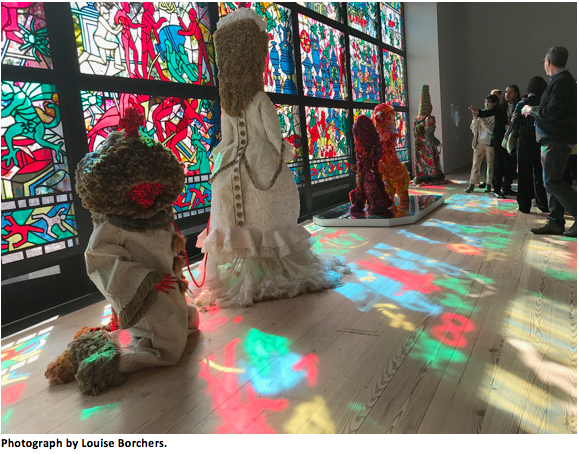
In several other works, the show uses the Whitney's natural light to gorgeous effect. One floor above Nieves’ work, Azad Raza has placed Root sequence. Mother tongue, an installation of twenty-six youthful trees placed in wooden boxes with one full-time caretaker designated to each of the trees. The room is alive with the small-talk and personal knickknacks of the caretakers, while the frail flowers and branches of the trees seem to peer out of the windows, beckoned like all youth by the shiny towers of Manhattan. Outdoors on the sixth floor terrace Larry Bell has installed Pacific Red II, a stunning dotted line of sculptures built from sheets of glass in varying hues of red so subtle you barely notice: darkest where the roof is shaded in the morning, lightest where the sculptures are fully lit by the morning sun.
On the western side of the Museum, Samara Golden has turned the Hudson River view into the The Meat Grinder's Iron Clothes, an uncanny hall-of-mirrors installation of miniature rooms that seem to reflect the dreams and nightmares of American class-based society: the luxury rooms and hotel spas of the upper-class are mixed with the gyms and corporate offices of the striving, stuck middle-classes, and the dirt-caked, doorless toilet booths of the mad or incarcerated.
America is at a bleak spot, the Whitney Biennial seems to propose, and we should sit with the discomfort a little longer. Behind the ticket counter, Park MacArthur has installed Another word for memory is life, two brown aluminum plates with the look of freeway signposts positioned to block out the Museum's informational screens. Apparently, no one will tell us how to find our way out of the darkness.
At the end of Anicka Yi's wondrous film, the expedition crew has mysteriously died and the protagonist is the lone survivor lost in the rainforest. The botanist explorer seems unfazed. She gathers supplies, pushes a limp body off a boat, starts the motor and head up the river alone, pushing deeper into the jungle. Wherever we go from here, it seems, we must pioneer into the unknown, light up the darkness, chart a new path. Luckily, these artists are already well at work.
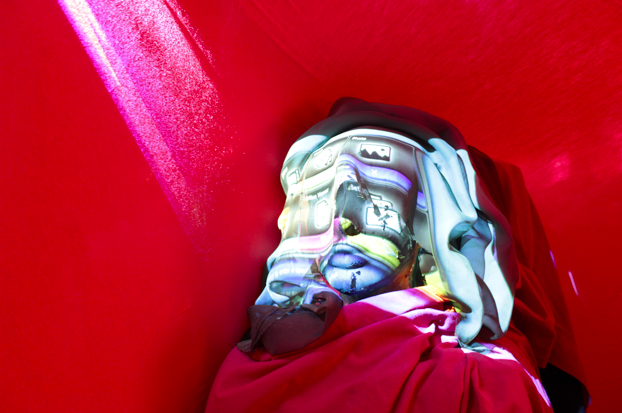
Lead image is a still from The Lesser Key of Solomon, 2015, by Tommy Hartung. Ultra-high-definition video, color, sound; 8:05 min. Courtesy the artist and On Stellar Rays, New York.