PRESENTE CONTINUO: the intimate ties between then&now

Starting May 30, PRESENTE CONTINUO will be available to purchase on presentecontinuo.com, cpcompany.com, and at the C.P. Company flagship store in Milan, Corso Matteotti 7.
Stay informed on our latest news!

Starting May 30, PRESENTE CONTINUO will be available to purchase on presentecontinuo.com, cpcompany.com, and at the C.P. Company flagship store in Milan, Corso Matteotti 7.

The conceptual basis of the show spawns from Eagleton’s grappling with the inevitability of death, an idea that became all the more potent when Eagleton realized he was approaching the age at which his father passed 20 years ago. After learning of these origins, the work becomes all the more fascinating when chronicling the ways in which Eagleton both maintains these ideas and departs from such.
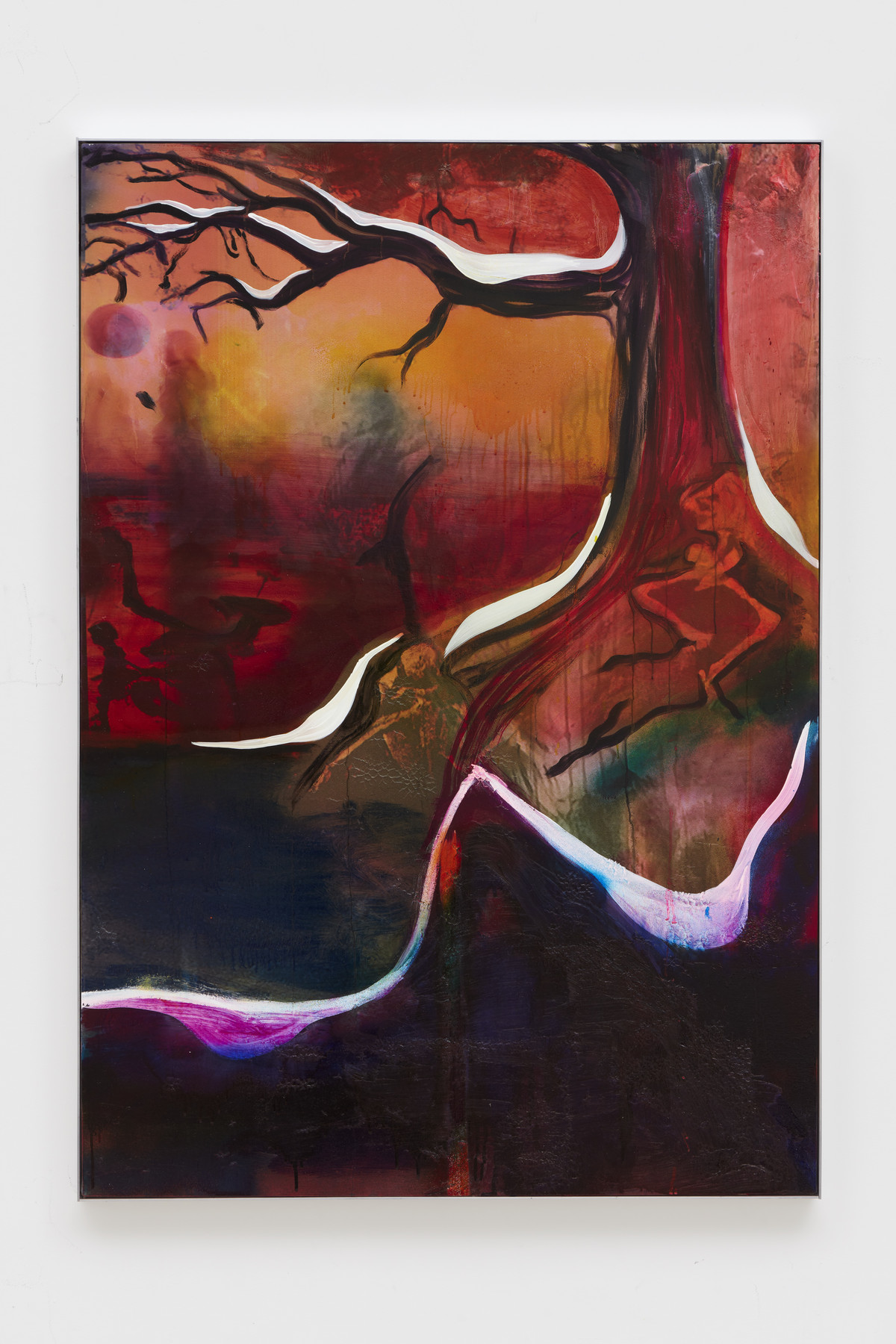
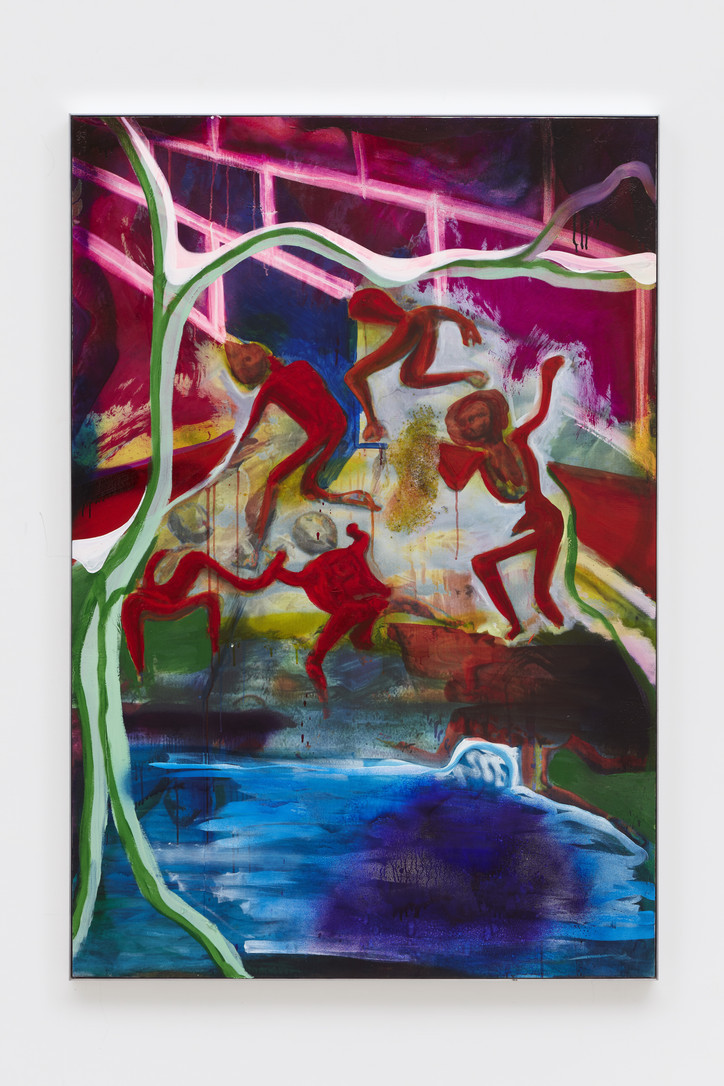
Though Eagleton’s motifs come from the works in his Grandfather’s collection, I find it particularly interesting to consider the his decision to eschew many aspects of these motifs, mainly the religious ideology that would be pervasive in these older works. Instead, Eagleton opts to render those same skeletal symbols as effectively futile, a decision which alienates them from any sort of religious ideology, or practically any ideology for that matter.


Instead, Eagleton asks us to grapple with the infinite uselessness of the human being in relation to its environments, an idea which is emphasized through the beautiful and unsettling landscapes that surround the subjects of the works. This emphasis on setting, maintained both through abstraction and an ethereal palette, effectively humbles the central characters that dance and contemplate in the works, making them seem almost secondary to the natural processes that exist with or without them.


Perhaps then there is an ideology within the work after all. I don’t want to fully commit to saying that the works resemble a nihilist picture, because I think that within Eagleton’s idea of human “futility” there exists a commitment to optimism: the half human - half skeletons continue to dance, in spite of, or maybe even because of the inevitable decay that surrounds them.

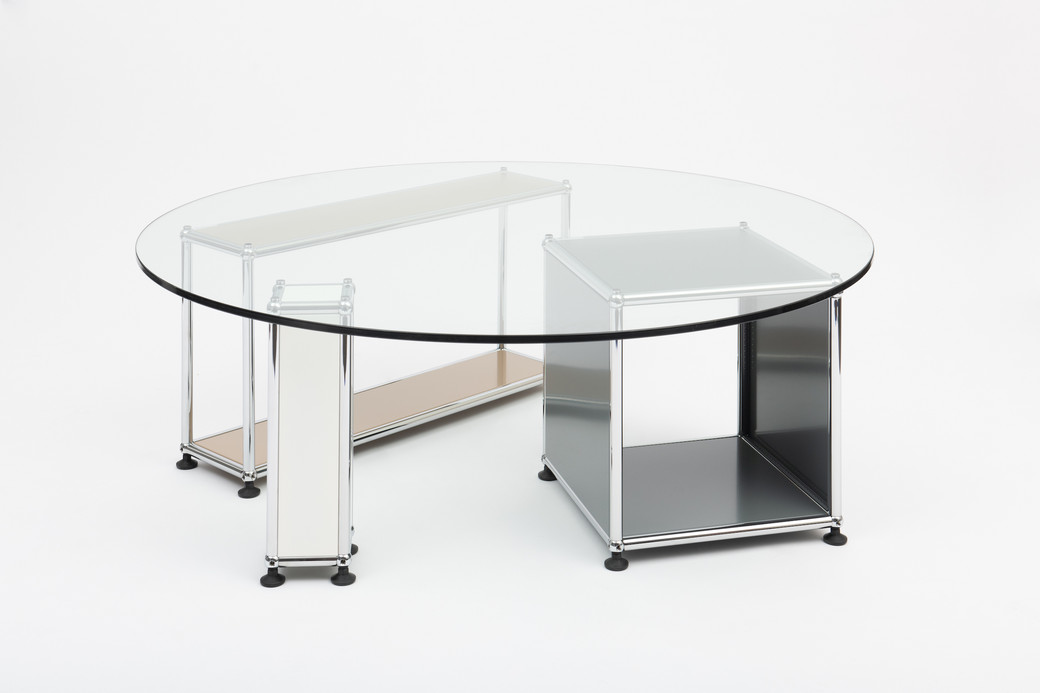
Following the opening of their collaboration last Friday at USM’s SoHo showroom, office caught up with Mercado to discuss the partnership, his creative process, and what it’s like to work with a furniture house that’s been innovating for over 50 years.
Let’s start at the beginning. How did you come to design and get started with your current practice?
Well, I've always made things; I went to school for art direction and design and got into graphic design in my early twenties. I still do it, but in college, I also had a few woodshop classes and that kind of changed my life. I got to really understand the tools I was working with, and then I ended up working at the woodshop. That's where a lot of my resourcefulness started because I was in college and didn't really have a bunch of money to spend on materials, so I was always digging through the scrap bin of the woodshop. I was always making stuff out of whatever people threw away.
It’s still very similar to what I do now — amateur style. I was always in the woodshop. Once I graduated, I didn’t have the woodshop anymore but knew I wanted to continue what I was doing. I had to scratch that creative itch of physically making stuff, so that's when I started exploring leatherwork. The process is similar — measuring, cutting, etc., but you can do it from your house, and it gets messy but not as messy as a woodshop. So I started really diving into leatherwork with small accessories — wallets and belts, hence the name @noel.walletchain.
How has your process evolved since the start?
Recently, I’ve wanted to tap back into my college days of coming up with crazy ideas and making them happen. Now I have all this knowledge of so many different materials — wood, metal, leather. During quarantine, I really used that time to my advantage. I was like, "I have to make something every single week. At the end of the week, I have to have a finished piece." I would make deadlines for myself and then be upset if I didn't hit them. I was pretty tough on myself about that, even though nobody else knew that the deadline even existed. If I slacked off the next week, I’d double it up. I was just always making stuff.
At some point, I started running out of materials — I go to the thrift store to source most of my materials — so I started hitting every alley within three miles of my house. I would track my movement, and it was just zigzag up and down alleys. It was kind of funny. I found a pretty decent chair, and that's kind of how I started with the chair stuff. That chair definitely set it off. I embroidered a Marlboro Camel chair on the back and the seat. After that, I became addicted to finding chairs, which slowly introduced me to furniture design. Whenever I do anything, if I'm actually interested, I go pretty hard on it.
What's the most important part?
Doing what I do, knowing how to do that, and knowing the history of what I’m working on is super important to me. I quickly became a furniture nerd about everything. I'm taking things apart and thinking about what that designer was thinking about and deconstructing it and seeing how this thing was fabricated or assembled. I learn a lot from deconstructing.
I’m also thinking about the other chair you did, “Choice of Champions.” You take something that had a particular function and give it a completely new one.
Yeah, that was a punching bag I found in my alley, actually right down the street... I was walking my dog and was like, "Whoa, perfect." It was after it rained too, so the punching bag weighed like 200 lbs, so I was in the alley with this dirty, wet punching bag, throwing all the stuff from the inside into the dumpster. I was like, "Dude, this sucks." But I was like, "The fabric is perfect." I like mixing the two worlds of high-end, super-expensive design and adding an element of grit and manual labor. Everything that I use is an everyday kind of object. I'm fascinated with production lines, especially the people who are assembling as their full-time job and don't think twice about it.
For USM, when I went to the warehouse, it was really cool to see where it all happens. They don't fabricate there, but they assemble everything there. It’s where everything in the US gets shipped out from. I'm very process driven, so I kind of geek out when I get to see the behind-the-scenes, you know?
What was it like working with a company as well-known as USM, considering that your practice has mostly been a solo act thus far?
USM was really awesome to work with. Everyone was asking me how they approached me. I was like, "Honestly, I just walked into the store." I'm from Chicago, so when I was in NYC, I asked my friend whether there was a USM store nearby and it was right there. I went in, started talking with them, and making art came up, and had a thought that I could work with them if I played my cards right. I showed them the RIMOWA piece that I did with MOBA for Art Basel a couple of years ago and then the seatbelt chair, and I was like, "I would really love to work with you guys one day. That'd be sick." Little did I know that the NYC showroom runs the whole country.
It kind of just jumped off from there, which was surreal because USM isn't cheap. It was crazy engraving on USM panels. Getting materials from the actual source has always been a dream. I got that with RIMOWA, which was great. It's the same feeling of, "Wow, this is completely unfabricated, raw materials that I get to do whatever I want with it." But with USM, it's crazy because it's modular furniture, so the options are limitless. There's no end to what you could do with it. It was like working with a blank page. I worked very closely on the team strategizing not only on design but on what sells the best. I learned a lot about sales strategizing, which I’ll definitely use in future projects, because a lot of it is retail, not just for the artwork. People are considering whether they want to buy this and keep it forever potentially.
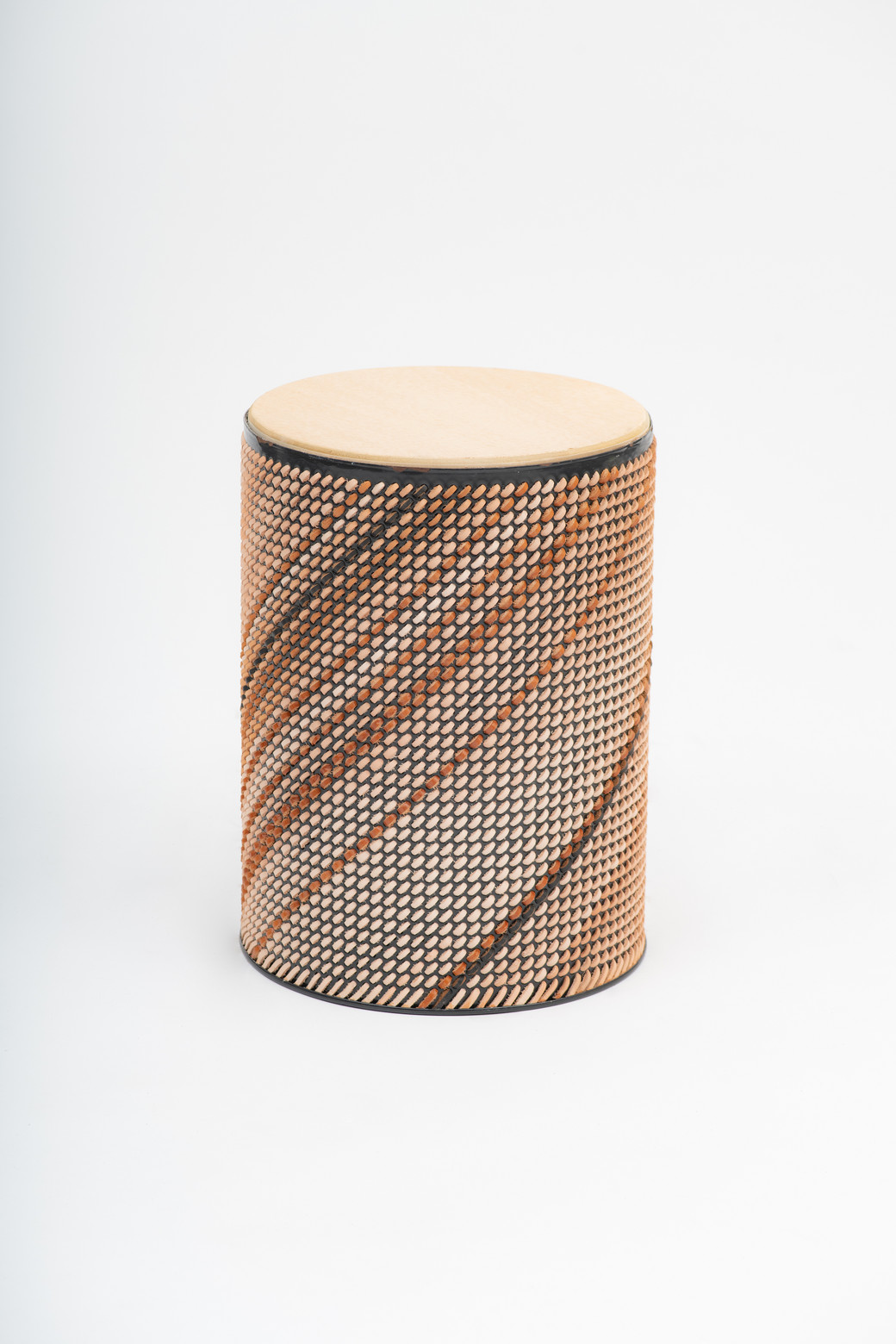
I was working on this project for close to a year. I worked on all the leatherwork throughout. They even gave me a perforated trash can, saying "You could probably do something cool with this. Here you go."
I was going to ask about that one.
I decided to weave it with leather, which took me three days to do. My hands were really raw. They were dry and bleeding by the end, but it came out cool.
You made everything by hand, right?
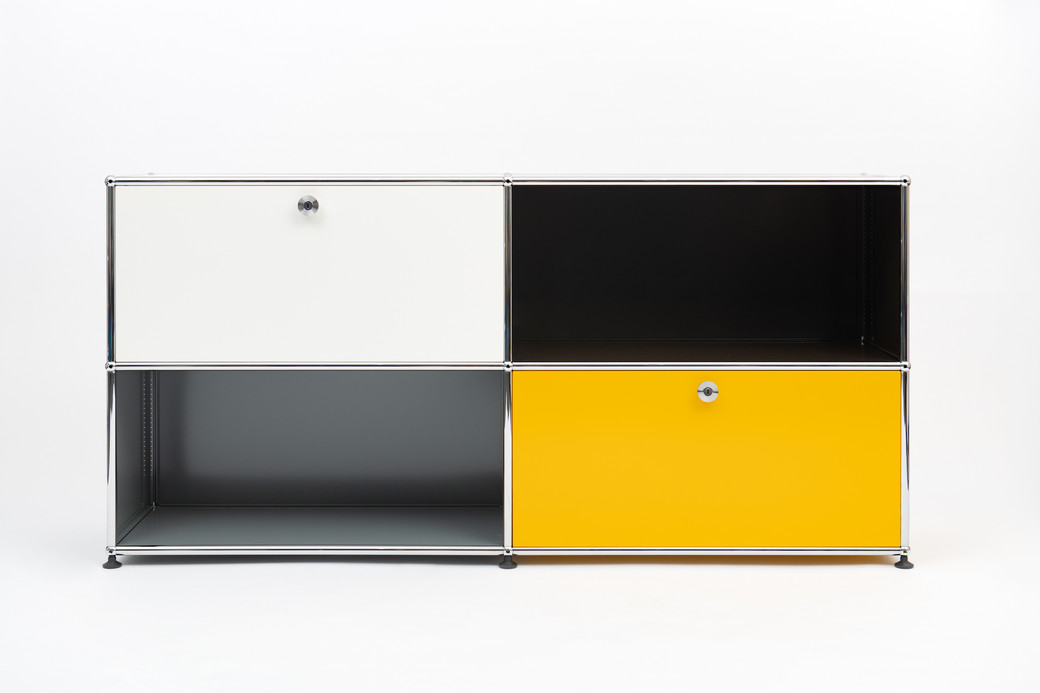
Yeah, except for the bigger furniture, like the credenza. I just designed those and came up with the colorways. The vests, the trashcan, the magazine holder, all of those were tied into this idea of repurposing products that they either just had in the showroom or don't sell that much.
There are 16 vests, and I handmade all of those. That was an experience, making all those vests and how limited they were. And sourcing the fabric. I'm picky as hell with everything I use, so it had to be exactly what I envisioned. Conceptually, the whole wearable tie-in was that in fashion houses, they wear white lab coats, so I made these vests like, "This is what they would wear if USM was a wearable fashion brand." That was the idea, and then matching the vests to the units I designed.
What was it like coming up with the colorways for all the pieces, especially those that will be used as furniture?
Again, I worked really closely with the team. I'm always thinking of the people, what would people actually want in their house, and even what is something I would personally have in my house. I couldn’t pick a color so I picked five colors. I thought about what it's like seeing a car with a different colored door and knowing that person found that door in the junkyard.
I also wanted it to be subtle, having muted areas with pops of color. Having one drawer be yellow and then the rest tan and white. A huge yellow credenza would dominate a space and delegate the rest of the layout, that’s not what I’m trying to do. Visually, if you can reach a good balance, then you're good; you are in a safe zone. That unit you bought is different enough, but it doesn’t clash, it just pops.
Could you tell me a bit about the centerpiece I Can See My House From Here? How did that come about?
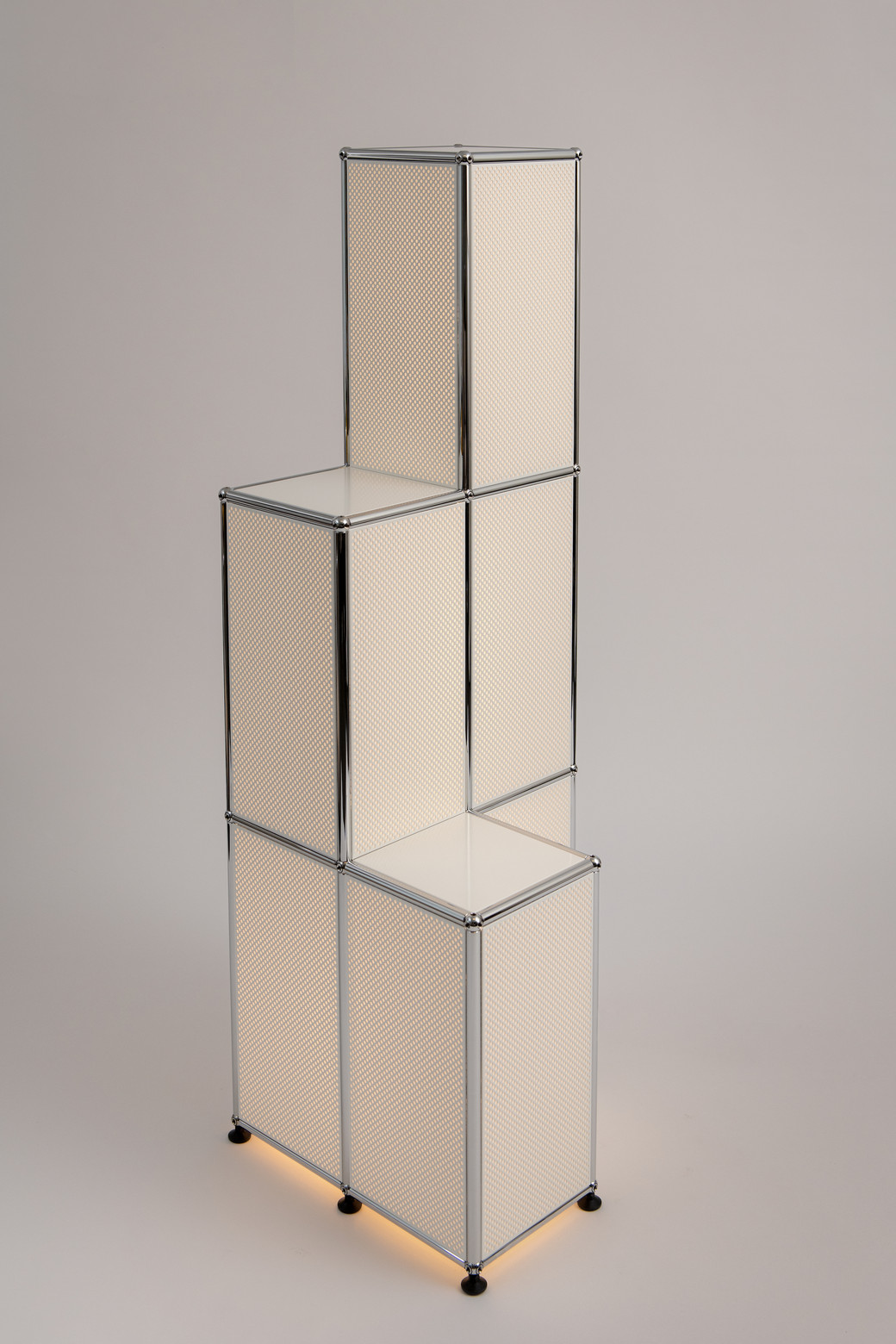
That was one of my original ideas when we first started rendering. Again I had to unlearn this idea of frugality working with USM. Usually, when I make art, everything is coming out of my pocket, so I’m always trying to be as economical as possible. USM just let me go wild. Originally, I Can See My House From Here was going to be triple the size. I wanted it to be a call back to Chicago because I live there. After conceptualizing this wearable aspect, I steered clear of going so big but still wanted people to know I was from Chicago. Mimicking the Sears Tower silhouette can very easily be corny and tacky. If you do it right, like when Virgil did his crazy skyline vest, that was sick. That was a big inspiration. I was like, "All right, Virgil did it maximalist. That was dope, and it looked cool as shit." I was like, "All right. How can I do it? Have the same effect, but—
Minimalist.
Yeah, exactly. That was a fun piece to make. I didn't know if it was going to happen because they've never built a piece like that in terms of the lighting, but we tried it, did some test runs, and it worked perfectly. I was like, "Sick, dude. This thing is fucking awesome. It's going to look so cool." The name came from what it’s like to be in the Sears Tower high up, mapping out where you are — where your house is, and where your friends live. You know what I mean? And then double entendre, I guess, of having this Chicago-inspired piece in New York as a piece of home. I'm like, "Oh, I'm in New York. I can see my house from here. I'm leaving a piece that's Chicago-inspired in New York, a city I love and visit all the time."
There are also those furniture pieces with the potted panel. How did those come about?
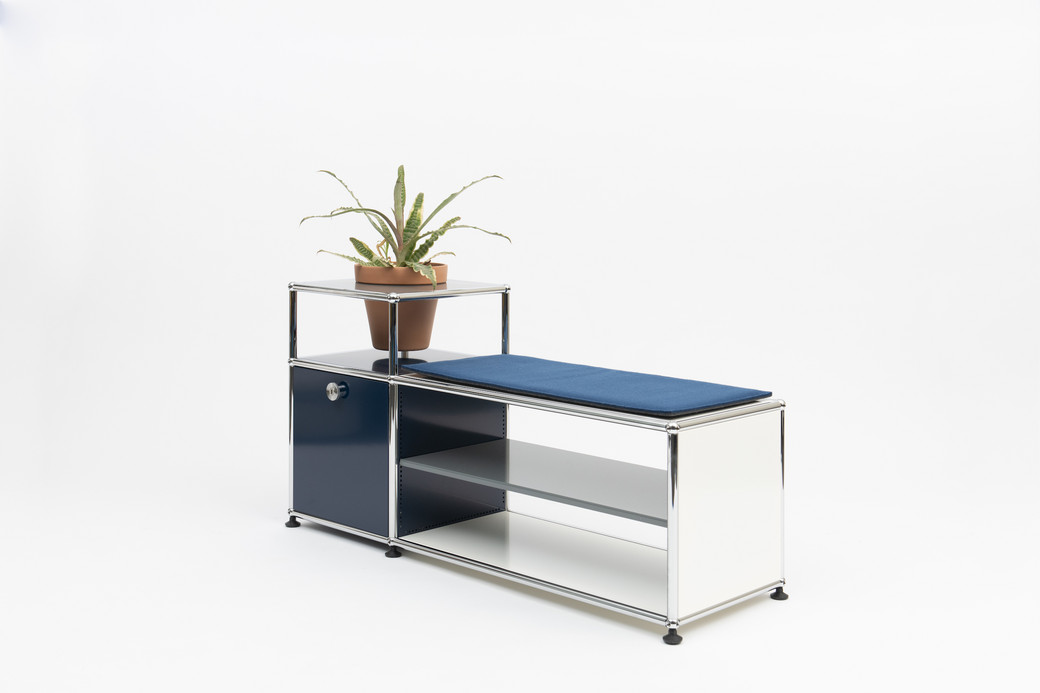
So USM has that as an option. It’s a custom USM pot made to fit into that panel. I kind of unintentionally always incorporate plants in my work if I can. This idea of my work actually living. I made a bootleg Louis Vuitton vase once, and I was like, "This is cool in terms of function, what it's made out of, and that it's something that has a life of its own because it's a vase.” You're always buying new flowers for that specific vase. Again, the life aspect of it is really interesting to me. That piece is called Take Off Your Shoes and Water Your Plant.
My idea was to have it as the entryway bench where you sit down and take your shoes off or put them on, whatever, because you do that most days, and it would prompt you to water your plant because it's right there. That was a fun piece to be able to incorporate something that I've already been adding in pretty organically, so it was dope. That's my favorite one.
What was it like working with both mobile and stationary bases?
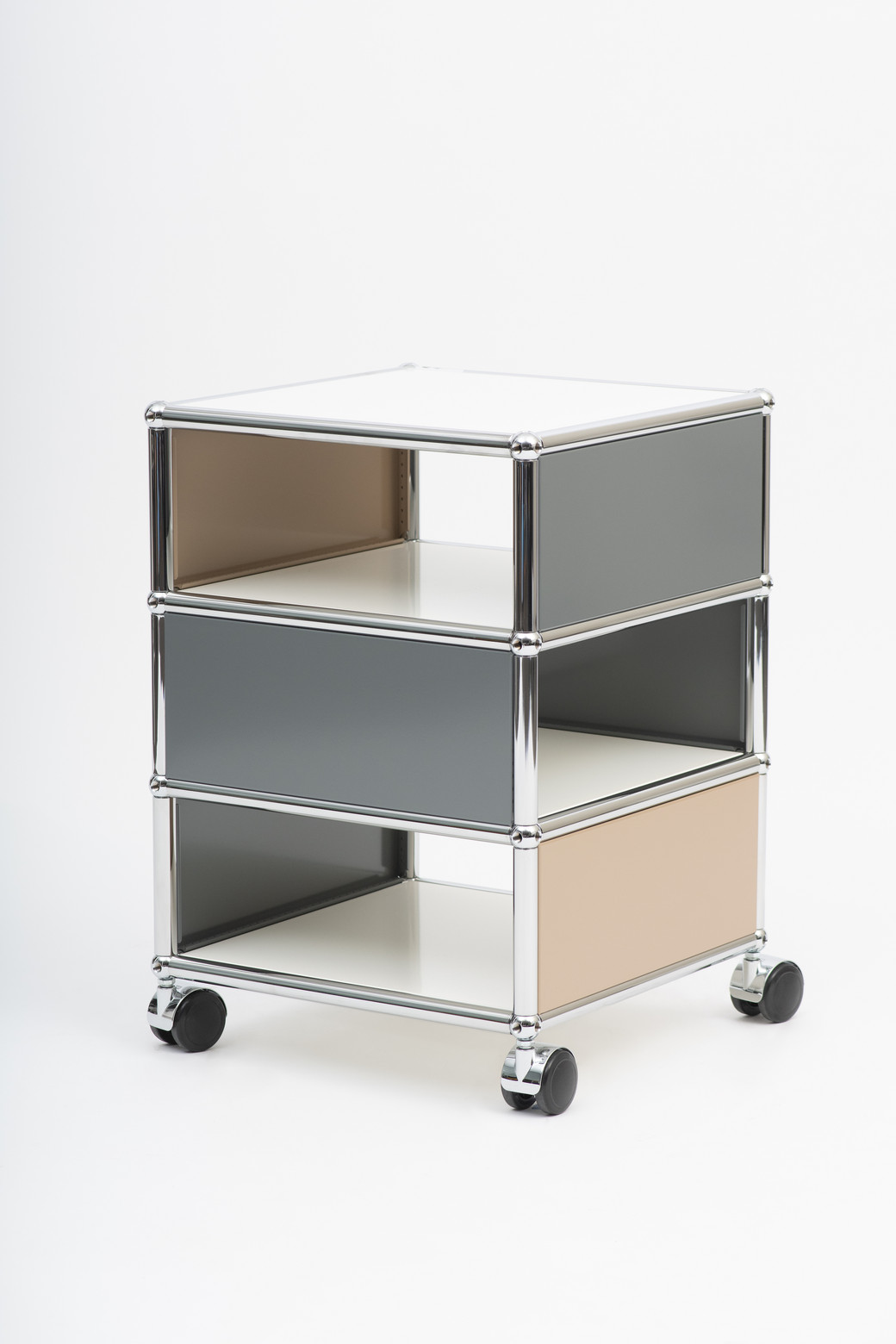
A few of the pieces in the show were inspired by some vintage designs that I personally use. The wheeled shelving cart that I did was based on a trolley by Joe Colombo that I have at my studio. The one I made is called When I Move, You Move because I literally drag the trolley I have at my studio around when I'm painting on a canvas or have my tools on it. It’s behind me the whole time. I wanted it to be extremely functional, with this idea of mobility and maximizing its functionality and using it as a tool more than anything. Almost like it’s alive and working with you.
What was the opening like last night?
I mean, it was a lot of work, but it was great. I got in on Wednesday morning, came straight to USM, and didn't leave till 9:30 p.m. I was here from 12:00 to 9:30 p.m. I was in the basement where I'm right now and still sewing the vests at 9:30 at night, the day before the show. It wasn't stressful because I knew I was going to get it done, but I had to make some alterations to all of them. It was definitely down to the wire in the best way possible where I was like, "All right, cool. We're going to get everything done right on time."
The opening was fantastic. I got to meet many Instagram friends and people I'm a fan of — designers, creatives, and people I didn't know followed my work. It was cool interacting with everyone, meeting people, and just seeing people interact with what I made. I spend so much time with what I make that I get so used to it. When people are like, "Oh, you hand engraved this?" I'm like, "Yeah." A lot of people think I have things made, especially with garments. I'm like, "No, I made everything, literally everything. I was very close to everything that everyone saw. The turnout was fantastic. I was really, really grateful all the way around, just the opportunity, the city, not being from New York, and having the crowd that came out, it was awesome.
Do you have any projects coming up this year that you can tell us about?
I have some stuff happening back home but nothing that's as work-intensive as this. I'm going to be doing some collabs with some friends on garment pieces. A friend of mine in Chicago runs this thing called Print Object. Her name's Anna. She's giving me this opportunity to make whatever I want, pretty much, and then have it available to sell online, which I usually don't do. Not intentionally; I just have to figure out how to make a web store, really. I'm excited I've also always wanted to do this conceptual sculptural base type thing. It's just some one-off things, but yeah, nothing too crazy. I'm probably going to take the month off.
Yeah, I mean, after this, you should.
Yeah, I definitely need to chill out for a second.

Now, Pink Essay is taking its mission global with Educación Física (Physical Education III), held on March 25 at FÁBRICA in Mexico City. The international iteration brings together an eclectic mix of designers, artists, and interdisciplinary creatives, offering a rich snapshot of CDMX’s thriving creative landscape.
Ahead of the opening, David and Matt sat down with Office to reflect on Pink Essay’s journey, the significance of bringing “Physical Education” to an international audience, and what’s on the horizon for the duo this year.
First of all, it’s major that you’re curating your third "Physical Education" show. Are you both excited?
David Eardley— Yes! It’s amazing seeing how the exhibitions and “Physical Education” concept has developed and evolved since the first show that Matt directed back in 2021.
Now we’re a bit more geographically separated. With Matt in New York full-time and me in both CDMX and New York frequently, we’ve been able to expand our physical reach. Matt has been coming up with some great ideas that speak to the New York community, while I’ve been focusing more on our international relationships and communities.
How did the “Phys Ed” concept even come to be? What was your vision for it?
DE— We defined Pink Essay as “a creative studio and platform celebrating radical design subculture.” Education has always been a big part of our exploration of design, as we both come from autodidactic backgrounds. I used to teach design thinking at an elementary school in Brooklyn and, even though I don’t teach full-time anymore, it’s still important to me that we built spaces for learning that foster a passion for design.
Matt Pecina— So much of what we do, I feel, is turning these pre-existing worlds on their head, flipping the script, taking something solid and seeing it from a different point of view. Phys Ed. came about very much in the same way. It's quite simply a play on words, a play on the concept of physical education. In the literal sense when we design we are learning physically, we are working in the physical space, so much of building and fabricating is our bodies interacting with objects and there is this give and gain that we like to see in the work we show.
I know for me I think a lot about high school ‘P.E.’ class and this idea of a huge group of kids all in the same gymnasium, not in competition with one another, but in practice with one another. Phys Ed. continues to be just a fun concept to explore.
How has it evolved since the start?
MP— Well like most of my ideas, it actually started when we were all brainstorming ideas for a t-shirt graphic. David made the first connection between PE (pink essay) and P.E. (phys ed.).
The first Phys Ed. show was 10 artists in my small storefront studio in LES, and since, it has mainly evolved with growth, and expansion. This Mexico City Show is testament to that.
It’s also your first show in Mexico City, right? What’s it like being part of and cultivating a community there?
DE— Our first Pink Essay show, yes! I independently curated an interdisciplinary exhibition that fell more under the “material arts” in February of last year, with a fantastic progressive art space called avant.dev. Some of the artists featured in that show are in this one as well!
I think that with any place that you get to know, there is a certain level of watching-and-learning that is involved. The past year and half, I’ve been focused on getting to know the design/furniture-adjacent communities here, forging relationships, taking intensive Spanish classes (shoutout to my profe), and visiting dozens of spaces to better understand CDMX’s relationship to furniture and the climates of the art and design communities here.
It’s an incredible city with a rich history of design that dates back to the 1300s, when the Aztec people founded Tenochtitlan, and it will be many more years before I feel like I even have a decent grasp on understanding the city’s identity, but building relationships and learning from the established design community here has been the first step in that process.
It’s also integral to our work to understand Mexico’s relationship with the international design community, and I’m grateful for the many conversations I’ve had with people here with far more experience than me. There is so much to learn and I’m so excited to be engaging in that.
So much of what Pink Essay does is online, but I also love how much care goes into the exhibitions you put on. What part do these in-person activations play in the broader goal of democratizing design culture?
DE— One of my favorite pieces of feedback I’ve ever heard from a member of our “designhead” community is that one of our exhibition openings was the first time that they had felt welcome in a design exhibition. I want Pink Essay shows to be places that people feel safe to explore their love for furniture design – to be able to dialogue about it without fear of being made to feel excluded or unwelcome by the aura of exclusivity and over-the-top luxury that can often characterize design spaces.
MP— I would go as far as to say that it’s the offline in-person activations that truly do the real good work. It's like any revolution: all theory til you take it to the streets.
Your most recent exhibition Wear Your Chair seemed like a great success, and I hope to see more of that series, but I’m curious to know what we can expect to see with Phys Ed this time around.
DE— For the first Physical Education show Physical Education: Parallax 101, Matt took the lead curatorially. For Phys Ed II, we worked as a team along with our previous collaborator, Anna Theroux Ling, who recently founded her own creative project, MARUCHI. This time, I curated the exhibition solo, with support from the creative community in CDMX – I know nearly all of the exhibitors personally and can vouch for them not only as talented creatives but as great people.
It was important that the exhibition focused on promoting a diverse portrait of the furniture scene in CDMX, so the exhibitor list is made up of furniture designers, fine artists, clothing designers, and more, each bringing their unique perspective and identity to the show.
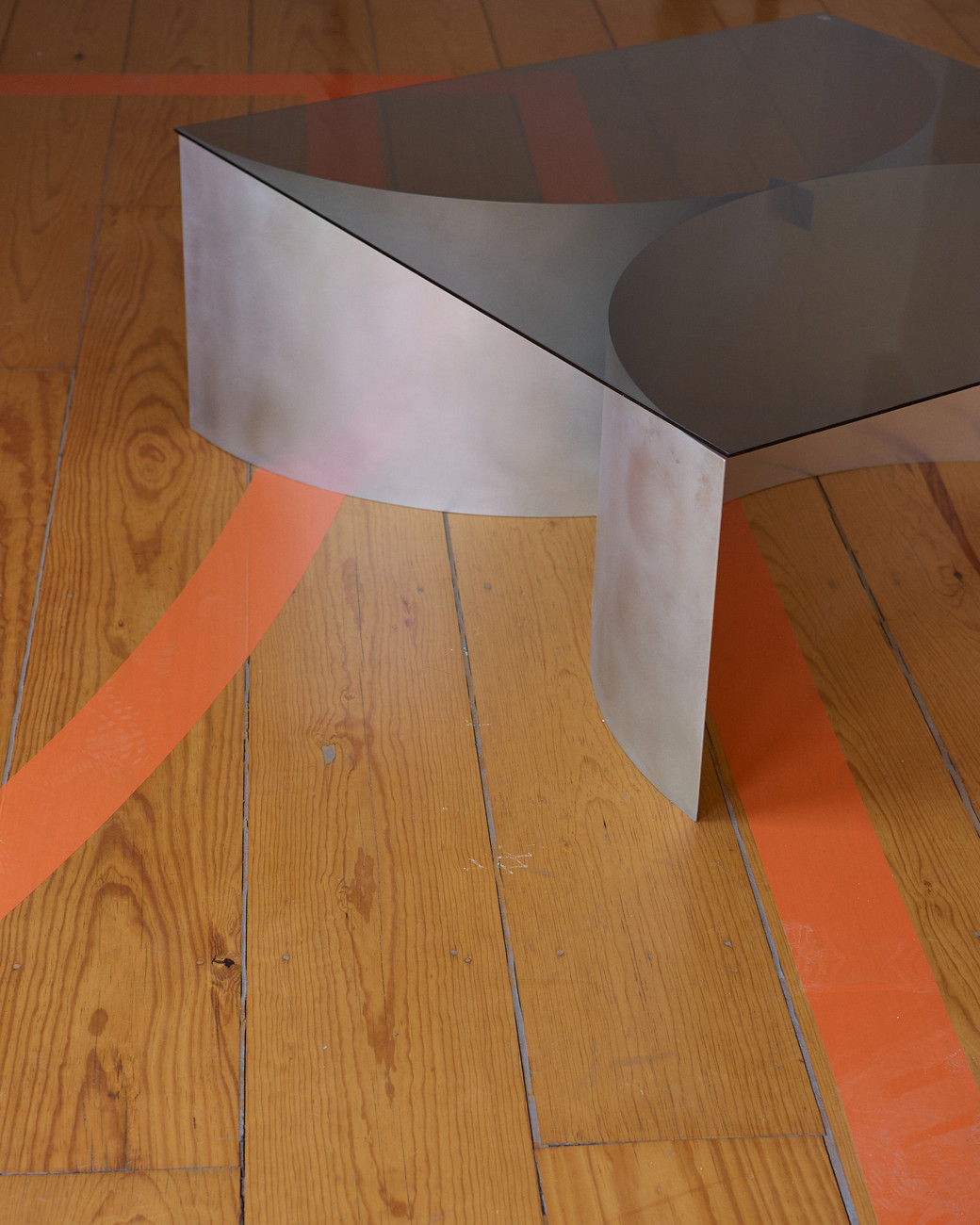
We have also continued to play on the double meaning/connotation of “Physical Education,” installing a gymnasium floor in the gallery space and exhibiting a projection of archival sports and design footage mixed with process video of the objects being exhibited.
How long did it take to get this one together?
DE— The idea was cooking for awhile – since last summer – but it really came together when we began our relationship with FÁBRICA and founder Darryl Richardson agreed to share his space with us, a little over 2 months ago or so. This is our fifth exhibition – we’re not experts by any means, but we’re used to making things happen quickly and our scrappy style allows us to move pretty nimbly when it comes to producing a show.
Why FÁBRICA? How was it collaborating and prepping the space?
DE— I first visited FÁBRICA for Salim Green’s solo show 1 (Phantom) last autumn. The space itself is so striking and Salim’s show was perfectly installed in balance with the architecture. Darryl, the founder, and I have some friends in common, and I had met him earlier in the year at another exhibition. Darryl has a grounded energy and similar outlook to the kind of space he wants to create, and it felt to me like a sign that the show needed to be here.
It’s been an adventure prepping the space! But I’m grateful for Darryl’s flexibility and endless patience, and the professionalism and kindness of all the exhibitors involved. It truly takes a village to make something like this happen.
My favorite part has to be the gym floor – seeing it in the gallery just brings an additional sense of fun and joy to the exhibition.
How did you find the 21 furniture artists and designers featured in this iteration?
DE— Most if not all of them are a part of my community here – the art and design scene is large but feels small at the same time, and I often run into people I know when I go to openings or design/art-related events.
With all of our exhibitions, we usually start with furniture designers: whose work is catching our attention? Once we have a core group of furniture designers, we build out an exhibitor group by asking, “Whose perspective would raise the level of the show? Who is making work outside of furniture that is innovative and intriguing?” Through this process, we’re able to create a rich and varied exhibition that is unlike many others.
What’s it like being able to collaborate with like-minded creatives through Pink Essay?
DE— I think it all comes down to collaboration – it’s really the best part of it all. The magic lies in finding that our community of “designheads” exists everywhere you go. When you can make something together, the "sum is greater than the parts" rule usually applies, and I love seeing what happens when we can share our vision with more and more people.
MP— Agreed. It's the community that makes it all worth it. Since joining Pink Essay, I think I've had the best conversations and connections with other creatives than ever before in my life.

So, what’s next this year?
DE— Some exciting things! In May, we’re relaunching our interview series “Designheads” as a full-blown publication on Substack: think 90s subculture magazine, if the topic was furniture. I can’t wait to show everyone what we’ve been working on!
And then! In August, we’ll be mounting Physical Education 4, in collaboration with Holly Rollins of ROLSTUDIO and Armand Da Silva of Time & Space, which will take place in London.
MP— I’d love to put on another "Wear Your Chair" show in NYC. It would be sick to get that in this year as well.
That’s both so exciting! Can you tell us a little bit about the first issue of the newsletter? When can we expect it?
DE— Back when Pink Essay first started, I used to write a monthly newsletter that contained interviews with designers and artists working in the furniture scene. We took an extended break from it, but I’ve always wanted to have a publication as part of the Pink Essay brand. My work outside of Pink Essay is editorial and copywriting, so it feels natural.
We started doing this series of profiles on our blog last year called “Designheads,” with questions about people’s relationships to furniture. The series was well received and, as someone who’s always been obsessed with the 90s golden era of print magazines, I wanted to create a publication that has a bit of an irreverent take on furniture than you typically find in your everyday interiors magazine. Expect interviews with designheads, chair astrology, AI design, and more. I’ve been working with a fantastic group of creatives to bring it to life and think it’s going to offer a truly unique take on the world of furniture.
How does it feel getting to this point with the platform and being able to branch out in new directions?
DE— It feels like – I don’t want to say growing pains… more like a growth spurt. The beginning of the next phase of our existence. I think it’s a bit intimidating but exciting: to see the world we’re creating take on a life of its own. This feels like just the beginning.
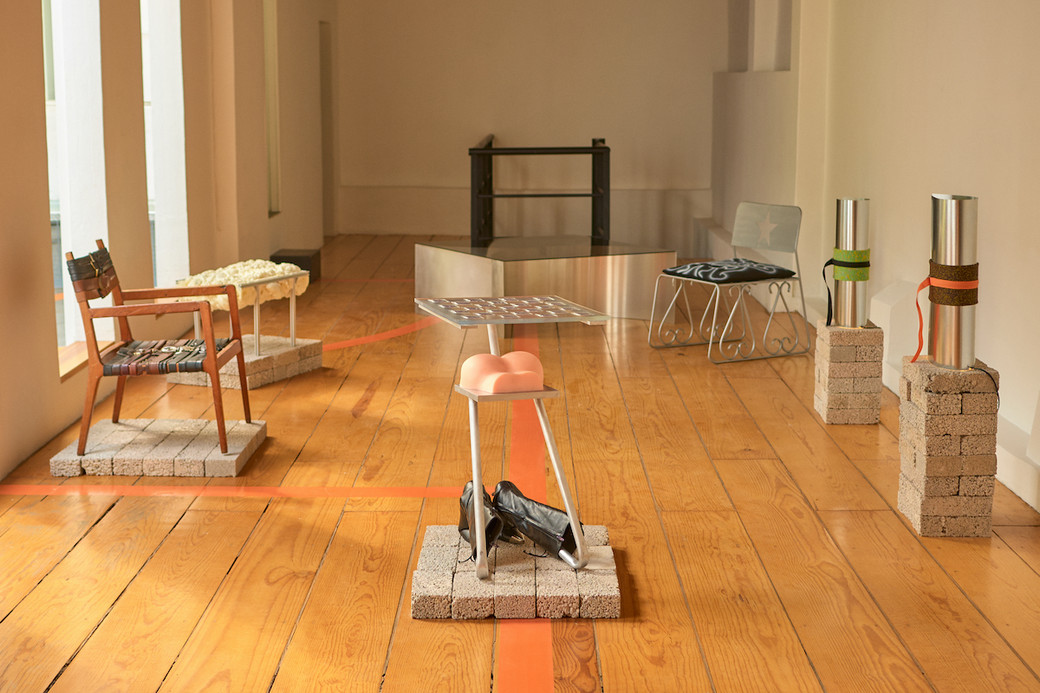
Check out images from the exhibition below, now on view through April 8 at FÁBRICA in CDMX.