PRESENTE CONTINUO: the intimate ties between then&now

Starting May 30, PRESENTE CONTINUO will be available to purchase on presentecontinuo.com, cpcompany.com, and at the C.P. Company flagship store in Milan, Corso Matteotti 7.
Stay informed on our latest news!

Starting May 30, PRESENTE CONTINUO will be available to purchase on presentecontinuo.com, cpcompany.com, and at the C.P. Company flagship store in Milan, Corso Matteotti 7.

Cover image— "Untitled I," 2019
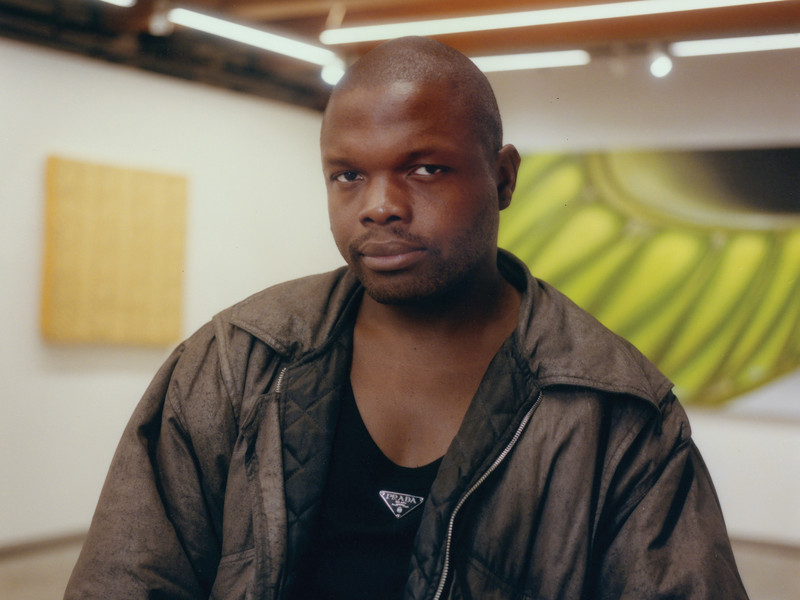
I am the artist Lance de los Reyes. I have a close brother Nemo Librizzi who has tolerated my flaws as I have matured into a man who loves his family/friends. Nemo had an idea for me to gather myself for a moment, as he gifted me the privilege along with office Magazine to write a POV on Julian Schnabel’s new body of work and what the name Julian Schnabel means to me. I love and understand the gifted curse of being an artist, living up to the challenge of chaos and order that entertains those amused by our faith. I have based the contents of the following text off of my personal connection with and within the myth of Julian Schnabel. I would not be an artist today without this story.


Left— "Preschool and Afterschool," 2018; Right— "Lagunillas III," 2018
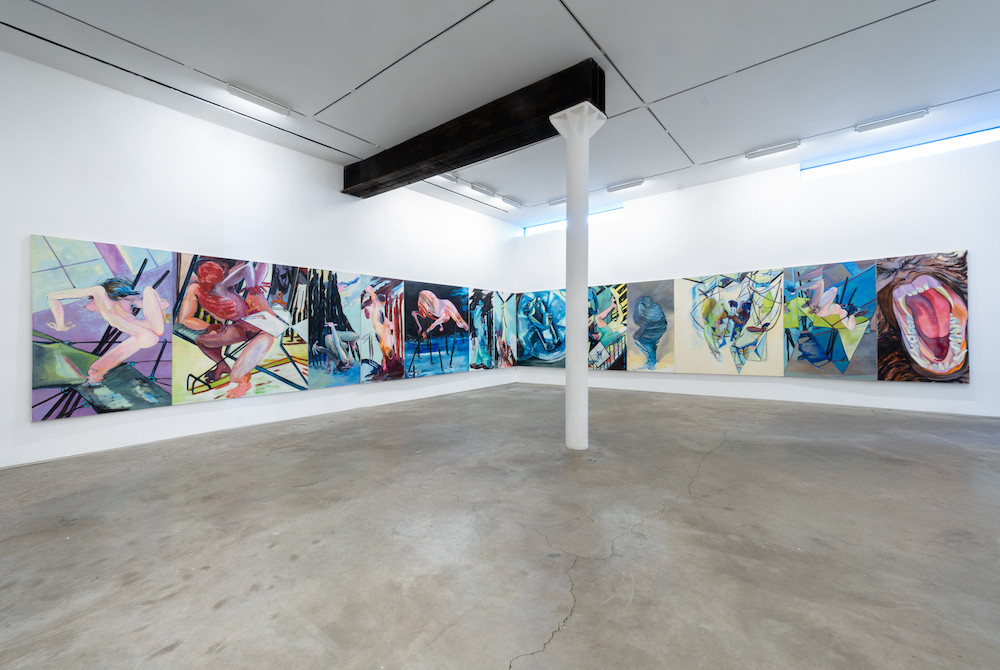
Julian has a name that echoes throughout the creative art world, and when I watch his interviews and films, I hear the artist saying things I relate to such as the time he said, “I don’t know what makes someone do something, but I believe probably the optimism, and love, and the blind faith that they had.” Schnabel’s new body of work at Pace Gallery is modern-day proof that a sophisticated renaissance master is among us. The paintings give birth to the idea of a human as a conduit and a conductor who is channeling landscapes that are represented by marks. These marks leave clues or hints of a conquest on the surface of the paintings, thus proving the legacy is fulfilled in this blind faith that Julian spoke about. I feel that Julian very much is proof that great forces are chosen to leave legacies. This is important to me as I constantly feel alone and, at the same time, protected by unseen forces. Julian Schnabel also said, “I mean I guess when god created the world, he maybe got a little tired at the end so he only put a certain amount of things in in the course of those seven days, and maybe poetry was something that he left out and he left that for humans to do.” Representing transformation as a contributor to the challenge of becoming an archetype, I would set off for New York in the early 2000s. Being misunderstood, loved and hated, I have always studied the names I find worthy and that seem to hold space as their work creates memories, basically spiritual weight, in my mental rolodex. A shaman once whispered to me in a ceremony, “Lance a Shaman is a showman.”


Left— "Lagunillas II," 2018; Right— "The Patch of Blue the Prisoner Calls the Sky I," 2019
I believe that men and woman do the work of gods and that there are mothers who are guardians as none of us is greater than all of us. I also believe that the work proves love and life are to be shown the utmost respect as legacy, myth, and avant-garde are all being carried out and shown in humans through their work. I feel internally inspired by Julian as he also said in an interview, “It’s a privilege to actually have the opportunity to engage in something that is the antithesis of reason.” There is an innocence in the layers of paint gestures on these new paintings as ghostly forms seem to present themselves. The palette feels like the key to maps, as it is possible that there is a governing council above us, and they are amused by Julian’s contributions to our modes of creation and have chosen him to represent the archetype of a human who does the work of the gods. What the name Julian Schnabel means to me is that we follow the path of least resistance and that we relearn the obligation to within the work of our heart and, somewhere during the process of life, realize that it’s very simple. It is simply life and death, and everything in-between is the abstracted truth that gives birth to the spiritual territory we fight for to prove that legacy is a mere myth as we were once dared to create alchemy and, it's possible, we dared ourselves. As contemporary artists, it is important to pay respect to living masters while perfecting our own craft in contribution to the modes of creation.


Juanita McNeely — James Fuentes Gallery
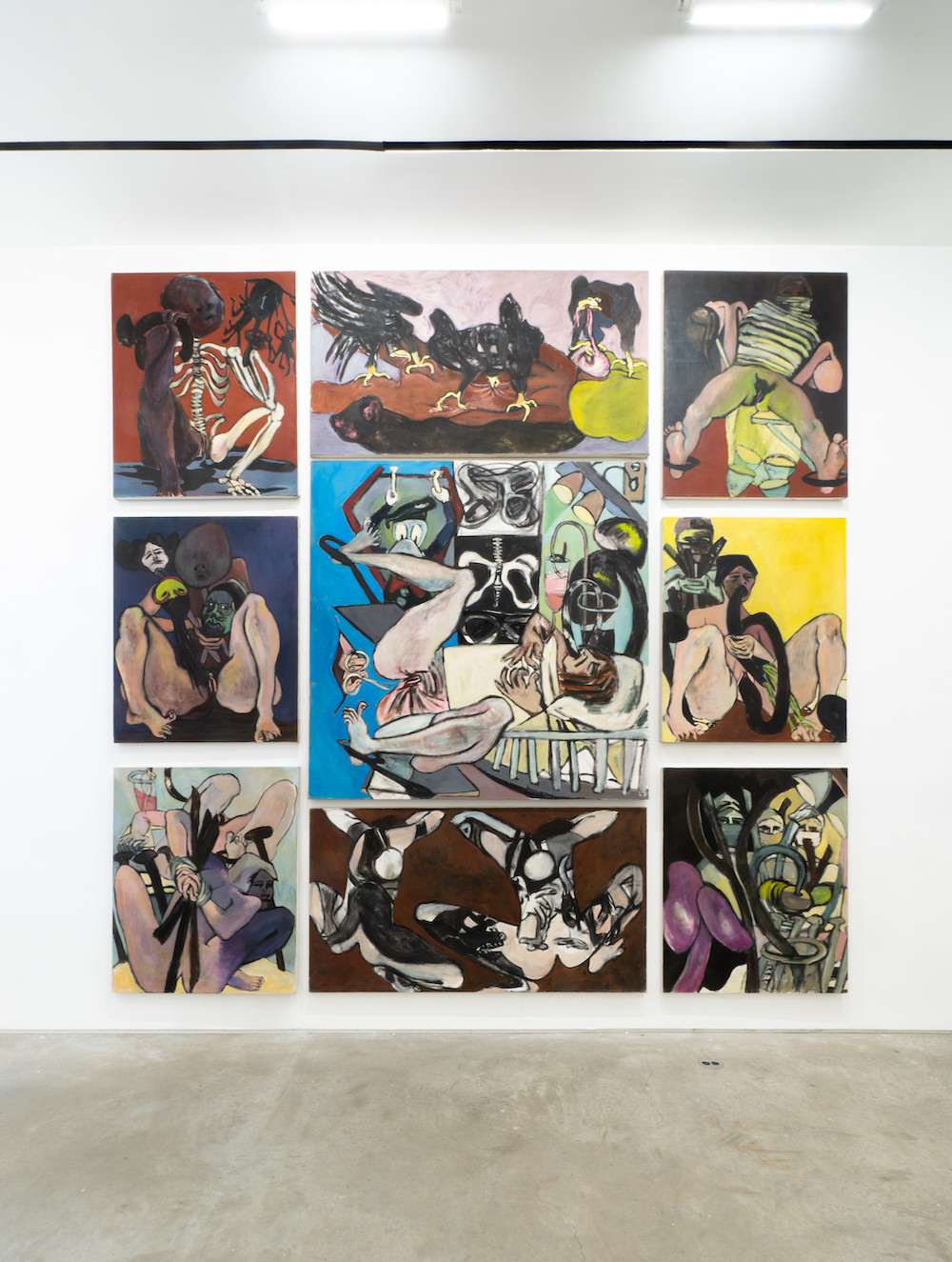
When an injury to her spinal cord gave doctors cause to tell her she’d never be able to paint again, Juanita McNeely produced “Triskaidekaptych” in 1985. It’s not a small-scaled clapback, but a momentous,13-panel work that spans the walls of the James Fuentes Gallery in the Lower East.
Much of McNeely’s life’s work hinges on this tension between her disabling physical suffering and her huge artistic output, bridged by paintings that relive her agony.
While the force of overcoming her pain looms large throughout the gallery, so does the memory of violence and trauma, particularly that of womanhood. McNeely’s 1969 painting “Is It Real? Yes, It Is!” confronts the reality of her abortion where the practice was illegal. In the painting, the cheeriness of the question-and-answer title readily belies the anguish fragmented by McNeely’s memory or rendering.
Though the subject matter is as difficult as it sounds, it’s well worthwhile to catch Juanita McNeely this weekend before the installation closes.


Elements of Existence — Closes March 8
Henri Paul Broyard, Carlo D’Anselmi, Madeline Donahue, Hilary Doyle, Hank Ehrenfried, Emilia Olsen, Rachel Rickert, & Michael Craig Tracy — Public Swim
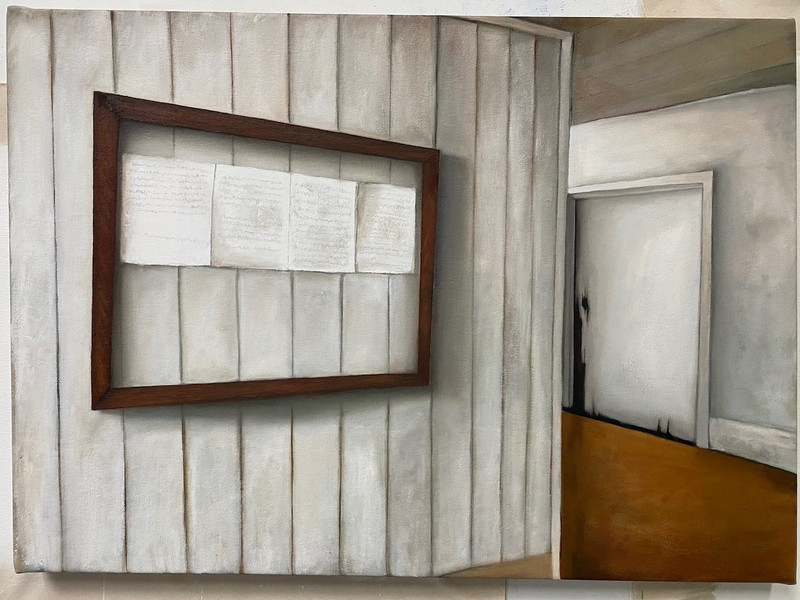
In 1922, American House & Garden journalist Mary Fanton Roberts asked us to “Consider What the Interior Door Contributes to the Comfort, Peace and Dignity of the House.” Almost a hundred years later, the curators at the Lower East gallery Public Swim called on eight contemporary painters to reconsider the question in an exploration of the boundaries within private spaces.
Michael Craig Tracy’s Floor Corner, a painting which is exactly what it sounds like, illustrates one iteration of an answer perfectly—it's an unassuming shot of the floor that we can’t help but think looks like a photo you would take on accident, as you pan your phone up to focus on the real subject, your dog maybe, or the setting sun outside your room window.
And that’s the beauty of Elements of Existence. You can’t flip through paintings of Tracy’s shoe rack, or Henri Paul Broyard’s tableaus, as easily as you can scrolls through rows of disposable photos on your phone, yet the scenes are magnifications of the same. As paintings, their minutiae are imbued with an unspoken dedication and intention, and as a cohesive exhibition, they echo each other’s treatment of intimacy. Rachel Rickert’s high frequency solo shots and Carlo D’Aneslmi’s honey-warm depictions of love, fate, and folks in quiet community resonate on the same spectrum, if at opposite ends from, Hank Ehrenfried’s cold art gallery and reconstructions of photos "sent through WeChat."
Among the displays of solitude Hilary Doyle’s work stands out in the artist’s uncanny rendering of familiar New York scenes; in multiple mediums Doyle probes the feeling of being alone on a subway car at dawn, the press of bodies walking up a flight of stairs, or the tension between two people in a public space.
Among the shit that will put you in your bag you do not want to miss Madeline Donahue’s sculptural ramen “sweater” works, fun, of-the-moment busts that balance out her freaky and lovely ceramic nude "Ladies".

The Bully Pulpit — Closes March 14
Haley Morris-Cafiero — TJ Boulting
“The major problem is she’s disgusting.”
That’s the matter-of-fact statement emblazoned on the front of Haley Morris-Cafiero’s t-shirt in size 14 Arial font. Except it’s not exactly Morris-Cafiero as herself but the artist dressed up in a wig and fake goatee, holding a hairless cat in imitation of the real-life troll who said those very words to her.
The photo and comment were spawned from Morris-Cafiero’s street photography series Wait Watchers, where she captured the critical gazes of passerby fixated on her body. In her latest exhibition The Bully Pulpit, Morris-Cafiero uses the comments on her previous project as the starting point, from “Normal people are never going to want to fuck you, regardless of how much you complain” to “Your work opens you up to criticism.”
The Bully Pulpit is a perfect mirror for Morris-Cafiero to hold up to all the ugliness people throw at her. You’ll walk away horrified that we still have to put up with this shit and endlessly grateful for the work itself.
If this sounds incredible to you, the London gallery is holding a talk with Morris-Cafiero in conversation with Tate Modern curator Emma Lewis on March 5.


A Charm Against All That — Closes March 14
Brandon Anschultz, Hélène Delprat, Harley Lafarrah Eaves, Trenton Doyle Hancock, Charline von Heyl — projects+gallery
As coronavirus whips across the globe and hurtles to our front doors, as we attempt to guide our parents into voting for our preferred presidential candidate, and Lady Gaga rules that the Earth is cancelled, you’d be forgiven for frantically refreshing your horoscope and holding tight to your good luck charms.
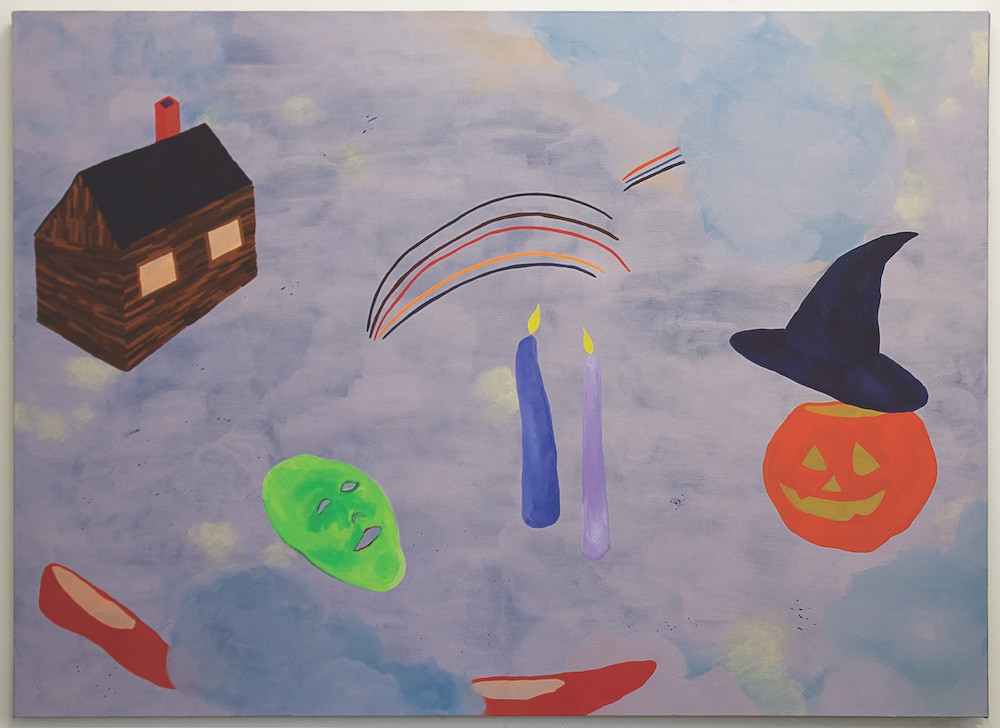
That’s the idea behind the St. Louis projects+gallery’s latest exhibition: Sometimes, the best defense against things that remain outside the realm of control is to embrace superstition. A Charm Against All That solicits the work of five artists to draw on experiences of anxiety, protection, and forces of the occult.
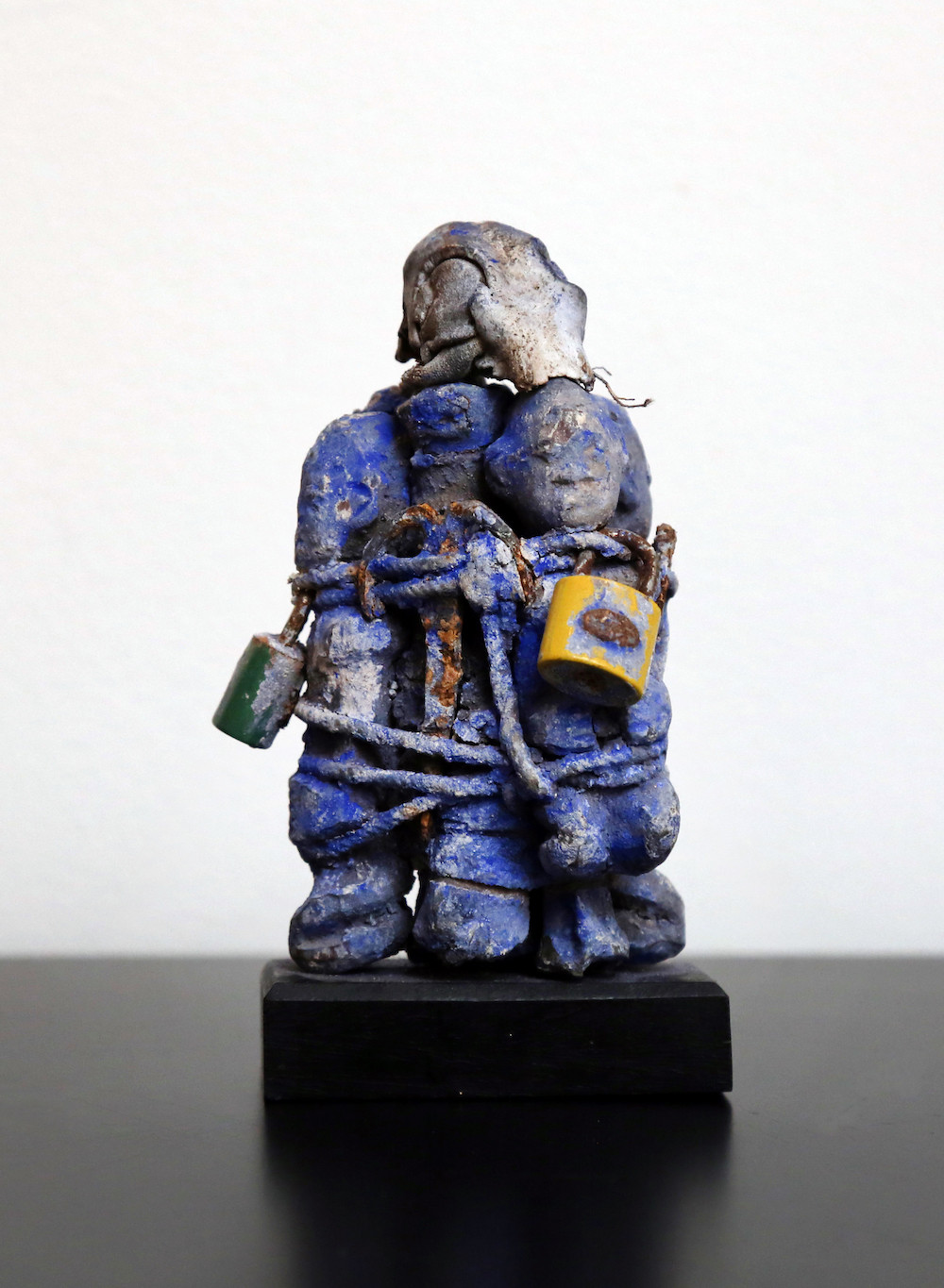
The exhibition stands in conversation with a collection of Vodun fetish objects drawn from the Fon people, who were captured during the transatlantic slave trade and enslaved on Louisiana plantations not far from today’s project+gallery. These sculptural pieces lend weight to the nightmarish paintings of Harley Lafarrah Eaves and the magical chaos of Hélène Delprat’s work. A Charm Against All That is a great opportunity to see some of Trenton Doyle Hancock’s work if you happen to end up passing through Missouri on a spring break road trip.

Originally shown in 2017 at James Fuentes in New York, Ulman’s reinterpretation of “Dignity” for Frieze brings back her characteristic elements of a cloud-print ceiling made of styrofoam office tiles and a metallic stripper pole with a curved top, nodding to an accident that left her disabled and reliant on the use of a cane. This edition however, sees her room bedecked in blue instead of her signature red color, and the inclusion of a branded photo booth leans into the obligatory photo-opp that art has become a vehicle for. A commentary on “the art world as entertainment” (and Instagram fodder), the photo booth invites fairgoers to participate in Ulman’s work, becoming part of the performance that she has set up.
Known for outfitting everyone from bohemian comfort-seekers to celebrities in functional footwear, Birkenstock debuted its first foray into luxury fashion with the new Birkenstock 1774 collection in partnership with MATCHESFASHION at Frieze. A collaboration with the legendary sandal company links Ulman’s recurring exploration and fashion’s ability to create imaginary characters. After all, all the world’s a stage, and Dignity sits smack dab in the middle of one the world’s greatest—Hollywood itself.
We caught up with Amalia below for her commentary:


What was the inspiration behind the project and what references did you look at when beginning the piece?
This work comes from the Privilege series which, like other works of mine, looks at spaces that are categorized as neutral or "normal" (instead of feminine or ethnic, etc.) by the ruling classes.
The element of performance is quite prevalent in your work. How does the photobooth play into this?
This part of the installation was determined before I even started working on the installation. It wasn't my idea originally but I like the idea of a Photo Booth especially when it gives a printed photograph. I like the lives this piece of paper can have. I still print a lot of photographs myself and like finding them unexpectedly.
How does a work such as "Dignity" play out in the context of an art fair versus a gallery space, where many of the themes such as power structures, privilege, and celebrity are literally at play?
I don't think art happens at the gallery, or the fair, or the museum. Art happens somewhere else. I don't prioritize one exhibition sphere over another, I don't think there's any difference, in the end, they all respond to the same capitalist needs. There are few exceptions but they always seem too pure to survive.
What do the elements of the blue walls, the stripper pole, and the clouded sky symbolize in the work?
The whole idea behind the Privilege series was to generate content based on a character that was an exaggeration of myself and the strange period of time the performance took place (the 2016 US presidential election). The blue sky was taken from the office ceiling where the content was filmed in Downtown Los Angeles, the stripper pole is a reference to Excellences & Perfections, the cane is a reference to... well, my own cane (I have a disability). Things just work or not. I just saw this room in my head and thought it worked. Deconstructing it won't really go anywhere. Art shouldn't be explained.
How has your work evolved with the changing landscape of social media?
I was never interested in social media but on the internet at large. My background is in internet art. I care about social media insofar as that it says something new about the economy and human relations.
Your “Dignity” installation incorporates red carpet images of yourself photoshopped with semen superimposed onto your face. Was this inspired by an interest in celebrity culture?
I don't care that much about celebrity culture. When I worked on the images that are also titled Dignity, I was more interested in the sexuality of the men photoshopping these red carpet images. The amount of care and attention to detail given to something others might consider degrading fascinates me.



What do you think of the fact that the Frieze art fair is located on a Hollywood studio backlot? Does this say anything about the relationship between celebrity and the art world to you?
When I think of the Hollywood studio backlot I don't think of celebrity but of films and fiction. I love movies but I also lived in LA for long enough to know that the representation of Los Angeles in films is nothing like Los Angeles itself. I'm very interested in propaganda and I can happily say that I lived in the biggest propaganda factory there is. To me, the relationship between the art world and celebrity is a distraction. There are way too many young talented artists not getting the recognition they deserve because their parents aren't famous, it's sad.
How does your work lend itself to a collaboration with a fashion footwear brand such as Birkenstock? Were you thinking about the brand at all while being commissioned or did you create the project independently?
I was approached by Frieze because of my site-specific immersive installations, so I worked with Frieze and Birkenstock to bring back some of these works with complete creative freedom. The only thing I had in mind was that there would be a frontal photograph being taken, which is very specific. Sometimes amazing installations don't work well in their photographic documentation and vice versa, I was trying to find a balance between what felt good in person and looked good on paper.
Do you wear Birkenstocks? If so, in what situations?
I do. I have a pair for the swimming pool and another to walk around during the summertime. I have a disability so they are lifesavers.
In the past, you’ve personified different characters and identities for your work. Do you occupy these personas in real life as well?
No. When I act, it is for a specific work, as if it were a play. There are rehearsals and stage work. Offstage, I don't do that. I just finished shooting a feature film where I did perform a character. Now, I'm only dealing with post-production as a director. If that's a persona, I guess I'm playing the character of a stressed filmmaker looking for post-production funding [laughs].
What are you working on next? Where will your next project take you?
I'm currently writing the script to a new video essay and finishing my first feature film, which is one of the biggest projects I worked on, a dark comedy about eviction.
What was the last thing you lied about?
I'm autistic so I can't lie. It is a problem.