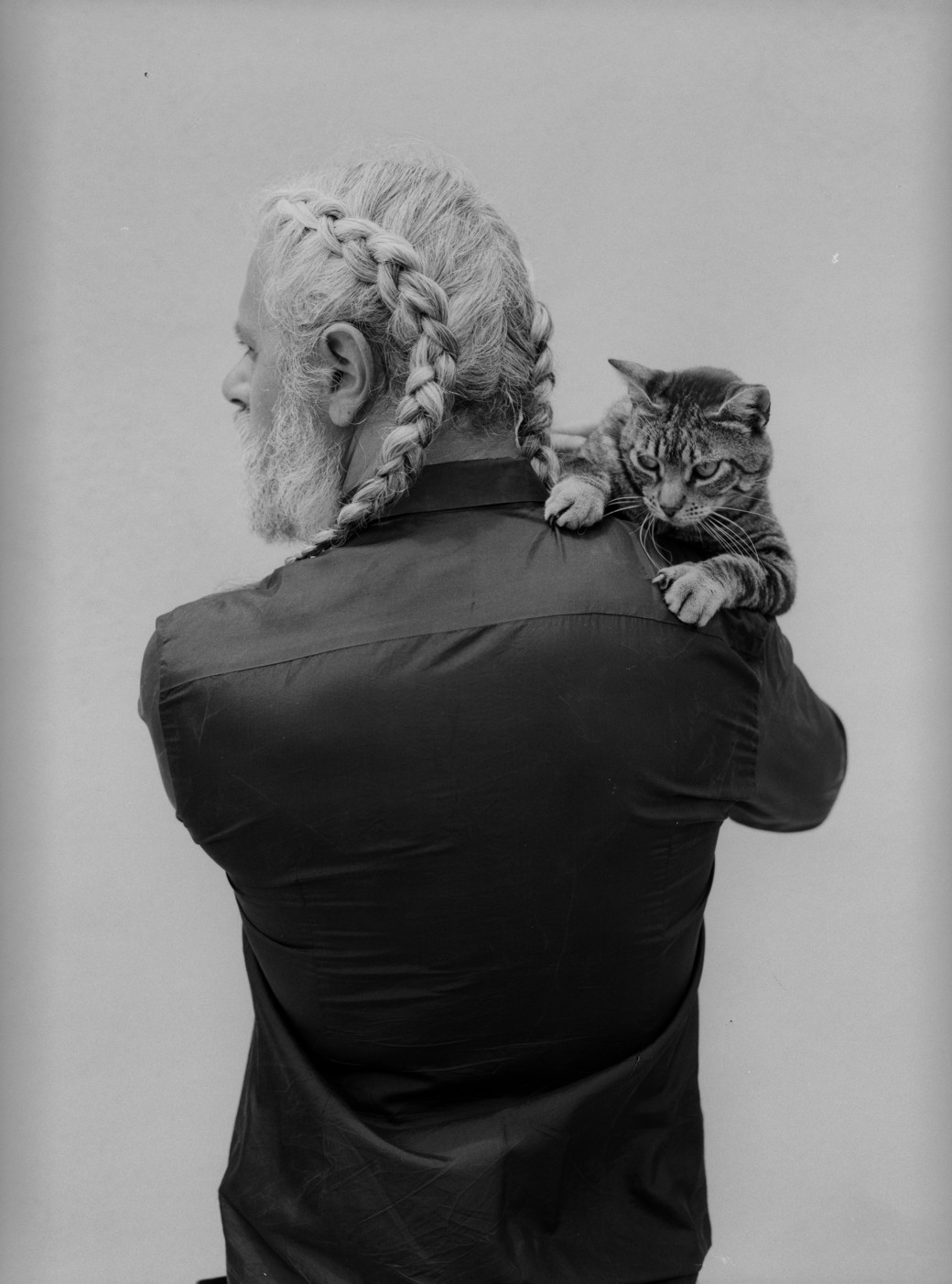
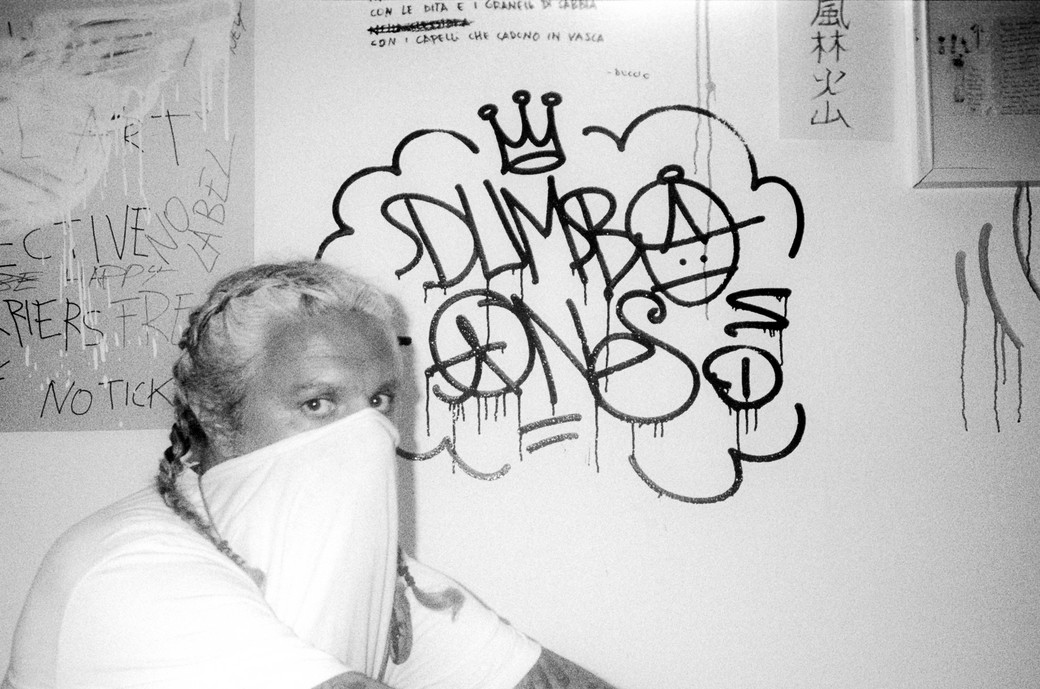
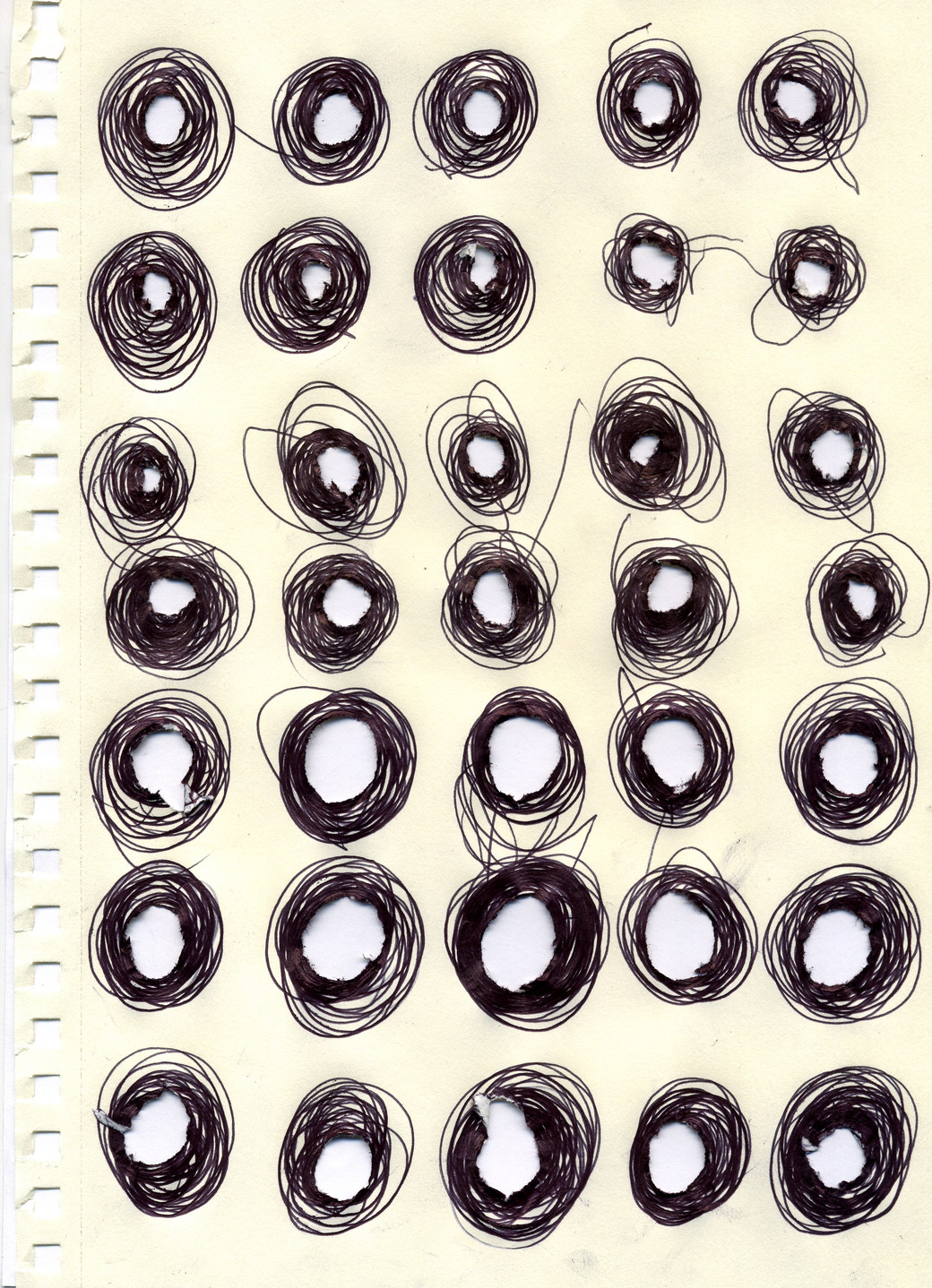
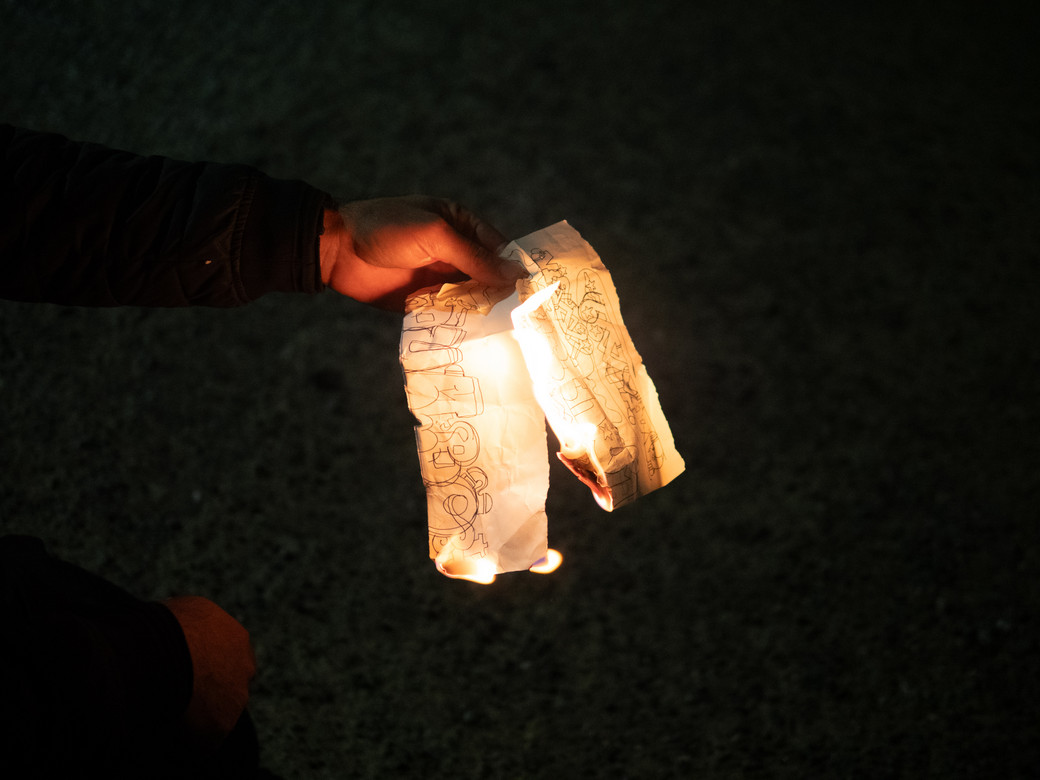
PRESENTE CONTINUO: the intimate ties between then&now

Starting May 30, PRESENTE CONTINUO will be available to purchase on presentecontinuo.com, cpcompany.com, and at the C.P. Company flagship store in Milan, Corso Matteotti 7.
Stay informed on our latest news!

Starting May 30, PRESENTE CONTINUO will be available to purchase on presentecontinuo.com, cpcompany.com, and at the C.P. Company flagship store in Milan, Corso Matteotti 7.

office met with the artists at the gallery to talk about the OG hysterical woman archetype and the curious case of the banana in Ms. Pac-Man. Read our interview, below.
Tell me about the show. How did you come up with the idea?
Smith: We’re friends actually, and we’ve been involved in each other’s art lives, sharing our work with each other. At one point we were kind of joking around at dinner, saying, 'When are we going to do our show together?'
Belanger: I visited Emily’s studio and pointed out a painting and said, 'This is for our two-person show, right?' just joking around.
Smith: Then it became, 'Yeah, we really should do that. Why don’t we do?'
Where did the concept come from, though?
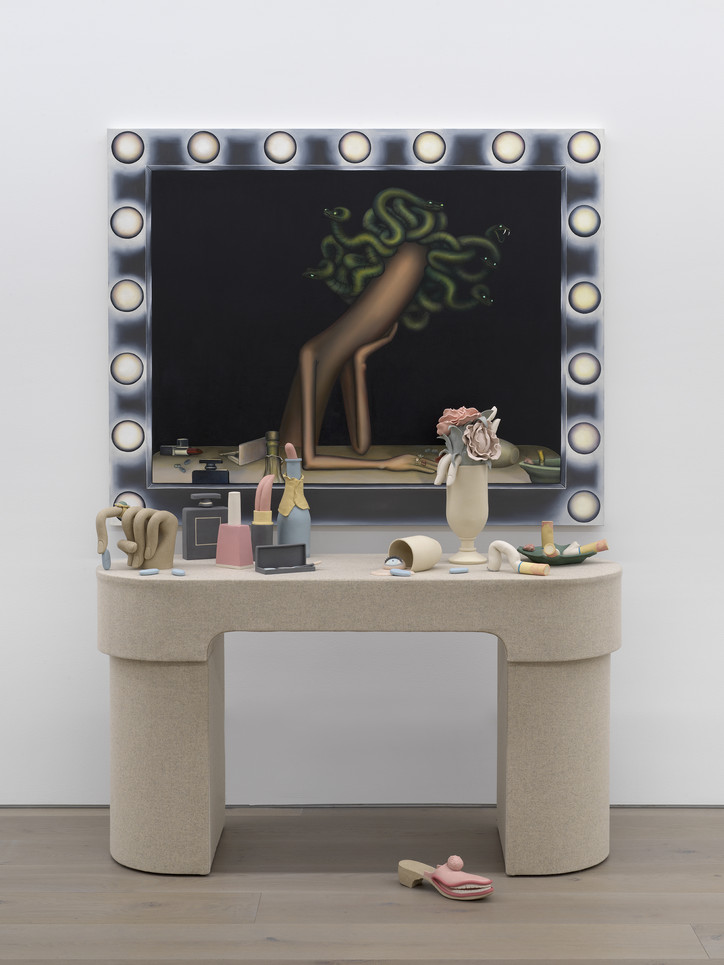
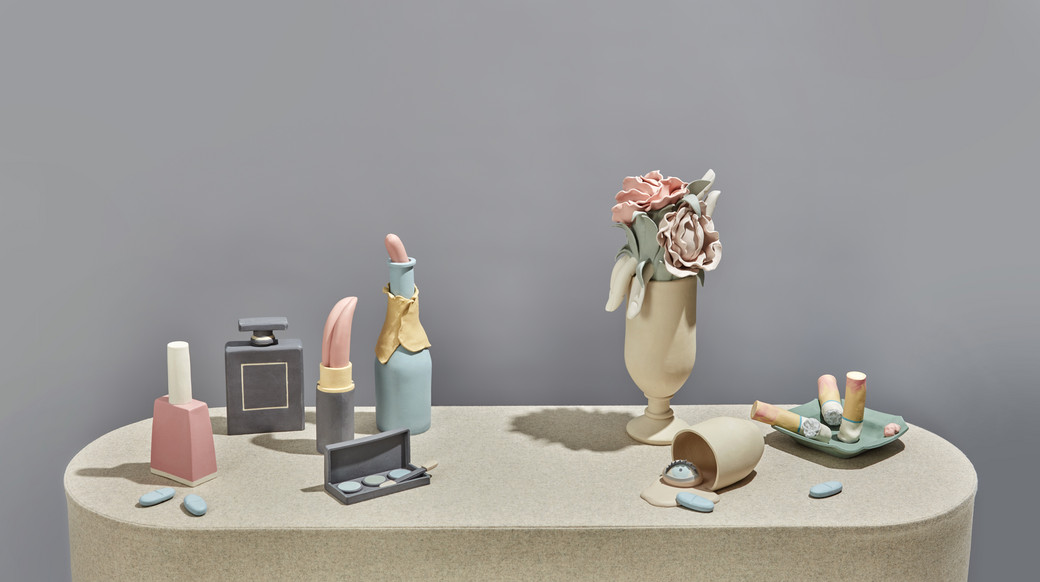
Smith: I guess the vanity table is really one of the first pieces we thought about.
Belanger: Valentine from Perrotin, who gave us the go-ahead to do the show, brought us a model of the gallery space, so that we could start to think about what we wanted to do, and we decided we really wanted to make some work that directly interacted with each other's.
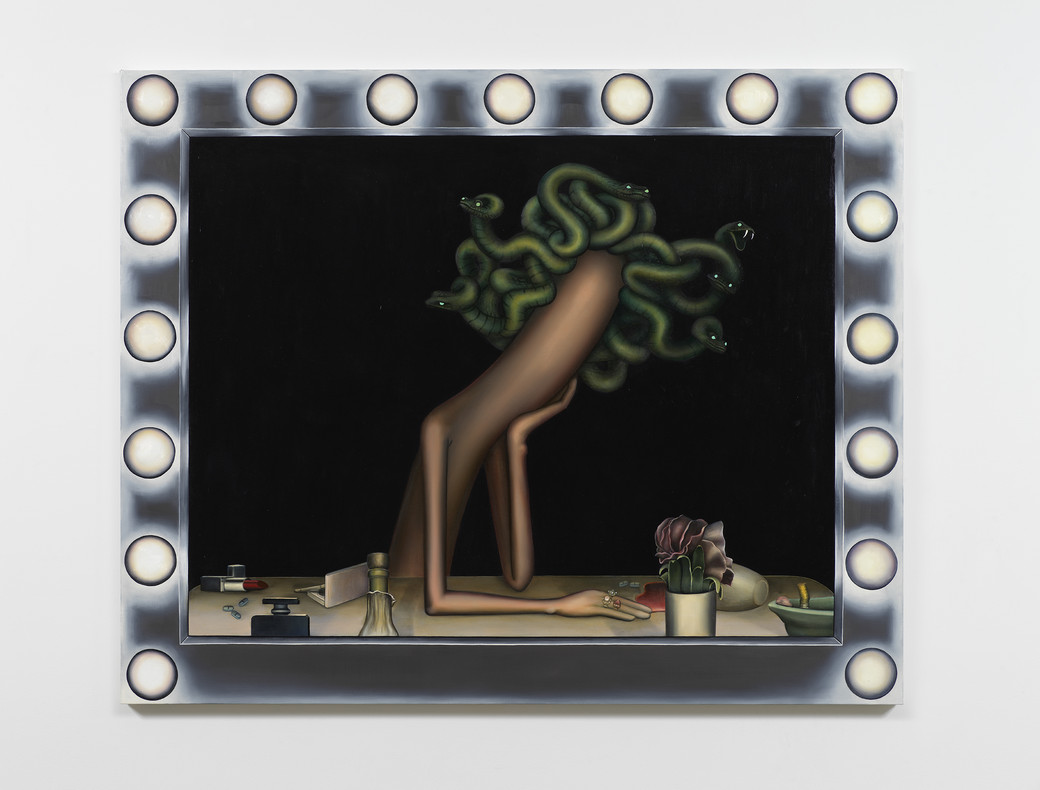
Smith: And this is the one where they most directly interact. We conceived of it together. I notice a lot of Genesis’ sculptures are aggregates—multiple pieces together on a pedestal or on a table or something. I think she even said, 'I’d love to make a vanity,' and I said, 'I’d love to make the vanity mirror, but as a painting.' Then, as she was constructing her sculptures, I realized I wanted to directly reference them as being quote unquote ‘reflected’ in the mirror, which is, of course, just a painting—but the perfume bottle is reflected, various objects are reflected. There’s a kind of absurdity—in the painting is a normal champagne bottle, but in the sculpture, it’s quite surreal and strange. So, it’s like a reverse Through the Looking Glass situation.
Who is the woman?
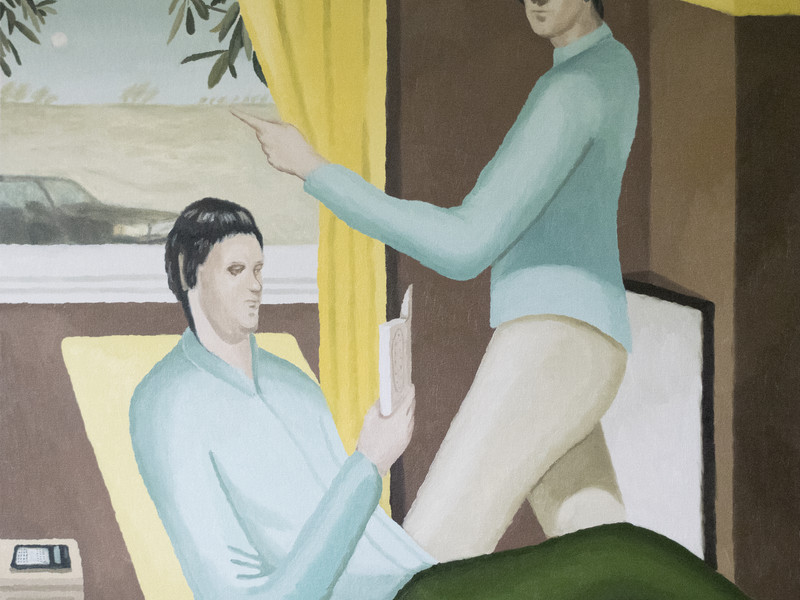
Smith: This is Medusa—the OG hysterical female archetype.
Belanger: We were looking at images of vanities, and the vanity is actually a vintage piece of furniture—rarely these days do you see a vanity set up in someone’s house. So, we were finding images from old films where the character was this hysterical woman, with crazy lipstick, too many martinis—just a total disaster. The washed up disaster female of the modern era.
Her hairstyle reminds me of Who’s Afraid of Virginia Woolf? But she’s not necessarily hysterical.
Belanger: She is hysterical! The fighting that they do—it’s just so unreasonable.
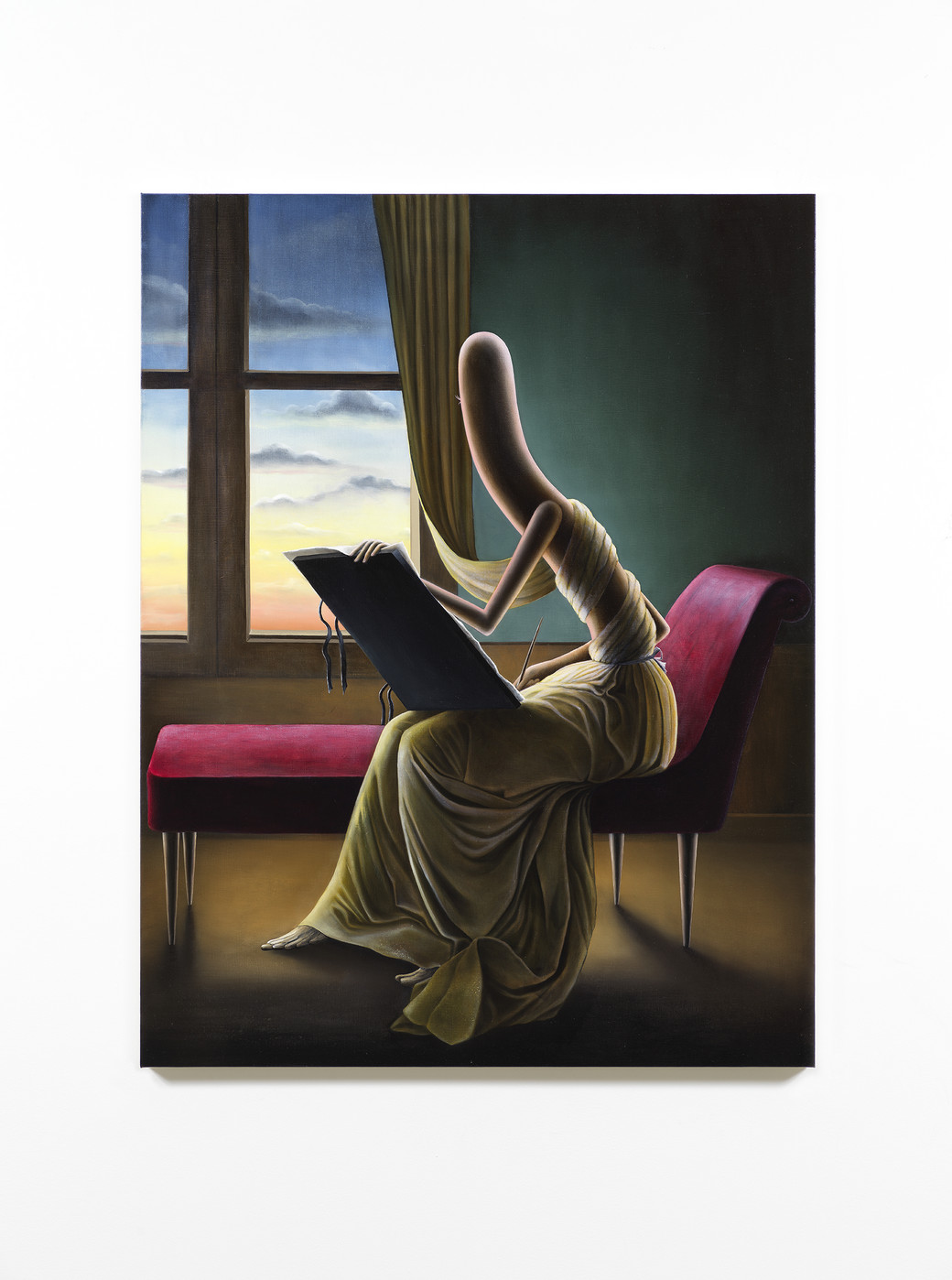
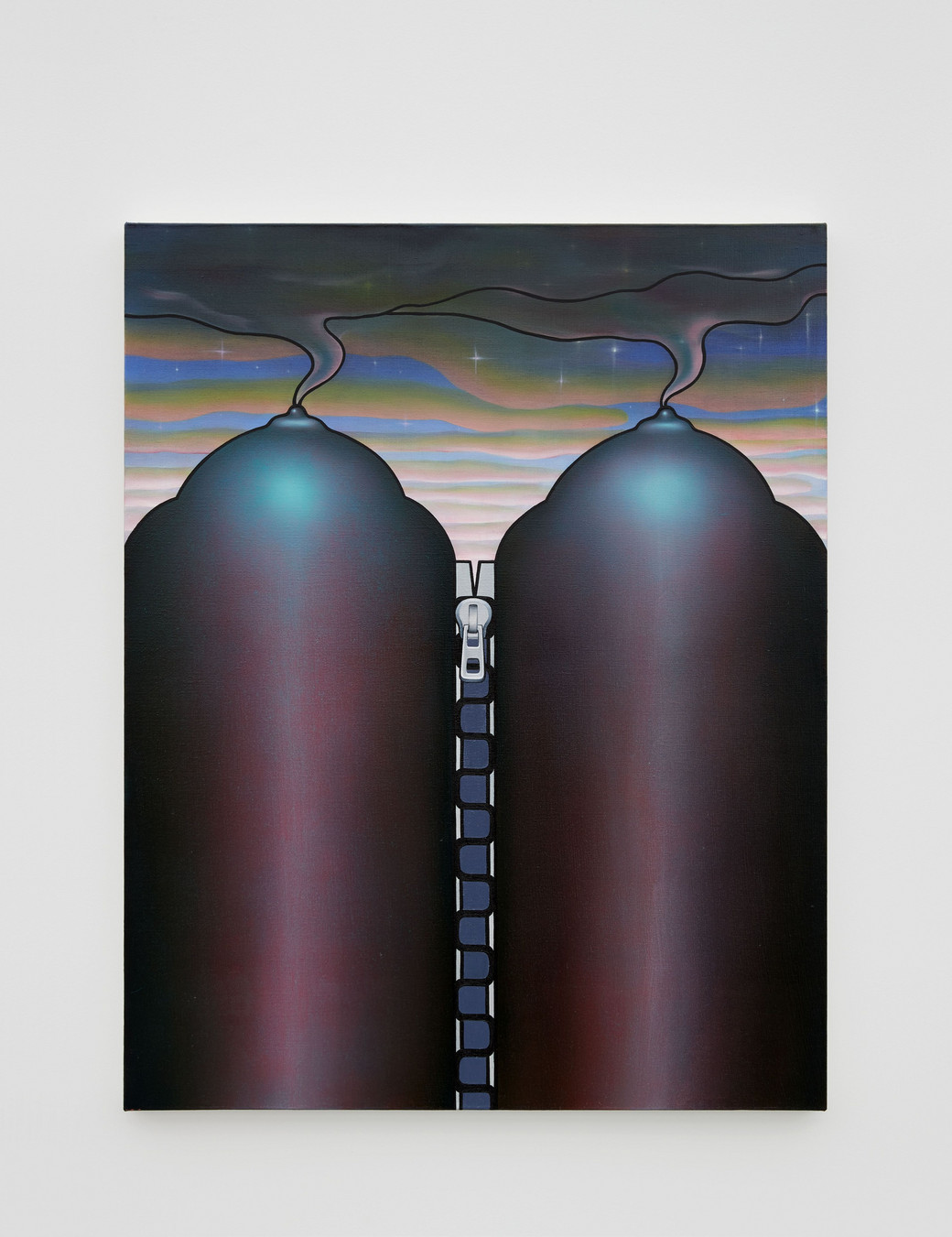
Smith: Medusa has been a bit of a recurring character in my work. The figure is an animated broom handle that transforms into all these different female archetypes in many different pieces I’ve made—it’s a kind of series.
It felt vaguely familiar. Is it the broom from Fantasia?
Smith: Yeah, that’s the broom, that’s the origin. These are all oil paintings, and Genesis’ work is all clay and stoneware.
Belanger: Right, and they’re not painted, so any color is integral. But the pedestals are all covered in 100% wool. They’re wearing coats.
I actually have a desk at home that I made into a kind of vanity because it’s too low to actually sit at. But I love the concept of vanities, especially the word. Do you have one in your house?
Belanger: I live in a 420 square foot apartment, so I have no extra furniture. I barely have a couch.
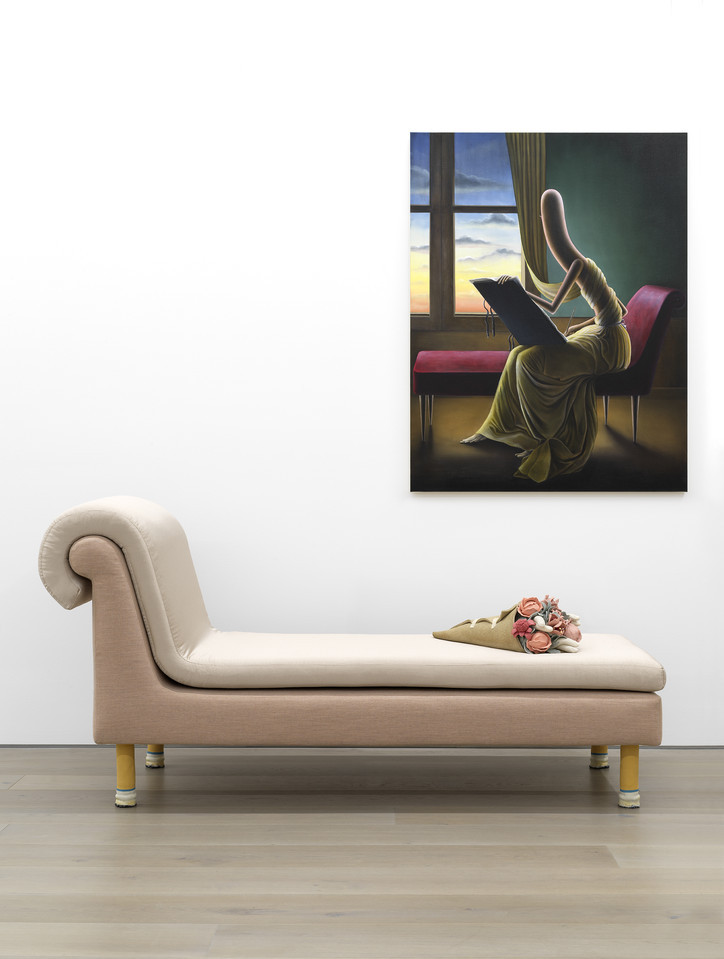
Smith: But so, yeah, this was the first piece we worked on. There was also this one painting I began thinking about based on one at the The Met by Marie-Denise Viller, that's a portrait of another woman drawing. There’s this kind of beautiful thing of one woman artist looking at another woman artist drawing—there’s this incredible acknowledgement of being a female artist. It was made in 1801, and it's called ‘Portrait of Charlotte Du Val D'Ognes.' It has this really wild backstory, which is that it has been misattributed to Jacques-Louis David, who’s like the ultimate French painter, and it was finally uncovered in the 1960s that it was a female who painted this, but nobody knows who she was or her story. It turned out, she was actually this reputed salon painter.
It’s a beautiful painting that has this light coming from the window, which is one of my favorite kinds of lighting to paint because it positions the viewer on the other side. There’s something about positioning the viewer as if they were behind something, like trying to paint from a new perspective. Anyway, I took my broom lady and put her in the place of the figure in the painting, and wrapped her in the domesticity—she’s wrapped in the curtain which becomes her dress, and she’s looking out the window instead of at the viewer. Then the chaise lounge—I knew that Genesis was going to build a chaise, so I wanted to make sure that’s what she was sitting on.
I’ve always wanted one of those—like a fainting couch.
Belanger: It’s perfect with the cigarette legs.
Above: Installation views of 'A Strange Relative.'
I noticed! So, you made it?
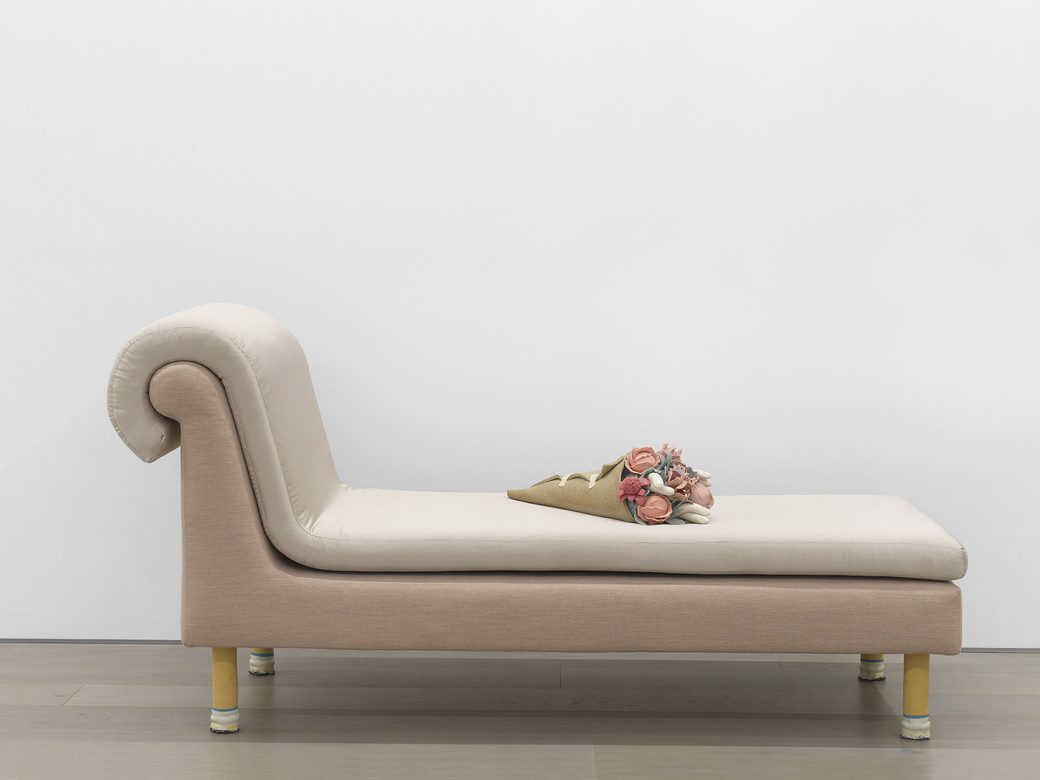
Belanger: Yeah. So, Emily had made some paintings that were also referencing more historical paintings and painted in a more classical style—sometimes her work is more pop, but not always. I was thinking it would be amazing if we had one of these more classical, art historical paintings as if it were in a grand living room, and what piece of furniture would be more perfect than a chaise lounge?
There’s something about a chaise lounge.
Belanger: It’s similar to a vanity in that it’s a piece of furniture that’s gendered. You never see a masculine study with a chaise lounge—I mean, that might not be entirely true because there’s those Bauhaus ones, but then it’s called a day bed.
Smith: And then there’s the association of the couch with psychoanalysis.
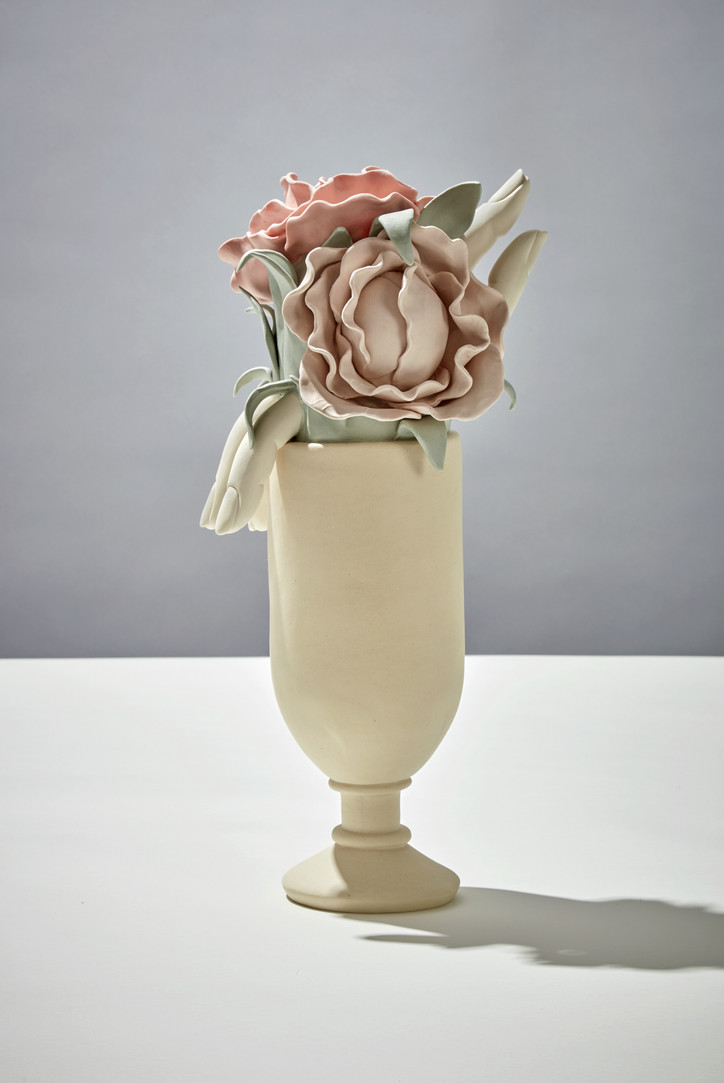
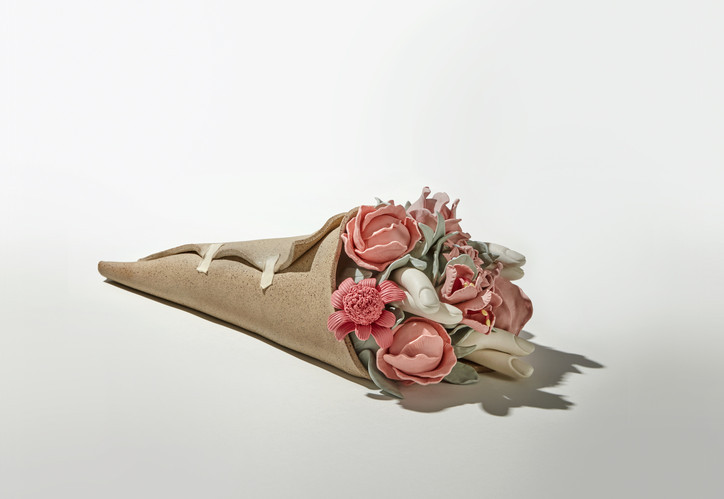
Belanger: Lots of times, I want my objects to be an embodiment of our psychology. So, how does that manifest in a piece of furniture? I feel like this chaise lounge is a grand lady. And then the bouquet—I think about flowers all the time and how they are a gesture of so many different things: condolences, apology, celebration. But they’re this gesture that’s pretty weak—like, if someone dies, do flowers really do enough? I don’t think so. They’re a band-aid. This is called ‘Double Standard,’ and I was thinking about how men cheat on their wives and bring them flowers to apologize. It’s just such a weak gesture—and what better thing than to be on this furniture embodiment of a woman?
I can’t get over these fingers in the bouquet.
Belanger: They're crossed fingers, like she’s keeping a secret, or she’s insincere. Like when you promise something or say you’re sorry and hold your crossed fingers behind your back. It also directly references the broom figures.
Belanger: Despite our intentions, our work already has a lot of parallels—it’s already in conversation. We also have the same birthday.
When's your birthday?
Belanger: May 27th.
So, you’re a Gemini? That's kind of perfect since you’re kind of like twins.
Belanger: The light and the dark.
Who’s light and who’s dark?
Belanger: Well, I’m silver and she’s black—just appearance, though. On the inside, we’re both.
I love all of your still lives, as well—all of the fruit.
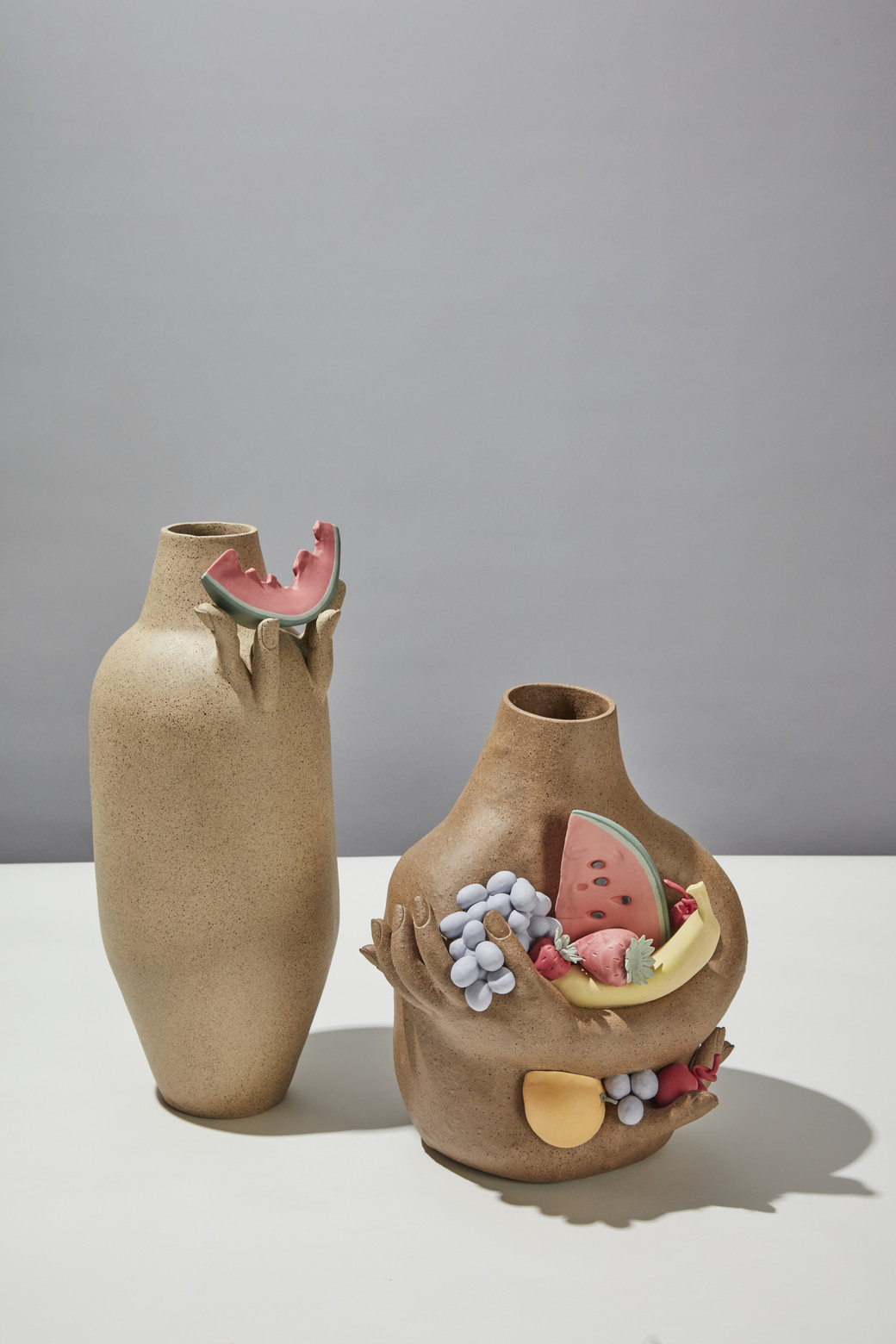
Belanger: I made my fruit sculptures inspired by Emily.
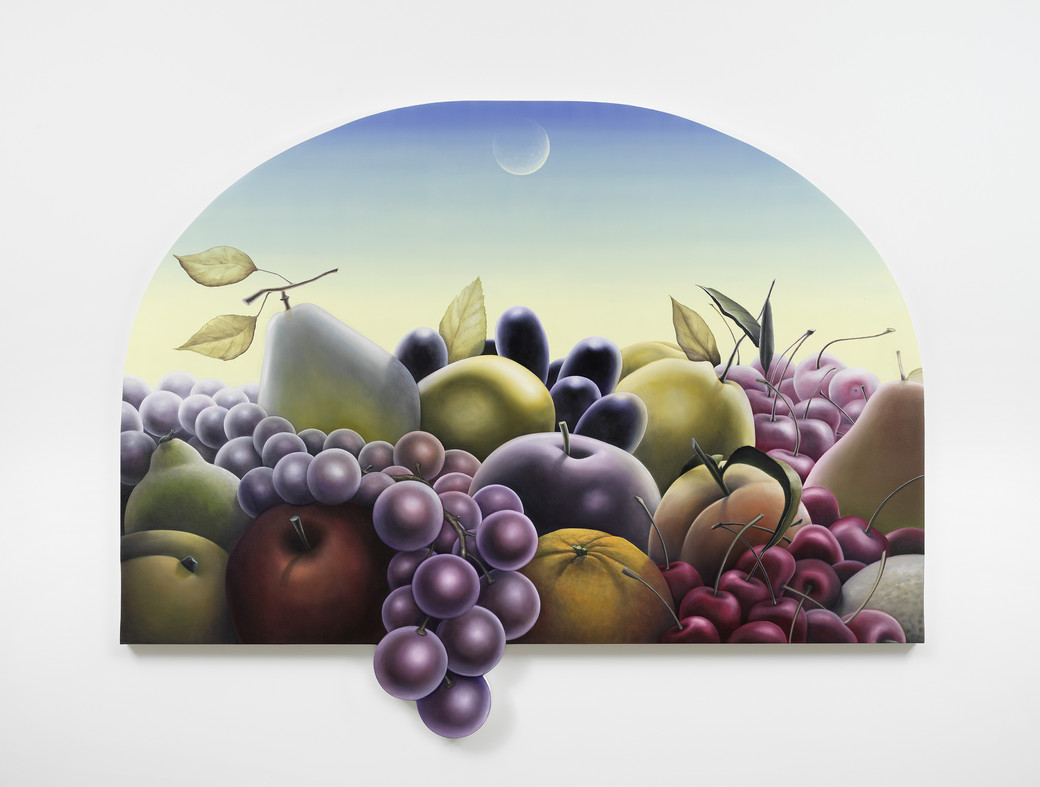
Smith: Last year, I made a painting with a specific frame. A lot of times, I paint a frame or border element in my work, which makes the painting sort of self-aware because it shows the boundaries, and these boundaries in our world are often invisible—it’s a way of rendering them visible. Art history is a boundary—all the boundaries of agency. So, I did this smaller painting of fruit last year and when I painted the grapes, I made them hang out over the edge of the frame, and I couldn’t really stop thinking about that as an important moment. Then I realized, 'What if I enlarged that scene, took away the painted frame and made that frame the shape of the painting itself?'
This arched shape at the top you see a lot in 19th century paintings, like sublime landscape paintings and symbolist paintings have this curve—even Casper David Friedrich had this curved top. So, basically, I kind of wanted to do my own version of a sublime landscape, but instead of it being great land of Manifest Destiny, it’s just an incredibly large bowl of fruit.
It’s not even a bowl—it’s literally a landscape.
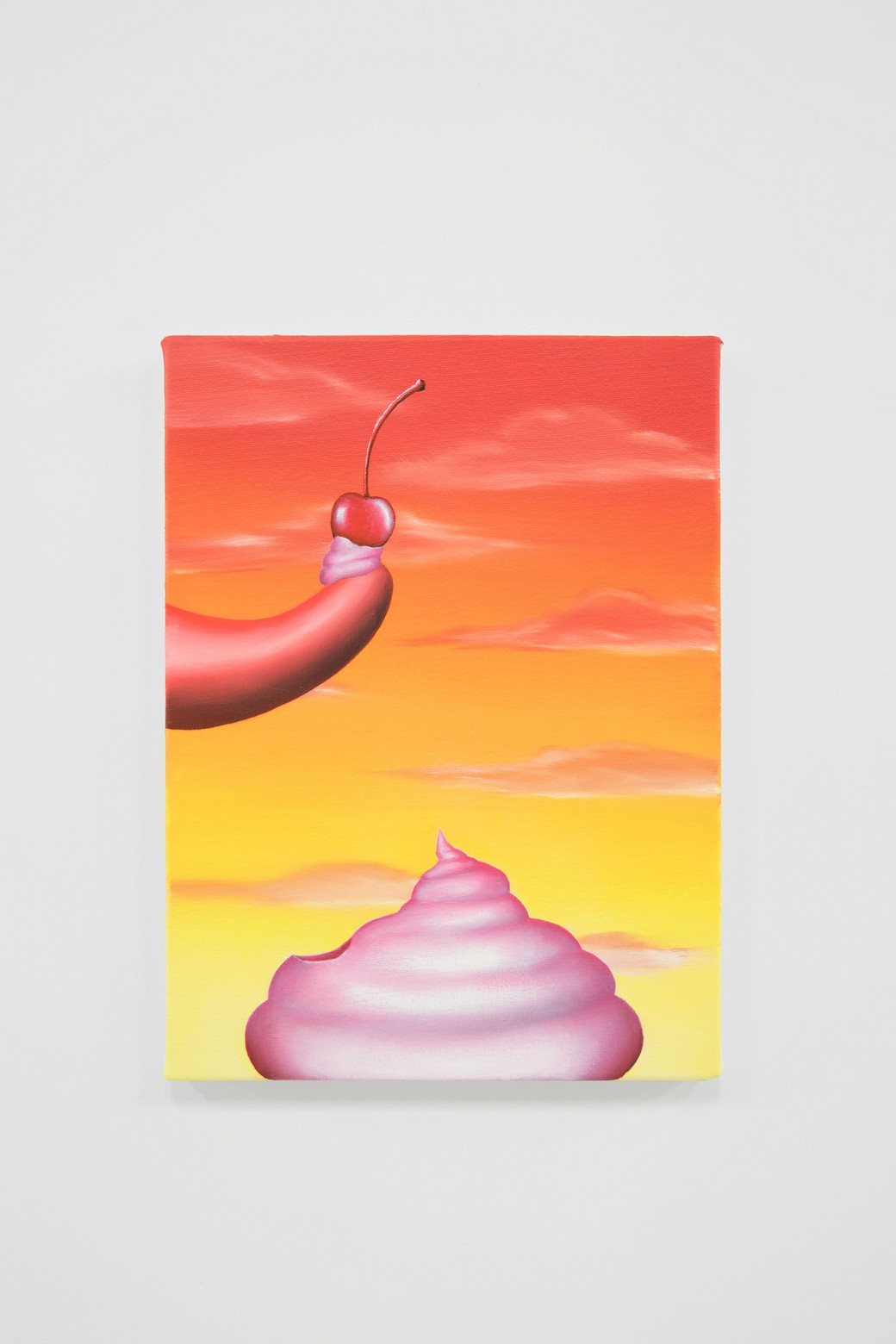
Smith: Yeah, it’s like, 'Where’s the end?' Perhaps there’s no end—maybe they keep going. Fruit is so suggestive and metaphoric—they represent the body, they’re sexual and they can be very funny.


Above: 'Well Appointed' and 'Daily Adoration' (detail) by Genesis Belanger.
You’ve also included the peach, which has taken on new meaning as an emoji...
Smith: Right, that’s true! Actually, I left the banana out on purpose. I have done bananas in the past, but this time I thought it would be too far into emoji-land.
It has a color scheme as well, because of the lack of the banana—it’s very purple and green, and they’re so circular. So, a banana wouldn’t make sense, aesthetically.
Smith: The other thing with this painting is the overall lighting situation, where the main light is behind the fruit, which gives it this weird sense of forever-ness, like it could keep going. I almost like to think that perhaps it’s what’s on the other side of the window in ‘The Drawing Room.’ There’s something so satisfying about the grapes breaking the frame and dangling—a bunch of friends have made the joke that they’re almost like testicles—just balls hanging from the bottom of the painting.
Belanger: If you think about those Manifest Destiny paintings too, they were talking about man’s agency over all of the wild land—it’s there to be reaped, and this is almost an exaggeration of the idea of a reaping.
Smith: That’s funny, I almost called it ‘The Reaping,’ but then there’s a movie called The Reaping and I was like, 'Nope, can’t call it that.'
But Genesis, you do have bananas in your work(s).
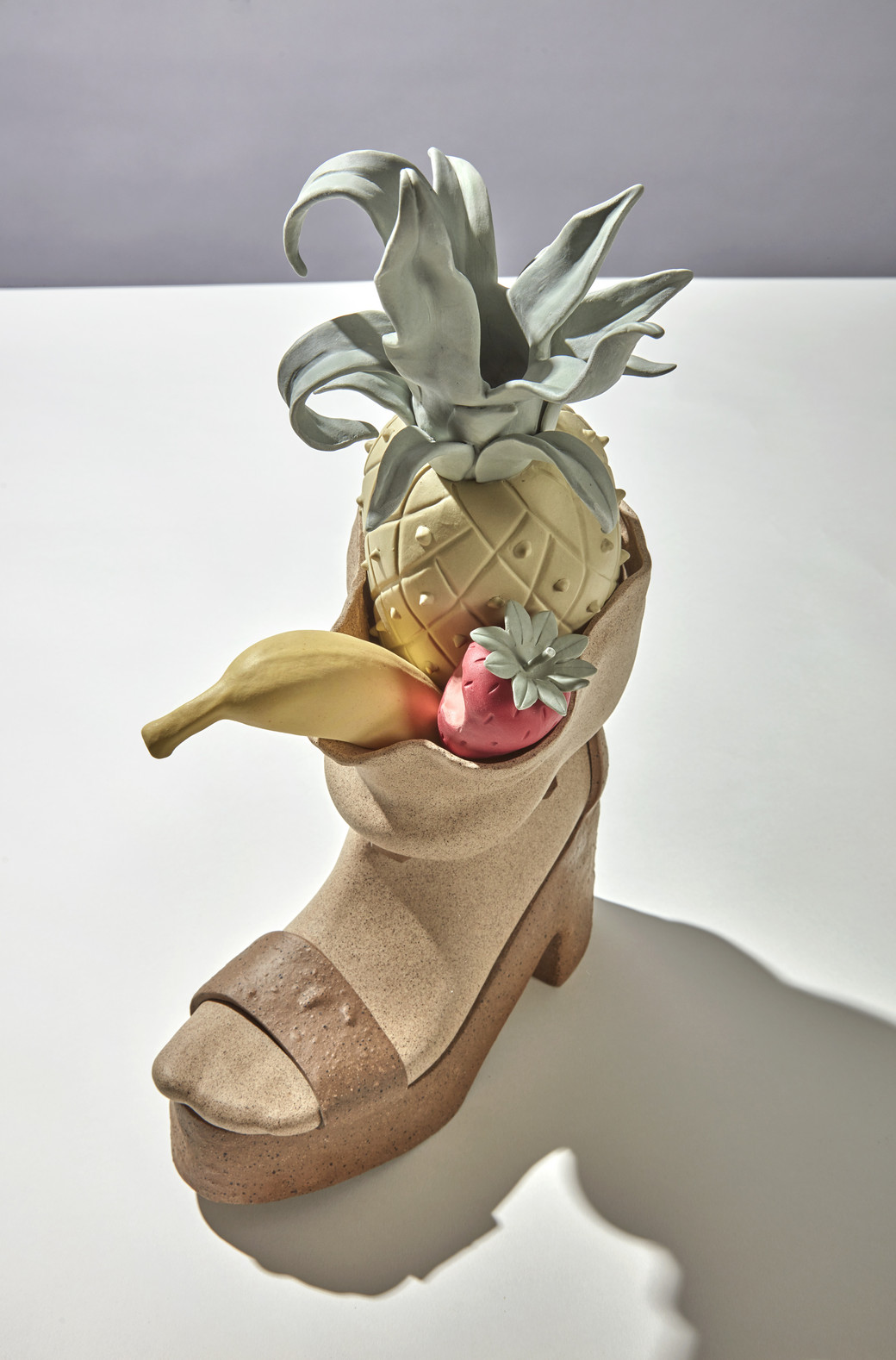
Belanger: So, then my base is kind of that same idea but grasping all the fruits—just hoarding them. I love fruit because it’s this way men talk about women. Like, 'She’s so ripe,' and it’s a reduction of a woman using fruit, and it’s absurd, and ridiculous, and insulting, but also, hilarious—I think about that a lot. The banana is really important to me because—I don’t know if you've noticed, but in Ms. Pac-Man the banana is worth as much as all the other fruits combined. The banana is the patriarchy in the Ms. Pac-Man game.
Do you play Ms. Pac-Man a lot?
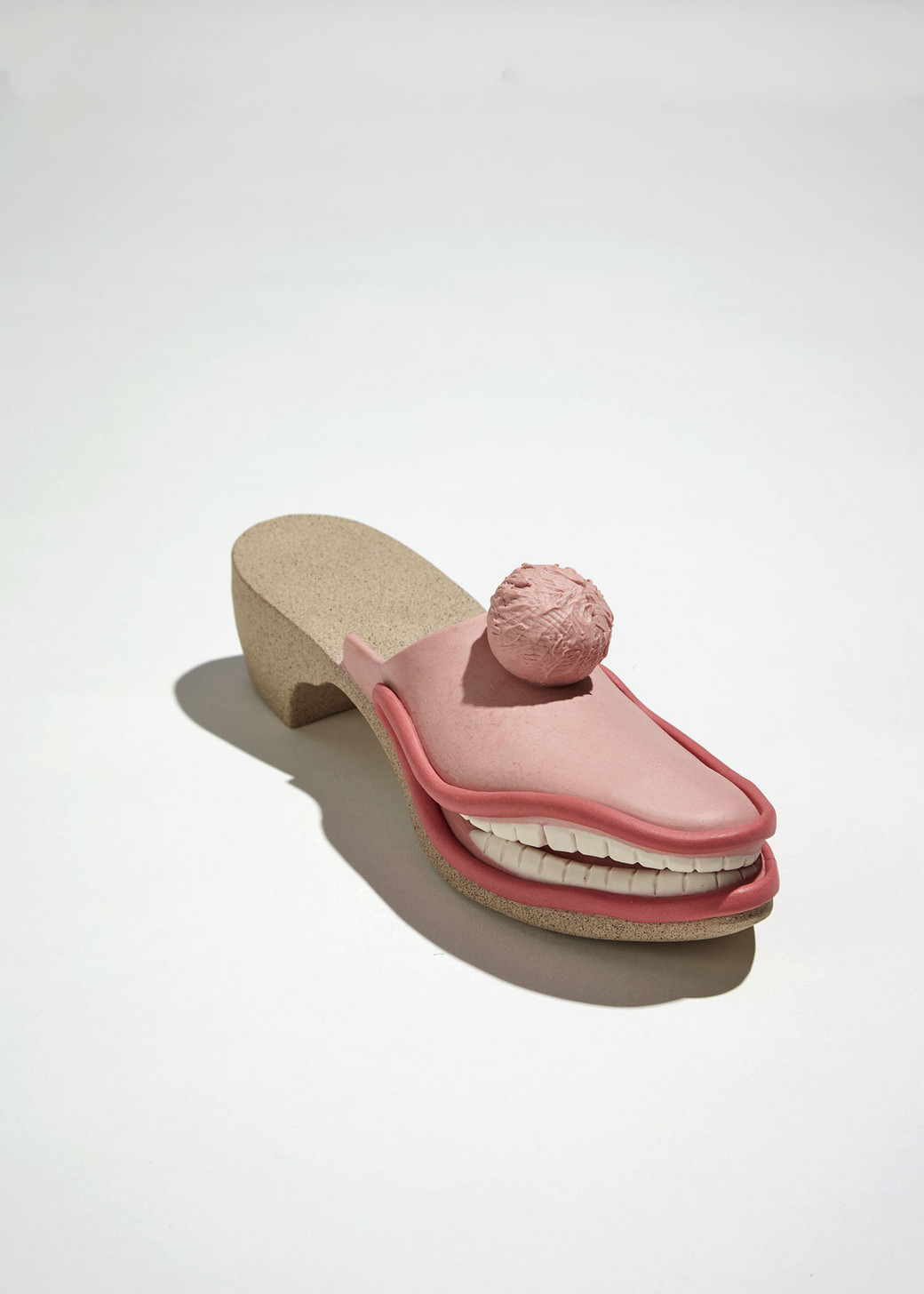
Belanger: I used to be sort of obsessed. Also, if you think about it, Ms. Pac-Man is just Pac-Man in drag. It’s like, drop a bow on it, now it’s a girl! I actually made a video of Pac-Man magically transforming into Ms. Pac-Man by eating lipstick and a shoe. But the thing about food that’s so true is that it’s a metaphor that’s used to dehumanize anybody who’s the object of dehumanization, especially racially, when they talk about skin colors as if they were food.
Smith: Like, 'She’s mocha,' or 'She’s vanilla.'
Belanger: It reduces someone into just what is consumable—it turns them into a consumable thing.
It’s desire—food and sex are like a hunger.
Belanger: The sandal with all the fruit in it I call ‘Swollen,’ and it’s like you’re stuffing as much consumable stuff into this tiny space until it’s bloated.
It’s cool, too, because the flowers and fruit decay. So, they’re going to fall apart.
Belanger: Right. I also think about our obsession with youth all the time. I turned 40 this year—Emily is actually a year younger than me—and I would never give one of those years back.
I would never have guessed.
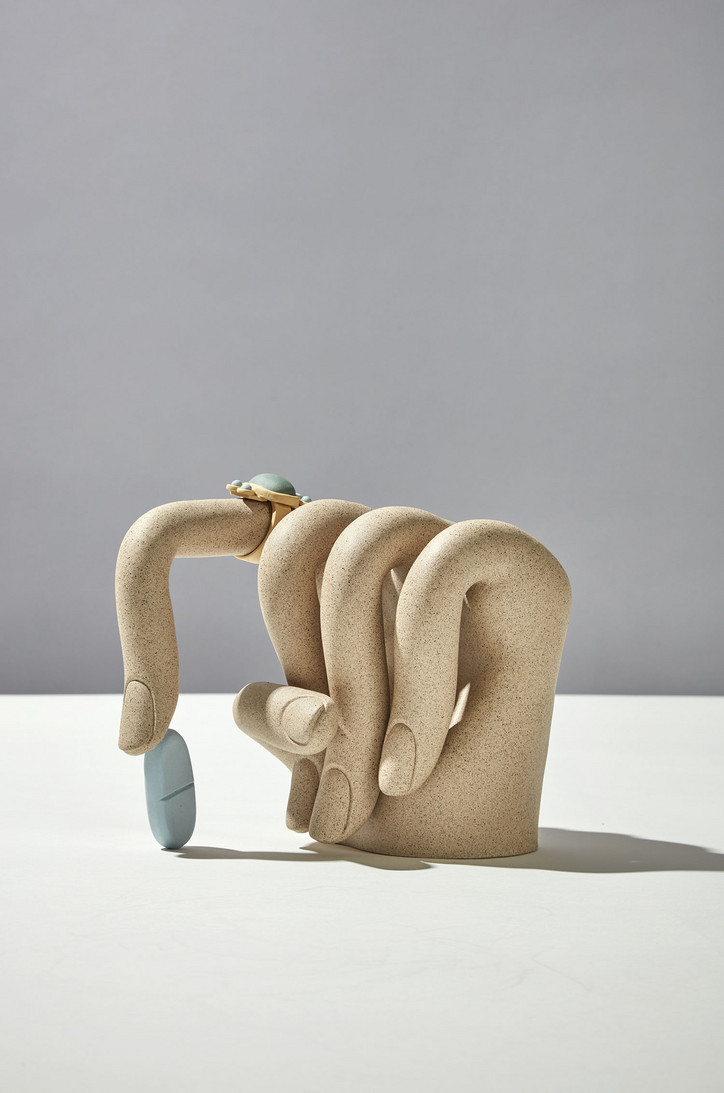
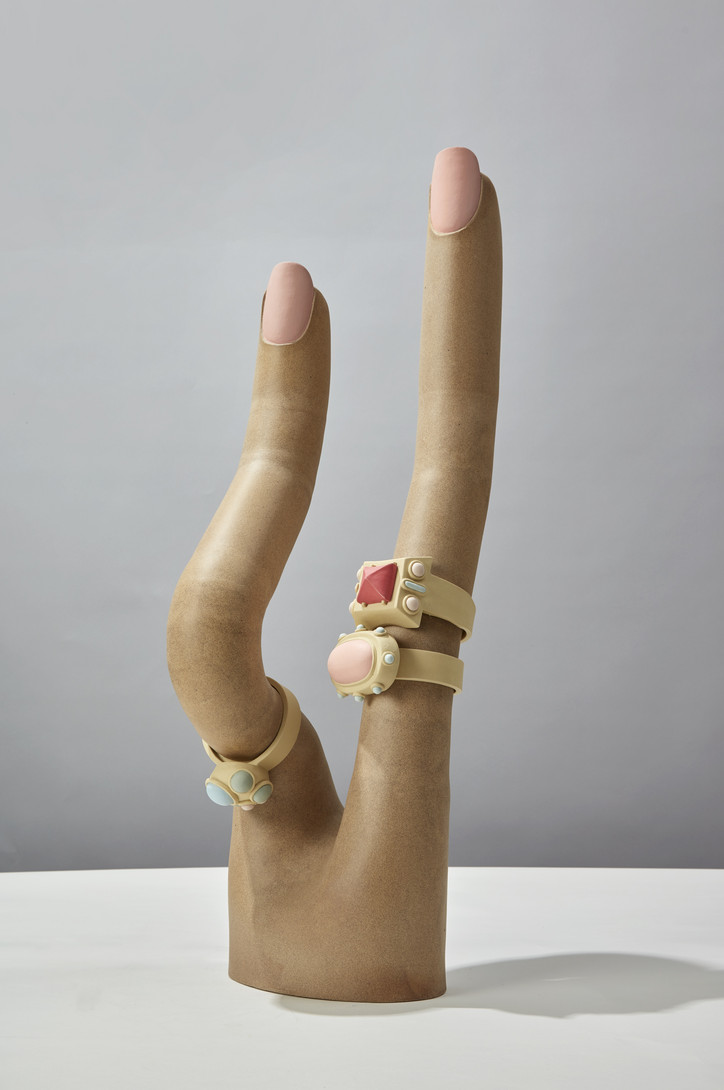
Smith: I don’t know if we talked about this, but I painted the rings from Genesis’ finger sculpture on Medusa’s fingers, and I was just thinking about how when you look at Medusa, she turns you to stone, and all of the sculptures are made out of stone.
Belanger: That’s why we needed her—before, she was going to be just the broom. But the giant fingers are the biggest ceramic piece I’ve ever made. I really love it when a portion of the body or an object becomes a stand-in for the body, and these fingers really started to feel like legs to me. The broom is a person, this is a person, it could be two people—it’s the Gemini. I hadn’t even realized that.
Smith: We’re geniuses.
'A Strange Relative' is on view at Perrotin through December 22, 2018.
All images courtesy of the gallery.

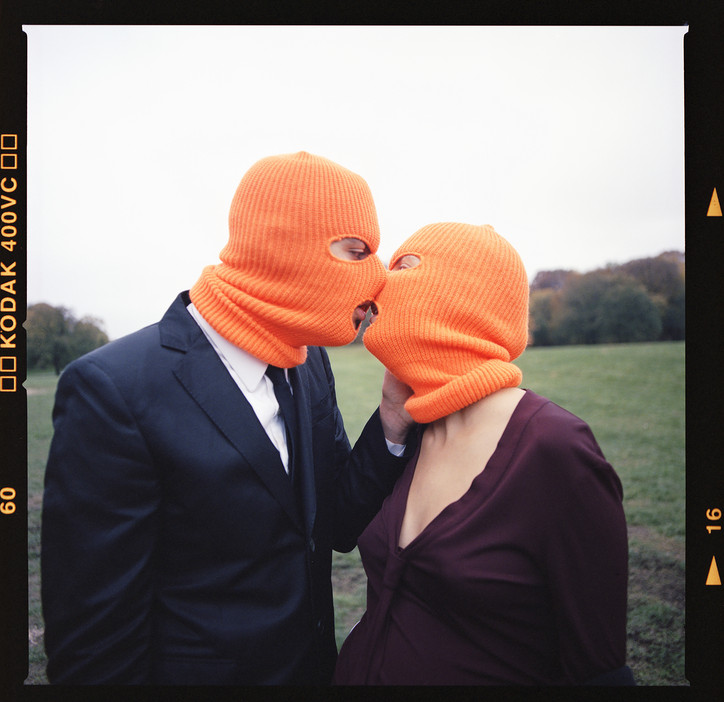
On view at Red Hook Labs this weekend, office sat down with de Brauw and van de Wijngaard; the duo sounds off on the project, below.
In three words, how does New York make you feel?
Saskia de Brauw: I would say New York has a sense of freedom, night and insanity.
Vincent van de Wijngaard: If I were to describe it in three words, it would be: I feel home.
As a foreigner myself, I can totally relate to the need to slow things down sometimes, especially when you live in a city that moves at such a high speed, like your exhibition references. So, how do you think the city’s pace affected the ways in which you interacted with your environment?
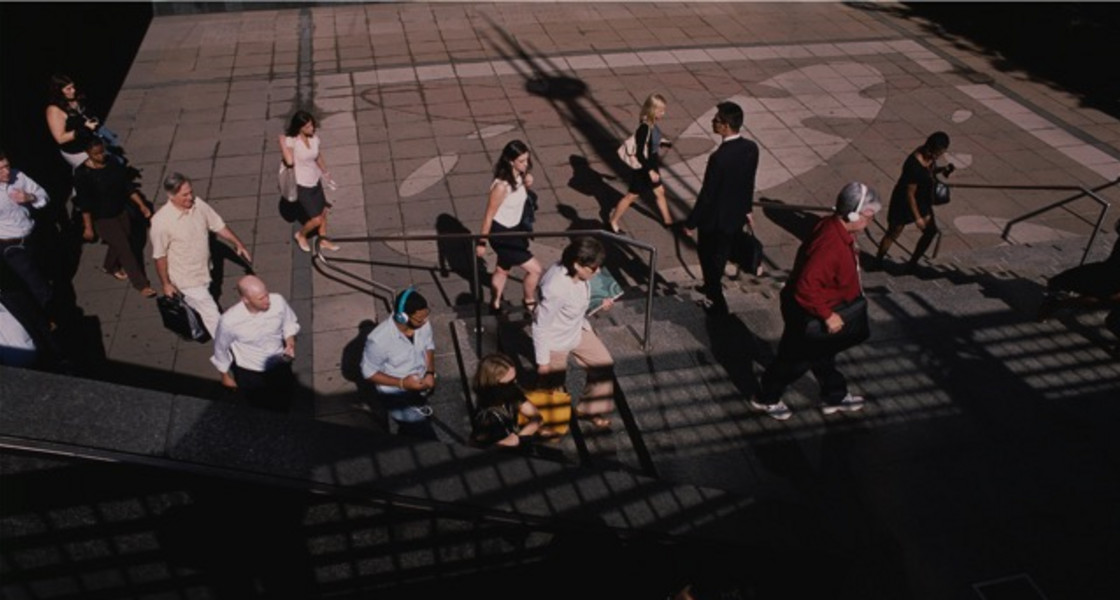
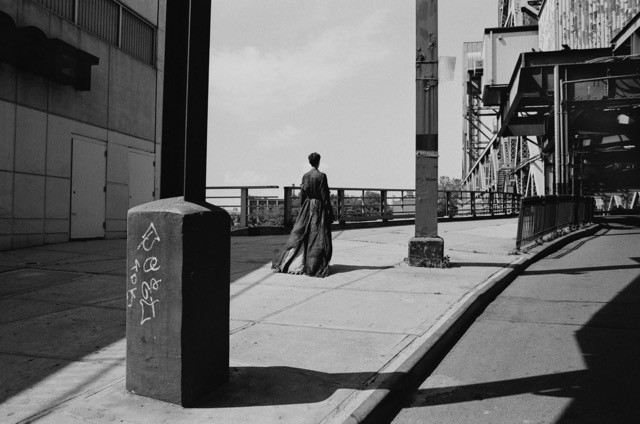
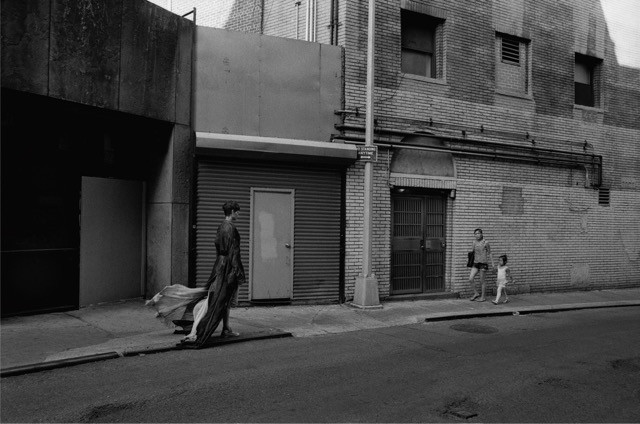
de Brauw: In New York, when you are doing something a little bit different, it’s not that strange, because many people here are doing different things. So, walking more slowly is not even that weird—it makes certain people really angry, but many don’t even realize they feel that way. I mean, there were parts of the route I walked that were really busy. So, I adapted my pace to the amount of people—the more people around, the slower I would walk. I didn’t consider myself as an obstruction and I never wanted to be in the way of people, and I felt that I was only once—in a very, very busy area around Times Square where someone pushed me and got really annoyed with my walking. But most of the time, I was able to be present and just move around. So, that’s something that’s definitely the case in New York—there’s space enough for everyone to have their own space, somehow.
Why did you start this project?
de Brauw: It was the moment before we moved to New York. When I was traveling a lot in the city with my work as a model, I found it quite hard to be here—the high pace was something I couldn’t really deal with. Then, these slow walks started to be an exercise for me to relax and be able to find my place in the city. After that, it kind of developed into this idea of, ‘What if I would do that for an entire day? How would that feel? And should I make a project out of this?’
What was the most surprising experience during your walk?
de Brauw: For me, it was when the experience of the walk at one point finally started to feel relaxing. Suddenly, I felt relaxed with what I was doing and my mind started to feel the same way. It’s the moment where you get a flow in your head—where everything kind of makes sense; it’s not busy with thoughts about what people might think or say, and the remarks just roll of you like water.
van de Wijngaard: Essentially, I am a photographer who works on the streets. So, the whole fashion aspect of it came a lot later. But I am someone who walks a lot on the streets, and there is hardly anything I enjoy as much as walking around with a camera and just looking at things that peak my interest for a moment. When I do get interested in something, I usually wander around a little bit more and investigate—that’s how we determined the certain routes that we followed in the film. But the walk is definitely the main subject—the film and photography are just evidence of it.
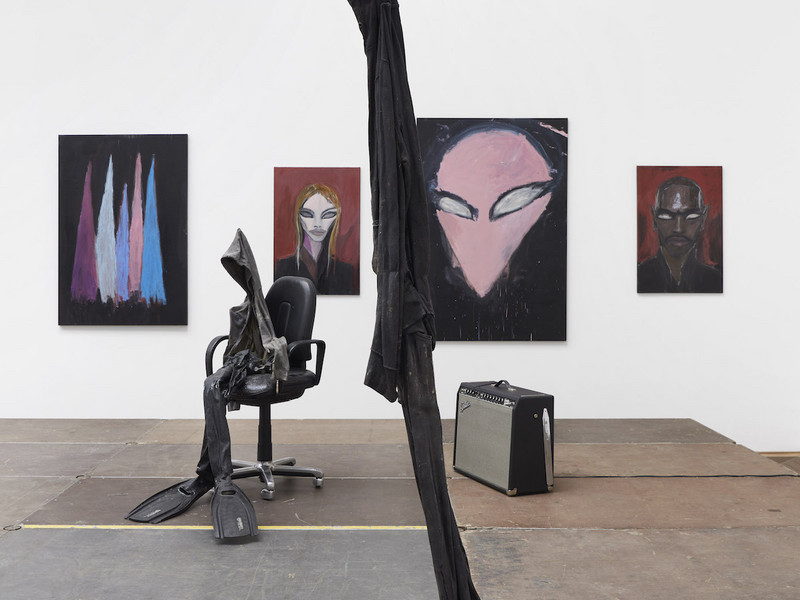
The project consists of the film, the exhibition and the book. Why did you choose those mediums?
van de Wijngaard: At one point, we sort of thought, ‘What would be the ideal way to document this walk?’ And of course, film is a good way to do it. So, the final film also includes a lot of Super 8 materials that function like flashbacks. Then we finally recorded and shot the final walk over a day, and those two were mixed in a chronological order. So, it’s almost like when Saskia passes a certain point on the road, there are these little inserts or breaks. Then we also had a lot of material that we had collected, like smaller interviews with people, and different quotes, and I had a lot of pictures. So, that’s when we thought we should maybe consider doing a book—that’s how it all came together.


You said you usually just find things or places that you like and wander around from there. But how did you decide on the actual route you took?
da Brauw: I just thought it was the most beautiful line that stretches from North to South—it basically takes us across the island that way. But for most of the route we follow Broadway, which is not a straight line on the grid. At one point, we do leave Broadway because we wanted to capture different neighborhoods and fields, and we really wanted to pass through Chinatown—so we do make a little detour. On our walk, we were avoiding the grid as much as possible, and tried to capture as many stories or interesting neighborhoods as we could.
What about the title Ghosts Don’t Walk In Straight Lines—what does it mean?
de Brauw: It refers to a street in Chinatown called Doyers Street, which is actually a small bended ally. There’s an old Chinese story that says that ghosts only move in straight lines. So, in this ally there where a lot of murders, but the bend in the ally happened to protect people from the ghosts of the people they murdered.
van de Wijngaard: It was more like, they had this alley with most extensive murders in the US, based in this little bend. The people committing those murders felt safe because they could never be seen by a ghost. So, there were these expanded network tunnels below the ground leading away from this little street, and some are still there today.
de Brauw: And our title is Ghosts Don’t Walk In Straight Lines, so the reference starts from there and includes a reference to the ghosts of the past, our memories, and the stories we all have—that everyone in the city does.
It’s 6AM, where in the city are you watching the sunrise?
de Brauw: Brooklyn.
What two totally normal things become really weird if you do them back to back?
de Brauw: In this case, the walking is something very normal, but when you change the pace of something that’s very normal, it can become quite strange. But it can be anything I think—that’s what performance art is really based on—doing something really normal but placing it in a different context, where it can become something strange.
Tell me about the Haider Ackermann dress in the film.
van de Wijngaard: We had this dress made for Saskia by Haider Ackermann, who we became friends with a couple of years ago while doing another short film. Haider designed the dress made of leftover pieces of textile which represent the patchwork of New York’s different neighborhoods. The idea we had for the dress was that it would be really interesting if we actually could see the change of time in the dress, by how much it was worn and through the changes that happened when it was used. So, Haider ended up making the dress from all these leftovers and because of the length of it, it takes the dust from the route, and little objects and other things you find on the surface of the streets, with it.
We also collaborated with musician Jim Beard. I have been a big fan of his for a really long time. He did this record that I really like that uses a lot of sounds from the streets, which was actually something that we were doing, as well. So, we were recording sounds for ourselves that we liked, and we wanted to have a beautiful soundscape supporting the film. We also worked with graphic designer Matt Watkins, whose book we had that we really loved. It’s a book by a filmmaker/photographer Will Wenders called Places, Strange and Quiet, and we just always went back to the book for inspiration because it’s so simple and minimalistic—we wanted our book to be very precise and clean.
What do you want the viewers to take away from the project?
de Brauw: Emotion.
van de Wijngaard: I think there are many layers to look at. You can look at the book, you can look at the people that we saw on our walk. For me, the pace which we move around—the high speed—is, in a way, really what it questions. Also, what all people hopefully will see is the diversity of it and the richness of it, just like if you were wandering around in the city, finding all these stories and seeing all these people, just looking at the scenery.
'Ghosts Don't Walk In Straight Lines' is on view at Red Hook Labs through November 11. Photos courtesy of the gallery.

office met with John Bock the day after the opening to talk about barber shops in Austin, Texas, the fleeting nature of desire and the fact that you can use anything as a medium—even Pepto-Bismol.
Tell me about your horror musical.
It’s true—it’s a horror musical. I did it for a museum in Austin—The Contemporary—and we shot the film in four days. In the end, it was 60 minutes long. The story is about an uncanny barber shop with all different kinds of people. Everything they do is abnormal—they tell stories and sometimes, they do different things with uncanny objects, then they sing. It was mostly improvised—I asked them what they like, and one of them said they like funk, or whatever band, so I'd have them sing a funk song and a song by that band. The Spanish guy was a great moment—suddenly, he said he was a singer and could play the harmonica, and it just went from there.
So, a big part of the process was that it came from Austin and the people there?
Yeah, I took an Austin barber shop and made it uncanny. The lead character disappears in a time warp into a hut, then a jungle, then suddenly, she stands in front of her own little apartment and looks in, and she sees herself. There’s the twist. What I liked most was the time in the barber shop—it’s kind of magical, they wait there and they switch off the brain and try to relax. It’s Americana, but it’s also a ritual. I thought, 'What happens when they’re there all the time?' Each day, they go to the barber shop, and they’re with each every day, with all the same guests in this same shop, and they don’t even cut their hair. They do other things though, little miracles and rituals. Then they’re singing. It’s a little bit like a '70s sitcom or a soap opera—like, All in the Family.
How did you decide on a barber shop?
We relax in a barber shop. It’s different than a coffee shop—everyone knows a coffee shop—but a barber shop is more for males, for shaving; a woman goes to a salon. I like this atmosphere where the guys are there, their shaving, cutting their hair. It’s a man’s world, but I was drawn to it, I don’t know why.
Right. But then the lead character is female.
It’s also a little erotic—this young girl and these old guys. But also, I wanted to incorporate different ethnicities—Mexican, black, white. But this is Texas. First, I looked at the faces.
What about the faces?
Oh, they look very good, right? You can tell something from them—the faces tell stories. It’s very easy to shoot animals, and to shoot old men and women because their face speaks in the so-called wrong way. They have so much experience—that's why I don’t understand why Americans get facelifts and all of that.
I was just talking about plastic surgery with another artist.
Yeah, it’s just, why? The thing is, your face is like a painting and it changes, but it’s the best thing you have. Normally, when you have a car, you keep it—only when you crash it do you need a new one. But with a face—it’s crazy.
I overheard some talk about cycles and I noticed a lot of spinning in the video.
And doubles. In the exhibition, there are pairs—two plates, two silicone creature objects in the barbershop—they are like twins, mirrors. And then I built not only one object, but two—and they come together.
How does the performance play into that?
This was a big improvisation, and it was the first time I’d done it. Normally, I work with a script, and learn text, then recite it. But in this case, I wanted only to be there and do something.


Why improvisation?
I don’t really know why I did this. It was the first time.
How do you feel about the result?
It was very new. In the beginning, I was wondering what I should do, but then I looked around at the objects and it came step by step. But the beginning was very difficult. I started with reading text and didn’t like that, so I used some objects—I worked with wigs, then later with shaving cream, then the machine.
It was really fun to watch you play with the materials. Why do you think you’re so attracted to these gooey things like shaving cream?
It disappears. Normally you fix everything, you build it in a frame, it’s a figure. Shaving cream—nobody cares about shaving cream—it’s not necessary to preserve it. The other point is the fear of these art objects. When I look at art, I feel fear because it’s art, because it’s expensive, it means something, it’s in a frame. When I work with shaving cream, or toothpaste, or liquids, then they have no detailed shape. And people don’t think about the shape with these materials. With traditional painting, you’re always thinking about shape, but when you work with liquids, you have no control over it, it flows, and people don’t want shaving cream to be in a shape.
Right. It doesn’t matter.
This is the language: it doesn’t matter. It disappears. They don’t think about the shape, they think about the material. And this is a different way to look at the world—instead of preserving everything, following the rules, speaking the right words, this is different. Art is a language—a different language than our language—and this is good, because our language is political. They check everything that you say, you can’t write without a certain shape to it—but I can. Art can say something that is not so directly political—it can talk about a sugar cube and it means a sugar cube, not a ‘white’ sugar cube, you know what I mean? So, it’s a different language that’s able to speak in many directions—it’s not physical, it’s not systemic, it’s not economic, it’s not political, it’s different. It’s political when the art is very expensive and society is interested in money, getting it, saving it, selling it. Then, it’s like a car.
Your work isn’t necessarily within that context.
It’s also difficult to buy this stuff. How can you buy art made out of shaving cream, or Pepto-Bismol? And the smell? Pepto-Bismol smells almost like candy—it’s so sweet, and it’s pink, and I handle it and you see it. But there’s no frame.
It’s kind of like something you have to experience, but that’s all that you get—the experience—then it vanishes.
But there’s also the movie—then there’s a frame, you edit it, there’s a soundtrack, you create a product. But the performance is less of a product.
So, you’re interested in this lack of control, or letting control go. It's almost like—not chaos—but something else. Maybe randomness?
Entropy, yeah. It’s like in a library—everything is in the right order, but some people say, 'No, I like this book, I don’t want to put it in M, I want to put it in B,' or 'I don’t want to put it in Art but in Politics, because nobody should see it.' Something happens in that moment.
I wanted to talk about the sculptures, as well. I love the idea of bringing something from a film into real life—I’ve seen it one other time, and it’s so interesting.
It’s very easy. When I studied art, I didn’t like to build the objects in the studio, and that’s it. Then you have to bring it in the closet, make another one, then wait for the art dealer. I said very early, 'No, the best is to do a performance and create the objects directly in front of the audience.' So, I used these kinds of cheap, secondhand materials, so the audience has no fear of the objects, because they have no larger value. Then I would do performances and combine this with language. Normally, the performances in the '70s and '80s, and also now—it’s always about pathos.


It feels like you’re breaking the fourth wall in a lot of ways—pulling people into the piece.
To me, it’s important what people see and what happens with them, not how I create the object, which material, or which technique. When I find that I have a technique, then I destroy it—that’s important. You perfect a technique and things get better and better, but the energy is lost. And when you do things, and you’re not a professional, it’s more charming. Like Jack Smith’s movies, for example—like Flaming Creatures from the '60s.
Have you ever thought about doing a professional film for a broad audience outside the category of art?
I did movies, but I didn’t show them at film festivals.
What about something more traditional?
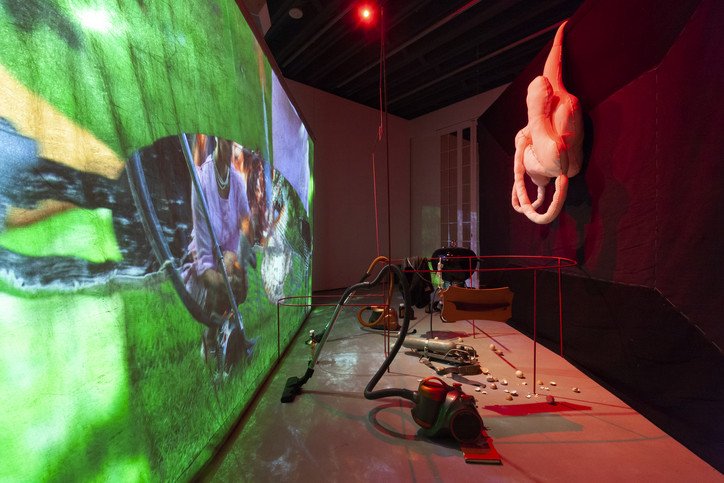
Well, this is traditional. There’s a narrative, the editing is normal. But in the installations, they are collages, there’s more intention, they’re more expressive, you can’t explain what’s happening. The pictures come in layers. There’s a game between the object and the projection—suddenly the original object is a part of the movie. Downstairs, there’s a projection where nothing happens—it shows a space and nothing happens, and it’s across from the barber shop we built in the gallery, which is a real space.
So, they’re both spaces that aren’t moving, but one is physical, and one is an image.
And in this little flat there are objects: the bike, a rat, the two plates—always double. The character in the film creates sculptures from tinfoil TV dinner trays, and these objects are in front of the projection. So, it’s like a mirror. One is a video projection, the other side is a shadow. It’s about the possibilities of how to show something. In the movie, they do something, but in the installation, they do the same things and suddenly it’s different. I tell the story in different ways: in a normal narrative way, and then through the installation.
It’s like you’re adding layers but also removing them at the same time—or inviting the viewer to become a layer.
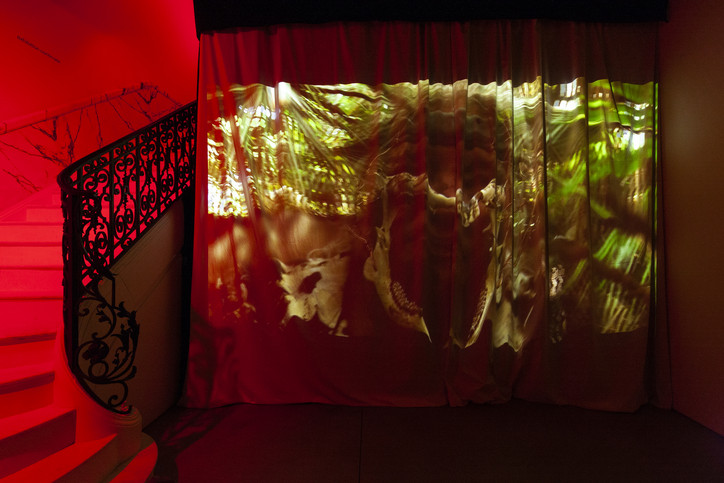
You can go around the screen and suddenly you see the objects. Things mutate. When you first enter the gallery, you see a projection on a curtain and when the curtain moves, the image mutates. So, there’s this idea of mutation and change. It’s a play with pictures and how you look at it—the point of view.
It reminds me of the part of the film where the main character’s describing some strange thing growing inside of her. It feels very psychological.
Most people want to buy a car—they’re interested in buying things. I’m interested in people’s brains, they’re stories. And it’s funny—when you buy something, you desire it until you have it. Once you own something, the desire for it disappears, and it becomes just another object.
So, it’s about economics in a way.
It’s about economics and how people exist within economics. I don’t think people are very happy with this system. We think it’s normal, but inside we feel weird. In the barber shop in the film, there is no money—they tell stories and sing. It’s about a connection between people in one space, and not always glued to your phone like people always are these days, even in Germany.
Right. They’re engaged.
It’s like a dreamland—a paradise. No one knows about it. It’s old guys, in an old style. And my language is more absurd in German than in English. I don’t believe in language; I actually hate it—that's why I work with it. There are a lot of mistakes and levels with language, and I want to break it down entirely.
'Dead + Juicy' is open now through December 1 at Anton Kern Gallery in NYC.
Photos courtesy of Anton Kern Gallery.