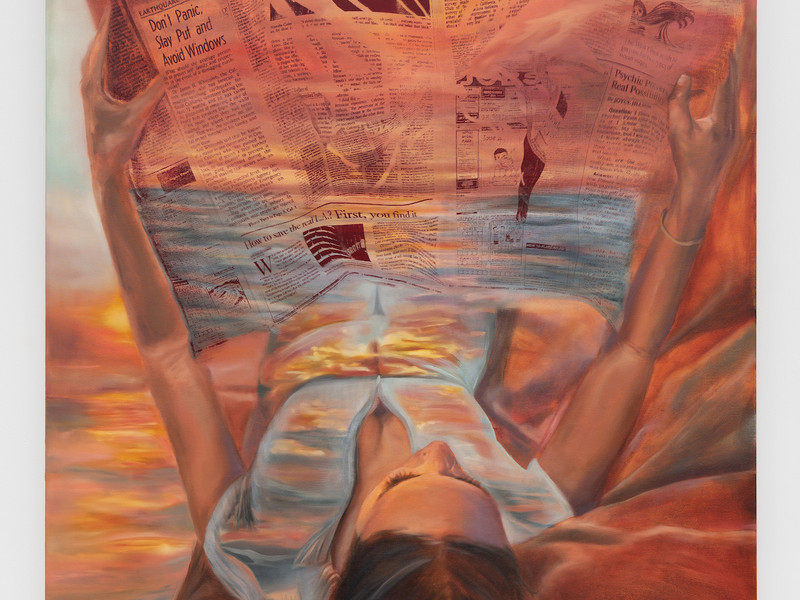
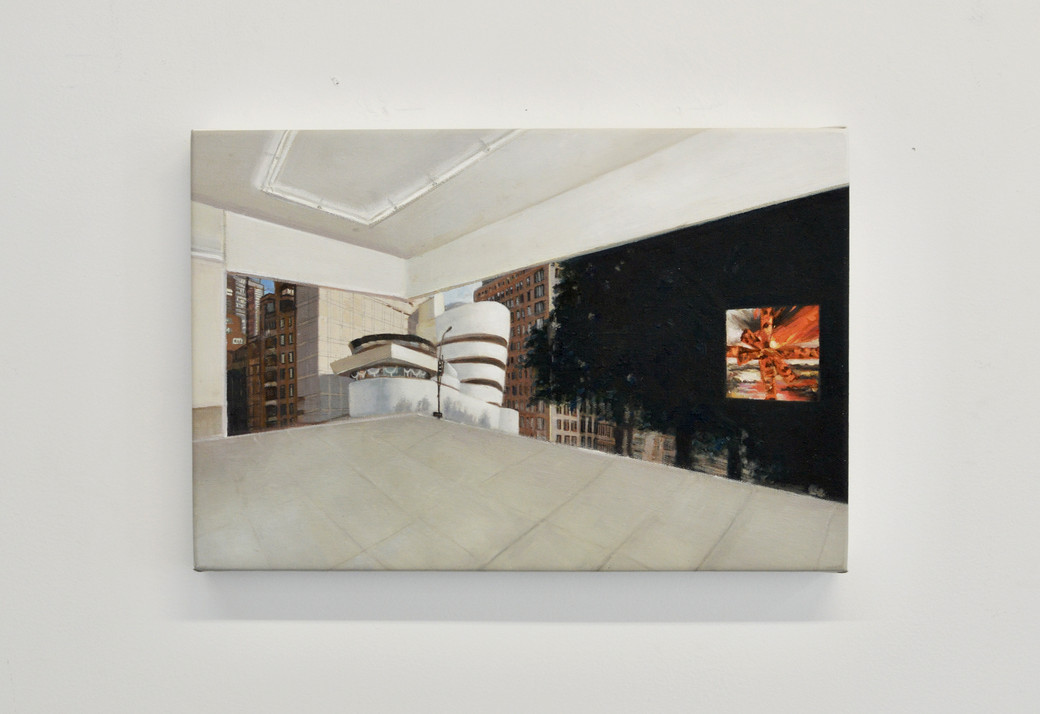
Your recent work explicitly references the works of other artists: your painting in The Meeting – your solo show at Pio Pico – is a copy of Jeremy Ringermacher and Ariel Pink’s The Last Art Piece; your poem “Gun” which was recently read by Petra Cortright makes reference to Gregory Corso’s poem “Bomb”; and your painting Eliza Douglas: Guggenheim, Overduin & Co. is a depiction of an installation view of an Eliza Douglas show, which was itself a staging of the Guggenheim. What interests you about these chains of repetition?
That’s a good question. None of that work is really a copy. The piece at Pio Pico, for example, remakes Ringermacher and Pink’s painting, but in composition only: the subjects are completely different, and the concept, too. Plus there’s not really any documentation of the original – it’s from 1999, when they were undergrads at CalArts… the truest reference was actually some random family photo with the painting way in the background – so how faithful could a copy really be? I guess, then, it makes more sense to call these moves “interpolations” or something, and I think that’s all about momentum and curiosity. The originals are autonomous little things that burrowed into me, mainly because of the stories that came with them. I’m chasing after all that to see where it goes, and sometimes it goes somewhere beautiful and unexpected, like what Petra did with Gun.
At the Pio Pico show, viewers had to hand over their phones before entering the room to see the painting (Untitled (Young adults are having less sex than ever), 2026), while your performance at the ArtCenter panel seemed designed to live on through retelling and digital recording. It often feels like your work is designed to acquire a social life. To what extent is that afterlife part of the work?
You’ve almost conflated these two things – “social life” and “afterlife.” I hadn’t considered it, but they’re pretty similar. When you’re out at a bar, at Prado or whatever… you might as well be in Hades, no? It’s just like this Fortnite lobby full of hysteria, intrigue, and dread. All those lives, unresolved, waiting to be judged... Isn’t that what art is? People want art to be heaven, but that’s so frictionless. And decided. The social life of a work is exciting precisely because it’s alive, and because I have no control over it. For example, that lady who fainted at Pio Pico – she’s now part of the work, whether I like it or not. She thought she saw herself in the painting and, even though she wasn’t actually in it, now she is.
Can rumor, gossip, and word-of-mouth be more aesthetically serious than images?
Well, we’re overrun by images at this point, that’s obvious, but it’s funny: without fail every artist still documents their stuff ruthlessly, and artlessly, in image form. Every single one. All this while they complain about “slop” and homogeneity, by the way. Again, their artistic choice – with the show’s “afterlife,” as you call it, in mind – is to do what everyone else does. Can you imagine? And, maybe worse, a lot of the time it’s the first thing they think about. “How will this look in documentation?” takes precedence over the personal encounter, over something more visceral. If documentation is really that important, and I think it is, why not approach it more critically? Why not use a new frame?