Do you have any other favorite bookstores around the world that you love?
Actually yes, quite a few. Well not that many—there are still a few people resisting the book crisis. There is definitely one in Paris that we look up to called Yvon Lambert. Colette used to be big. We’ve been really close to Colette from the start, and Colette was super supportive of our publications from the beginning. There’s Dashwood in New York; Printed Matter, of course—they’re like the masters of the game. There’s Donlon in London, which is amazing, and also Claire de Rouen, which is super important. We have our friends from Batt, in Montmartre. Those are the names we feel close to.
What do you look for in the books that you bring into CLASSIC or that you like to publish yourself? You already highlighted the importance of stringing together pieces of culture.
Exactly, and if we were to answer the question strictly from the point of bookmaking, we have great taste for little details in the making of books. When you look at a lot of the titles we publish, everything has a little detail. For example, the one we did with Pablo Tomek where we re-cut the cover to make the inside design visible. There’s also a catalogue we did with photographer Asger Carlsen that has a natural latex sleeve which we hand-glued to the cover. There’s a book we did with FUZI, which involved a collaboration with Krink ink, who provided markers, and we hand-painted the edges of the book so it looks like all those old soap books from the ‘70s. It’s bright orange, as that’s the subject he’s talking about in the book—the commuter trains of his childhood had orange seats. It was cool because it was also a great way to keep contact with the current graffiti scene. Krink is so New York, and Fuzi is very about Paris, so it was interesting to do the book together. And we launched the book at 8Ball Newsstand so it all connected. All books are industrially made and we like when the process includes an element of craft, so it has to be made by hand. Specifically, with this one, we painted the edges of 300 copies.
It makes a difference, for sure.
It felt like a good idea when we first did it. Like, ‘Oh we can hand do it!’ But then they delivered the 300 copies, and we were like, ‘Oh shit.’
Is there any specific art book or zine that changed your life?
Yes. Since I’ve been talking about graffiti and craft and all of that—there’s this one book made by ADAMS called King Size, and each copy has a different cover made out of retrieved cardboard from the street. The whole subject is about craft. He made these jumbo, custom-sized markers and sent them to Sace—Dash Snow in New York—one to Barry Mcgee, and one to O’Clock in Paris. So, he picked several writers from around the world and sent them this marker, and asked them to document their action with it. He then gathered all the images and it was printed on newsprint, black and white only, mostly handmade. This is exactly what I like about graffiti writing—it respects vandalism and takes vandalism as art. The result is super beautiful and handmade, and it has soul. King Size really embodies my taste for publishing and graffiti. I’m also into art, in general. For art, I have plenty and plenty of references, but for publishing, it’s that book. He also self-published it, so I realized you can be alone and do something on your own that makes a difference worldwide.
What do you think if the future for print?
I think there’s room for it forever. There will still be people interested in holding physical stuff that has soul—it’s a transmission of an idea into the shape of something. Of course, the way we read, the way we consume books, and information, and art, and images, and everything—all of that changes a lot, and super fast with the internet. For example, when we start a project this is the conversation we have: ‘Is the book worth it, or can it just be an Instagram account with just this series of images? Do we need to cut trees to print paper for this subject?’ We have this in mind each time we put out a project—we really think about the final object. We’re geeks and collectors, so we always think about us in the first place—would we buy what we’re going to put out? If we discovered this finished, would we be the first client for it? We always try to keep that stuff in mind.
It’s like, nobody buys physical music anymore, but vinyls are still the thing. That’s how you discover music, even if you can access worldwide music online. You need people to introduce you to music, and those people dig in crates and discover things. On the album covers you have information—that’s why album covers are as important as books—you have all the credits to discover. Like Nas being involved with the members of Mobb Deep—that’s how you discover that Queensbridge is a whole scene. You can get all these little details from a record cover. So, I think books, records and physical objects related to culture will last forever. It’s what will remain, even if everything is digitized, because we will always go back to what was physically produced to get information.
So, you still buy actual books.
I could spend hours at The Strand digging for vintage books—it’s crazy how many things there are to discover still about our past. Things that predate the internet and have not wound up there. There is still the need for holding a piece of something. Why do we still print photos? Because there is a need. There is so much information. You can then go and dig through the web about something you hold in your hand. Definitely, physical objects are the bridge to access culture. Like with music, nothing will replace going to a live gig. You could have access to the music 24/7 online, but actually going to a physical gig and experiencing music live, and feeling it physically is unique. Holding a book, buying a book—it’s the same thing; it’s something you own. Maybe the whole difference between objects and digital media is that nobody owns anything. It’s there, it’s accessible, but you don’t own it—it’s like a forever rental. But I think the feeling of possessing something is a basic human feeling that you can fulfill with a book. You can discover a lot online, but sometimes you need to stop and spend money on something, and hold it, and keep it, and bring it back to your place to experience and share.
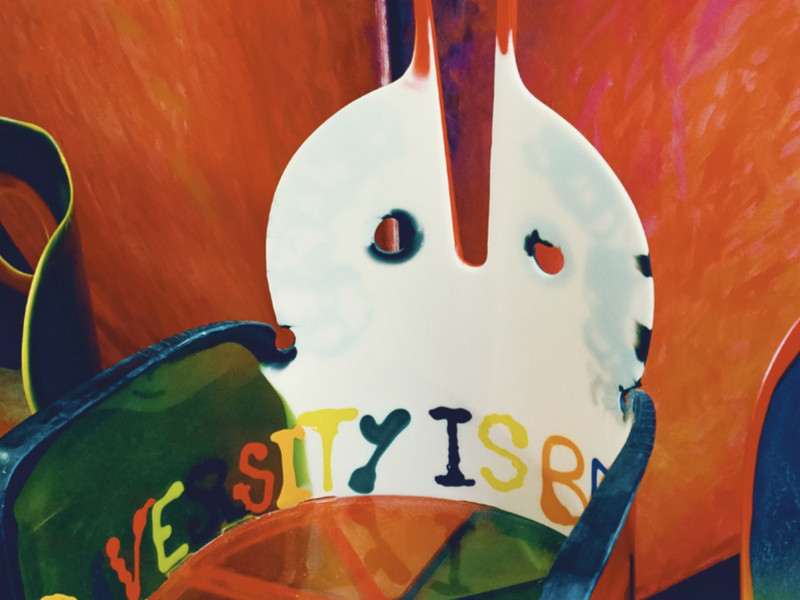
Photo from 'À l’origine est venue l’idée…' by Clement Pascal; available through CLASSIC PARIS.