One phrase appeared in my notebook: the magnetism of desire.
What does desire actually do? It focuses attention. It reorganizes the body. It changes our perception. It pulls one thing toward another. I became interested in magnetism itself: attraction as an organizing force. The possibility that desire, approached with intention, can become generative.
And that brought me back to the sculptures. Because this is how I make them.
These materials do not naturally belong together. They remain themselves while forming a relationship. I can sense when a piece needs to move. Sometimes I know something is wrong long before I can articulate why. I might walk around a sculpture for hours, and then, suddenly, the right gesture becomes clear.
My notes during this period became filled with words like clairvoyance, clairaudience, clairsentience, and claircognizance, not because I am interested in claiming a supernatural ability, but because I became fascinated by the vocabulary humans have created to describe different forms of knowing.
Knowing something without knowing how you know it. That is very close to making art.
You accumulate information. You train your eye and your body. You spend years working with materials. You read. You travel. You look at architecture. You build relationships. You experience grief, love, ambition, disappointment, pleasure, longing.
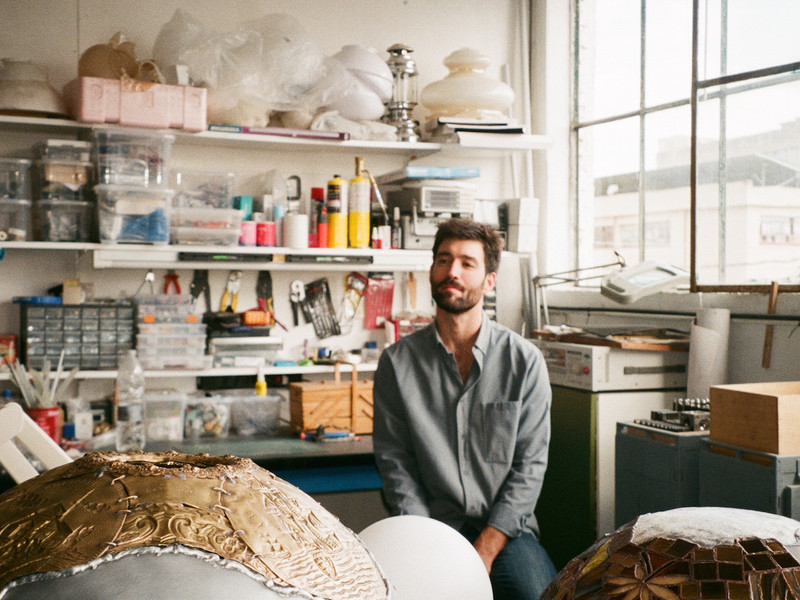
And somehow all of it becomes available when I stand in front of a piece of metal in the studio. The knowledge arrives before the explanation.
Maybe that is what I have been trying to understand through all of this research.
Why do these systems keep appearing in different cultures and across time? Why do people keep turning toward the body to understand what we cannot see? And why have religious institutions worked so hard to determine where some of those experiences could and could not belong?
Now these objects, my works, are entering a room surrounded by the architectural language of Christianity. That matters to me.
The sculptures carry Mary Magdalene, but also my childhood. They carry the monastery outside Bordeaux, Hildegard, Venice, the studio, discarded metal, and paint that was poured and peeled and allowed to become its own body. They carry my questions about partnership and purpose, desire and discipline, intimacy and sacrifice. They carry the question of what we do with all of the creative energy moving through us all the time.
I don’t think the work answers those questions.
Rather, the sculptures are evidence that I was inside them.
Maybe that is what this exhibition became for me: not a statement about sex, religion, the feminine, or the masculine, but a record of a year spent chasing a force I could feel before I could name it.
A force between bodies. Between materials. Between what we know and what we sense.
Between the earthly and whatever exists beyond it.