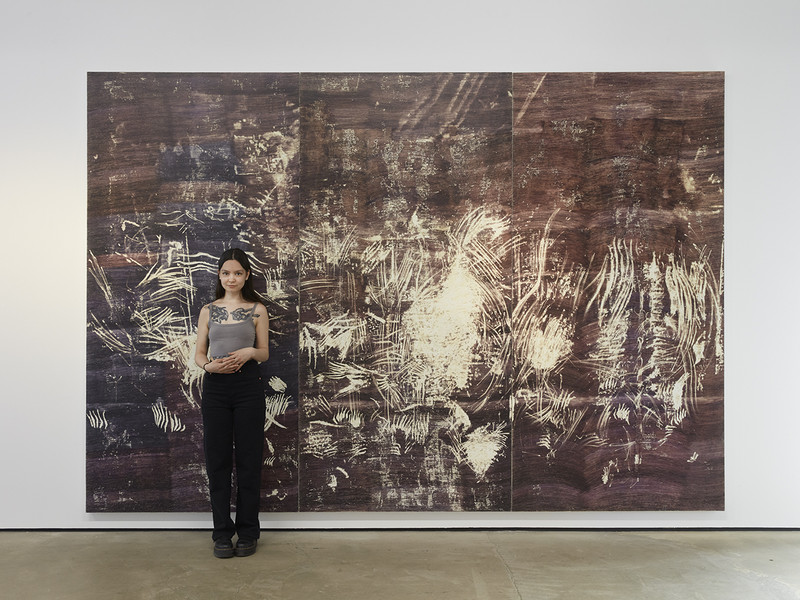
Lara Saget's Sculptures of Divinity and Spirituality
So, you’re getting ready for your show. How’s that going?
It’s good. Not everything’s done, but it will be. Basically, I’m making an almost five-foot glass tree for it. Which is not done, but it will be by next week. I have my baby trees here—everything else is ready. I’m one of those people who likes to do things ahead of time. I'm not a last minute-r, but [laughs] sometimes you can't control it.
I think a natural place to start this [conversation] is by talking a little bit about your spirituality. What do you believe in? Do you consider yourself religious?
I just got a Master's in Divinity from the Center for Religion and Advanced Spiritual Studies. I'm not religious. Maybe religious in the initial meaning of the word, to link back up to the part of the teachings that my teacher brings forth, in really linking myself up to the divine, that I am and everybody is. My direct experience, my path, and my studies were a combination of scholarship, and then direct experience, through specific meditation techniques, et cetera. It's liberating for me because it's not looking outside myself, or too high in the sky. It's really all experiential.
I think considering religion or spirituality not from a theological perspective, but as something scholarly, at least for me, has allowed me to see more of the intricacies of what people are believing in, instead of just believing it because somebody said so.
Exactly. That is fascinating because if you go back to the beginning of monotheism, which was in ancient Egypt, that was when they started to look at one unifying God; before that it was a bunch of different Gods. But for me, it's not a God in the dogmatic sense, but really in spirit—the oneness that is everything.
We're also at a point in history where religion doesn't really need to be an explanation for something; it can be a really personal journey. Not even just religion, but spirituality in general.
Exactly, and I'm experiencing the shaking up of all of this—shit that's been happening in the world; people are really looking for something. There's so much unknown; there's so much uncertainty.—even with COVID. That's when I really started my spiritual practice. Before that, I was my mom's yoga baby, before yoga was that popular. So, I’ve done yoga my whole life. I was always looking for a spiritual teacher and thought that I was going to find it in India. There are certain dispensations in India. It's called the Sound Current path. It's a Bodhi path, so it's devotion and surrendering everything. Negativity, pain, hurt, attachments, all that good stuff.


Sculpture is a very physical art form. Why do you think it is the best medium for you?
I was always searching for materials, because of the limitations of the physical. But in my practice now, I feel like I'm being led. For a really long time, I was trying to control and manipulate different materials, but I have noticed, really through heat—I feel like heat is my main material, honestly—heat is a catalyst for transformation. Through heat, I've been able to allow materials to show me what they are, when they break up into their fundamental components. So, I've been doing a lot of work for a long time, uniting glass and stone, or metal and stone. Using the physical to show my internal experience. I tried a lot of resin stuff for a long time. Resin always kind of fell flat. That's why I fell in love with glass, because glass is an amorphous solid or liquid, depending on how you think about it; the crystalline structure is always changing. Even in medieval window panes, it's thicker at the bottom than at the top. They're not sure if that's because the structure is changing. So that's why I love glass, but I think there's also just naturally how I work. It's just through sculptural materials.
Your artistic process intrinsically mimics natural processes; how does that disposition affect your relationship to the final product?
It's been a lot of trial and error. So many things [that] I consider failures are really a conversation with the materials, and letting them show me what's next. So, I've had to get to know the materials. I've been doing these experiments with glass and stone, and merging them with stone and metal for ten years, if not longer. Each time, I learn something. Now I know when to stop. But anything else, it's just been practice. There have been a lot of times where I’ve gone way too far. Now I hear really clearly, like "stop!" and I'm like "okay, okay."
That’s a good trait as an artist to have–to know when to stop. It's really hard to find that line, especially with something so personal like a sculpture where it's literally in your hands.
Yeah. It’s hard to stop.
Going back to your philosophies. I read an interview where you stated: "The truth is bigger than the brain will ever cognitively understand. It's limitless." How do you cope with this kind of existentialism?
I mean, a lot of fear comes up. So, [it's] a lot of releasing that fear. To be honest, it's been at the heart of my work since I was a teenager. I look back, when I was maybe seventeen or eighteen, I was making work about how the bubble is going to pop. I also think I've had a lot of near-death experiences. Really, because of my spiritual practice, it's like my experiences [are] that I'm wearing the body, that my soul is wearing the body. So, it's almost like letting go of identifying only with the physical, and then it makes it easier to accept how limitless everything is. It’s expanding my consciousness.


You said you've had a lot of near-death experiences. Is there one that you can think of that really changed your view, or contributed to how you think of existentialism now?
One that was kind of scary was like, I was a—[laughs]—there actually have been many. I had an infection from a spider bite when I was thirteen. I got MRSA. I was in the isolation ward. I wasn't really conscious of it then, but, I realize that I was starting to see my body as more of like a container than anything else. Even though I couldn't move, I still was having all of these internal experiences, even though I couldn't access things fully because my arm was like this big [gestures].
I know you've stated the body as an inspiration for your work, but also the natural world. What is the connection between the two? Besides the fact that humans are a part of the natural world, what specifically about the nature of humanity intrigues you?
The body was really an entry point for me, maybe for like five to six years. I was doing a lot of body work. I also have taught yoga for like twenty years, and I was taking all of these anatomy classes. I was just very fascinated by bone, and how bone changes shape dependent on how you distribute your weight. Similarly to how glass is alive, bone is rigid and fixed, but it's really very viscous and fluid. So, I became fascinated by that. Although now, I feel like a lot of the work I did about the body is very limited. But, it was where I was at. Moving beyond that, into the foundation of what goes beyond the body, what is beyond the physical? That led me into the natural world, really looking at things that are a mirror to what's going on internally. So, merging these different materials or looking at the very nature of the ground of being—But, really just as a reflection of my internal experience, so less one to one.
Contradicting that question a little bit—I was reading today and something came up that reminded me of this question that made me think in a different way. I'm going to restate the concept for you: "What if the category of person, along with all of its supposedly natural elements (gender, erotic desire, emotions, intelligence etc) is actually produced by culture rather than nature?" What do you think about that?
I think that everybody is definitely shaped by culture. But then, you look back at ancient cave paintings—I don't know what it would've been like to be in a body at that time, but there was a version of culture in that as well. But beyond that, my experience has been that we are all one. We all have these different personalities, et cetera. But the soul, or the spirit, is like the ocean– a vast, vast ocean. Each soul is like one drop of water in the ocean. And we are all having these experiences that are affected by the times, by all of these things.
That’s a great analogy. I've never heard somebody explain it like that. I think it's a really beautiful way of describing the essence of humanity. It's very accurate.
That's really coming from my school, from my teacher. The path that I’m on is called The Path of Soul Transcendence. It's the direct experience of what is beyond everything physical. We're all swimming in this ocean together, and that makes me really responsible, because what I do is going to affect somebody else.


Shifting back to your debut show in New York—congratulations, by the way—And The World Came Apart, you've been working on it for over a decade. What has been the easiest and hardest thing to handle?
A lot of the work I've been carrying very close to my chest, particularly these experiments that I’ve been doing with the stone and the metal. I have been doing the same experiment for ten years. The definition of insanity is doing the same thing over and over and expecting different results [laughs]. But it’s not doing the same thing over and over, each time its slightly different. It’s a slight iteration of it. I feel like the biggest challenge in general has been not allowing what people [say] to throw me off kilter. The biggest challenge has been somebody being like, "That's never gonna work," and like going with my knowing, "No, it is gonna work, I just haven't gotten the right combination yet." Going with that, and staying with that, and letting go of whatever anybody else says. Also, with the glass trees, I'm making these trees that are extremely textural, and glass doesn't really want to be textural. So, to give it that really textured surface is really hard. It's been so much experimentation to get to that point. I feel like staying with "No, I know that is going to work, I just have to keep going."
But a decade is a very long time to develop and sit with a body of work. How did you work through any block or fatigue?
I mean, it's been different iterations of the same process. So, I think just having fun with it. I have so much fun when I'm working. I went to art school, which was amazing. I love my art school. But, even there, they didn't really teach it. I think a part of me thought I had to physically suffer because I wasn't suffering in the actual making because I just love making. So like, even when it's hard, I just love it. I thought that, oh if I’m really good, I really have to suffer. So, I would carry these hundreds of pounds of rocks, and do all this insane stuff [laughs] because I have to suffer. But honestly, I'm so grateful I get to do it.


You mentioned your travels to India. I'd love to hear about your travels and how it affected this project.
I’ve been going to India for the past seven to eight years. Every year, I go to this teeny, tiny village, to this residency called Art Ichol, where I get to experiment with stone and metal. I went having never been to India, with a tiny carry on bag. I started experimenting with the stone and the metal at the next iteration, in India. Everything is done 100% by hand. which I love, because so much here is mechanised; it loses the natural feeling. I love that for the work. The place has become like my second home. I've become really close with all the people there. Even if we don't speak the same language, we're like best friends [laughs].
The language you speak transcends words, or language itself.
Yes! It does!
So you'd say the physical aspect is what differentiates the work that you do in New York versus India?
I’m in a tiny village, where there's nothing much around. The nearest town is like an hour [away], and I'd consider it a big city, but it’s not. You're off the beaten path. Over the past years, I've always found it really helpful doing residencies where I’m off the grid. Obviously I have my phone, but the wifi is spotty, and it feels like I have so much quiet time to let the work tell me what it wants to be. Although, I do feel as I’ve gotten spiritually stronger, it’s easier for me to do that in New York.
In terms of actual processes and working with people, here it’s just money driven, and I have incredible people I work with here and I’m grateful for that. But in terms of how slow and methodical the process is, specifically with the metal there—basically, when you're steaming out the wax, we make a hut for the molds. We start a fire and let the wax steep out. The molds sit in there for a couple days while the wax melts. I don't know where I would find that here. There's something about just the fire, the heat, the transformations, it’s not like, "Oh we only have x amount of time to do this, let’s speed it on up." It's like, "We need to wait for the fire, we need to wait for this, we need to wait for that." It’s almost like the materials are going on their own kind of journey. But, I do most of my glass work in the states. I work with Shiny Sparkle Studio in Brooklyn, and they're incredible and it’s very slow as well, because it takes us forever to work through these processes. Maybe I've kind of mimicked that in a way, but being in the middle of a tiny village with your materials cooking for two days; that's like its own thing.
Does the slowness of this process seep into other parts of your life? Do you think that you've learned how to live slower through your very long artistic process?
I have. I used to run around like a chicken without my head on; I taught yoga all over the city; I was running around like a nut, just packing things into the day. Now I am very methodical about how I choose to spend my time or spend time that I've been given, just allowing things to unfold more, even if that means seemingly doing less. When I really give things the time that they need, everything works out.