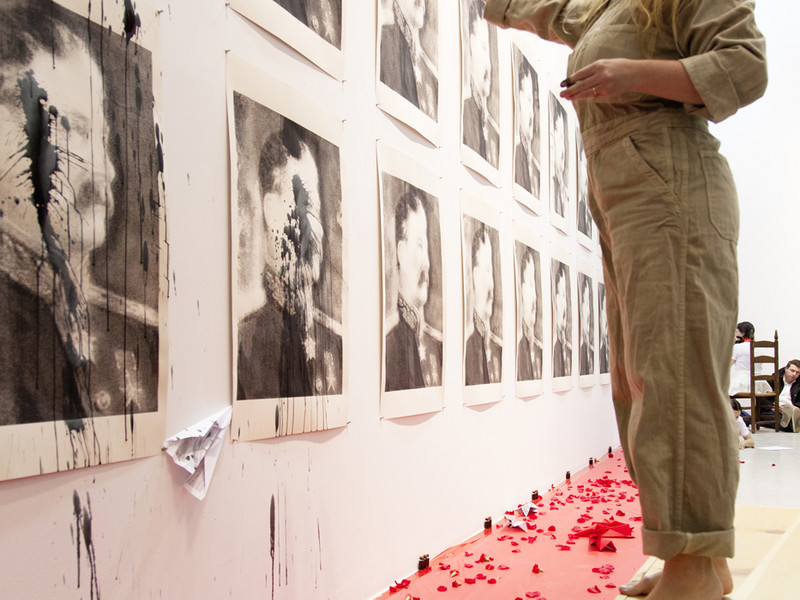
Vulvatious

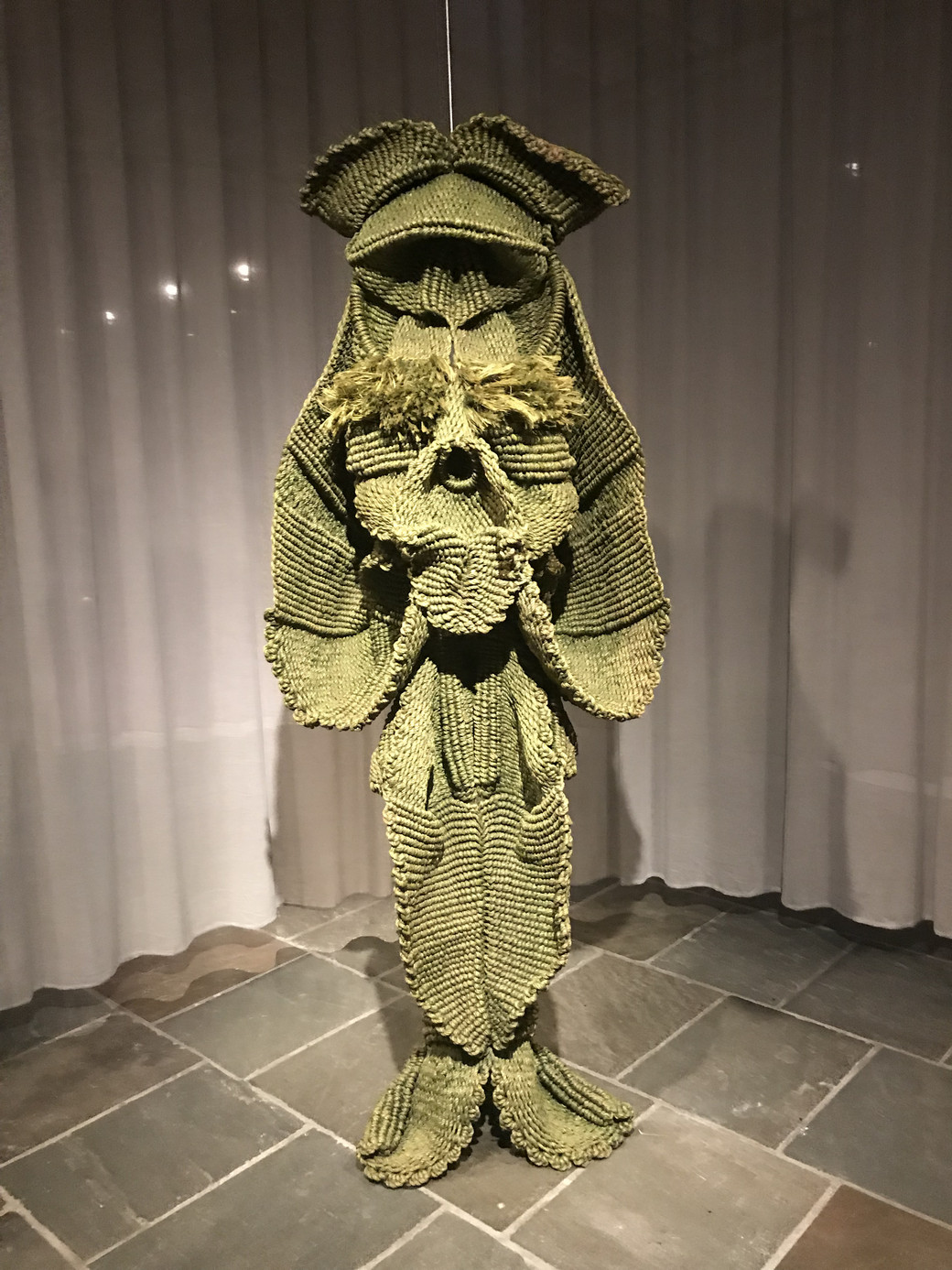
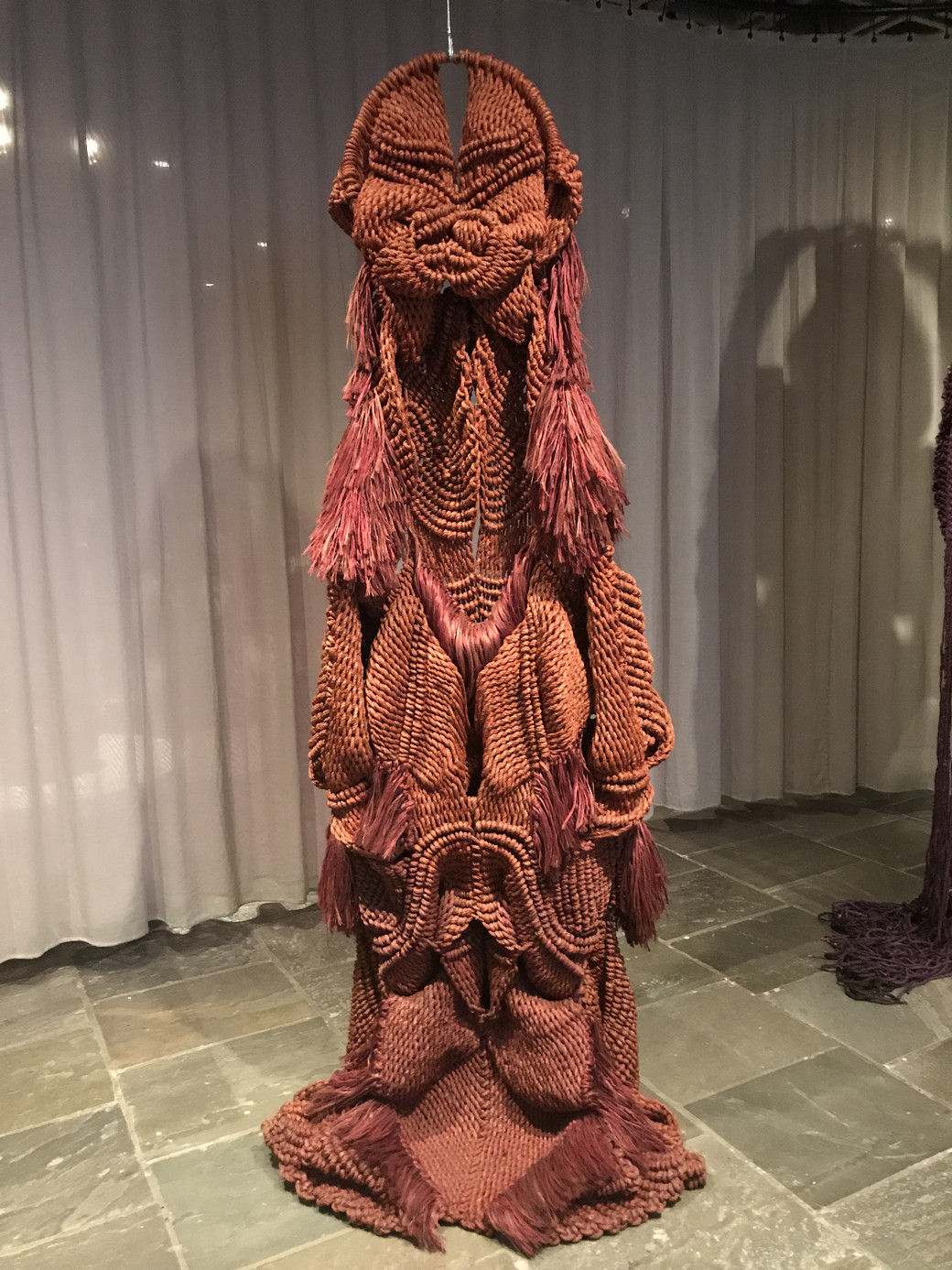
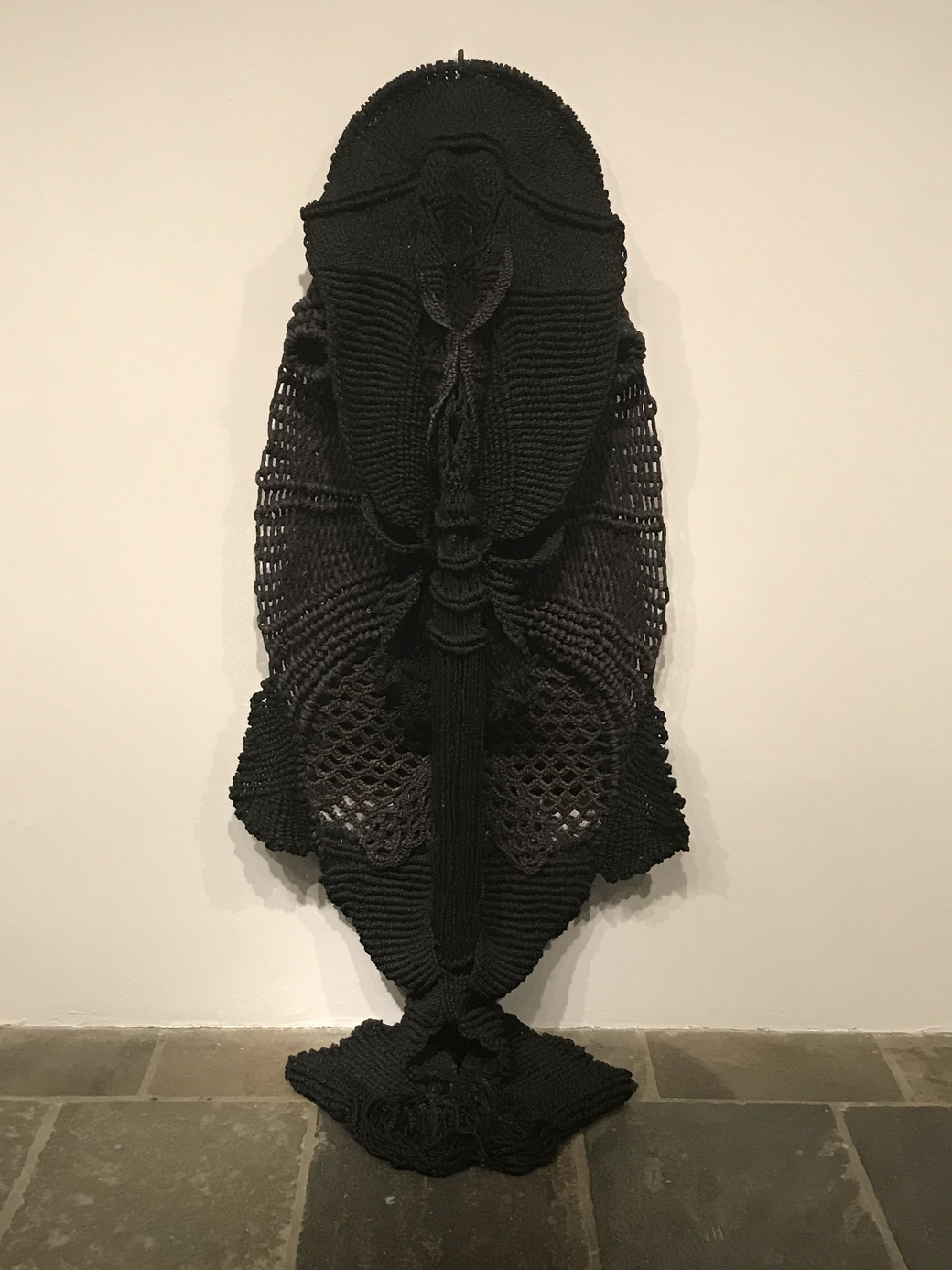
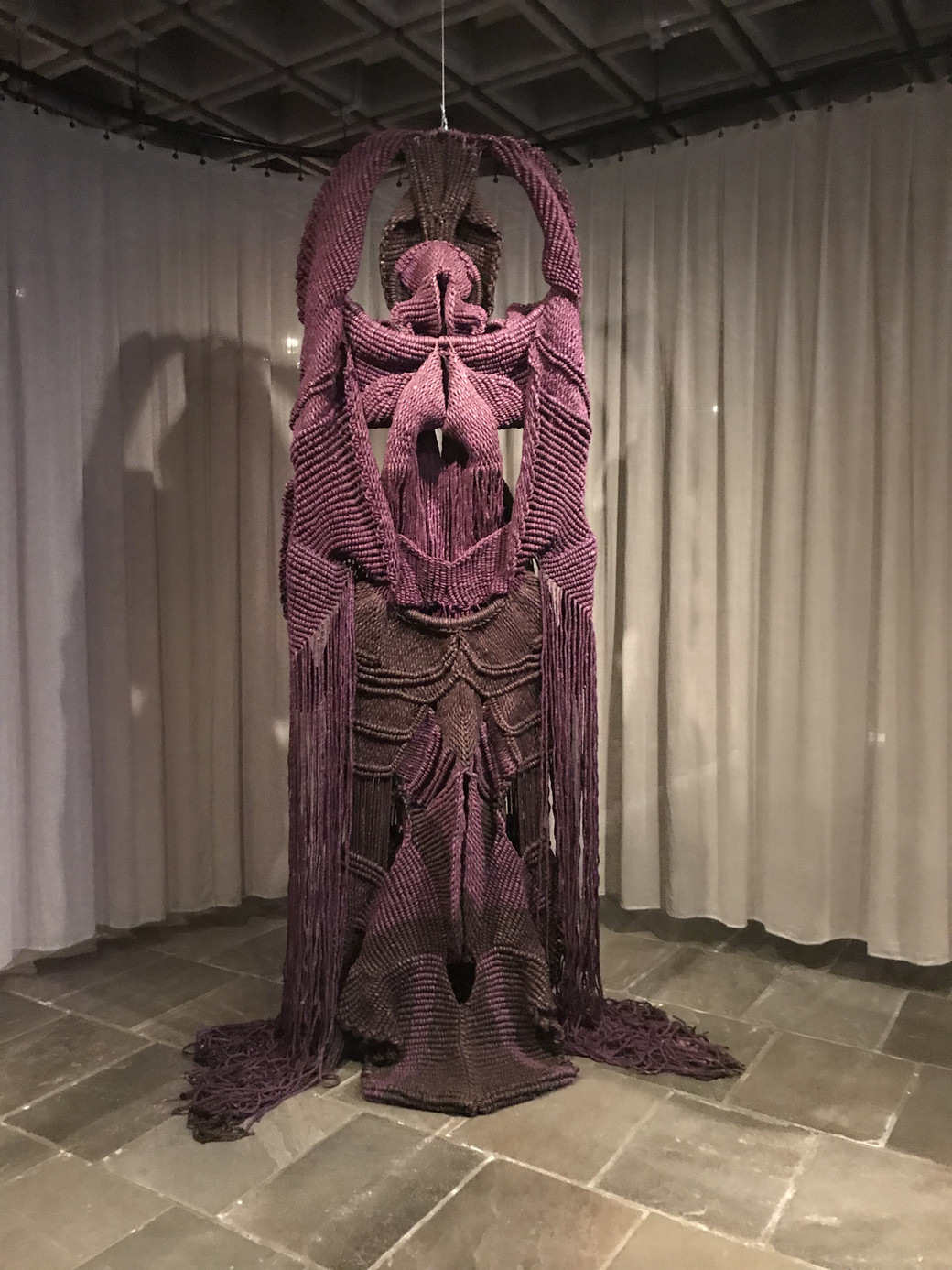
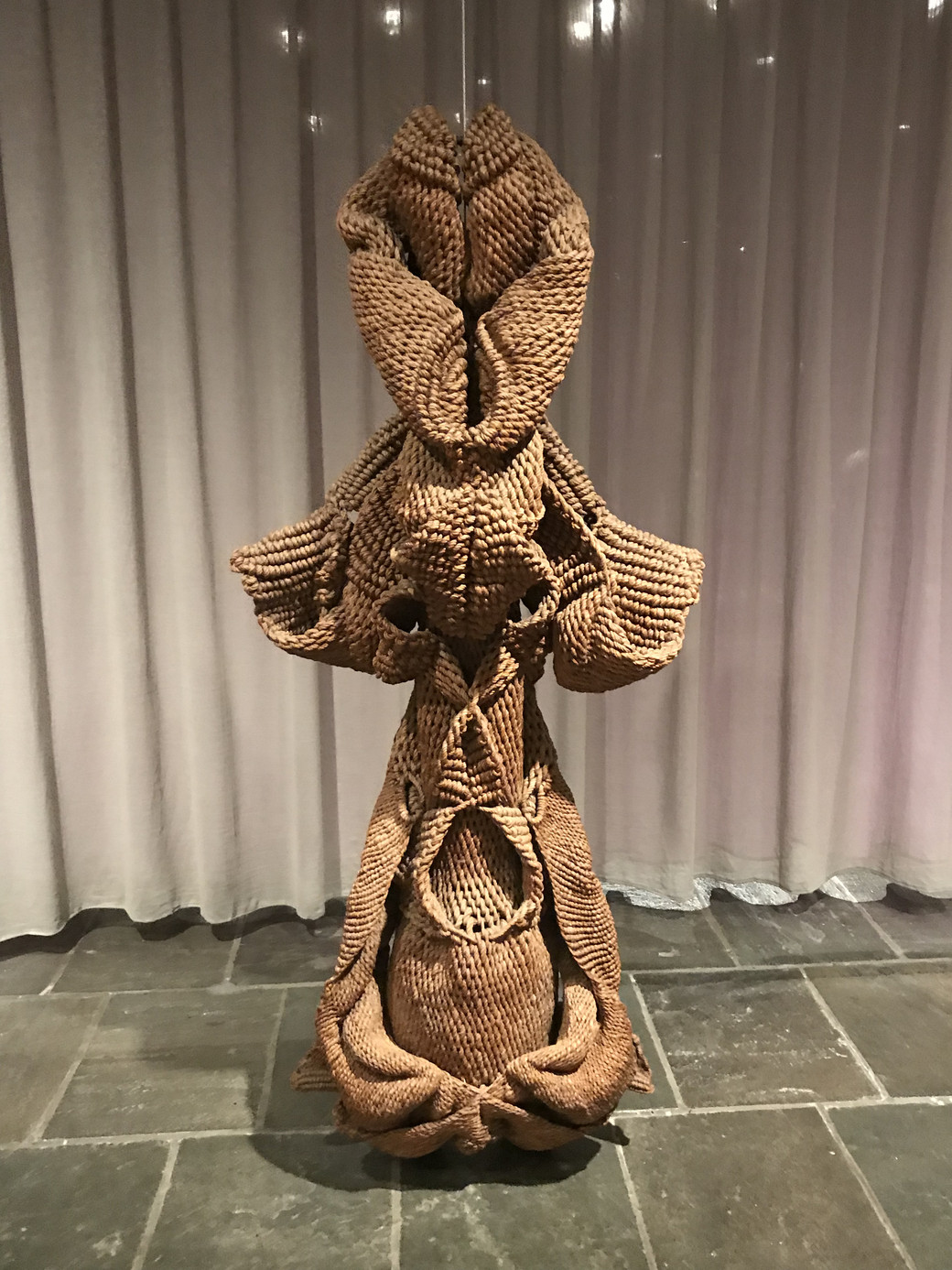
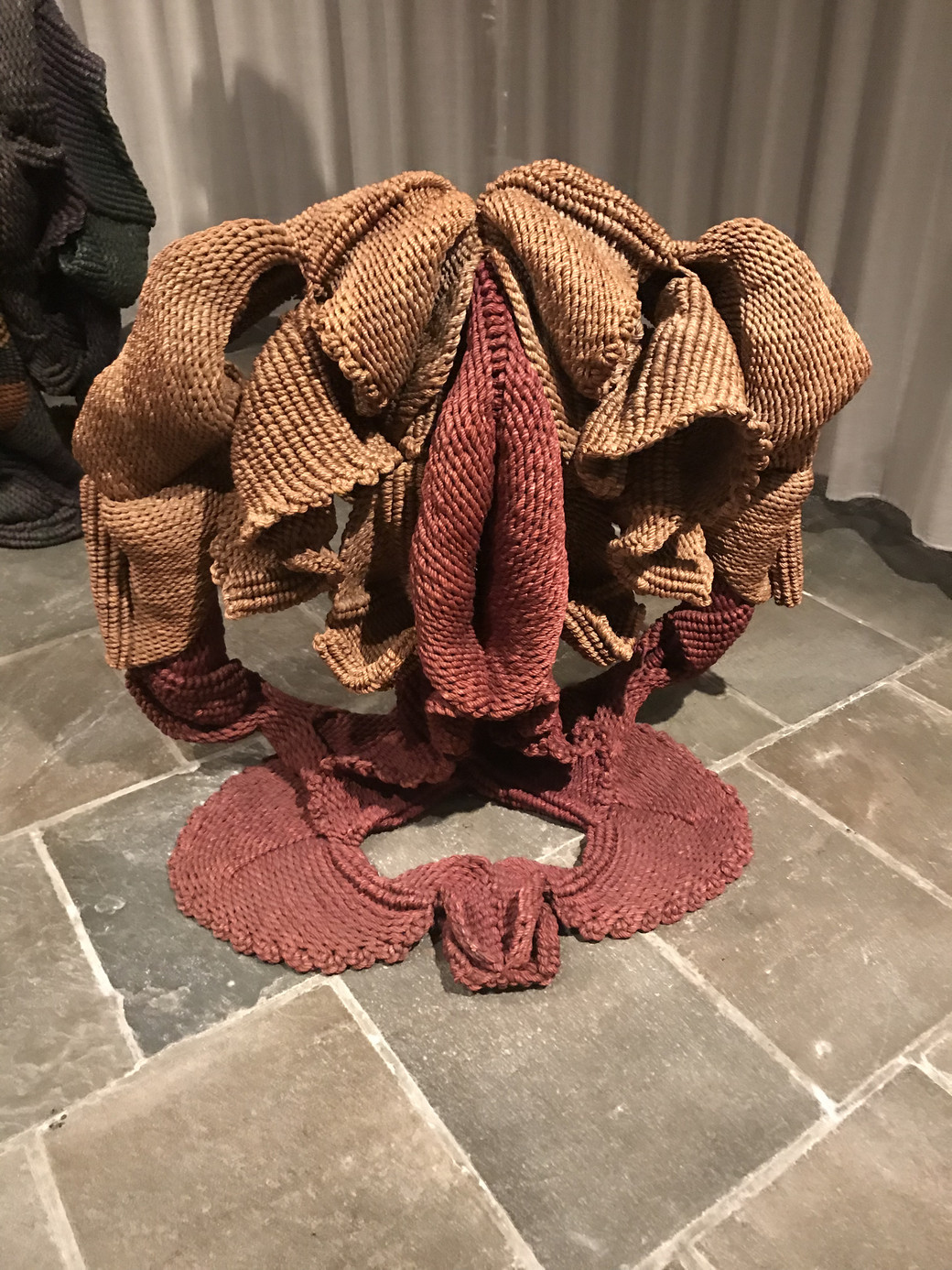
"Phenomenal Nature: Mrinalini Mukherjee" is on view at the Met Breuer through September 29th, 2019.
"Phenomenal Nature: Mrinalini Mukherjee" is on view at the Met Breuer through September 29th, 2019.
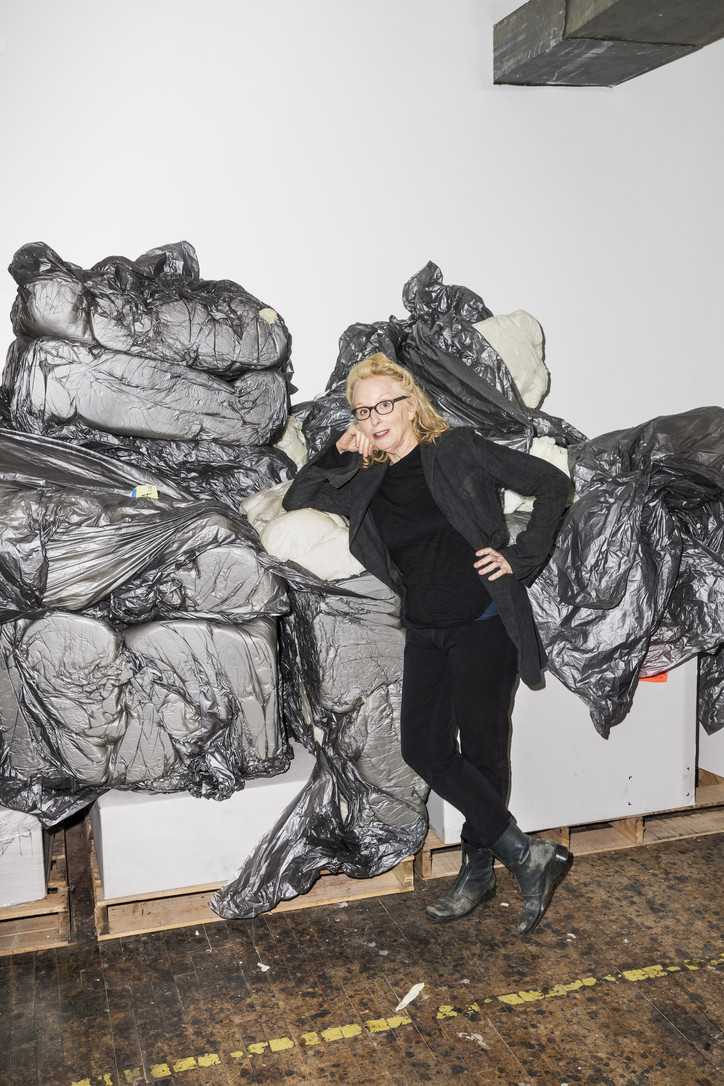
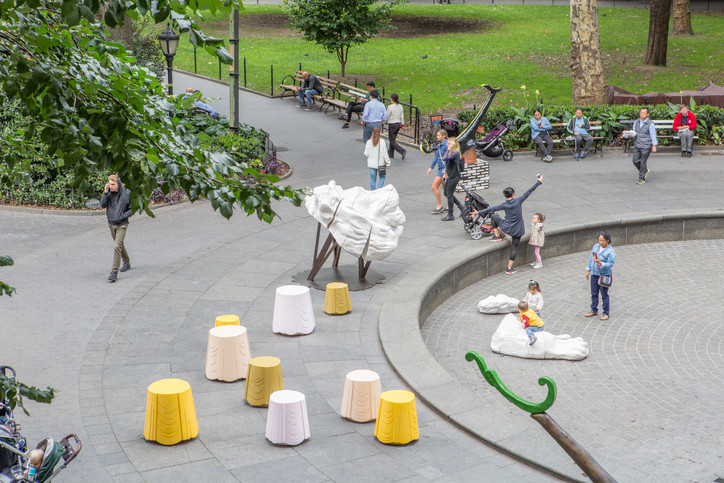
Indeed, this is the point. After I made my quick circle around the environment, Arlene explained that it was meant to be thought of as just that: an environment, not merely a collection of objects.
Most artists, when commissioned by Madison Square Park, use the lawn to display their work—not Arlene. She told me she she didn’t care for this tactic, that planting an artwork on the lawn was just mimicking the experience of a gallery or museum, in that it removes the work from the viewers, making it faraway and precious. She wanted to push against this preciousness—in the more urban, paved center of the park you can touch the sculptures, whose materiality is a large part of what defines them, and something the artist emphasized heavily: real wood, real iron, real porcelain. These sculptures ask you to interact with them, to become a part of their world by lending your body’s shape to the overall composition.
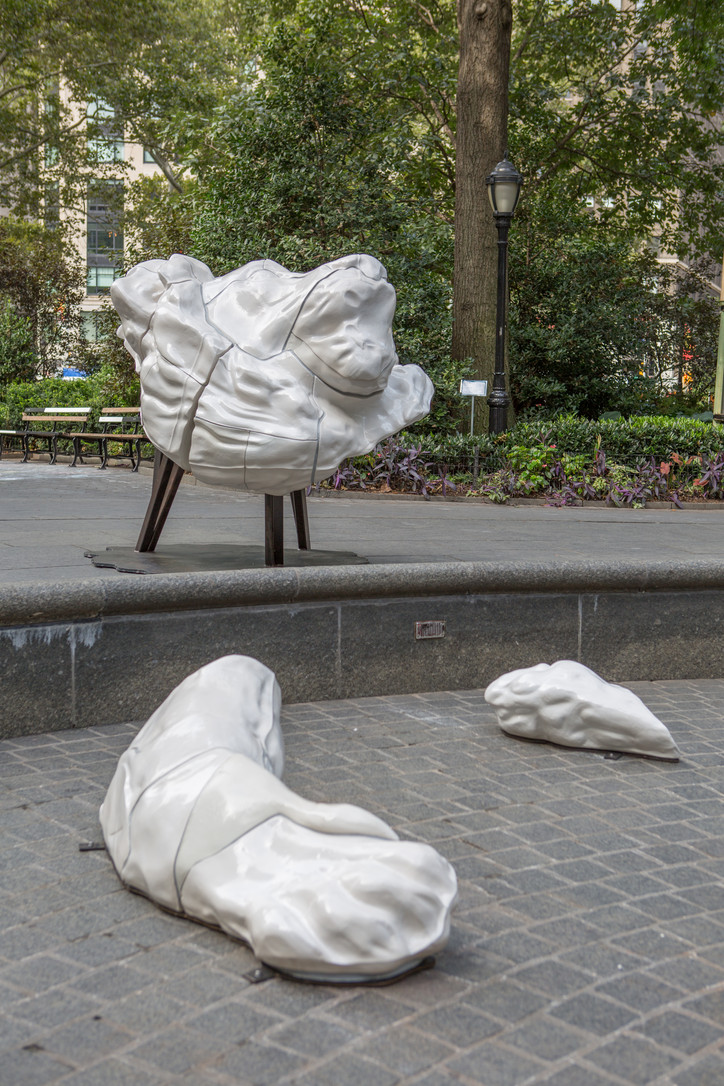
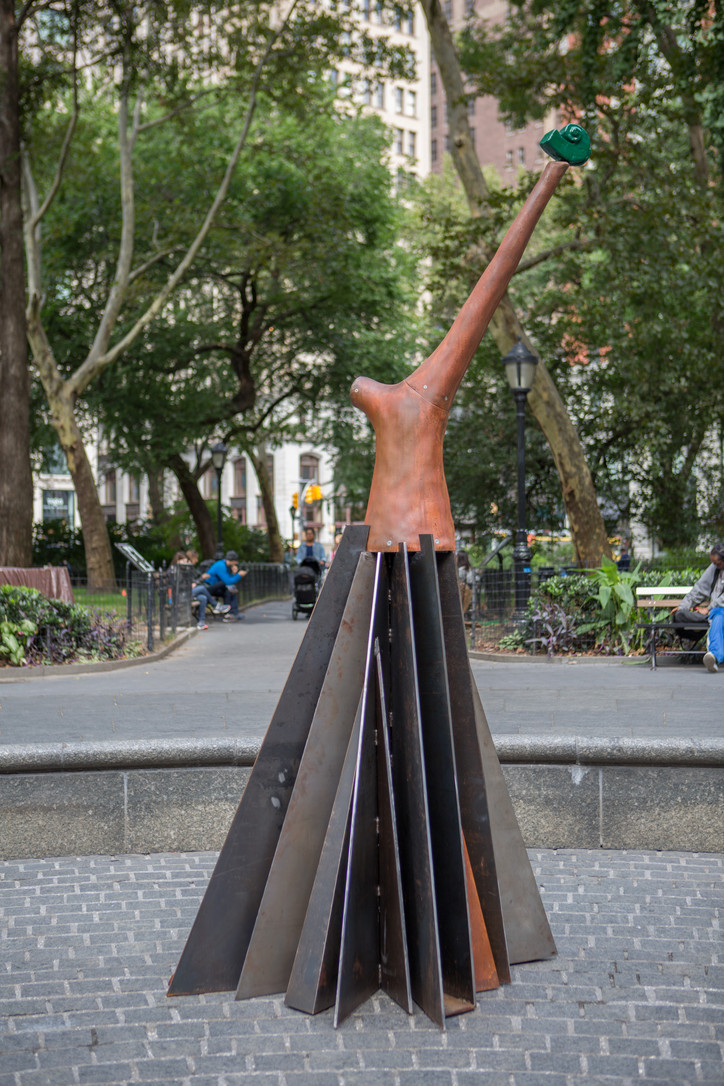
Above: 'Low Hanging Cloud (Lion),' 'Kandler to Kohler' and 'Channel Liberty (with Fallen Arm).'
One compelling element of the installation is the removal of not only the water from the central circular pool, but the removal of the tiles therein. The artist explained to me that, over several months, she had photographed where water tended to puddle up in the drained circle, then placed reflective tiles in these places where the water would naturally pool. She calls it the "Shadow of Water"—an homage both to the water that would otherwise be there, and to her artist’s hand in mimicking it. Water was the original mirror, Arlene mused to me, and New York is hollow, carved out by tunnels underneath our feet—when you look down into the reflective world of the tiles, it's as if you look both at yourself and down inside the city upon which you stand. Again, you inadvertantly become a part of the piece, in the same way you are a part of the city.
At one point, she led me over to one of the central pieces: a huge fluted white porcelain flourish, the base of which can function as a bench. The porcelain pieces are record-breaking—she worked with the manufacturer Kohler to produce them, and the lion’s head alone is 34 separate pieces that had to be fused together. Jeff Koons’ sculpture of Micheal Jackson and Bubbles was the world’s previous record-holder for largest porcelain sculpture, but here Arlene has beat him—and at the risk of their destruction (their exposure to the public and the elements makes them challenge the idea of preciousness on a scale that would make most artists squirm).
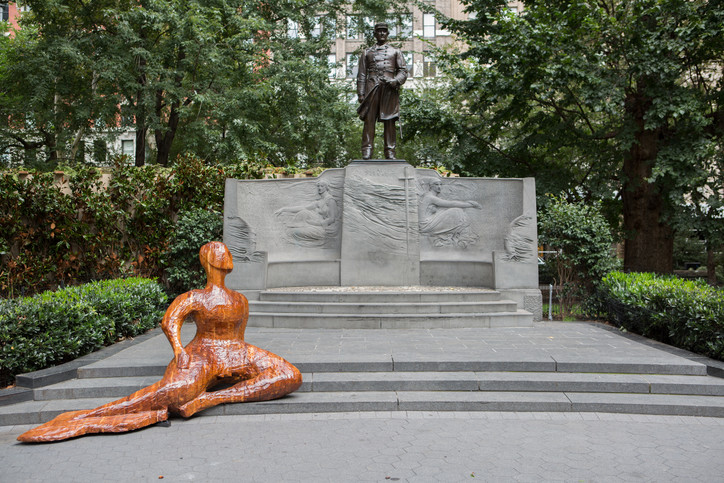
Above: 'Forward' and 'Full Steam Ahead.'
On the ground where we sat was another circle, which I thought looked like a planet—in fact, it was a blown up glaze from another one of her works (more mimicry!). When I told her it looked almost accidental, she nodded emphatically—a glaze is a natural process, after all, and its reference to something both planetary and accidental is a connection she can personally appreciate. What is nature but a planetary accident, anyway?
The sculptures themselves are strange, organic and jocular—I was particularly drawn to the removal of the bench slats and their replacement with black and white planks. The color scheme, I said, reminded me of Alice in Wonderland. Arlene smiled, telling me that the benches were in fact the through-line of the installation. She then said something I won’t soon forget: that she didn’t see why humor and joy couldn’t coincide with intellectual rigor. I couldn’t agree more.
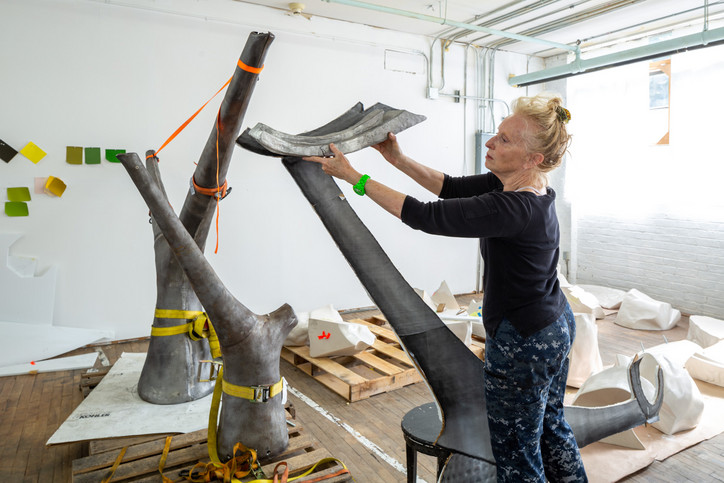
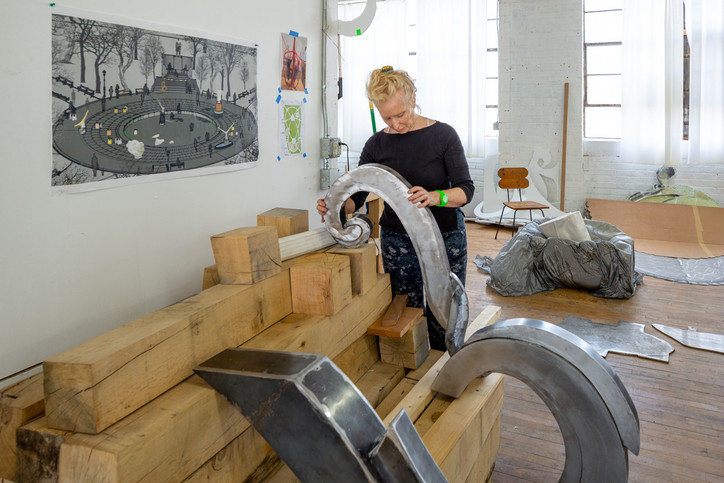
Photos of the artist by Yasunori Matsui; installation photos by Rashmi Gill; all courtesy of Madison Square Park Conservancy.
'Full Steam Ahead' will be on view in Madison Square Park through April 28, 2019.

The event runs for three days and office hit the scene on Saturday to get an inside look at the work and workspaces of Bushwick’s brightest new talent.
Here’s a rundown of the artists who caught our eye:
Insil Jang
Artist Insil Jang works with photography sourced from government archives and historic records, silkscreening the imagery onto gleaming mirrored surfaces that give viewers a look at themselves, as well as the faces of those who history often forgets. Standout subjects include The Kim Sisters, a Korean-American music trio who performed on national television more than 20 times in the ‘50s and ‘60s. Another is Wong Ark Kim, the San Francisco-born Chinese-American whose Supreme Court case led the American government to begin issuing green cards to people whose parents are not U.S. citizens. Jang’s work with Ark’s image brings an important yet overlooked piece of American history into the modern world. The artist has recently evolved her practice to include personal photographs of Asian-American men in vulnerable states.


Julia Sinelnikova
With a day job in set design, Julia Sinelnikova’s personal practice involves site-specific installations called Fairy Organs and Reveals & Sprites. Sinelnikova finds inspiration in the female-centric Eastern European folktales of her childhood which focus on the duality of beauty and nature. Stepping into her studio is like stepping into a high-fantasy realm populated by floating organic forms—modular designs with hand-cut details that Sinelnikova says can take up to a year to create.


Michael Stefanovich
Sculptor Michael Stefanovich has been working since 1996, using stone to express his inner emotions and ideas. With sculptures made of marble and rare alabaster, Stefanovich’s finished works include an incredibly timely large-scale marble form called No Water Without Waves, that combines hard and soft edges to represent the ways in which society can function when people with opposing opinions cooperate with one another. Showing us a number of his completed projects, Michael expressed that he approaches his work the same way he approaches life: with a sense of engagement, immersion and respect for the experience.


Bobby Hill
Working with screenprinting and collage, artist Bobby Hill’s studio is a paint-splattered gallery of pop-culture icons and history makers from the worlds of music, film, fashion and politics. Bobby chooses established subjects, like James Baldwin and Alek Wek, based on the significant impacts they’ve made on modern culture, as well as newcomers like Lil Yachty, who he believes will expand their influence as time continues. Bobby has also been working on an untitled series of figurative collages that are evocative of ‘80s hip-hop meets ‘60s psych.


Greg Allen-Müller
With elements of the readymade and formalism at the forefront of his practice, Greg Allen-Müller is an artist of few words who prefers to let his conspicuous yet enigmatic work speak for itself. Many of his sculptures resemble large medicine cabinets with color-tinted mirrors and compartments that open automatically courtesy of hydraulics. While not speaking much about his work, Greg did express the necessity of art in his life as a means of escape from the stresses of everyday reality.


Camila Cañeque
Staging her installation in the basement space of 17-17 Troutman Ave’s artist studios, Barcelona-born Camila Cañeque’s Summer Painting is composed of 50 gallons of melting ice cream, spread out into a swirling, marble-esque designs that evolve and change throughout the course of the day. Having done the installation twice before, Cañeque’s work demands patience and the contemplation of passive movement across the 10 hours it typically takes to fully form. The process is one the artist admires as it makes the piece “like a blooming flower—you never know when the drama will unfold.”


Vaidehi Kinkhabwala
Dividing time between New York City and her home country of India, Vaidehi Kinkhabwala addresses masculinity in its range of forms with Rooster Series, a collection of rooster paintings wherein the namesake animals each represent a man from her own life. Many of the works are meant to critique the toxic traits of the subjects, as is the case with The Traitor —a depiction of a duplicitous-looking male chicken representing a friend who espoused feminist views to the artist’s face while contradicting those statements with their behavior. On the other side of the spectrum is a subject representing the artist's father, whom she credits with using his privilege to actively combat misogyny and elevate the platform for women in his community.


Taha Clayton
Kinship between subject and artist radiates from Taha Clayton’s oil-on-panel portraits of effortlessly stylish men and women from across the globe. Often styling his subjects in select pieces from their personal wardrobe, Clayton’s works are imbued with dignity and an understated reverence. A particularly striking work titled Angel of the Sunlight depicts a farmer that the artist met while traveling in Nairobi—the subject’s vibrant clothing and shadow-obscured face are rendered with such photorealistic detail, while still retaining the appeal of seeing the artist’s hand in his work.


Read the interview, and don’t forget to stop by the office Newsstand to get your hands on some CLASSIC PARIS drops.
When did you first become interested in books or print as a medium?
I’ve always been into printed matter—I used to collect comic books when I was a teenager. My earliest memory of book obsession was with them. I used to arrange them on my shelf. I discovered that one writer would work with different artists and vice versa, so I’d organize my comic books according to who worked with who—finding connections between each of the artists. As far as I can remember, I’ve been obsessed with who is doing what, book-wise.
So, even when you were a kid you were thinking about how all of this works?
Yes—how things connect and how you can open doors through discovering one specific subject, or one artist, and where their books can lead you. You want to buy a book and when you go to the book shop you realize that this artist has this book, and another, and another. Through books, you can travel and discover new worlds. I guess that’s what we call culture. I think that’s how I got into—through books and music.
When did you start CLASSIC?
I started in 2010. I grew up doing graffiti in the ‘00s—hip-hop and graffiti were big in France, especially in Paris. So, I got into graffiti writing and stuff like that. There were also some major exhibitions held in Paris around graffiti and it was all super cheesy. Of course, it’s polished and ‘more beautiful’ to just appreciate the aesthetics, but the beauty of graffiti comes from the gesture, the vandalism, and from being out in the streets doing illegal stuff.
Being disruptive.
For no reason. There’s no politics in it. It’s political act, but there is no political idea within graffiti, and I think that’s the whole beauty of it. So, I kind of felt, if I don’t see what I want to see then I should just start to make it. But I came to realize that it’s really hard to do stuff. So, that’s how it began.
It started out as more of a reaction then?
Exactly—a reaction.
And the CLASSIC PARIS bookshop came out of that?
We opened the book shop two years ago. At a certain point, the shop was just a natural evolution of the CLASSIC project. We had already done some books, some exhibitions and some collaborations, and I felt we needed a window to really show what our idea was of the art scene and what surrounded us. And since putting out books is really slow, it’s really expensive. It was also a matter of being faster and gathering as much stuff as possible to put out.
We really wanted to push the idea of an art scene and also connections, once again. We can put some books out in the world besides our own that explain the connections and how we jump from one project to another. ‘Cause if we just release two of our books—say there is one with a techno producer, and one with a fashion photographer, and the gap between subjects is too wide, we can just simply fill it in with two or three other titles from two or three other publishers or artists that explain the whole link. That’s why we did the shop. It’s really important to us—it’s like creating the inside of our heads. It also serves as a document of where we travel and everyone we’ve met—it makes everything straightforward and accessible. It’s the way we want to live, and it’s made up of the things we want to be part of, and the things we want to showcase.
Do you have any other favorite bookstores around the world that you love?
Actually yes, quite a few. Well not that many—there are still a few people resisting the book crisis. There is definitely one in Paris that we look up to called Yvon Lambert. Colette used to be big. We’ve been really close to Colette from the start, and Colette was super supportive of our publications from the beginning. There’s Dashwood in New York; Printed Matter, of course—they’re like the masters of the game. There’s Donlon in London, which is amazing, and also Claire de Rouen, which is super important. We have our friends from Batt, in Montmartre. Those are the names we feel close to.
What do you look for in the books that you bring into CLASSIC or that you like to publish yourself? You already highlighted the importance of stringing together pieces of culture.
Exactly, and if we were to answer the question strictly from the point of bookmaking, we have great taste for little details in the making of books. When you look at a lot of the titles we publish, everything has a little detail. For example, the one we did with Pablo Tomek where we re-cut the cover to make the inside design visible. There’s also a catalogue we did with photographer Asger Carlsen that has a natural latex sleeve which we hand-glued to the cover. There’s a book we did with FUZI, which involved a collaboration with Krink ink, who provided markers, and we hand-painted the edges of the book so it looks like all those old soap books from the ‘70s. It’s bright orange, as that’s the subject he’s talking about in the book—the commuter trains of his childhood had orange seats. It was cool because it was also a great way to keep contact with the current graffiti scene. Krink is so New York, and Fuzi is very about Paris, so it was interesting to do the book together. And we launched the book at 8Ball Newsstand so it all connected. All books are industrially made and we like when the process includes an element of craft, so it has to be made by hand. Specifically, with this one, we painted the edges of 300 copies.
It makes a difference, for sure.
It felt like a good idea when we first did it. Like, ‘Oh we can hand do it!’ But then they delivered the 300 copies, and we were like, ‘Oh shit.’
Is there any specific art book or zine that changed your life?
Yes. Since I’ve been talking about graffiti and craft and all of that—there’s this one book made by ADAMS called King Size, and each copy has a different cover made out of retrieved cardboard from the street. The whole subject is about craft. He made these jumbo, custom-sized markers and sent them to Sace—Dash Snow in New York—one to Barry Mcgee, and one to O’Clock in Paris. So, he picked several writers from around the world and sent them this marker, and asked them to document their action with it. He then gathered all the images and it was printed on newsprint, black and white only, mostly handmade. This is exactly what I like about graffiti writing—it respects vandalism and takes vandalism as art. The result is super beautiful and handmade, and it has soul. King Size really embodies my taste for publishing and graffiti. I’m also into art, in general. For art, I have plenty and plenty of references, but for publishing, it’s that book. He also self-published it, so I realized you can be alone and do something on your own that makes a difference worldwide.
What do you think if the future for print?
I think there’s room for it forever. There will still be people interested in holding physical stuff that has soul—it’s a transmission of an idea into the shape of something. Of course, the way we read, the way we consume books, and information, and art, and images, and everything—all of that changes a lot, and super fast with the internet. For example, when we start a project this is the conversation we have: ‘Is the book worth it, or can it just be an Instagram account with just this series of images? Do we need to cut trees to print paper for this subject?’ We have this in mind each time we put out a project—we really think about the final object. We’re geeks and collectors, so we always think about us in the first place—would we buy what we’re going to put out? If we discovered this finished, would we be the first client for it? We always try to keep that stuff in mind.
It’s like, nobody buys physical music anymore, but vinyls are still the thing. That’s how you discover music, even if you can access worldwide music online. You need people to introduce you to music, and those people dig in crates and discover things. On the album covers you have information—that’s why album covers are as important as books—you have all the credits to discover. Like Nas being involved with the members of Mobb Deep—that’s how you discover that Queensbridge is a whole scene. You can get all these little details from a record cover. So, I think books, records and physical objects related to culture will last forever. It’s what will remain, even if everything is digitized, because we will always go back to what was physically produced to get information.
So, you still buy actual books.
I could spend hours at The Strand digging for vintage books—it’s crazy how many things there are to discover still about our past. Things that predate the internet and have not wound up there. There is still the need for holding a piece of something. Why do we still print photos? Because there is a need. There is so much information. You can then go and dig through the web about something you hold in your hand. Definitely, physical objects are the bridge to access culture. Like with music, nothing will replace going to a live gig. You could have access to the music 24/7 online, but actually going to a physical gig and experiencing music live, and feeling it physically is unique. Holding a book, buying a book—it’s the same thing; it’s something you own. Maybe the whole difference between objects and digital media is that nobody owns anything. It’s there, it’s accessible, but you don’t own it—it’s like a forever rental. But I think the feeling of possessing something is a basic human feeling that you can fulfill with a book. You can discover a lot online, but sometimes you need to stop and spend money on something, and hold it, and keep it, and bring it back to your place to experience and share.
Photo from 'À l’origine est venue l’idée…' by Clement Pascal; available through CLASSIC PARIS.