
On this album, each instrument sits distinctly apart from one another, so their tenors and harmonic contributions can be easily picked out. Wood flutes hover above round 808s; simple melodies on the piano poke through swirly sheets of retro synths. The combination is familiar and foreign. On songs such as “Blueberry Beads,” it’s as if David Axelrod scored the soundtrack to a Nintendo Gameboy game. On others, like “San Nicolas Island,” it’s as though the expressive muzak at your favorite Chinese restaurant was covered by Daft Punk.
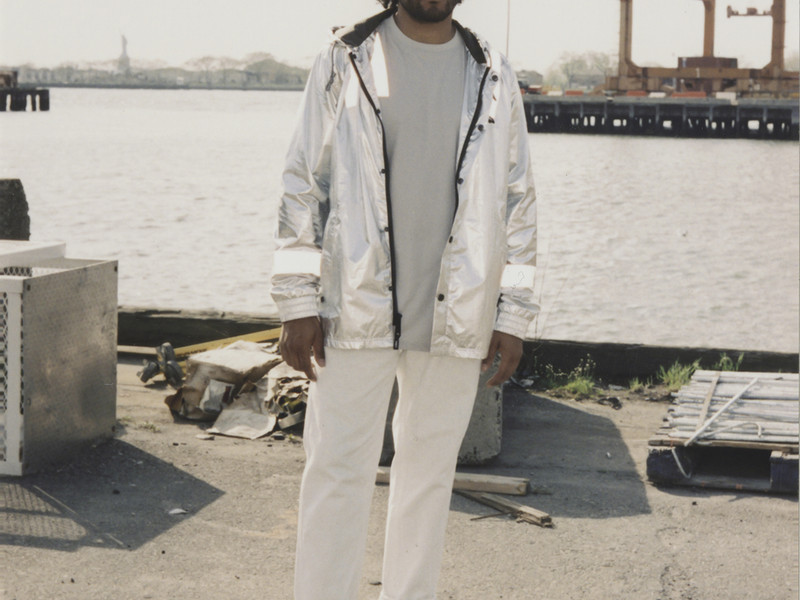
office caught up with the composer to talk about meeting Karl Lagerfeld, third-generation exotica, and how his time with guru Sri Dharma Mittra has influenced his music.
Your last LP, a visual album Travel, featured a lot of found footage. Why'd you op for previously recorded footage instead of recording it yourself?
I was really just working with the means that we had. It was more just to have a visual component. I actually ended up doing it again down the road. On Tuscany, my piano album from last year, we did a bit of found footage.
Have you found any benefits to using found footage?
Aside from the obvious, that it's easier, it's just cool to do. Especially with my music. I'm not gonna make a music video where two attractive people meet at a party and fall in love, let's say. It's not the kind of narrative I'm creating. So in a way, it's cool to use things that already exist, because I'm not really a fan of narrative music videos. I'd rather have it where you can just listen to the music along with light, visual suggestions of something.
I read in an interview that you have a guru, Sri Dharma Mittra.
Yeah, he's actually in New York. He's a very accessible guy. But I wouldn't say he's my personal guru—it's not like I go to his house or anything. Though, he is the person I study yoga philosophy with very intensely and who I refer to in times of confusion. He's been very helpful to me and to a lot of folks throughout my life. His teacher, known as Swami Gupta, was one of the first to bring yoga to New York. That was probably, 1940s or '50s. Dharma Mittra is actually himself Brazilian, but he read a book about his guru and left everything behind in Brazil and came to New York, really never looking back. He's done a lot in New York to pass along that tradition.
How'd you find him?
I found him because I was practicing Bikram Yoga quite intensely, which has since fallen apart because of scandal. One of the gentlemen who was actually the Bikram World Champion, a guy named Jared McCann—also just a phenomenal yoga teacher in New York—he came in and saw that I was going to Bikram a lot, and he said, "Oh, this is cool, but you got to go check out Dharma. He's up in Flatiron. You got to go take his class."
Do you find that your yoga practices make their way into your music?
It does. I released an album a few years ago called Meditations in Music, and that was recorded when I felt I was at a very peaceful place, really sticking to his teachings a lot, following a calm and peaceful process throughout my day. Since moving back to LA and being away from him and his teachings, I think I've maybe fallen off a little bit, but it works its way in my music a lot. On my upcoming album, the first song, it's called "Blueberry Beads," is also inspired by him. "Blueberry Beads'' is another name for rudraksha beads, which are kind of like rosary beads for a yogi. [Mittra] is a very funny guy; he always keeps things very light. Almost at the end of every class, he says, "Hey, I'm just passing on to you what I found helpful in my life. If some of this doesn't resonate with you, no pressure." I like that approach a lot. In my music, I wouldn't want anyone to feel like I'm belaboring any point or overemphasizing any kind of spirituality.
I'd love to know more about your introduction to music. When did you start playing?
I started playing when I was 13 years old, when I started piano. I was studying with this really funny dude, a kind of neurotic Woody Allen–type dude, Roark Honeycutt. I really enjoyed those lessons. He was a great teacher, because he just made it fun. A lot of times we would go into the lesson and just talk the whole time, bugging out on stuff. On whatever. I remember there was a stain on the ceiling this one time, and I think we talked about mold. I think such a big part about being a musician is actually just being able to hangout and talk to people—it seems like you actually do that more than you play sometimes. On tour, or if you have a gig, you might play for an hour, but you'll be at the gig for five or six. After Roark, I went on to study music at the University of Southern California with a man who became my mentor. His name is John Clayton. He himself was a bass player and arranger in Count Bassie's orchestra. He was first actually a family friend, then when he saw that I was serious about music, I got to study with him.